

Accounting Aggressive Optimization Standards for SA Businesses in 2025
South African businesses are facing a year of change as accounting rules and technology keep shifting in 2025. Nearly 80 percent of companies are now moving their books to the cloud for real-time insights and compliance. That sounds like progress. But most businesses are missing out on the biggest advantage this new tech provides. Accounting is no longer just about keeping score. It is now the secret weapon that can help local companies survive and grow in a fast-moving economy.
Table of Contents
- Why accounting best practices matter in 2025
- Implementing cloud-based bookkeeping solutions
- Simplifying payroll and tax compliance in South Africa
- Improving financial reporting and business insights
Quick Summary
| Takeaway | Explanation |
|---|---|
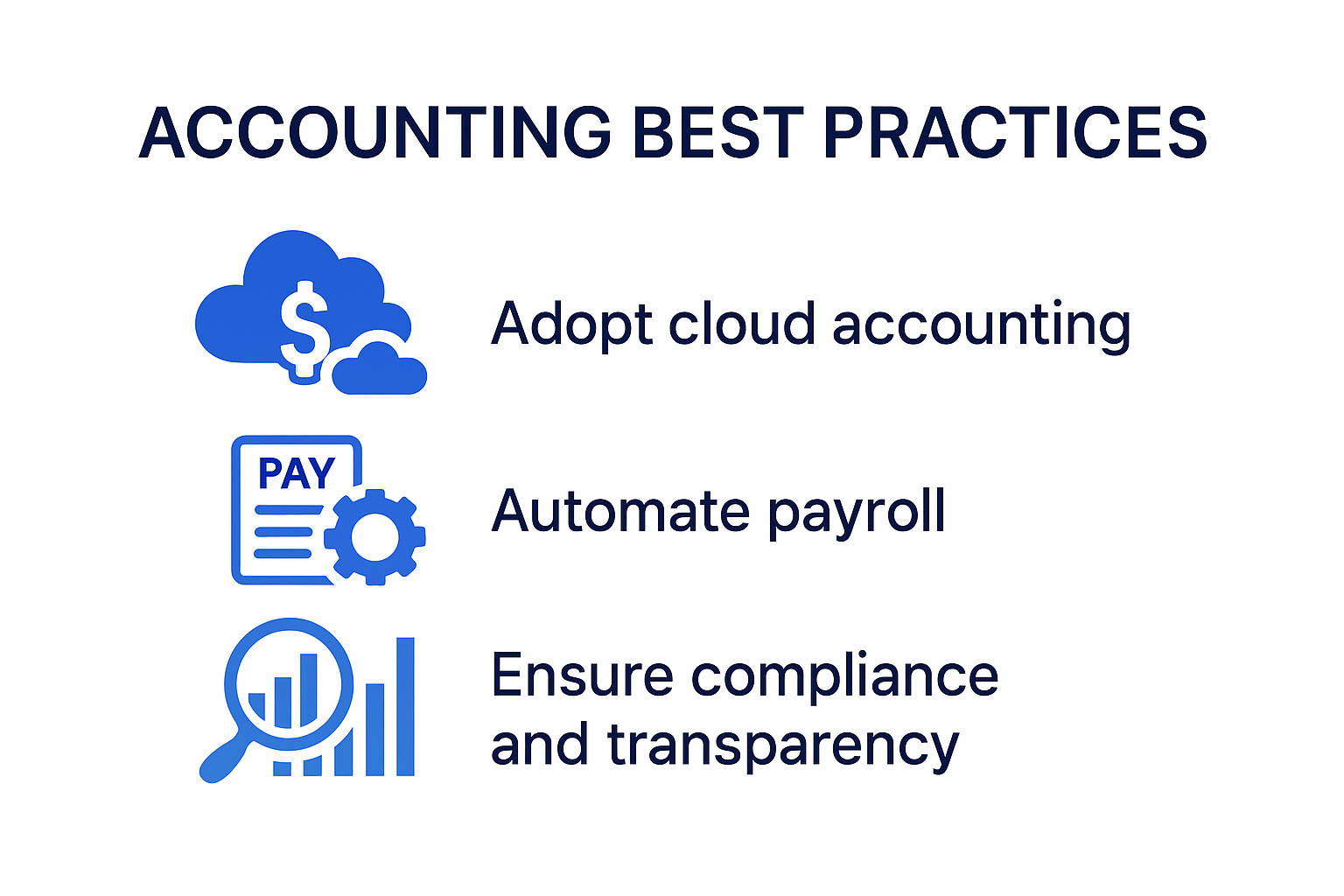
| Adopt Cloud Accounting Solutions | Leverage cloud-based platforms for real-time financial insights and efficiency. |
| Invest in Payroll Automation | Implement automated payroll systems to increase compliance and reduce errors. |
| Focus on Financial Transparency | Enhance clarity in financial reporting for stakeholders. |
| Prioritize Compliance Updates | Stay informed on changing tax laws and regulations. |
| Utilize Advanced Analytics | Integrate analytics for deeper business insights and forecasting. |
Why Accounting Best Practices Matter in 2025
Accounting best practices are no longer optional for South African businesses in 2025 they are fundamental survival strategies in an increasingly complex financial environment. Modern businesses require robust financial management systems that go beyond traditional bookkeeping to provide strategic insights and ensure regulatory compliance.
The Strategic Importance of Financial Precision
In the rapidly evolving South African business landscape, accounting best practices serve as the backbone of sustainable growth and financial resilience. Our comprehensive guide to accounting strategies highlights how precise financial management can transform business performance.
According to Forbes research, modernizing accounting practices is critical for businesses seeking to improve efficiency and maintain competitive edge. Companies that implement advanced accounting controls reduce financial risks and create opportunities for strategic decision making.
Technology and Compliance Convergence
The integration of technology with accounting practices has become paramount. Accounting Today emphasizes that automation of accounting controls ensures reliable access to capital and streamlines year-end reporting processes.
Cloud-based accounting solutions provide real-time data insights, enabling businesses to make informed decisions quickly. These technologies help companies stay compliant with SARS regulations, manage VAT submissions efficiently, and maintain accurate financial records.
Risk Mitigation and Financial Health
Effective accounting best practices are fundamental to managing financial risks. By implementing robust accounting systems, businesses can:
- Prevent Financial Errors: Minimize human error through automated reconciliation processes
- Ensure Regulatory Compliance: Stay updated with changing tax laws and reporting requirements
- Enhance Financial Transparency: Provide clear, accurate financial reporting for stakeholders
Adopting these practices is not just about avoiding penalties it is about creating a sustainable financial framework that supports long-term business growth. South African businesses that prioritize accounting best practices position themselves for success in an increasingly competitive and dynamic economic environment.
The message is clear: in 2025, accounting is no longer a back-office function but a strategic tool for business survival and prosperity.
Implementing Cloud-Based Bookkeeping Solutions
Cloud-based bookkeeping solutions represent a transformative approach for South African businesses seeking efficient, flexible, and secure financial management in 2025. By leveraging advanced technological platforms, companies can revolutionize their accounting processes, reduce operational complexity, and gain real-time insights into their financial performance.

Selecting the Right Cloud Accounting Platform
Choosing an appropriate cloud accounting solution requires careful consideration of several critical factors. Discover the key benefits for small business growth to understand the strategic advantages of cloud technology.
According to research from the International Research and Scientific Innovation Society, businesses must evaluate platforms based on scalability, security protocols, and integration capabilities. South African enterprises should prioritize solutions that offer:
- Robust Security Measures: Advanced encryption and multi-factor authentication
- SARS Compliance: Automatic updates reflecting current tax regulations
- Real-Time Financial Reporting: Instant access to critical financial data
Addressing Technical and Operational Challenges
Implementing cloud-based bookkeeping is not without potential challenges. A systematic review from academic research highlights critical considerations around data privacy and system security. Businesses must develop comprehensive strategies to mitigate potential risks.
Key strategies include:
- Conducting thorough vendor security assessments
- Implementing strong internal data governance protocols
- Training staff on cloud platform best practices
- Establishing regular data backup and recovery procedures
Integration and Optimization Strategies
Successful cloud bookkeeping implementation extends beyond technological selection. It requires a holistic approach that aligns technological solutions with business objectives. South African businesses should focus on:
- Seamless integration with existing financial systems
- Customizable reporting capabilities
- Scalable solutions that grow with business needs
- Continuous staff training and development
By embracing cloud-based bookkeeping solutions, South African businesses can transform their financial management approach. These platforms offer unprecedented flexibility, enabling companies to adapt quickly to changing economic landscapes while maintaining rigorous financial control and compliance.
The future of accounting is not just about recording transactions it is about leveraging technology to drive strategic decision-making and sustainable business growth.
To help businesses evaluate cloud accounting platforms, the following table summarises key features that should be considered when selecting a solution, as discussed above.
| Feature | Importance | Benefit to SA Businesses |
|---|---|---|
| Robust Security Measures | Critical for data protection | Safeguards financial records from breaches |
| SARS Compliance | Mandatory for legal operation | Ensures tax & VAT rules are always updated |
| Real-Time Financial Reporting | Enables fast, informed decisions | Immediate insights improve business agility |
| Scalability | Allows future business growth | Platform grows with your company |
| Integration Capabilities | Simplifies connections with other systems | Streamlines financial processes |
| Customisable Reporting | Tailors reports to unique business needs | Supports better decision-making |
Simplifying Payroll and Tax Compliance in South Africa
Payroll and tax compliance represent critical challenges for South African businesses in 2025, requiring sophisticated strategies that balance regulatory adherence with operational efficiency. The complex landscape of SARS regulations demands proactive management and strategic technological integration to minimize financial risks and ensure smooth administrative processes.
Understanding Tax Complexity and Compliance Dynamics
Learn about the latest payroll tax regulations to navigate the intricate South African tax environment effectively. According to research from the Academy of Accounting and Financial Studies Journal, the complexity of tax legislation often overwhelms businesses, potentially leading to unintentional non-compliance.
Key challenges in tax compliance include:
- Rapidly changing regulatory frameworks
- Complex calculation requirements
- Varying reporting deadlines
- Significant penalties for non-compliance
Strategic Approaches to Payroll Management
Research from the International Tax Studies Journal emphasizes that increased tax knowledge directly correlates with higher compliance rates. Businesses must invest in comprehensive strategies that transform payroll management from a mere administrative function to a strategic operational component.
Critical strategies include:
- Implementing automated payroll systems
- Conducting regular staff training on tax regulations
- Maintaining meticulous financial documentation
- Developing robust internal audit mechanisms
Technological Solutions for Compliance Optimization
Cloud-based technologies are revolutionizing payroll and tax compliance management. A 2025 technological study highlights that cloud-based payroll systems offer significant advantages, including enhanced processing speed, improved storage capacity, and real-time regulatory updates.
Modern payroll solutions provide businesses with:
- Automated tax calculation mechanisms
- Seamless SARS reporting integration
- Real-time compliance monitoring
- Secure data management protocols
By embracing these advanced technological approaches, South African businesses can transform payroll and tax compliance from a potential source of stress into a streamlined, efficient operational process. The key lies in understanding regulatory requirements, investing in appropriate technological solutions, and maintaining a proactive approach to financial management.
Successful payroll and tax compliance is not about mere survival it is about creating a robust financial ecosystem that supports sustainable business growth and minimizes potential regulatory risks.
Below is a summary table highlighting the key challenges in South African payroll and tax compliance, along with strategic and technological solutions drawn from the content above.
| Challenge | Strategic Solution | Technological Solution |
|---|---|---|
| Rapid regulatory changes | Continuous staff training | Automated regulatory updates |
| Complex tax calculations | Invest in payroll automation | Automated tax calculation |
| Varying reporting deadlines | Maintain meticulous documentation | Real-time compliance monitoring |
| Risk of non-compliance penalties | Develop robust audit mechanisms | Seamless SARS integration |
Improving Financial Reporting and Business Insights
Financial reporting has evolved from a traditional compliance exercise to a strategic tool for business intelligence in 2025. South African businesses now recognize that comprehensive financial reporting goes beyond mere number crunching it provides critical insights that drive strategic decision making and sustainable growth.
Transforming Financial Statements into Strategic Assets
Explore the fundamentals of financial reporting to understand how modern businesses leverage financial data. Contemporary financial reporting is about creating a narrative that connects financial performance with broader business objectives.
Key elements of modern financial reporting include:
- Integrated reporting that links financial and non-financial performance
- Real-time data visualization
- Predictive analytics capabilities
- Comprehensive risk assessment frameworks
The shift towards more dynamic financial reporting reflects the need for businesses to respond quickly to changing economic conditions. By transforming financial statements from static documents into interactive strategic tools, companies can gain deeper insights into their operational efficiency and market positioning.
Advanced Analytics and Business Intelligence
Modern financial reporting integrates advanced analytics to provide unprecedented business insights. Machine learning algorithms and sophisticated data processing techniques enable businesses to:
- Predict cash flow trends
- Identify potential financial risks
- Uncover hidden performance patterns
- Benchmark against industry standards
Regulatory Compliance and Transparency
In the South African business environment, financial reporting is not just about internal insights but also about maintaining rigorous compliance with regulatory standards. Businesses must ensure that their financial reporting:
- Adheres to IFRS standards
- Meets SARS reporting requirements
- Provides transparent and accurate representations of financial health
- Supports effective corporate governance
The future of financial reporting lies in creating comprehensive, forward-looking documents that serve multiple stakeholders. These reports are no longer just for accountants and investors but are strategic tools that inform decision-making across all levels of an organization.
By embracing advanced financial reporting practices, South African businesses can transform financial data from a compliance requirement into a powerful strategic asset that drives innovation, identifies opportunities, and mitigates potential risks.
Frequently Asked Questions
What are the best accounting practices for South African businesses in 2025?
Adopting cloud-based accounting solutions, implementing payroll automation, ensuring compliance with tax regulations, and focusing on financial transparency are essential best practices for 2025.
How can cloud accounting benefit my business in South Africa?
Cloud accounting offers real-time financial insights, enhances compliance with SARS regulations, simplifies report generation, and reduces manual errors through automation.
What challenges do South African businesses face with payroll and tax compliance?
Businesses often struggle with rapidly changing tax laws, complex calculation requirements, varying reporting deadlines, and the risk of non-compliance penalties.
Why is financial reporting important for businesses in 2025?
Financial reporting has evolved into a strategic tool that provides critical insights for decision-making, helps maintain regulatory compliance, and offers transparency to stakeholders.
Transform How Your Business Handles Accounting in 2025
Are you struggling to keep up with the fast-changing world of accounting, compliance, and technology? This article made it clear that cloud bookkeeping, real-time data, and advanced payroll tools are now essential for South African businesses. If terms like “cloud-based solutions,” “automated payroll,” and “dynamic financial reporting” feel overwhelming or you are unsure how to stay ahead of new SARS regulations, you are not alone. Many local business owners worry about avoiding costly mistakes and want to unlock the power of their financial data.
Let Ready Accounting help you eliminate these worries and give your business the edge to succeed. You can explore our simple, expert-led options for streamlining your accounting and automation or discover how we can tackle complex payroll management and compliance challenges together. Book your consultation with our team today by visiting Ready Accounting and see how modern accounting can drive your business forward before regulations or inefficiencies set you back.
Recommended
- Annual Financial Statements in South Africa: What Business Owners Need to Know for 2025 – Ready Accounting
- What Is Outsourced Accounting? Simplified Guide for 2025 – Ready Accounting
- SARS Record-Keeping Rules for Businesses – Ready Accounting
- Types of Accounting Services for SMEs in 2025: Your Guide – Ready Accounting