

Accrual accounting for Corporate Assets in South Africa: a protocol
Executive Summary
- Accrual accounting records transactions when they occur, providing an accurate picture of business performance.
- South African law requires businesses exceeding R2.5 million turnover to use accrual accounting for tax and reporting.
- Modern cloud software simplifies accrual processes, helping SMBs manage timing, compliance, and financial insights effectively.
Your business just had its best month ever on paper. Invoices sent, deals closed, revenue recorded. But your bank account tells a different story. This gap between recorded profit and actual cash is something many South African business owners experience without fully understanding why. Accrual accounting is the framework that explains it, and more importantly, the one that gives you a true picture of your business performance. This guide breaks down what accrual accounting is, how it works in practice, what South African law requires, and how to apply it without losing your mind.
Table of Contents
- What is accrual accounting?
- Core mechanics: How accrual accounting works
- South African rules: When accrual is required
- Common challenges and how to address them
- Advantages, disadvantages, and when accrual makes sense
- A practical perspective: Accrual accounting for South African SMB growth
- Get expert help with accrual accounting and cloud solutions
- Frequently asked questions
Key Takeaways
| Point | Details |
|---|---|
| Records timing matters | Accrual accounting matches income and expenses to when they occur, not when cash moves. |
| Required for larger SMBs | South African businesses over R2.5 million turnover or on invoice VAT basis must use accrual accounting. |
| Accrual aids true performance | Unlike cash accounting, accrual provides a realistic snapshot of business profitability. |
| Complexity needs process | Accrual can be tricky—using schedules and accounting software helps avoid mistakes. |
| Software makes it easier | Modern cloud accounting systems simplify compliance and reduce manual work for SMBs. |
What is accrual accounting?
Accrual accounting is a method of recording financial transactions when they happen, not when money physically moves. If you deliver a service in March but only get paid in April, accrual accounting records that income in March. If you receive an invoice for electricity in June but pay it in July, the expense belongs in June.
This approach follows what accountants call the matching principle: revenues and expenses are matched to the period they relate to, giving you a more accurate view of how your business actually performed. As accruals explained by Investopedia confirms, this is the foundation of reliable financial reporting.
Here are the core principles that underpin accrual accounting:
- Revenue recognition: Record income when it is earned, not when payment arrives
- Expense recognition: Record costs when they are incurred, not when they are paid
- Period allocation: Assign transactions to the correct financial period
- Matching: Align revenues with the expenses that generated them
To understand how this differs from cash accounting, look at this comparison:
| Feature | Accrual accounting | Cash accounting |
|---|---|---|
| Income recorded | When earned | When cash received |
| Expenses recorded | When incurred | When cash paid |
| Financial picture | More accurate | Simpler but incomplete |
| Suitable for | Growing SMBs, VAT-registered | Very small, simple businesses |
| Compliance (SA) | Required above R2.5m turnover | Allowed below R2.5m |
The accrual principle confirms that accrual records revenues when earned and expenses when incurred, regardless of cash movement. The same source notes that while accrual provides better profitability insight, it can show profits even when cash is tight, whereas cash accounting is simpler but can distort your true performance.
Accrual accounting recognises revenue and expenses when they occur, not when money moves.
For South African SMBs learning the basic accounting principles, this distinction is the starting point for everything else.
Core mechanics: How accrual accounting works
Now that you know what accrual accounting means in theory, let’s see how it works in practice.
Two key building blocks make up the mechanics: accruals and deferrals.
- Accruals are revenues earned or expenses incurred that have not yet been paid or received. Think of wages your staff earned this month that you will pay next week.
- Deferrals are payments made or received before the related service or expense is used. Prepaid insurance is a classic example: you pay upfront, but the expense belongs to future months.
Here is how to record these in practice:
- Identify the transaction and the period it belongs to
- Determine whether it is an accrual (already happened, not yet paid) or a deferral (paid, not yet used)
- Create the journal entry in the correct period
- Reverse or adjust the entry when cash actually moves
- Reconcile your accounts at period end to catch anything missed
As accruals (Investopedia) explains, core mechanics include journal entries such as debiting Accounts Receivable and crediting Revenue for credit sales, with similar logic applied to prepaid expenses and unearned revenue.
Here are some practical examples relevant to South African SMBs:
| Transaction | Journal entry | Period recorded |
|---|---|---|
| Invoice sent to client, unpaid | Dr Accounts Receivable / Cr Revenue | Month of invoice |
| Prepaid annual insurance | Dr Prepaid Insurance / Cr Cash | Spread over 12 months |
| Wages earned, not yet paid | Dr Wages Expense / Cr Accrued Wages | Month wages were earned |
| Deposit received for future work | Dr Cash / Cr Unearned Revenue | Month work is completed |
Missed accruals are a real risk. If you forget to accrue wages at month end, your expenses are understated and your profit looks better than it is. That misleads you and can cause problems with SARS.

Pro Tip: Set up a recurring monthly schedule in your accounting software to review all prepaids and accrued items before closing your books. Automating accruals through cloud tools can make this process almost effortless.
South African rules: When accrual is required
Understanding the basics is crucial, but knowing the South African laws and thresholds can make or break compliance.
Not every business is legally required to use accrual accounting, but more are than you might think. According to cash versus accrual accounting guidance for South African SMEs, sole proprietors and partnerships with turnover below R2.5 million may use the cash basis, but businesses above that threshold must use accrual accounting for tax reporting.
Stat callout: Businesses with turnover above R2.5 million must use accrual accounting for tax reporting in South Africa.
Here is a summary of the key rules you need to know:
- Turnover threshold: Cash basis is only available to sole proprietors and partnerships below R2.5 million annual turnover
- Companies and close corporations: Must use accrual accounting regardless of size
- VAT registration: Most VAT vendors use the invoice basis, which is essentially accrual, meaning VAT is declared when invoices are issued, not when payment arrives
- IFRS for SMEs: If you prepare financial statements for external parties like banks or investors, IFRS for SMEs requires accrual-based reporting
- Payments basis VAT: A limited exception exists for qualifying businesses, but most registered vendors default to the invoice basis
The consequences of getting this wrong are serious. SARS can reassess your tax returns, impose penalties, and charge interest on underpaid tax. If your VAT returns are on the invoice basis but your books are on cash, the mismatch creates compliance gaps that are costly to fix.
If your business is switching methods as you grow past the R2.5 million mark, the transition needs careful planning. And if you are still unsure about your VAT obligations, the VAT compliance basics guide is a practical starting point.
Common challenges and how to address them
Despite best intentions, SMB owners often run into avoidable mistakes when applying accrual methods.
The most common problem is period cut-offs. This happens when transactions near the end of a reporting period are recorded in the wrong month. A December invoice recorded in January shifts your revenue and distorts both periods. Cut-off issues at period-end and estimates for unbilled services are well-documented challenges, along with complexity that rises with inventory and subscriptions.
Other frequent pain points include:
- Estimating unbilled revenue: If work is done but not yet invoiced, you still need to accrue the income
- Utility accruals: Your December electricity bill arrives in January. It belongs in December.
- Bad debts: Under accrual, you record revenue when invoiced, even if a client never pays. You then need a separate bad debt provision.
- Subscriptions and retainers: Revenue received upfront must be deferred and recognised monthly as the service is delivered
- Inventory timing: Costs must match the period the goods are sold, not when they were purchased
Here is how to stay on top of these:
- Use a monthly accruals schedule and review it before closing your books
- Set up automated reminders in your accounting software for recurring items
- Review all estimates quarterly and adjust for actuals
- Work with a bookkeeper or accountant for period-end reviews
Pro Tip: Reconcile your accruals and prepaids ledger at least two days before your reporting deadline. Catching a missed accrual early is far easier than filing an amended return. Reviewing bookkeeping mistakes that other SMBs make can also help you avoid the same traps. For a broader view, explore which automated accounting tasks can take the manual burden off your plate entirely.
Advantages, disadvantages, and when accrual makes sense
Finally, every method has pros and cons. Let’s summarise when accrual makes business sense.
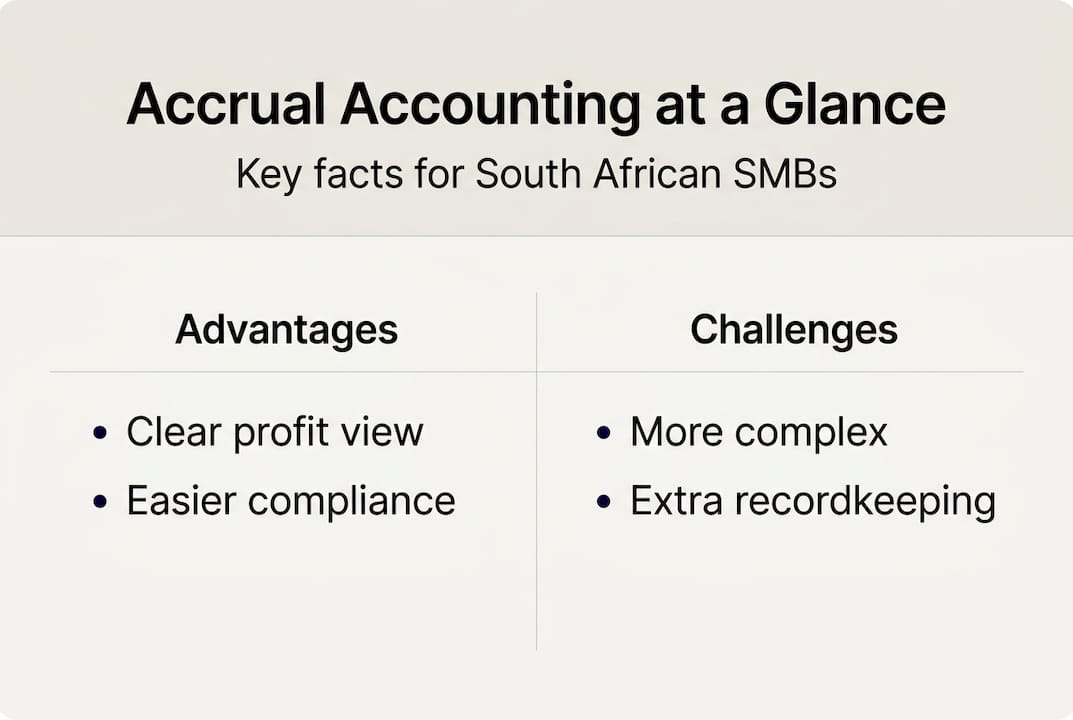
Advantages of accrual accounting:
- Gives you a true picture of profitability in each period
- Aligns with VAT invoice basis and IFRS for SMEs requirements
- Makes it easier to secure business finance, since banks trust accrual-based statements
- Supports better budgeting and forecasting because income and costs are matched correctly
- Scales with your business as complexity grows
Disadvantages of accrual accounting:
- More complex to maintain than cash accounting
- Requires proper processes, software, and often professional support
- Can show strong profits even when cash flow is tight, which can mislead owners who do not monitor both
- Tax timing differences can create situations where you owe tax before you have collected payment
The accrual principle makes clear that accrual provides a better profitability view but can show profits without cash, while cash is simpler but distorts performance. A hybrid approach is sometimes possible for tax purposes.
So when should you switch? Consider accrual accounting when:
- Your turnover approaches or exceeds R2.5 million
- You register for VAT on the invoice basis
- You apply for a business loan or seek external investment
- You have multi-period contracts, subscriptions, or retainers
- You want accurate monthly management accounts
SME South Africa recommends switching to accrual as your business grows beyond R2.5 million and using software for automation to manage the added complexity. If you are exploring cloud accounting for growth, the tools available today make the transition far less painful than it used to be.
A practical perspective: Accrual accounting for South African SMB growth
This covers the technical and legal side, but here is the real-world view from our team’s experience.
Most small business owners wait until they are forced to adopt accrual accounting, usually by a threshold breach or a bank asking for proper financials. By then, the cleanup is expensive and the missed insights have already cost them. We have seen businesses that looked profitable on a cash basis but were quietly accumulating liabilities that only became visible once accrual was applied.
Accrual is not just a compliance box to tick. It is a growth tool. When you know your true monthly profit, you make better decisions about hiring, pricing, and investment. Even lean operations with small teams benefit from this visibility.
The good news is that cloud and automation tools have made accrual adoption genuinely affordable for small businesses. You do not need a large finance team. You need the right software and a clear process. See the full cloud accounting guide to understand how modern tools can support this shift. Do not wait for a compliance crisis to get your books right.
Get expert help with accrual accounting and cloud solutions
If you are ready to get accrual right or need expert assistance, here is how we can help.
At Ready Accounting, we work with South African SMBs every day to set up proper accrual-based bookkeeping, ensure VAT compliance, and build financial reports that actually mean something. Whether you are switching from cash accounting or starting fresh, our team combines professional expertise with cloud technology to make the process smooth. Explore the cloud accounting benefits that our clients experience, or read the full cloud accounting guide to see how automation fits in. When you are ready to take the next step, visit Ready Accounting to book a consultation with our team.
Frequently asked questions
How does accrual accounting differ from cash accounting?
Accrual accounting records income and expenses when they occur, while cash accounting only recognises them when cash changes hands. The accrual principle confirms that revenues are recorded when earned and expenses when incurred, regardless of cash movement.
Am I legally required to use accrual accounting in South Africa?
If your business turnover exceeds R2.5 million, or you are VAT registered under the invoice basis, you must use accrual accounting for compliance. Cash versus accrual accounting rules in South Africa make cash basis available only to smaller sole proprietors and partnerships.
What’s a simple example of an accrual in business?
If you invoice a client in December but only receive payment in January, the revenue is recorded in December under accrual accounting. This follows the accruals (Investopedia) principle of debiting Accounts Receivable and crediting Revenue at the time of the invoice.
Is accrual accounting more complicated for small businesses?
Accrual accounting is more complex than cash because it involves timing rules and extra record-keeping, but it provides far more useful financial information. The accrual principle notes that cash accounting is simpler but distorts business performance over time.
Can accounting software help with accrual accounting?
Yes, modern accounting software can automate much of the accrual process, reducing errors and saving time. SME South Africa recommends using software for automation when switching to accrual as your business grows.
Recommended
- Understand financial statements: guide for South African SMBs – Ready Accounting
- Tax compliance guide for South African SMBs in 2026 – Ready Accounting
- What are financial statements: guide for South African SMBs – Ready Accounting
- How to avoid tax penalties: protect your South African SMB – Ready Accounting