

SA SMEs: Bookkeeping agency with automation and fractional CFO access
SA SMEs: Bookkeeping agency with automation and fractional CFO access
Yes, and for most South African SMEs the math is not close. A bookkeeping agency typically costs between R3,000 and R7,500 a month for standard SMEs, with micro-businesses paying as little as R400 to R900, versus roughly R14,000 to R24,200 to employ someone in-house. Beyond the savings, an agency keeps your VAT201 and payroll filings current, which lowers your risk of a SARS compliance flag. One option built specifically around automation and tax defense for growing SMEs is Ready Accounting-style firms.
Executive Summary
- Bookkeeping agencies cost significantly less than in-house staff, typically R3,000 to R7,500 monthly for SMEs, with micro-businesses paying R400 to R900, while in-house prices range from R14,000 to R24,200.
- Most agencies use cloud-based software with direct API bank feeds, reducing reconciliation errors and speeding up month-end closes compared to manual or spreadsheet-based systems.
- When selecting an agency, prioritize credentials such as ICB, SAIPA, or SAICA, and ensure clear communication about scope, data security, reporting schedules, and compliance management.
- Effective onboarding involves a discovery phase, data migration, catch-up work, and stabilization, with clear KPIs and documentation to prevent delays and unexpected costs.
- Outsourcing is usually more cost-effective than hiring in-house for SMEs with moderate transaction volumes, and agency redundancy reduces compliance risks from staff absence or turnover.
Table of Contents
- What does a bookkeeping agency actually do?
- How much does a bookkeeping agency cost?
- How do you choose the right bookkeeping agency?
- Outsourced vs in-house bookkeeping: which costs less?
- How does bookkeeping keep you SARS compliant?
- What should onboarding with a new agency look like?
- Client support and communication: what to expect
- SLAs and contract terms to expect
- Security and data privacy: what agencies should have in place
- How agencies handle reporting and compliance updates
- The overlooked part of choosing a bookkeeping agency
- Get a bookkeeping quote from Ready Accounting
- Sources
- FAQ
What does a bookkeeping agency actually do?
A bookkeeping agency handles the recurring financial admin that keeps your business compliant and your numbers accurate, month after month. That is the core job. It is not the same as having a full accounting firm sign off your annual financial statements, and understanding that boundary saves a lot of confusion when you are comparing quotes.
Most agencies structure their monthly work around a fixed set of tasks:
- Transaction capture — every sale, expense, and transfer gets recorded in your books, usually pulled automatically from bank feeds.
- Bank reconciliation — matching your bank statement to your ledger so nothing slips through unrecorded or duplicated.
- VAT201 preparation and submission — calculating your VAT liability and filing it with SARS on schedule.
- Payroll processing — payslips, PAYE, UIF, and SDL calculations, plus the monthly EMP201 submission.
- Debtors and creditors management — tracking who owes you money and who you owe, so cashflow stays visible.
At the end of each month, you should receive a specific set of deliverables: reconciled ledgers, a set of management accounts (income statement and balance sheet at minimum), proof of VAT submission, and a payroll summary. If your agency cannot produce these without you asking, that is worth raising early.
Here is where the scope line matters. A bookkeeper prepares your monthly records, but signing off an Annual Financial Statement or conducting an independent review is the legal domain of a registered accountant through SAIPA or SAICA. The practical sequence most startups use is to engage a qualified bookkeeper for the monthly grind, then bring in a SAIPA or SAICA member at year-end for the AFS, unless funders or equity structures demand earlier involvement.
Software matters more than most business owners expect. Ready Accounting-style firms and most competent agencies today run on cloud accounting platforms with direct API bank feeds, meaning transactions flow in automatically rather than being typed in from PDF statements. If an agency you’re vetting still works from spreadsheets and manual bank statement downloads, ask why. That gap tends to show up as slower month-end closes and more reconciliation errors down the line.
How much does a bookkeeping agency cost?
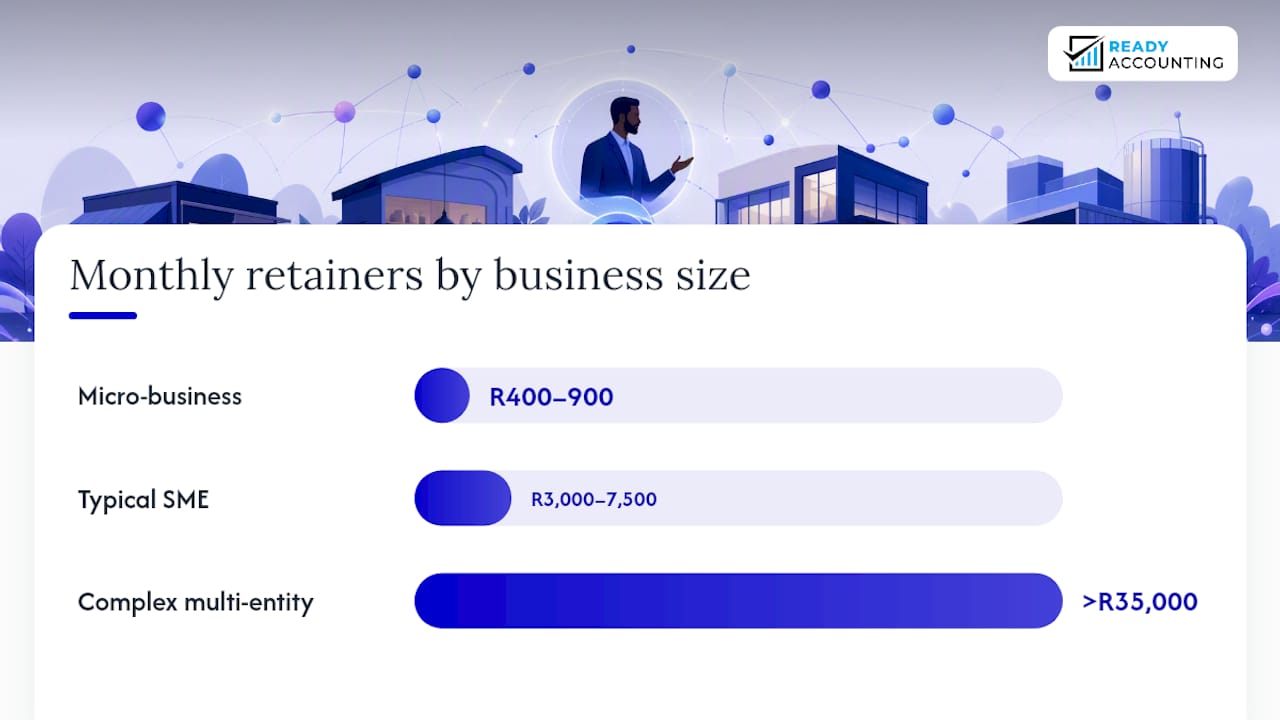
Pricing scales with transaction volume, and the bands are wide enough that you need a real quote rather than a rule of thumb. Monthly retainers for a typical South African SME run R3,000 to R7,500, while micro-businesses with light transaction volume can find services for R400 to R900. Complex multi-entity groups requiring consolidated reporting can push past R35,000 a month.
A closer look at what drives the number: transaction-tiered pricing tracked by industry sources shows up to 30 transactions costing approximately a few hundred rand a month, up to 60 transactions a somewhat higher amount, and up to 90 transactions an amount generally in the low thousands range. Add payroll, and the fee climbs regardless of transaction count, since payroll carries its own compliance calendar.
Hourly billing shows up mostly for once-off cleanups, catch-up work, or advisory sessions rather than routine monthly bookkeeping. Rates typically fall between R100 and R575 an hour depending on the practitioner’s experience and whether the work is basic capturing or more technical reconciliation and reporting.
Four factors move the price more than anything else:
- Transaction volume — more sales and expense lines mean more capturing and reconciliation time.
- Payroll headcount — each employee adds calculation, payslip, and submission work.
- Catch-up or cleanup work — reconciling months of backlog costs more than steady-state bookkeeping, and should be quoted separately from your ongoing retainer so it doesn’t quietly inflate your monthly fee.
- Multi-entity consolidation — group structures with several registered companies multiply the reporting burden.
Pro Tip: When you request quotes, send every agency the exact same scope document: transaction count for the last three months, payroll headcount, VAT registration status, and whether you need catch-up work. Quotes built on different assumptions are impossible to compare fairly, and that’s the single biggest reason business owners feel misled by pricing later.
Before you request quotes, write down: current transaction volume, number of employees on payroll, VAT registration status, software currently in use, and whether your books are up to date or need catch-up work. An agency that quotes without asking these questions is guessing, and you’ll pay for that guess eventually.
How do you choose the right bookkeeping agency?
Start with qualifications, not marketing. Look for practitioners with ICB (Institute of Certified Bookkeepers), SAIPA, or SAICA credentials, and confirm whether the person actually filing your returns holds active SARS Tax Practitioner registration. This is checkable, and any legitimate agency will provide the registration number without hesitation.
Beyond credentials, weigh these criteria:
- Software fluency — do they work in the cloud platform you use, or will you need to migrate?
- Data security practices — encrypted storage, access controls, and audited backups, not just “we’re careful.”
- Reporting cadence — will you get monthly management accounts on a fixed date, or “whenever we get to it”?
- Named personnel — who specifically does your bookkeeping, and is there a backup if that person is out?
- References from similar businesses — a firm handling retail SMEs may not be the right fit for a services startup with international invoicing.
When you get on a quote call, ten questions separate serious agencies from order-takers:
- What’s your SARS Tax Practitioner registration number?
- Which cloud accounting platform do you use, and does it integrate with my bank?
- Who specifically will be working on my account?
- What happens if that person leaves or is unavailable?
- What’s included in the monthly retainer versus billed separately?
- How do you handle catch-up work if my books are behind?
- What’s your turnaround time for management accounts each month?
- How do you back up my financial data, and how often?
- Can you provide two client references in my industry?
- What’s your process if SARS raises a query on a submission you filed?
Watch for red flags during that conversation. Vague answers about scope, no clear familiarity with SARS processes, no mention of backups or data security, and an unwillingness to name who actually does the work are all signs to walk away.
Normalise every proposal before comparing them. Put transaction volume, payroll headcount, and required deliverables side by side against each quote, so you’re comparing identical scope rather than whichever quote happens to look the cheapest on paper. Once you shortlist a provider, insist the contract spells out deliverable dates, escalation procedures for SARS queries, and what counts as billable extra work.
Outsourced vs in-house bookkeeping: which costs less?
For most SMEs, outsourcing wins on cost by a wide margin. A full-time in-house bookkeeper in South Africa carries a total employment cost of roughly R14,000 to R24,200 a month once you add salary, UIF, payroll levies, and the software licences they need to work. A comparable outsourced service typically runs R2,500 to R7,500 a month for the same scope of work.
| Factor | In-house bookkeeper | Outsourced agency |
|---|---|---|
| Monthly cost | R14,000 to R24,200 | R2,500 to R7,500 |
| Redundancy if staff is away | None (single point of failure) | Team-based, multiple people |
| Software licensing | Business bears full cost | Usually bundled into retainer |
| Specialist VAT/payroll knowledge | Depends on one person’s skill | Access to a full team’s expertise |
| Scaling with growth | Requires hiring more staff | Retainer adjusts with volume |
The break-even point tends to shift toward in-house only once a business has genuinely high transaction volume, needs someone physically on-site daily for cash handling or stock reconciliation, or runs a finance function large enough to justify a full team. Below that threshold, outsourcing wins on both cost and risk.
Redundancy is the underrated part of this decision. One in-house bookkeeper going on leave, resigning, or getting sick creates a real gap in your compliance calendar. An agency spreads that risk across a team, which reduces the chance of a missed VAT or payroll deadline landing squarely on your business.
A quick scenario check: a five-person consulting firm with under 90 transactions a month and no daily cash handling is a clear outsourcing candidate. A 40-employee retail operation with daily till reconciliations and stock counts is where an in-house finance clerk, supported by outsourced oversight, starts to make more sense.
How does bookkeeping keep you SARS compliant?
Good bookkeeping is what actually generates the paper trail SARS expects when it asks questions. SARS requires businesses to retain supporting documents, including invoices, receipts, and bank deposit slips, generally for five years. A bookkeeping agency’s monthly reconciliation work is, in effect, that record-keeping happening in real time rather than in a panic during an audit.
The compliance risk most owners underestimate: missed periodic returns, whether VAT or PAYE, are one of the most common triggers for automated SARS verification checks, and those checks can block your Tax Compliance Status, affecting tenders and finance applications. A calendarised submission process, with a firm’s own internal deadlines set ahead of SARS’s own, is the practical defense against this.
When vetting an agency’s compliance approach, ask directly:
- Who is filing my VAT201 and EMP201, and can I see proof after each submission?
- What evidence do you keep in case SARS raises a query on a past return?
- How do you handle penalty or interest exposure if a deadline is at risk?
- Do you follow the SARS record-keeping checklist for supporting documents?
For the primary source on retention rules and what SARS itself expects from small businesses, the SARS small business leaflet is the document to check, and Ready Accounting’s own record-keeping guide walks through how that applies in practice.
What should onboarding with a new agency look like?
Onboarding typically runs through four stages, and knowing what each one demands from you keeps the process from dragging on for months.
- Discovery — the agency reviews your current books, bank accounts, software, and outstanding SARS or CIPC matters. Expect this to take one to two weeks.
- Data migration — moving your records into the agency’s cloud platform, connecting bank feeds, and setting up payroll if applicable.
- Catch-up work — if your books are behind, this is where historical transactions get reconciled. Treat this as a separate line item on your quote, since it’s priced differently from ongoing monthly work.
- Monthly stabilisation — the first two or three regular monthly cycles, where the agency and your team settle into a rhythm.
Before your first call, gather bank statements for the past six to twelve months, prior ledgers or trial balances, your SARS and CIPC registration documents, payroll history if you have staff, and login access to any existing accounting software.
Pro Tip: Set 90-day KPIs with your agency before you sign anything: fully reconciled bank accounts, current VAT returns with no backlog, and accurate payroll runs with no payslip corrections. If those three boxes aren’t ticked by day 90, something in the handover went wrong.
Realistically, budget for catch-up costs if your books have been neglected for more than a few months. Untangling a year of unreconciled transactions costs meaningfully more than a clean handover, which is exactly why agencies quote it separately. Ready Accounting’s step-by-step setup guide covers the practical side of getting a small business’s books structured correctly from day one.
Client support and communication: what to expect
Most agencies commit to a monthly touchpoint at minimum, usually a call or written summary alongside your management accounts, but the better ones layer in more frequent contact during VAT season or payroll cycles. Ask upfront which channel they default to. Email, a shared portal, or WhatsApp all work, but you want one clear primary channel rather than communication scattered across three.
Escalation matters more than routine contact. If SARS raises a query, or a payroll error surfaces, you need to know who picks up that problem and how fast. A firm with a named account manager and a defined escalation path, rather than a shared inbox that anyone might answer, tends to resolve issues faster.
Ask specifically: how often will I get a report, who do I contact if something urgent comes up, and what’s the response time for a non-urgent question versus a compliance emergency? Firms operating a fractional CFO model on top of bookkeeping often provide more proactive contact, flagging cashflow issues or upcoming deadlines before you have to ask.
SLAs and contract terms to expect
A service level agreement should spell out deliverable dates, not just services included. Expect monthly management accounts by a fixed date (commonly the 7th to 15th working day), VAT201 submission before the statutory deadline, and payroll processed with enough lead time for payday.
Contracts typically run month-to-month or with a short notice period, rather than locking you into a long-term commitment, though catch-up or project work may carry separate terms. Look for clarity on what counts as included work versus billable extras, data ownership on termination, and what happens if a deadline is missed on the agency’s side. If the SLA doesn’t mention penalty or interest liability for a missed SARS deadline caused by the agency, ask why not.
Security and data privacy: what agencies should have in place
Your financial data deserves the same scrutiny you’d apply to any sensitive business system. Reputable agencies run on cloud platforms with encrypted data storage, role-based access controls limiting who inside the firm can see your books, and audited or automated backups so a system failure doesn’t cost you months of records.
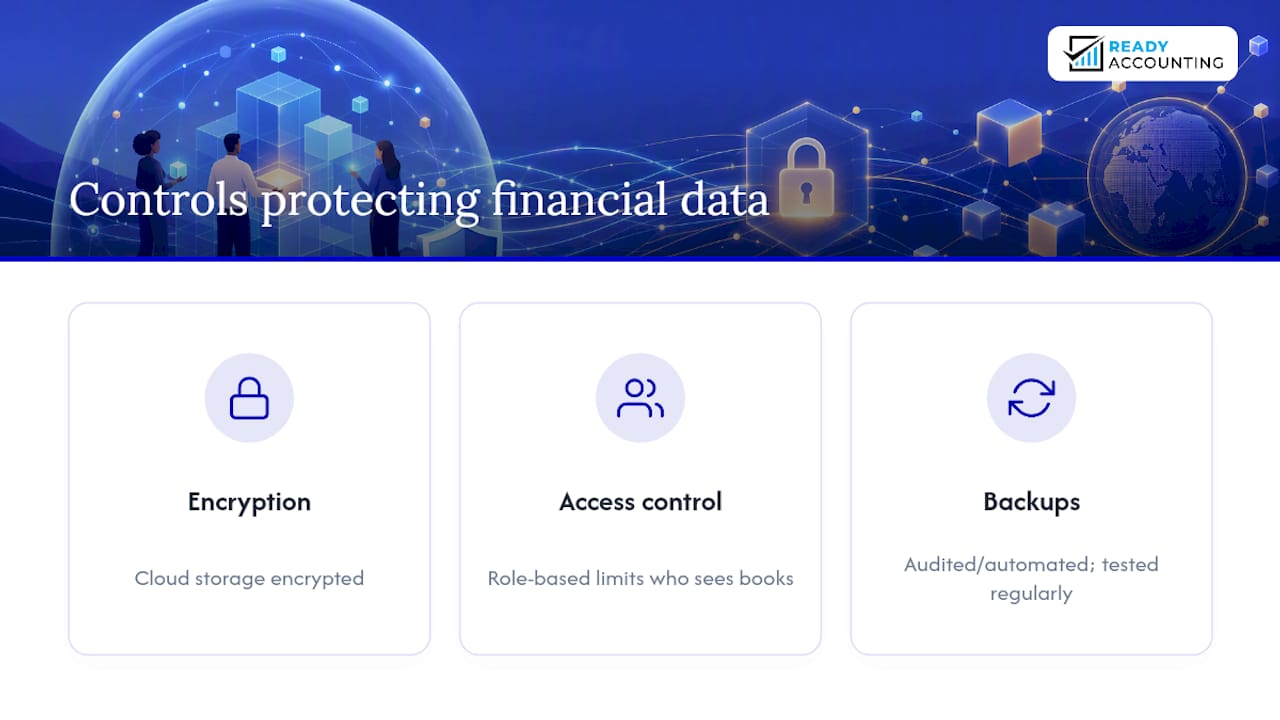
Ask directly whether backups are tested, not just scheduled, and whether your data is stored in compliance with South Africa’s Protection of Personal Information Act (POPIA) requirements around consent and access. An agency that can’t answer clearly, or that stores everything in a single shared spreadsheet with no access logging, is a genuine risk to your business, not just an inconvenience.
How agencies handle reporting and compliance updates
Tax and payroll rules shift often enough that a bookkeeping agency’s real value shows up in how it tracks those changes. Competent firms build compliance updates into their monthly workflow rather than reacting after a deadline passes, adjusting VAT calculations or payroll deductions the moment a rate or threshold changes.
Financial reporting should follow a consistent monthly structure: an income statement, balance sheet, and a short commentary on anything unusual, delivered on the same schedule every month. If an agency also offers CFO-style advisory, that reporting extends into cashflow forecasting and runway tracking, turning routine numbers into something you can act on rather than just file away.
The overlooked part of choosing a bookkeeping agency
Most advice on this topic focuses entirely on price, and that’s the wrong starting point. The research is clear that the real differentiator between agencies is not the monthly fee. It’s whether the firm treats compliance as a calendar problem to solve proactively, or a paperwork problem to solve after SARS sends a letter.
Conventional guidance tells you to shop for the cheapest retainer that covers your transaction volume. That misses what actually costs SMEs money: a missed VAT deadline that triggers a SARS verification, or a payroll error that takes three months to unwind. Automation-first firms catch these before they happen, because the reconciliation and submission calendar runs on software rather than someone’s memory.
If you take one thing from this guide, prioritise the interview questions over the price comparison. A firm that answers every compliance question specifically, with named personnel and real registration numbers, is worth more than one that’s marginally cheaper but vague. Price matters, but it’s the second filter, not the first.
— Johan
Get a bookkeeping quote from Ready Accounting
Some agencies use custom cloud infrastructure with direct API bank feeds and real-time runway dashboards, allowing clients to see their cashflow position without waiting for month-end. Certain firms build their services around financial automation and tax defense specifically for scaling South African SMEs and VC-backed startups, acting as a fractional CFO rather than just performing monthly ledger clean-up.
To get a quote, send us your last three months of transaction volume, payroll headcount, and current VAT registration status. We typically respond within two business days with a scoped proposal. See how automation improves cashflow visibility for your business, or check the top accounting tasks worth automating before your next quote call.
This article is general information, not a substitute for advice from a qualified financial advisor. Consult a qualified financial professional about your own circumstances before acting on anything here.
Sources
FAQ
How much should you pay someone to do your bookkeeping?
Monthly retainers for South African SMEs typically run R3,000 to R7,500, with micro-businesses paying R400 to R900 and complex multi-entity setups exceeding R35,000.
How much per hour does a bookkeeper charge?
Hourly rates generally fall between R100 and R575, depending on experience, and hourly billing is mostly used for once-off cleanups or catch-up work rather than routine monthly bookkeeping.
What are the three types of bookkeeping?
The three common approaches are single-entry bookkeeping for very small operations, double-entry bookkeeping used by most registered businesses, and cloud-based bookkeeping, which automates capturing through bank feed integrations rather than manual entry.
Can a bookkeeper realistically earn a high income in South Africa?
Earnings scale with client volume and specialisation rather than hours alone. A bookkeeper managing multiple retainer clients, particularly one with payroll and VAT expertise, can build a meaningful practice, though income depends heavily on client base size and service scope rather than any fixed hourly ceiling.
Should I outsource to a bookkeeping agency or hire in-house?
For most SMEs below high transaction volumes, outsourcing costs less. In-house total employment costs run R14,000 to R24,200 a month versus R2,500 to R7,500 for a comparable outsourced service, and outsourcing adds team-based redundancy that a single in-house hire cannot match.