

Cash vs accrual accounting: make the right choice in 2026
Executive Summary
- Choosing the right accounting method affects financial accuracy, tax compliance, and funding ability.
- Cash accounting records transactions when cash moves, while accrual records when earned or incurred.
- Regularly review your method as your business grows or changes to ensure compliance and clarity.
Choosing the wrong accounting method can quietly distort your business’s financial picture, and many South African SMB owners only discover this when SARS comes knocking or a bank rejects a funding application. The method you use to record income and expenses shapes everything from your monthly profit figures to your VAT submissions and your ability to attract investors. Yet most small business owners pick a method by default, often because it is what their bookkeeper has always done, not because it is the right fit. This guide breaks down both cash and accrual accounting in plain language so you can make a confident, informed decision for your business.
Table of Contents
- Understanding the basics: Cash vs accrual accounting
- Advantages and disadvantages: Which method works for you?
- Tax compliance and reporting in South Africa
- Deciding and switching: How to choose the best fit for your business
- Why most owners get accounting method selection wrong (and how you can get it right)
- Need help? Streamline your business accounting with expert support
- Frequently asked questions
Key Takeaways
| Point | Details |
|---|---|
| Cash accounting is simple | Great for micro-businesses but can mislead about growth and liabilities. |
| Accrual accounting meets standards | Offers clarity and credibility and is required for larger or VAT-registered businesses. |
| Tax compliance is critical | Confirm which method aligns with SARS and VAT obligations before switching or starting out. |
| Evaluate before switching | Assess your current needs and growth plans to choose the right approach and execute the transition smoothly. |
Understanding the basics: Cash vs accrual accounting
At its core, accounting is about timing. When do you record a sale? When do you record an expense? The answer depends entirely on which method you use.
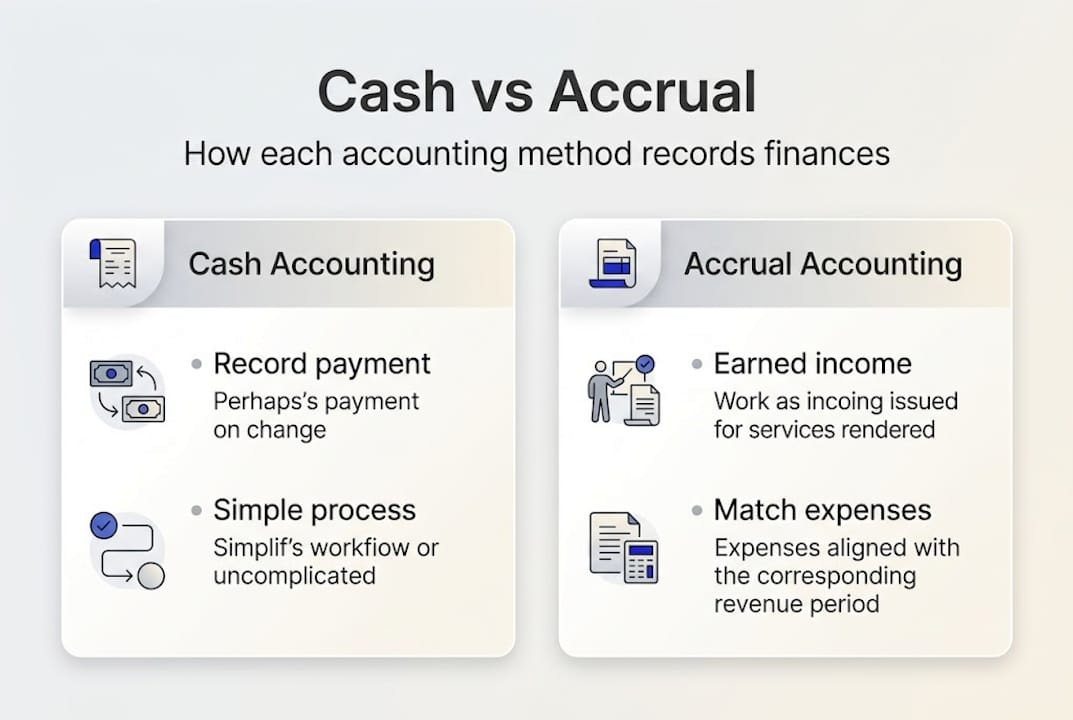
Cash accounting records transactions only when money physically moves. You invoice a client in March, they pay in May. Under cash accounting, that income appears in May. Simple. Straightforward. This is why most micro-businesses and sole traders start here.
Accrual accounting works differently. It records income when it is earned and expenses when they are incurred, regardless of when cash actually moves. That March invoice? It shows up in March. As cash basis vs accrual basis explains, cash basis records when money changes hands while accrual records when income is earned and expenses incurred.
Here is a quick side-by-side to make it concrete:
| Feature | Cash accounting | Accrual accounting |
|---|---|---|
| Revenue recorded | When cash received | When earned |
| Expenses recorded | When cash paid | When incurred |
| Complexity | Low | Medium to high |
| GAAP/IFRS compliant | No | Yes |
| Best for | Micro and early-stage businesses | Growing SMBs, VAT vendors |
A few misconceptions are worth clearing up. Many owners assume cash accounting means they are always up to date with their finances. Not quite. If you have outstanding invoices or unpaid supplier bills, your cash-basis books will not reflect those obligations at all. Your profit can look great on paper while debt quietly builds.
Some common reasons SMBs choose each method:
- Cash accounting: Easy to manage, low admin burden, suits businesses with simple transactions
- Accrual accounting: Required for accrual accounting guide compliance, gives a realistic view of financial health, needed for GAAP-aligned reporting
Understanding basic accounting principles is essential before committing to either method, especially if you plan to grow.
Pro Tip: Many start-ups begin with cash accounting because it is easy, but they often outgrow it within two to three years. If you are already tracking debtors and creditors manually, you are probably ready to switch.
Advantages and disadvantages: Which method works for you?
With a foundation set, let’s see how the two systems stack up for your day-to-day operations.
As noted in cash basis vs accrual basis accounting, cash is easy and cheap but misleading for larger firms, while accrual is accurate and GAAP-compliant but more involved. That is a fair summary, but the detail matters.
| Cash accounting | Accrual accounting | |
|---|---|---|
| Pros | Simple, low cost, easy to understand | Accurate, GAAP-compliant, investor-ready |
| Cons | Distorts seasonal performance, hides debt | More complex, needs skilled bookkeeper |
| Tax timing | Pay tax when cash arrives | Pay tax when income is earned |
| Funding readiness | Weak for bank applications | Strong for lenders and investors |
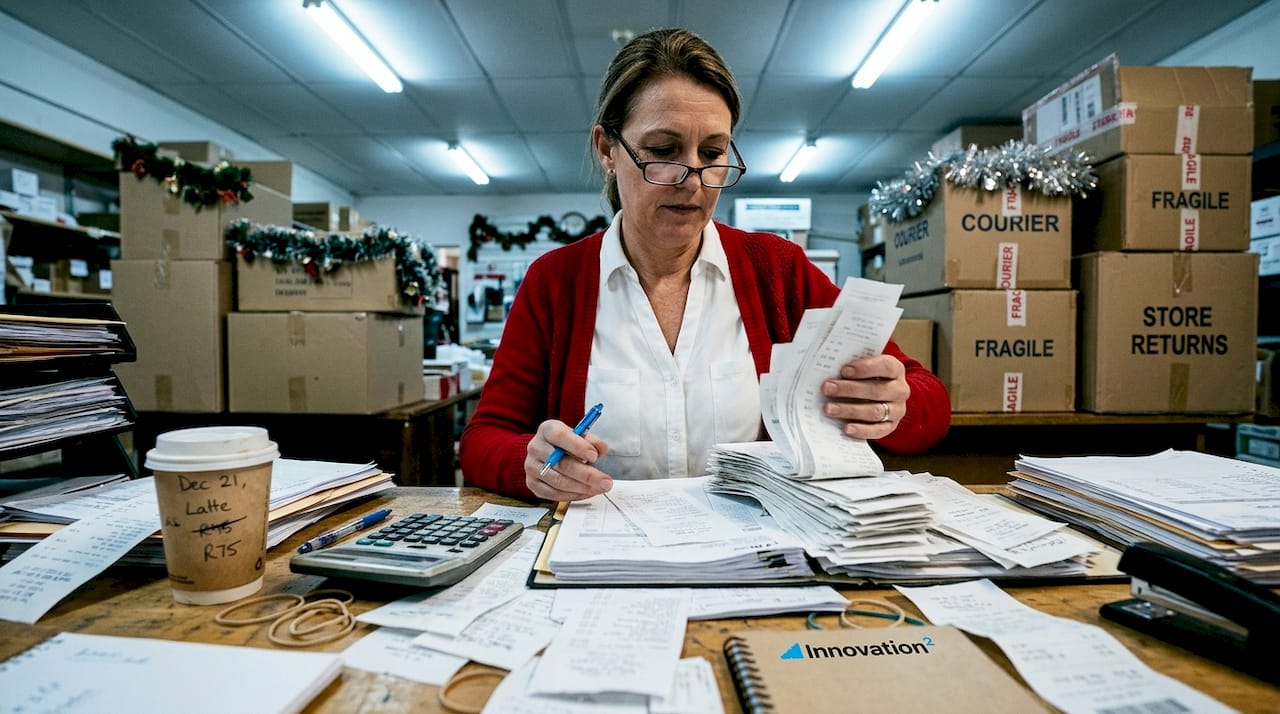
Let’s talk about seasonal distortion. Imagine you run a retail business and December is your biggest month. You collect most payments in January. Under cash accounting, January looks wildly profitable and December looks flat. That is a false picture. It can lead to poor staffing decisions, premature spending, or confusion when comparing year-on-year performance.
Accrual accounting solves this. Revenue is matched to the period it was earned, so your December financials reflect December’s actual performance. This is why automation and cash flow tools built for accrual systems give far more useful insights.
On the flip side, accrual accounting does require more skill. You need someone who understands journals, prepayments, accruals, and deferred income. If your bookkeeper is not trained in these, errors can creep in fast.
Key advantages at a glance:
- Cash: Faster month-end close, lower bookkeeping cost, easier for owner-managed books
- Accrual: Supports better budgeting, tracks cash flow KPIs accurately, required for audits
Pro Tip: If you are applying for a business loan or pitching to investors, accrual-based financial statements will carry far more weight. Banks want to see a true picture of your obligations and earnings, not just your bank balance.
Tax compliance and reporting in South Africa
Once you have weighed the options, it is vital to confirm your method aligns with South African legal requirements.
SARS allows smaller businesses to use the cash basis for income tax purposes under certain conditions, but this flexibility has limits. The moment your business registers for VAT, the rules tighten. VAT vendors are generally required to account for VAT on either an invoice basis (accrual) or a payments basis (cash), but the invoice basis is the default. Larger VAT vendors are typically required to use the invoice basis exclusively.
For annual financial statements, most businesses that require audited or reviewed financials must comply with IFRS for SMEs or full IFRS. As cash basis vs accrual basis accounting confirms, the accrual system is required by GAAP while the cash system does not comply with GAAP. This matters enormously if your financials need to be signed off by an auditor or independent reviewer.
Compliance note: Any business required to file audited financial statements under the Companies Act must use accrual-based accounting. Non-compliance can result in qualified audit opinions, which damage your credibility with lenders, investors, and SARS alike.
Steps to stay compliant:
- Confirm your annual turnover and check whether SARS requires accrual-based reporting for your entity type
- Register for VAT if your turnover exceeds R1 million and confirm your VAT accounting basis with your accountant
- Align your accounting method with your preparing financial statements obligations under the Companies Act
- Maintain records for at least five years as required under SARS record-keeping rules
- Review your method at the start of each financial year, not mid-year, to avoid complications
Pro Tip: If your revenue is approaching the R1 million VAT threshold, start transitioning to accrual accounting now. Switching under pressure, mid-year, is far more stressful and error-prone than planning ahead.
Deciding and switching: How to choose the best fit for your business
Finally, knowing the rules and pros and cons equips you to make a confident, practical decision.
The right method depends on where your business is today and where you want it to go. Ask yourself these questions:
- Is my annual turnover below R1 million with no plans to scale rapidly?
- Do I have very few debtors and creditors at any given time?
- Am I the only person managing the books with no dedicated finance staff?
- Do I not need audited financials or external funding in the next 12 months?
If you answered yes to all four, cash accounting may still serve you well. But if even one of those answers is no, accrual accounting will give you a far stronger foundation.
It is also worth noting that hybrid and modified cash accounting methods are used in public sectors or special circumstances, but for most South African SMBs, the choice is binary: cash or accrual.
If you decide to switch, follow these steps:
- Consult your accountant to assess the impact on your current year’s financials and tax position
- Notify SARS of the change in accounting basis, particularly if it affects your income tax or VAT submissions
- Update your accounting software settings. Most cloud platforms like Xero or Sage handle both methods but need to be configured correctly
- Restate your opening balances to reflect accruals, prepayments, and outstanding debtors and creditors
- Train your bookkeeper or finance team on the new processes and journal entry requirements
- Use an accounting automation guide to streamline recurring entries and reduce manual errors
- Build a cashflow forecasting steps process into your monthly routine so you always know your real cash position alongside your accrual-based profit
Switching is not as daunting as it sounds when you have the right support and a clear plan.
Why most owners get accounting method selection wrong (and how you can get it right)
Here is the uncomfortable truth we see repeatedly when working with South African SMBs: most business owners choose their accounting method once, at the very beginning, and never revisit it. They picked cash because it was easy. Years later, they are still using it while managing a team of 15, carrying significant debtor balances, and wondering why their bank statements never seem to match their “profit.”
Short-term simplicity has a long-term cost. Cash accounting feels easier until it does not. Suddenly you are sitting with a profitable-looking income statement and a cash crisis because you failed to account for a large creditor payment due next week.
The smarter move is to treat your accounting method as a living decision, not a once-off setup. Review it annually, ideally before your financial year begins. If your business has grown, if you have taken on investors, or if you are applying for credit, it is time to reassess. Our mastering accrual accounting resource walks you through the transition in detail.
Pro Tip: Schedule an annual accounting review in your calendar every year, not just during tax season. Thirty minutes of proactive planning can save you months of reactive cleanup.
Need help? Streamline your business accounting with expert support
If this still feels overwhelming, you do not have to do it alone. Choosing and implementing the right accounting method is far easier with expert guidance tailored to your specific business size, industry, and growth plans. At Ready Accounting, we work with South African SMBs every day to set up, clean up, and automate their financial systems so they stay compliant and make better decisions. Explore the cloud accounting benefits that come with modern bookkeeping, or read our full cloud accounting guide to see how technology can simplify your transition. Ready to take the next step? Book a consultation with our team today.
Frequently asked questions
Is cash or accrual accounting better for South African small businesses?
Cash accounting suits very small businesses with simple, low-volume transactions, but accrual accounting provides more accurate records and is required for most VAT-registered entities and those needing GAAP-compliant financial statements.
Can I switch from cash to accrual accounting during the tax year?
Switching mid-year is technically possible but creates complexity. Coordinate with your accountant and inform SARS, as system switching should be planned carefully to avoid restating errors or tax miscalculations.
Why is accrual accounting required by SARS for some businesses?
Accrual accounting fulfills GAAP and IFRS standards, which are mandatory for larger or VAT-registered entities. As confirmed by accrual basis aligns with GAAP, it gives regulators and auditors a true and fair view of your financial position.
Are there any alternatives to cash or accrual accounting?
Hybrid and modified methods exist mainly for public sector bodies and non-profit organisations. For most South African SMBs, the practical choice remains either cash or accrual accounting.
Recommended
- Accrual accounting for SMBs in South Africa: a guide – Ready Accounting
- How to create a cashflow forecast statement in 2026 – Ready Accounting
- How Automation Improves Cash Flow – Ready Accounting
- Ultimate Guide to Accounting Automation in 2025 – Ready Accounting
- Master financial operations automation steps for 2026 | Ailerons IT Consulting