

CIPC Company Registration Protocol for South African Businesses 2025
Starting a company in South Africa sounds daunting but more locals are taking the leap than ever. More than 535,000 new businesses were registered through the CIPC in just one year. Most people expect endless queues and paperwork. The surprise is that digital platforms like BizPortal now make it possible to register online in minutes and handle tax and compliance all in one place.
Table of Contents
- Understanding Cipc Company Registration Process
- Essential Documents And Compliance Requirements
- Integrating Cloud Accounting And Payroll Solutions
- Financial Reporting, Tax, And Bookkeeping Tips
Quick Summary
| Takeaway | Explanation |
|---|---|
| Understand registration prerequisites clearly | Entrepreneurs must prepare identification, proof of address, and the Memorandum of Incorporation before starting the CIPC registration process. |
| Utilize BizPortal for efficient registration | The BizPortal platform allows businesses to register online, simplifying the process and reducing administrative burdens through integrated registrations with various government entities. |
| Maintain compliance with ongoing regulations | After registration, businesses must comply with requirements like tax submissions and accurate record keeping as per the Companies Act to sustain legal status. |
| Adopt cloud accounting solutions | Using cloud accounting can enhance financial management, offering real-time tracking, automated reporting, and improved security for small businesses. |
| Implement effective bookkeeping practices | Entrepreneurs should adopt systematic bookkeeping methods and maintain separate financial accounts to enhance accuracy and readiness for tax audits. |
Understanding CIPC Company Registration Process
Navigating the CIPC company registration process in South Africa requires strategic preparation and understanding of the legal framework for establishing a business entity. The Companies and Intellectual Property Commission (CIPC) serves as the primary regulatory body responsible for facilitating business registrations and maintaining corporate records.
Preliminary Requirements for Company Registration
Before initiating the registration process, entrepreneurs must meet specific prerequisites. According to the South African Government portal, businesses need to prepare several critical documents and make key decisions. These include selecting an appropriate company name, determining the company’s legal structure, and identifying initial shareholders and directors.
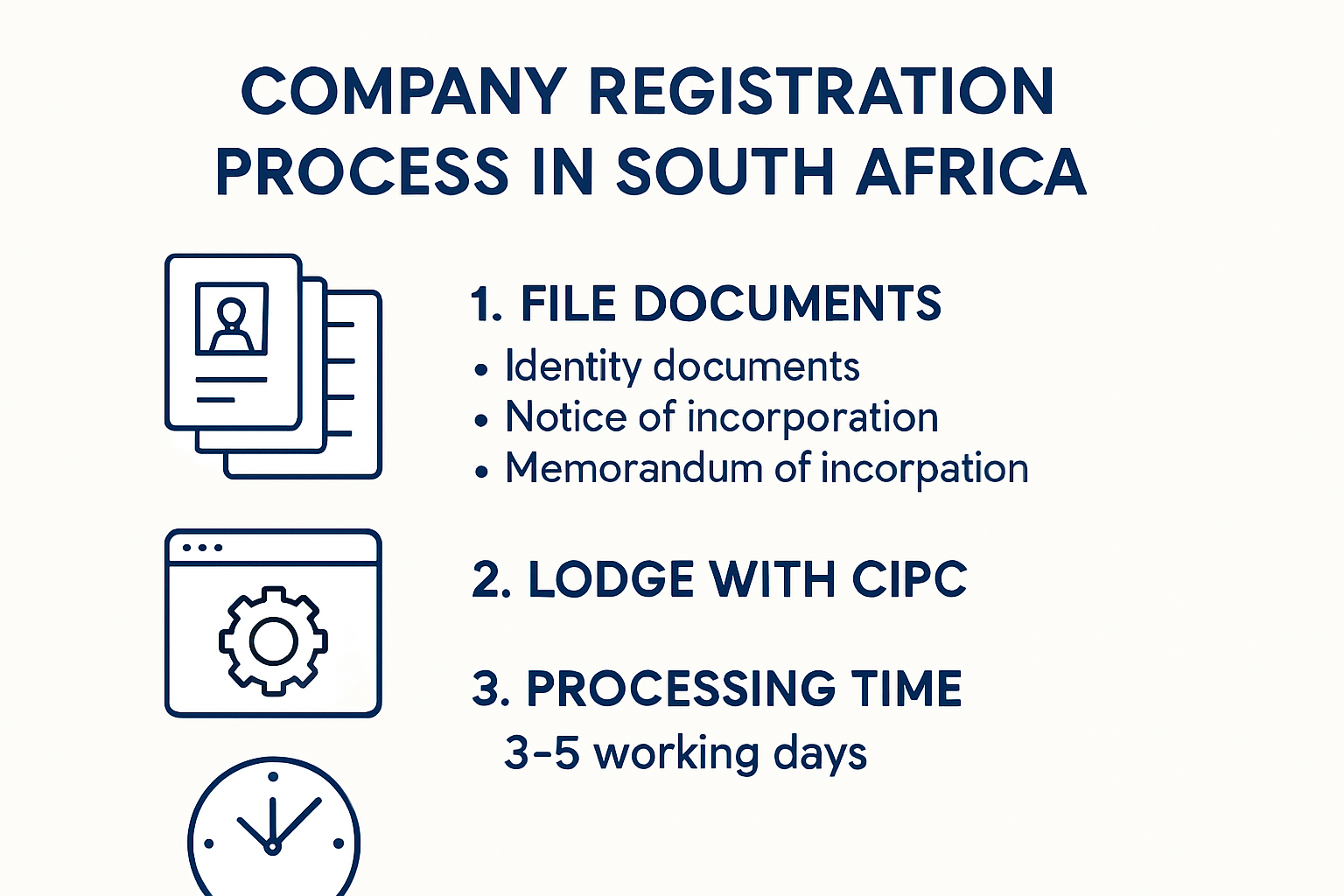
The registration process involves multiple steps that demand careful attention. Prospective business owners must compile documentation such as:
- Identification Documents: Copies of directors’ and shareholders’ identification
- Proof of Business Address: Verified residential and business addresses
- Memorandum of Incorporation (MOI): Detailed company governance document
- Registered Company Name: Unique and compliant business name
Digital Registration through BizPortal
South Africa has modernized its company registration approach through BizPortal, a comprehensive digital platform that streamlines the entire registration workflow. This paperless system allows entrepreneurs to complete registration processes electronically, significantly reducing administrative complexity.
Through BizPortal, businesses can simultaneously register with multiple government entities. The platform automatically facilitates registration with the CIPC, South African Revenue Service (SARS), Unemployment Insurance Fund (UIF), and Compensation Fund. This integrated approach minimizes bureaucratic hurdles and accelerates business establishment timelines.
To help you compare the traditional manual registration method with the modern BizPortal digital process, the table below summarizes key features of each approach.
| Feature | Manual Registration | BizPortal Digital Registration |
|---|---|---|
| Registration Method | In-person, paperwork | Online, paperless |
| Required Visit to Offices | Yes | No |
| Integration with Other Agencies | Limited | SARS, UIF, Compensation Fund |
| Speed of Registration | Slower, days to weeks | Fast, often within minutes/hours |
| Administrative Burden | High | Low |
| Error/Delay Risk | Higher (paper/document loss) | Lower (automated checks) |
Tax and Compliance Considerations
Upon successful registration, businesses must promptly address tax obligations. SARS guidelines emphasize that newly registered companies receive an automatic Income Tax reference number. Entrepreneurs must subsequently register on the SARS eFiling platform to manage ongoing tax responsibilities.
The registration process demands meticulous attention to detail. While digital platforms have simplified procedures, businesses must ensure complete accuracy in submitted documentation. Errors or incomplete information can lead to registration delays or potential legal complications.
Entrepreneurs are advised to consult with professional accounting services to navigate the complexities of CIPC registration effectively. Professional guidance can help streamline the process, ensure compliance, and provide strategic insights for new business establishments.
Essential Documents and Compliance Requirements
Registering a company in South Africa requires precise documentation and adherence to specific compliance standards set by the Companies and Intellectual Property Commission (CIPC). Understanding these requirements is crucial for entrepreneurs seeking to establish a legally recognized business entity.
Core Documentation for Company Registration
The registration process demands a comprehensive set of documents that validate the business’s legal standing. According to the South African Government portal, businesses must prepare and submit several critical documents:
- Identification Documents: Certified copies of all directors’ and shareholders’ identification documents
- Proof of Business Address: Verified residential and business address documentation
- Memorandum of Incorporation (MOI): A detailed governance document outlining the company’s operational framework
- Notice of Incorporation: Official registration document specifying company details
Documents must be meticulously prepared and certified. The CIPC certification guidelines specify exact requirements for document authentication, emphasizing the importance of accuracy and completeness.
For greater clarity, the following table outlines the essential documents required for CIPC registration and their respective purposes.
| Document | Purpose |
|---|---|
| Certified ID copies (Directors/Shareholders) | To verify identity and legal eligibility |
| Proof of Business Address | To confirm the registered location of the business |
| Memorandum of Incorporation (MOI) | Defines company governance, structure, and operational framework |
| Notice of Incorporation | Officially registers the business with CIPC |
Compliance and Regulatory Considerations
Beyond initial documentation, businesses must maintain ongoing compliance with South African regulatory standards. The Companies Act mandates specific requirements for corporate governance, financial reporting, and statutory obligations. Record keeping becomes critical for maintaining legal and financial transparency.
Key compliance areas include:
- Annual financial statement submissions
- Tax registration and reporting
- Maintaining updated company records
- Compliance with employment regulations
- Intellectual property protection

Ongoing Regulatory Obligations
Registration is merely the first step in a company’s legal journey. Businesses must continuously meet regulatory requirements to maintain their legal status. The Companies and Intellectual Property Commission monitors and enforces these standards, ensuring businesses operate within legal frameworks.
Entrepreneurs should consider professional guidance to navigate these complex requirements. Consulting with accounting professionals can help ensure complete compliance, mitigate potential legal risks, and establish a solid foundation for business operations.
Timely submission of required documents, maintaining accurate records, and staying informed about regulatory changes are essential strategies for successful business registration and sustained legal compliance in South Africa.
Integrating Cloud Accounting and Payroll Solutions
Modern South African businesses increasingly recognize the transformative potential of cloud accounting and payroll solutions in streamlining financial management and regulatory compliance. As companies navigate complex registration processes, integrating technological solutions becomes crucial for operational efficiency and strategic growth.
Cloud Accounting Technology Landscape
Cloud accounting platforms have revolutionized financial management for South African businesses. According to research from Multiplier, the digital transformation of business processes now enables entrepreneurs to complete registration and financial tracking more efficiently than ever before.
Key advantages of cloud accounting solutions include:
- Real-time Financial Tracking: Instant access to financial data
- Automated Reporting: Simplified compliance and tax preparation
- Scalable Infrastructure: Flexible solutions for growing businesses
- Enhanced Security: Robust data protection mechanisms
Payroll Management and Compliance
Effective payroll management represents a critical component of business operations. Automated payroll solutions help businesses navigate complex regulatory requirements, including PAYE tax calculations, UIF contributions, and social security payments.
Businesses must consider several factors when selecting payroll systems:
- Compliance with South African labor regulations
- Integration with existing accounting platforms
- Automated tax calculations
- Employee self-service capabilities
- Multi-currency and multi-location support
Strategic Technology Integration
Successful technology adoption requires a strategic approach. Top accounting automation strategies emphasize the importance of selecting solutions that align with specific business needs. According to Sage Business Cloud research, cloud-based platforms offer unprecedented flexibility for small and medium enterprises.
Entrepreneurs should prioritize solutions that:
- Offer seamless SARS and CIPC integration
- Provide comprehensive financial reporting
- Support mobile and remote access
- Enable easy scalability
The digital transformation of financial management represents more than technological upgrades. It signifies a fundamental shift in how South African businesses approach operational efficiency, regulatory compliance, and strategic planning.
By embracing cloud accounting and payroll solutions, businesses can reduce administrative burdens, minimize errors, and focus on core growth strategies. Professional guidance remains essential in selecting and implementing these transformative technologies, ensuring alignment with specific business requirements and regulatory standards.
Financial Reporting, Tax, and Bookkeeping Tips
Navigating the financial landscape for South African businesses requires strategic planning, meticulous record-keeping, and a comprehensive understanding of regulatory requirements. Effective financial management goes beyond mere compliance and serves as a critical foundation for sustainable business growth.
Essential Financial Reporting Standards
Financial reporting in South Africa demands adherence to rigorous standards set by regulatory bodies. According to the South African Institute of Chartered Accountants (SAICA), companies must prepare Annual Financial Statements (AFS) that comply with International Financial Reporting Standards (IFRS). These statements provide a transparent snapshot of a company’s financial health and performance.
Key components of comprehensive financial reporting include:
- Accurate Income Statements: Detailed revenue and expense tracking
- Comprehensive Balance Sheets: Precise asset and liability documentation
- Cash Flow Statements: Transparent financial movement analysis
- Comprehensive Notes and Disclosures: Contextual financial information
Tax Compliance and Strategic Planning
Tax management represents a critical aspect of financial operations for South African businesses. The South African Revenue Service (SARS) mandates specific tax registration and reporting requirements for companies. Businesses must register for corporate income tax upon incorporation and submit annual tax returns.
Critical tax considerations include:
- Timely VAT registration for businesses with annual turnover exceeding R1 million
- Accurate PAYE and UIF contributions for employee payroll
- Maintaining comprehensive financial records for tax audits
- Understanding corporate tax rate structures and potential deductions
Bookkeeping Best Practices
Effective bookkeeping forms the backbone of financial management. Avoiding common bookkeeping mistakes can significantly enhance a company’s financial accuracy and compliance. Entrepreneurs should develop systematic approaches to financial documentation and leverage technological solutions for improved efficiency.
Recommended bookkeeping strategies include:
- Implementing robust accounting software
- Maintaining separate business and personal financial accounts
- Consistently tracking and categorizing expenses
- Conducting regular financial reconciliations
- Preserving financial documentation for the mandatory seven-year period
Businesses must recognize that financial reporting extends beyond regulatory compliance. Understanding financial statements enables entrepreneurs to make informed strategic decisions, identify potential growth opportunities, and mitigate financial risks.
Professional guidance from qualified accountants and financial advisors can provide invaluable insights, helping businesses navigate complex financial landscapes, optimize tax strategies, and establish robust financial management systems that support long-term success.
Frequently Asked Questions
What documents are required for CIPC company registration in South Africa?
To register a company with CIPC in South Africa, you need the following documents: certified identification copies of all directors and shareholders, proof of business address, a Memorandum of Incorporation (MOI), and a Notice of Incorporation.
How can I register my company online in South Africa?
You can register your company online using the BizPortal platform. This digital system allows you to complete the registration process electronically, streamlining your business setup while allowing for simultaneous registration with various government entities.
What are the tax obligations for newly registered companies in South Africa?
Newly registered companies are automatically assigned an Income Tax reference number and must register on the SARS eFiling platform to manage ongoing tax responsibilities, including VAT registration if applicable and timely submission of annual tax returns.
What are the ongoing compliance requirements after registering a company with CIPC?
After registering, businesses must maintain compliance with various regulations, including submitting annual financial statements, adhering to tax registration and reporting, keeping updated company records, and ensuring compliance with employment regulations.
Take the Hassle Out of CIPC Registration and Compliance
You have just learned how tricky it can be to navigate CIPC company registration and South Africa’s ever-changing compliance rules. Even with BizPortal simplifying the process, it is still easy to make mistakes with documentation, ongoing record-keeping, or tax filings—and one small error could delay your business launch or put your compliance at risk. Many new entrepreneurs feel overwhelmed by the paperwork and unsure if everything has been handled correctly.
Ready to focus on running and growing your business instead of getting buried in admin? Let the experts at Ready Accounting handle your financial statements, bookkeeping cleanup, and tax planning from day one. We offer tailored support in cloud accounting, automate your processes, and keep you audit-ready all year. Visit Ready Accounting now to book your personalised consultation and stay compliant with confidence. Make your move today and avoid the headaches tomorrow.
Recommended
- Top Tax Questions Small Business Owners Ask in 2025 – Ready Accounting
- Xero Accounting for South African Business Success 2025 – Ready Accounting
- SimplePay for Payroll: Streamlining South African Business in 2025 – Ready Accounting
- Small Business Tax Deductions: Complete 2025 Checklist – Ready Accounting