

Cloud accounting protocol for South African Corporate Asset growth
SARS is phasing out manual VAT filing by 2029, requiring near real-time digital submissions. South African SMBs face mounting pressure to digitize their financial processes or risk penalties and compliance failures. Cloud-based accounting offers a practical solution, automating tax reporting, reducing errors, and providing instant financial visibility. This guide walks you through how cloud accounting transforms compliance burdens into competitive advantages for your business.
Table of Contents
- Introduction To Cloud-Based Accounting For South African SMBs
- Navigating SARS Compliance: VAT, Payroll, And Digital Tax Reporting
- Benefits Of Adopting Cloud Accounting For South African SMBs
- Common Misconceptions About Cloud Accounting In South Africa
- Choosing The Right Cloud Accounting Software For Your South African Business
- Implementing Cloud Accounting: Best Practices For Smooth Transition
- Conclusion: Embracing Cloud Accounting For Future-Ready Financial Management
- Explore Ready Accounting’s Cloud Solutions For South African SMBs
- Frequently Asked Questions
Key takeaways
| Point | Details |
|---|---|
| Real-time compliance | Cloud accounting automates SARS VAT and payroll submissions, reducing manual errors and late penalties. |
| Financial visibility | Access up-to-date financial data anywhere, enabling faster decisions and improved cash flow management. |
| Cost efficiency | Subscription pricing eliminates large upfront software costs and reduces IT infrastructure expenses. |
| Local integration | Choose software with South African bank feeds, payroll systems, and built-in SARS compliance features. |
| Smooth implementation | Plan data migration carefully, train staff thoroughly, and monitor compliance outputs regularly. |
Introduction to cloud-based accounting for South African SMBs
Cloud-based accounting stores your financial data on secure remote servers rather than local computers. You access the software through a web browser or mobile app, working from anywhere with internet connectivity. Core features include automated bank feeds, real-time reporting, invoicing, expense tracking, and tax compliance tools.
South African SMEs increasingly adopt cloud solutions to meet evolving regulatory demands. Cloud ERP systems provide anywhere access, real-time data, and built-in compliance for tax and POPIA regulations. Manual spreadsheets struggle to keep pace with monthly EMP201 filings, quarterly VAT returns, and annual tax reconciliations.
Key reasons driving adoption include:
- Instant access to financial data from any device
- Automatic synchronization with bank accounts and payment platforms
- Built-in SARS tax templates and submission workflows
- Multi-user collaboration without version control headaches
- Automatic software updates including compliance changes
The shift from desktop software to cloud platforms reduces upfront costs significantly. Traditional accounting packages require expensive licenses, dedicated servers, and IT maintenance. Cloud subscriptions spread costs monthly, scaling with business needs. Compare cloud accounting software options to find pricing that fits your budget.
Integration capabilities matter immensely in South Africa. Your cloud software should connect seamlessly with local banks like Standard Bank, FNB, and Nedbank. Direct feeds eliminate manual data entry, reducing errors and saving hours weekly. Check whether your preferred solution supports South African payroll calculations, UIF contributions, and SDL reporting.
Initial setup takes time, but the long term efficiency gains outweigh temporary disruptions. Understanding accounting service costs helps you budget appropriately for software subscriptions plus professional implementation support.
Navigating SARS compliance: VAT, payroll, and digital tax reporting
SARS modernizes tax administration aggressively between 2025 and 2030. The revenue authority rolls out mandatory e-invoicing and near real-time VAT reporting across all registered businesses. These reforms eliminate monthly manual submissions, replacing them with continuous digital data flows.
The phased timeline impacts SMBs progressively:
- Large taxpayers adopt e-invoicing first in 2026
- Medium enterprises join the system by 2027
- All VAT vendors transition by 2029
- Real-time transaction reporting becomes mandatory for high-risk sectors
- Penalties escalate sharply for non-compliant businesses
Monthly EMP201 payroll submissions are mandatory by the 7th with automation detecting errors faster. Payroll accuracy directly impacts employee tax certificates, UIF claims, and annual EMP501 reconciliations. Mistakes trigger SARS audits, penalties, and reputational damage.
Cloud accounting automates these compliance steps systematically:
| Compliance requirement | Cloud automation benefit |
|---|---|
| Monthly VAT201 filing | Auto-calculates output/input VAT from transactions, flags missing invoices |
| EMP201 payroll submission | Generates accurate PAYE, UIF, SDL calculations with built-in tax tables |
| EMP501 annual reconciliation | Matches monthly submissions automatically, highlights discrepancies early |
| Company tax return (ITR14) | Compiles financial statements, depreciation schedules, and tax adjustments |
| Provisional tax payments | Sends deadline reminders, calculates estimated liability from current data |
Pro Tip: Enable automatic SARS eFiling integration in your cloud software. Direct submission eliminates manual PDF uploads and reduces filing errors by 70%.
Maintaining proper SARS records becomes simpler when your system stores supporting documents digitally. Attach invoices, receipts, and contracts directly to transactions. SARS auditors access complete documentation instantly during reviews.
Payroll tax compliance demands precision. A single incorrect SDL calculation multiplies across all employees, creating significant liabilities. Cloud systems apply current tax brackets, thresholds, and contribution rates automatically. Updates roll out immediately when SARS announces rate changes.
The shift toward digital enforcement means SARS detects non-compliance faster than ever. Third-party data matching identifies discrepancies between bank deposits and declared income. Cloud accounting creates an auditable trail proving your figures match reality.
Benefits of adopting cloud accounting for South African SMBs
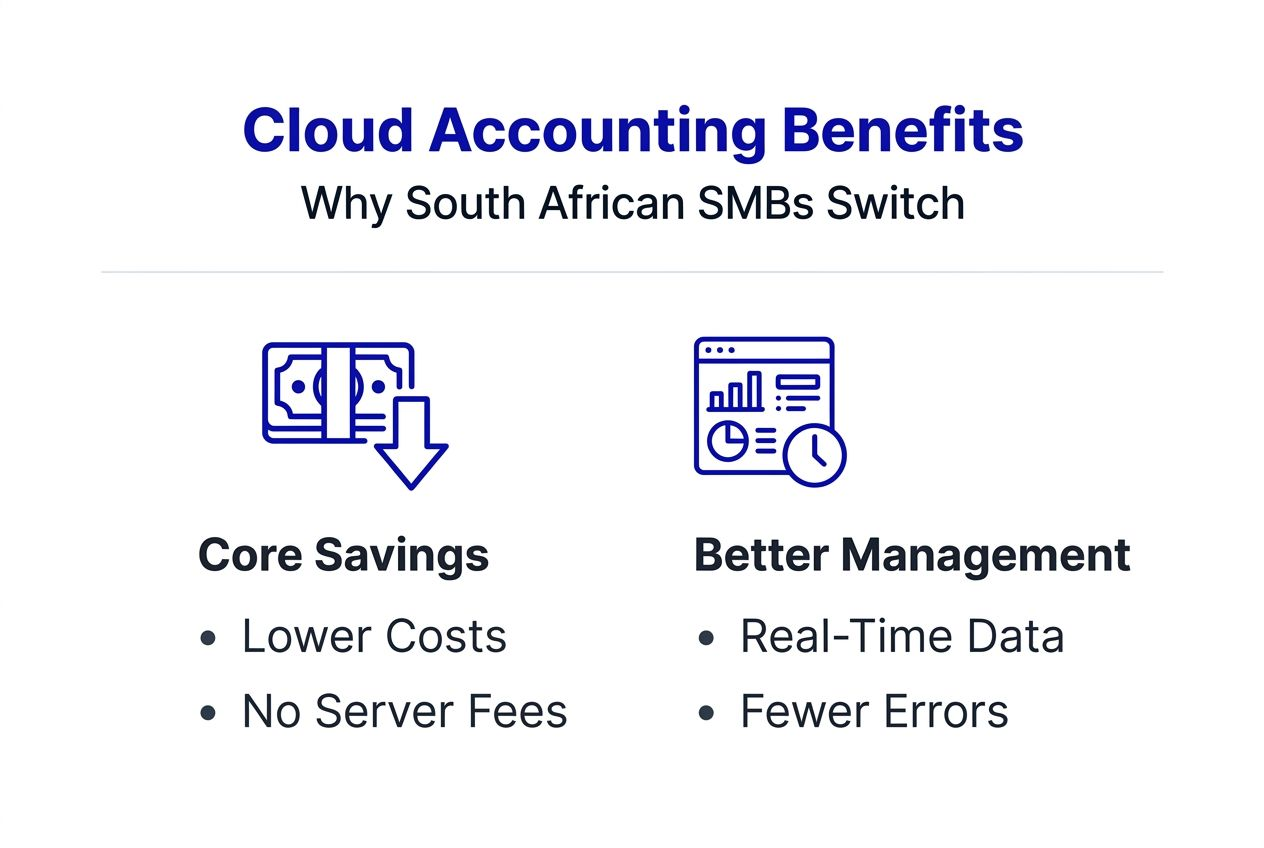
Real-time financial insights transform decision making fundamentally. Traditional month-end reports arrive weeks late, showing outdated snapshots. Cloud dashboards display current cash positions, outstanding invoices, and expense trends instantly. You spot problems before they escalate into crises.

Automation reduces common tax, payroll, and reconciliation errors dramatically. Manual data entry introduces mistakes in 5 to 10% of transactions. Bank feed automation eliminates typing errors completely. Your bookkeeper focuses on exception handling rather than repetitive data capture.
80% of South African SMEs report improved compliance and operational efficiency after adopting cloud systems. Real-time data access enables faster month-end closes, reducing accounting cycles from two weeks to three days. Management receives actionable insights while decisions still matter.
Integration with local financial institutions ensures accuracy automatically:
- Bank feeds import transactions daily, matching payments to invoices
- Payment gateways sync online sales with accounting records
- Payroll platforms submit PAYE, UIF, and SDL directly to SARS
- Expense management apps capture receipts and categorize spending
Cost efficiency stems from subscription pricing and reduced infrastructure needs. Desktop software requires expensive servers, backup systems, and IT support. Cloud providers handle security, updates, and maintenance centrally. Your monthly fee covers everything, making budgeting predictable.
Improved cash flow visibility prevents late payments and overdraft fees. Automated invoice reminders chase overdue accounts systematically. Cash flow forecasts project upcoming shortfalls weeks in advance, giving you time to arrange financing. Many SMBs recover 15 to 20% more receivables through persistent automated follow-ups.
Audit readiness improves dramatically with organized digital records. SARS or bank auditors request specific documents during reviews. Cloud systems retrieve any invoice, receipt, or statement instantly by date, vendor, or amount. Complete documentation protects you from penalties and speeds resolution.
Pro Tip: Review your cloud dashboard weekly, not monthly. Early detection of unusual expenses or revenue dips lets you correct course before problems compound.
Understanding cloud accounting benefits in depth helps you maximize ROI. The value extends beyond compliance into strategic planning, growth financing, and investor reporting. Clean, current financials attract better lending terms and partnership opportunities.
Recognize that accountants play crucial roles in interpreting cloud data. Software automates tasks but human expertise translates numbers into strategy. Combining cloud efficiency with professional guidance creates powerful competitive advantages.
Common misconceptions about cloud accounting in South Africa
Many SMB owners believe cloud accounting suits only large corporations with complex needs. This myth persists despite most cloud platforms targeting small businesses specifically. Entry-level subscriptions start under R200 monthly, offering full SARS compliance for sole proprietors and micro-enterprises. Scalability means you upgrade features as your business grows.
Affordability concerns stem from comparing subscription costs incorrectly. Traditional desktop software requires R5,000 to R15,000 upfront plus annual maintenance fees. Cloud subscriptions total R2,400 to R6,000 yearly with no additional costs. Over three years, cloud solutions cost 40 to 60% less while delivering superior functionality.
Some owners fear losing control over financial data. Cloud platforms actually enhance oversight through detailed audit logs showing who accessed what information when. Permission controls restrict sensitive data to authorized users only. You maintain complete ownership of your data, downloading backups anytime.
The misconception that cloud tools replace human judgment ignores their true purpose. Automation handles repetitive tasks like data entry and calculation. Your bookkeeper focuses on analyzing trends, investigating anomalies, and providing strategic advice. Technology amplifies human capabilities rather than replacing them.
Common myths debunked:
- Cloud accounting is too expensive for startups (entry plans cost less than monthly cellphone contracts)
- Internet outages prevent accessing financial data (offline modes cache recent data locally)
- Security risks exceed desktop software (cloud providers invest millions in encryption and redundancy)
- Implementation takes months (basic setup completes in days with proper planning)
- Only tech-savvy people navigate cloud interfaces (modern designs prioritize simplicity)
Manual processes carry hidden risks that SMBs underestimate. Spreadsheets lack audit trails, enabling fraud and errors to hide indefinitely. SARS digital enforcement catches discrepancies that manual systems miss. Penalties for non-compliance often exceed annual cloud software costs by 10x.
Pro Tip: Request free trials from multiple cloud providers. Test actual workflows with your data before committing. Most platforms offer 30-day trials with full functionality.
Addressing common bookkeeping mistakes becomes easier with cloud automation. The software flags duplicate entries, missing receipts, and incorrect categorizations immediately. Real-time validation prevents errors from accumulating across months.
Understand that resistance to change creates more problems than learning new software. SMBs clinging to manual processes face escalating compliance burdens as SARS digitizes enforcement. Early adopters gain competitive advantages through better financial control and faster decision making.
Choosing the right cloud accounting software for your South African business
Selecting appropriate cloud software determines long-term success and satisfaction. SARS tax compliance must rank as your top priority. Verify that platforms support current VAT rates, PAYE calculations, and eFiling integration. Software lacking local compliance features creates more problems than it solves.
Essential features for South African SMBs include:
- Automated VAT201 and VAT203 calculations and submissions
- Monthly EMP201 payroll filing with current tax tables
- UIF and SDL contribution tracking
- Annual EMP501 reconciliation support
- Multi-currency handling for import/export businesses
- CIPC annual return preparation assistance
Integration capabilities separate excellent platforms from mediocre ones. Your software must connect with South African banks directly. Standard Bank, FNB, Nedbank, Absa, and Capitec should offer automatic transaction feeds. Payment gateways like PayFast, Yoco, and Peach Payments need seamless integration.
Pricing models vary significantly across providers. Compare these common structures:
| Pricing model | Description | Best for |
|---|---|---|
| Per user subscription | Monthly fee multiplied by active users | Small teams under 5 people |
| Tiered feature access | Basic, standard, premium plans with increasing functionality | Growing businesses needing scalability |
| Transaction volume | Charges based on monthly invoice/bill counts | Seasonal businesses with variable activity |
| Flat enterprise rate | Unlimited users and transactions for fixed price | Larger SMBs with 10+ staff |
User interface simplicity matters more than feature count. Complex navigation frustrates non-accountants, reducing adoption and accuracy. Request demonstrations focusing on daily tasks like invoice creation, expense recording, and report generation. Intuitive design saves training time and reduces errors.
Customer support quality varies dramatically between providers. South African businesses need local support during business hours, not overseas call centers. Check whether platforms offer phone, email, and chat support in English. Response times under 4 hours prevent workflow disruptions.
Scalability ensures your software grows with your business. Entry-level plans work initially, but adding employees, locations, or inventory tracking requires upgrades. Compare cloud accounting software focusing on upgrade paths and pricing changes.
Pro Tip: Prioritize software with strong South African user communities. Active forums and local user groups provide peer support and practical tips.
Consider payroll management requirements carefully when evaluating options. Some platforms include full payroll functionality while others require third-party integrations. Integrated solutions simplify compliance but may cost more monthly.
Security certifications demonstrate commitment to protecting your data. Look for ISO 27001 compliance, POPIA adherence, and regular security audits. Cloud providers should encrypt data in transit and at rest, maintaining multiple backup copies across geographic regions.
Implementing cloud accounting: Best practices for smooth transition
Assess your current accounting situation thoroughly before selecting software. Document existing processes, pain points, and compliance gaps. Identify which manual tasks consume the most time. Understanding current state helps you prioritize features and measure improvement post-implementation.
Select compliant cloud software with strong local integrations using criteria from the previous section. Shortlist three platforms, test each with real scenarios, then choose based on ease of use and support quality. Confirm pricing includes all necessary features to avoid surprise upgrade costs.
Plan data migration carefully to prevent errors and downtime:
- Clean existing data before migration, correcting errors and removing duplicates
- Export historical transactions in standard formats (CSV or Excel)
- Import opening balances, customer/supplier lists, and chart of accounts first
- Verify imported data accuracy by comparing reports to previous system
- Run parallel systems for one month to catch discrepancies early
Staff training determines adoption success. Schedule hands-on sessions covering daily workflows like invoicing, expense entry, and report generation. Create simple reference guides for common tasks. Designate power users who master the system first, then train colleagues.
Phased rollout minimizes risks for complex businesses. Start with one business unit or process, perfect the workflow, then expand gradually. For example, implement accounts receivable first, master customer invoicing, then add accounts payable and bank reconciliation.
Monitor compliance outputs religiously during the first six months. Review VAT calculations, payroll submissions, and financial statements closely. Compare cloud-generated tax returns to previous manual calculations, investigating any significant differences. Early detection prevents penalties.
Pro Tip: Schedule monthly check-ins with your implementation consultant for the first quarter. Professional guidance catches issues before they compound into major problems.
Explore outsourcing accounting tasks if internal capacity limits successful implementation. Many SMBs combine cloud software with part-time bookkeeping support. Professionals handle complex reconciliations while you manage daily data entry.
Maintain proper SARS records by establishing document management protocols early. Attach supporting documents to every transaction immediately. Create consistent filing systems for contracts, bank statements, and correspondence. Digital organization prevents frantic searches during audits.
Regular system reviews ensure continued accuracy and optimization. Monthly reviews should verify bank reconciliations, check for duplicate entries, and confirm compliance calculations. Quarterly reviews assess whether you utilize all available features effectively. Annual reviews evaluate whether current software still meets evolving business needs.
Conclusion: Embracing cloud accounting for future-ready financial management
Cloud-based accounting transforms SARS compliance from a burden into a strategic advantage. Automated VAT filing, payroll submissions, and real-time reporting position your SMB ahead of competitors still struggling with manual processes. Digital readiness becomes mandatory as SARS enforces stricter e-invoicing and data matching protocols through 2029.
Financial control improves dramatically when you access current data instantly. Better visibility enables faster decisions, tighter cash flow management, and proactive problem solving. The cost efficiency of subscription pricing combined with reduced IT overhead makes cloud solutions accessible even for micro-enterprises.
South African SMBs adopting cloud accounting gain competitive edges in lending negotiations, investor presentations, and partnership opportunities. Clean, current financials signal professionalism and reliability. Understanding cloud accounting benefits fully helps you maximize returns on your investment.
The transition from manual or desktop systems requires planning and commitment. Following best practices for software selection, data migration, and staff training ensures smooth implementation. Professional guidance accelerates adoption while avoiding costly mistakes.
Explore Ready Accounting’s tailored cloud solutions designed specifically for South African SMB compliance and growth. Our expertise combines technology with human insight, delivering financial management that scales with your ambitions. Review our comprehensive cloud accounting guide to deepen your understanding and take the next step.
Explore Ready Accounting’s cloud solutions for South African SMBs
Ready Accounting specializes in helping South African small and medium businesses implement cloud accounting systems that ensure SARS compliance while improving operational efficiency. Our tailored solutions combine leading cloud platforms with expert financial guidance, handling everything from initial setup to ongoing optimization.
We understand the unique challenges facing SMBs navigating digital tax reporting, monthly payroll submissions, and VAT compliance. Our team configures your cloud software with South African tax templates, connects local bank feeds, and trains your staff for confident daily use. Ongoing support ensures you maximize your investment while maintaining audit-ready records.
Explore our cloud accounting benefits for SMBs to understand how we transform financial management. Our comprehensive business guide walks you through platform selection, implementation planning, and best practices.
Pro Tip: Consult cloud accounting experts before selecting software. Professional guidance prevents expensive mistakes and accelerates your path to compliance and efficiency.
Frequently asked questions
What is cloud-based accounting and why is it important for South African SMBs?
Cloud-based accounting software stores financial data on secure remote servers accessible through web browsers or mobile apps, eliminating the need for local installation and maintenance. This technology has become critical for South African SMBs facing SARS’s digital compliance mandates, including mandatory e-invoicing by 2029 and monthly electronic payroll submissions. Cloud platforms automate VAT calculations, generate compliant tax returns, and provide real-time financial visibility that manual systems cannot match. The subscription pricing model makes professional-grade accounting accessible to businesses of all sizes, typically costing 40 to 60% less than traditional desktop software over three years. Read our detailed cloud accounting explanation to understand how it transforms financial management for South African businesses.
How does cloud accounting help with SARS VAT and payroll compliance?
Cloud accounting platforms automate SARS compliance by calculating VAT output and input tax automatically from coded transactions, flagging missing invoices or receipts that create audit risks. Monthly EMP201 payroll submissions generate automatically with current PAYE, UIF, and SDL calculations based on legislated rates, reducing errors that trigger penalties. Many systems offer direct eFiling integration, submitting returns electronically without manual PDF uploads or portal navigation. Real-time error checking catches discrepancies immediately rather than at month end, when corrections disrupt deadlines. Understanding SARS record keeping rules helps you maintain compliant documentation alongside automated submissions.
What should South African SMBs consider when choosing cloud accounting software?
Prioritize SARS-compliant features including automated VAT201 filing, monthly EMP201 payroll submissions with South African tax tables, and direct eFiling integration. Verify that the platform connects with your local banks for automatic transaction feeds, reducing manual data entry and associated errors. Evaluate pricing structures carefully, comparing per-user subscriptions against tiered feature plans to find the most cost-effective option for your business size. User interface simplicity matters significantly since non-accountants will use the system daily for invoicing and expense recording. Our detailed software comparison analyzes leading platforms specifically for South African business requirements.
How can South African SMBs ensure a smooth transition to cloud accounting?
Begin by thoroughly assessing your current processes to identify compliance gaps and inefficiencies that cloud software must address. Clean your existing data before migration, removing duplicates and correcting errors that would compound in the new system. Plan comprehensive staff training covering daily workflows, not just system navigation, and designate power users who master features first then train colleagues. Run parallel systems for at least one month, comparing outputs to catch discrepancies before fully committing to the cloud platform. Schedule regular monitoring of compliance outputs, especially VAT calculations and payroll submissions, during the first quarter. Learn effective outsourcing strategies if internal capacity limits successful implementation.
Recommended
- How to Prepare Financial Statements for South African Businesses in 2025 – Ready Accounting
- Understanding the Cost of Accounting Services in 2025 – Ready Accounting
- How to Audit Financial Records: Easy Guide for SA Businesses – Ready Accounting
- What Is Outsourced Accounting? Simplified Guide for 2025 – Ready Accounting