

Company car tax implications for South African Scaling Companies 2026
Executive Summary
- In South Africa, company cars are considered taxable fringe benefits based on their original retail value.
- Accurate logbooks and proper structuring of salary or lease arrangements are essential to minimize tax liabilities.
- Many SMEs overlook company car tax risks, risking penalties, non-deductible expenses, and double taxation.
Providing a company car feels like a straightforward business decision until SARS sends an unexpected bill. Many small and medium business owners treat vehicles as simple operational tools, not realising that a company car triggers a taxable fringe benefit under the Seventh Schedule to the Income Tax Act. The result is a web of PAYE obligations, logbook requirements, and structural risks that catch even experienced owners off guard. This guide breaks down exactly how company car tax works in South Africa, where the hidden traps are, and what you can do right now to stay compliant and reduce your tax exposure.
Table of Contents
- How company cars are taxed in South Africa
- Impact of private vs. business use: logbook rules and deductions
- Special risks for SMEs and close corporations: the compliance trap
- Strategies and real-world scenarios: smarter company car decisions
- Why most SMEs underestimate company car tax risks
- Expert support for every tax and compliance decision
- Frequently asked questions
Key Takeaways
| Point | Details |
|---|---|
| Fringe benefit calculation | Company car tax is based on 3.5% or 3.25% of the vehicle’s retail value monthly. |
| Logbook compliance is crucial | Maintaining accurate logs is essential to claim deductions and avoid audit risk. |
| Private vs business use drives tax | Non-business use can result in higher tax and loss of deductibility. |
| Risk for SME directors | Special rules apply to directors and CC members, making expert structure essential. |
| Smart structuring saves money | Using a correct salary or lease arrangement and keeping records minimises tax. |
How company cars are taxed in South Africa
When your business provides a vehicle to an employee or director, SARS does not see it as a neutral arrangement. It sees a benefit, and benefits are taxable.
The fringe benefit is calculated monthly at 3.5% of the vehicle’s determined value, or 3.25% if a qualifying maintenance plan was included at the point of purchase. The determined value is the original retail price including VAT, as listed by the manufacturer or importer. This figure does not decrease as the car ages, which surprises many owners.
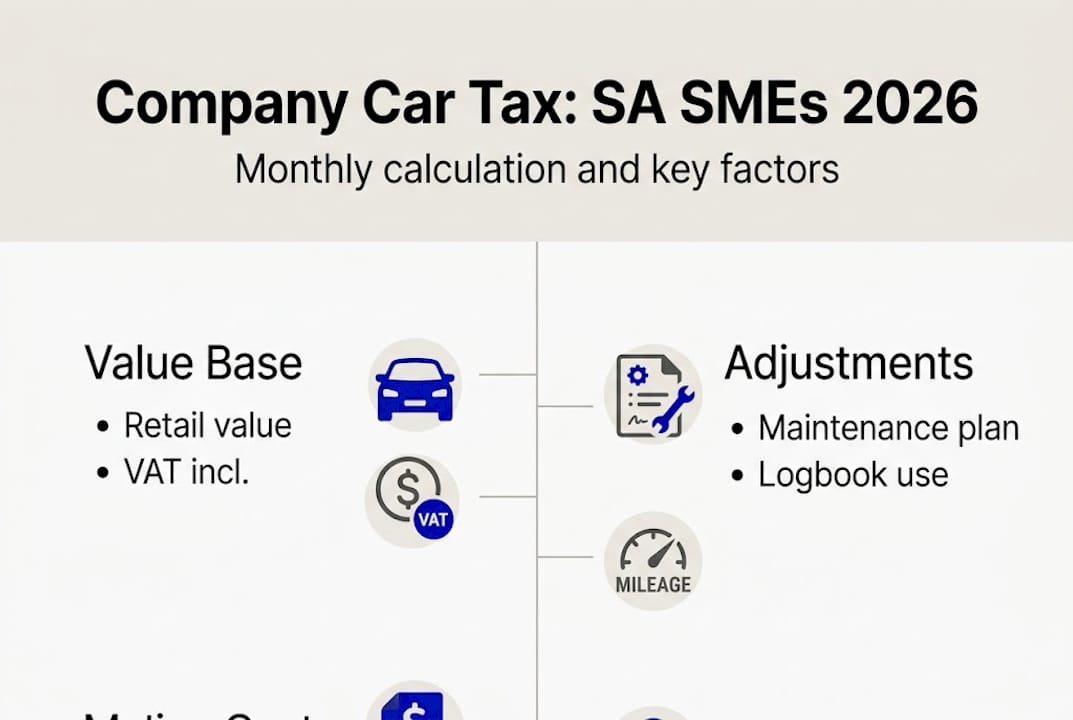
Here is a quick example to make this concrete:
| Vehicle retail value (incl. VAT) | Monthly rate | Monthly taxable benefit |
|---|---|---|
| R400,000 (no maintenance plan) | 3.5% | R14,000 |
| R400,000 (with maintenance plan) | 3.25% | R13,000 |
| R600,000 (no maintenance plan) | 3.5% | R21,000 |
This monthly taxable benefit gets added to the employee’s or director’s gross income and is subject to PAYE (Pay-As-You-Earn). As the employer, you must withhold and pay this to SARS each month. Failing to do so creates a liability that sits on your business, not the employee.
Key points to keep in mind:
- The determined value is fixed at the date the vehicle is first made available
- VAT is always included in the determined value calculation
- The fringe benefit applies even if the vehicle is only partly used for private purposes
- Employers must also account for the Skills Development Levy on the increased remuneration
Pro Tip: If you are buying a company vehicle, choosing one that comes with a manufacturer maintenance plan can reduce your monthly fringe benefit by 0.25%. On a R500,000 vehicle, that is R1,250 saved in taxable benefit every single month.
For more answers to common SME tax questions or a broader overview, our tax guide for South African SMEs covers the full landscape.
Impact of private vs. business use: logbook rules and deductions
Knowing the calculation is only half the story. How the vehicle is actually used determines whether you can reduce that taxable fringe benefit.
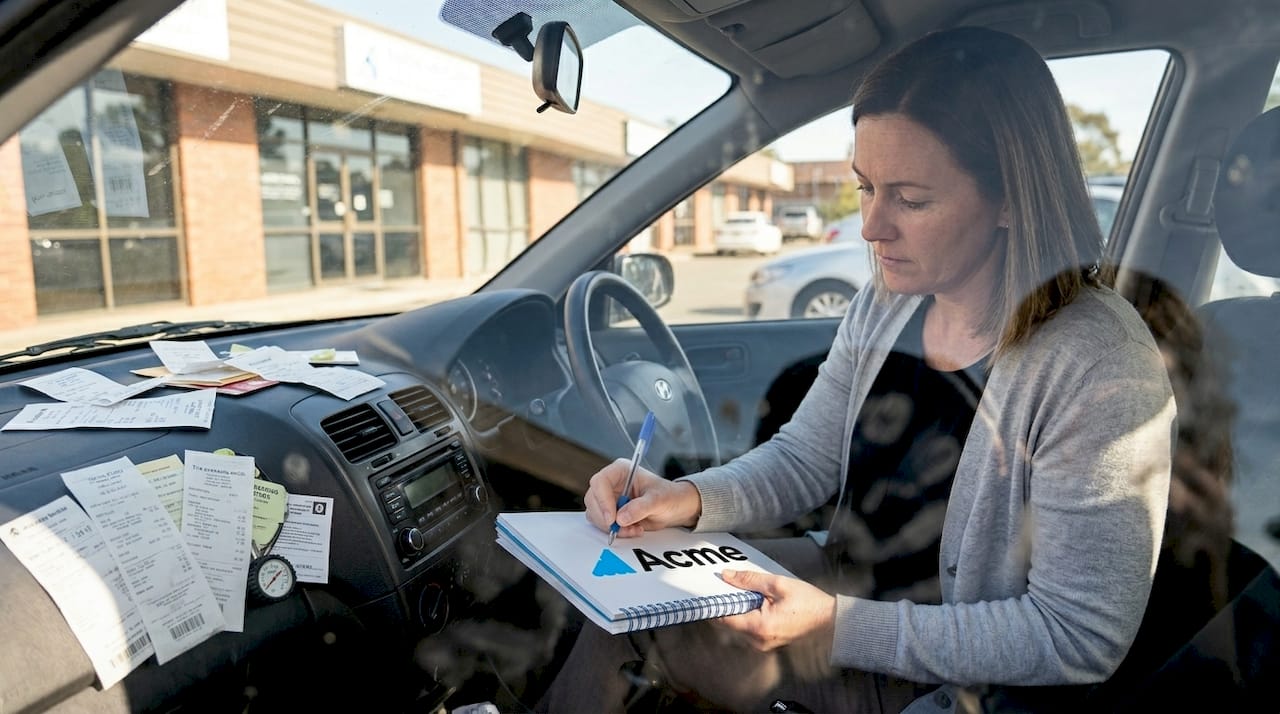
SARS allows a reduction in the taxable benefit if the employee or director can prove that a portion of the travel was for business purposes. The tool for proving this is a logbook, and it is not optional. Logbooks are mandatory for substantiating business versus private use. Without one, SARS treats every kilometre as private travel, and you lose any chance of a reduction.
Here is what a compliant logbook must record for every trip:
- Date of travel
- Opening odometer reading
- Closing odometer reading
- Destination and purpose of the trip
- Name of the client or business contact visited (where applicable)
One critical point that trips up many business owners: home-to-office travel is classified as private use, even if you are heading to an important client meeting from home. This is a firm SARS rule with no exceptions.
| Travel type | SARS classification | Reduces fringe benefit? |
|---|---|---|
| Client visits during work hours | Business use | Yes |
| Home to office (morning commute) | Private use | No |
| Office to client and back | Business use | Yes |
| Weekend personal errands | Private use | No |
Incomplete or missing logbooks are one of the most common triggers for SARS audits among SMEs. If your records cannot hold up under scrutiny, the entire fringe benefit becomes taxable with no reduction, and penalties may apply on top.
A well-maintained logbook can meaningfully reduce your taxable exposure. If 60% of travel is for business, only 40% of the monthly fringe benefit is taxable. On a R14,000 monthly benefit, that is R5,600 instead of R14,000 added to gross income. The savings compound quickly over a tax year.
Our tax compliance guide walks through practical steps for keeping your business documentation audit-ready.
Special risks for SMEs and close corporations: the compliance trap
Beyond the standard fringe benefit rules, there are specific risks that apply to close corporations (CCs) and owner-managed SMEs that most business owners are completely unaware of.
When a CC member or director uses a company vehicle for private purposes without drawing a salary, the tax situation becomes significantly more complex. Additional risks include non-deductibility of vehicle expenses under Section 11(a), PAYE obligations on the fringe benefit value, a Skills Development Levy of 1%, and potential deemed distributions under Section 64C, which can trigger dividends tax.
This creates a double-taxation scenario that is entirely avoidable with the right structure.
“Many CC owners believe that because they own the business, using the company car is a neutral transaction. In reality, SARS sees it as a taxable event at multiple levels simultaneously.”
Here are the most common compliance traps for SMEs and CCs:
- No salary drawn: If a director uses a company car but draws no salary, SARS still imposes PAYE on the fringe benefit value, creating a liability with no income to offset it
- Expenses disallowed: Vehicle running costs may be disallowed as deductions if private use is not properly separated
- Deemed distributions: Under Section 64C, private use of company assets can be treated as a distribution, attracting dividends tax at 20%
- SDL exposure: The Skills Development Levy applies to the grossed-up remuneration, adding another layer of cost
Pro Tip: If you are a CC member or director, consider structuring the vehicle arrangement as a formal lease from the CC to yourself, or ensure you draw a salary against which the fringe benefit can be offset. Both approaches reduce your overall tax exposure significantly.
Understanding which expenses are deductible business expenses and how to structure your affairs for reducing SME tax liability is essential. If deemed distributions are a concern, our guide on dividends tax for SMEs explains the mechanics clearly.
Strategies and real-world scenarios: smarter company car decisions
With the groundwork in place, let us explore how to put these rules into practice and avoid the most costly mistakes.
The first question to ask is whether a company car is the right structure for your business at all. For some SMEs, a travel allowance paid to an employee who owns their own vehicle is simpler and carries fewer compliance obligations. For others, a company-owned vehicle is essential for operations.
Here are three common mistakes and how to fix them:
- Not keeping a logbook from day one. Many owners start logging only after an issue arises. SARS requires records from the moment the vehicle is made available. Start immediately and use a digital logbook app to make it effortless.
- Ignoring the salary structure. Pure private use without salary creates fringe benefit obligations with no income to absorb them. Structure a salary, even a modest one, to create a legal offset.
- Using the wrong determined value. Some owners use the current market value of an older vehicle instead of the original retail price. SARS uses the original determined value, which means older vehicles can still carry a high taxable benefit.
Scenario comparison: A salary-earning employee with a R400,000 company car and a 60% business use logbook pays PAYE on R5,600 per month in fringe benefit. A director with the same car, no salary, and no logbook pays PAYE on R14,000 per month with no offset and risks additional Section 64C exposure. The difference in annual tax cost can exceed R100,000.
For year-end tax planning, reviewing your vehicle arrangements before the tax year closes can unlock significant savings.
Pro Tip: Have a tax professional review your company car policy annually. Tax rules shift, and what was optimal two years ago may now be costing you money.
Why most SMEs underestimate company car tax risks
Here is an uncomfortable truth: most SME owners treat company car tax as an afterthought because the cost is invisible until it is not. There is no invoice, no monthly reminder. The liability builds quietly in the background until SARS comes looking.
The businesses we see managing this well share one trait: they treat vehicle policy as a financial decision, not an HR one. They review the numbers before buying, structure ownership deliberately, and maintain logbooks as a non-negotiable habit.
Conventional wisdom says “get a company car for the tax benefit.” The reality is more nuanced. A company car can be tax-efficient, but only when structured correctly. Without that structure, it is often more expensive than paying a travel allowance or simply increasing a salary.
SMEs that stay on top of their deductible business expenses and approach vehicle decisions with the same rigour as any other capital expenditure consistently avoid the penalties and stress that catch others off guard. Proactive advice costs far less than reactive damage control.
Expert support for every tax and compliance decision
If you are ready to secure your compliance and financial future, consider these next steps. Navigating company car tax rules requires more than reading a guide. It requires applying the right structure to your specific business, entity type, and salary arrangement. At Ready Accounting, we help South African SMEs do exactly that. From reviewing your cloud accounting benefits to understanding the cost of accounting services and building a solid tax compliance guide for your business, our team provides practical, personalised support. Book a consultation today and let us help you turn a potential liability into a well-managed asset.
Frequently asked questions
How do I calculate the taxable benefit of a company car in South Africa?
Multiply the vehicle’s determined retail value (including VAT) by 3.5% monthly, or 3.25% if a qualifying maintenance plan was included at purchase. This monthly amount is added to the employee’s taxable income.
Are there tax risks if a director uses a company car only for personal reasons?
Yes, private use by a director without a salary may trigger non-deductibility of expenses, PAYE liability on the fringe benefit, and possible dividends tax under Section 64C deemed distribution rules.
Do I need to keep a logbook for a company vehicle?
Yes, maintaining a complete logbook is mandatory to claim any reduction for business use. Without one, SARS treats all travel as private and the full fringe benefit becomes taxable.
How can SMEs reduce company car tax liability?
Structure the arrangement through a formal salary, maintain accurate logbooks from day one, and work with a tax expert to ensure your vehicle policy is optimised for your specific business structure and tax exposure.
Recommended
- Top Tax Questions Small Business Owners Ask in 2025 – Ready Accounting
- Dividends tax in South Africa: essential guide for SMEs 2026 – Ready Accounting
- How to save tax in South Africa: smart strategies for SMEs in 2026 – Ready Accounting
- Tax efficient structures for South African SMBs in 2026 – Ready Accounting
- Small business tax tips for 2026: maximize deductions | Ibrandmedia