
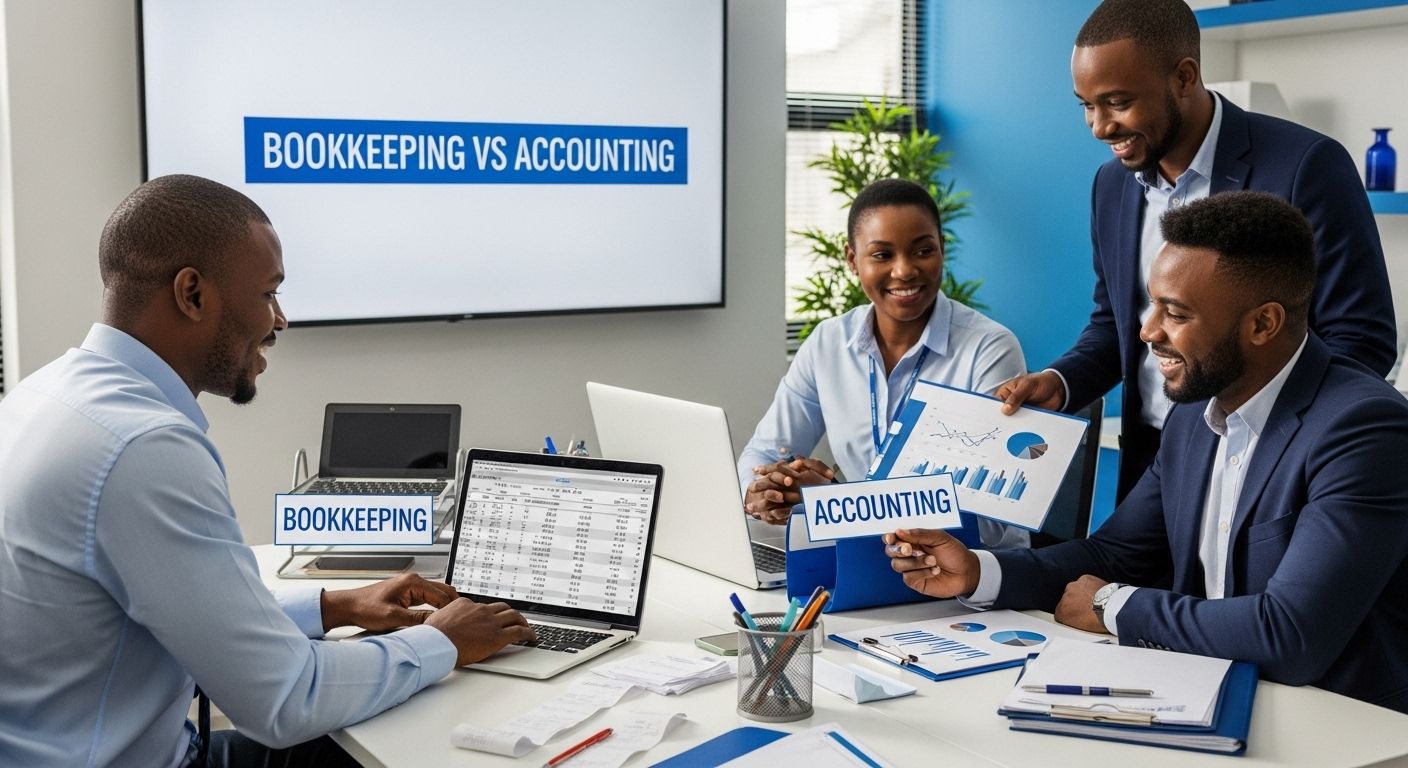
Difference Between Bookkeeping and Accounting Explained for SA Businesses 2025
Managing your company’s money can seem straightforward until you realise bookkeeping and accounting are not actually the same thing. In South Africa, nearly 60 percent of small businesses make costly compliance mistakes simply by confusing these roles. Everyone talks about staying on the right side of SARS, but what most owners miss is how good record keeping and smart analysis together can decide whether your business survives tough times or sinks into trouble. This difference is more than just numbers on a screen.
Table of Contents
- Bookkeeping Vs Accounting: Core Differences
- How These Roles Support South African SMEs
- Choosing The Right Solution For Payroll And Tax
- Simplifying CIPC, Company Registration, And Reporting
Quick Summary
| Takeaway | Explanation |
|---|---|
| Understand the distinction between bookkeeping and accounting. | Bookkeeping focuses on recording financial transactions, while accounting interprets this data for strategic decision-making. |
| Invest in both bookkeeping and accounting services. | Professional services help ensure compliance and provide valuable insights that support business growth. |
| Use technology to streamline financial processes. | Cloud-based tools and professional guidance can simplify payroll, tax, and reporting responsibilities for South African businesses. |
| Focus on financial compliance and transparency. | Accurate record-keeping is essential for meeting regulatory obligations and maintaining financial health. |
| Leverage strategic financial management for decision-making. | Analyzing financial data enables informed decisions about investments, cash flow, and growth opportunities. |
Bookkeeping vs Accounting: Core Differences
Understanding the difference between bookkeeping and accounting is crucial for South African businesses seeking robust financial management strategies. While these terms are often used interchangeably, they represent distinct yet interconnected financial functions that play critical roles in maintaining a company’s financial health.
Recording vs Interpreting Financial Data
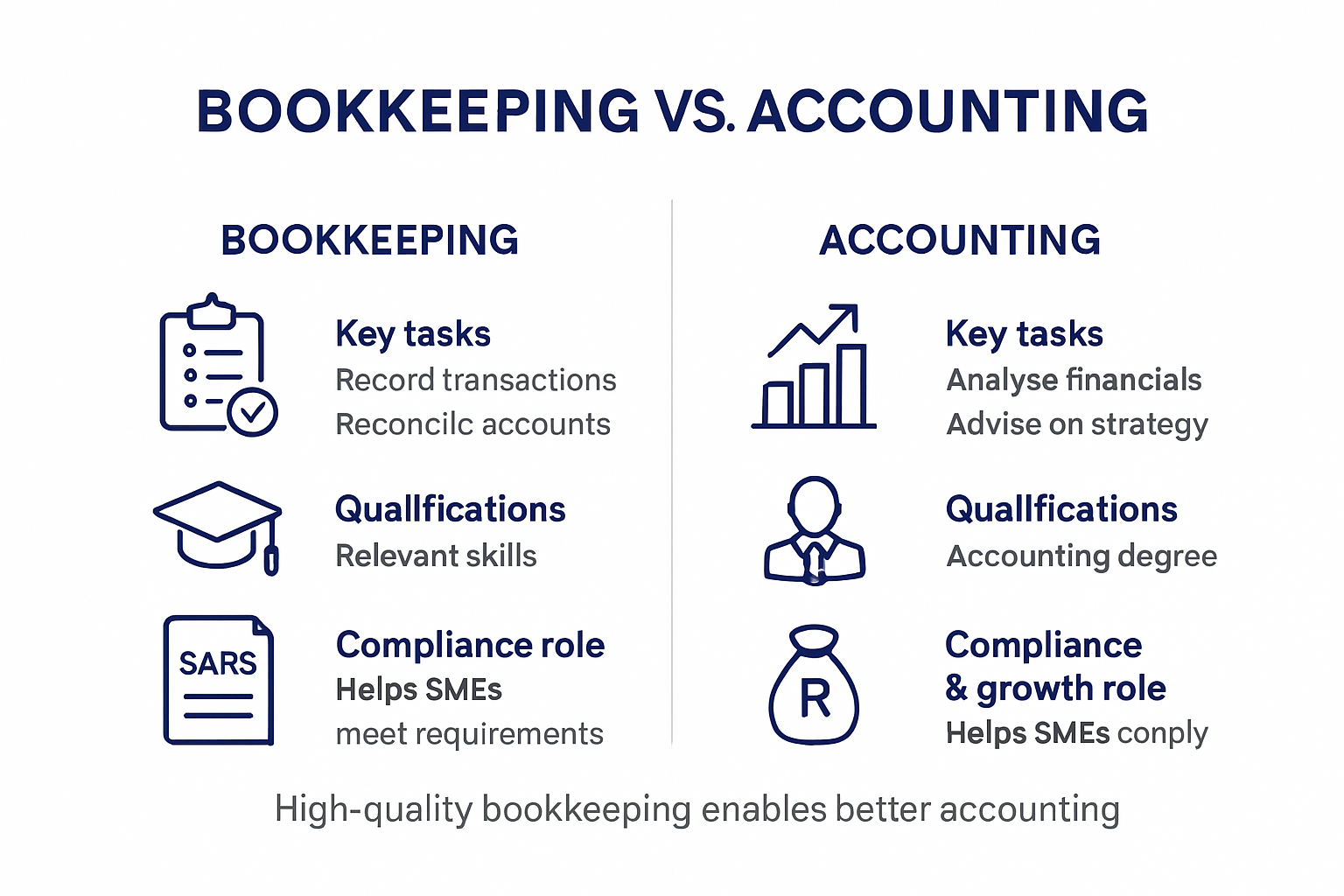
Bookkeeping is fundamentally about the meticulous recording of daily financial transactions. According to NetSuite, bookkeepers focus on tracking income and expenses, managing ledgers, handling accounts receivable and payable, and processing payroll. It is essentially the systematic documentation of financial activities that form the foundation of a company’s financial records.
In contrast, accounting transforms these recorded transactions into meaningful financial insights. EDx Education explains that accountants take a broader strategic view, analyzing financial data, preparing comprehensive financial statements, managing tax obligations, and providing strategic financial advice. They interpret the raw data generated by bookkeepers to help business owners make informed financial decisions.
Technical Skills and Professional Requirements
The professional qualifications and technical skills required for bookkeeping and accounting differ significantly. Bookkeepers typically need strong organizational skills, attention to detail, and proficiency in accounting software. They often hold diplomas or certificates in bookkeeping and are responsible for maintaining accurate financial records.
Accountants, however, usually possess more advanced qualifications. In South Africa, this often means being a registered member of professional bodies like SAICA (South African Institute of Chartered Accountants) or SAIPA (South African Institute of Professional Accountants). They require deeper financial knowledge, including understanding complex tax regulations, financial reporting standards, and strategic financial planning.
For small to medium businesses in South Africa, understanding these distinctions is essential. While bookkeeping provides the foundational financial data, learn more about avoiding common bookkeeping pitfalls to ensure accurate record-keeping. Accounting then elevates this data into strategic insights that drive business growth and ensure regulatory compliance with SARS and other financial authorities.
Ultimately, both bookkeeping and accounting are interdependent. High-quality bookkeeping enables precise accounting, which in turn helps businesses make strategic financial decisions, manage tax obligations, and maintain financial transparency. For South African entrepreneurs, investing in both professional bookkeeping and accounting services is not just a compliance requirement but a strategic business advantage.
To better understand the main differences between bookkeeping and accounting for South African businesses, see the comparison table below:
| Aspect | Bookkeeping | Accounting |
|---|---|---|
| Primary Focus | Recording daily financial transactions | Interpreting, analysing and reporting financial data |
| Key Tasks | Managing ledgers, processing payroll, accounts payable/receivable | Preparing financial statements, managing taxes, strategic advice |
| Skills Required | Attention to detail, organisational skills, software proficiency | Advanced financial knowledge, strategic planning, compliance expertise |
| Qualifications | Certificate or diploma in bookkeeping | Degree & membership in SAICA/SAIPA or equivalent |
| Compliance Responsibilities | Accurate record-keeping for audits & tax | Ensuring regulatory compliance, tax management |
How These Roles Support South African SMEs
In the dynamic landscape of South African small and medium enterprises (SMEs), bookkeeping and accounting play pivotal roles in driving business success and financial sustainability. These financial functions are not merely administrative tasks but strategic tools that can significantly impact a company’s growth trajectory and compliance landscape.
Ensuring Regulatory Compliance and Financial Transparency
For South African SMEs, navigating the complex regulatory environment is crucial. According to SME South Africa, bookkeeping and accounting are essential in maintaining financial transparency and meeting legal requirements. Bookkeepers meticulously record financial transactions, creating a clear audit trail that helps businesses stay compliant with SARS regulations and other statutory obligations.
The South African Qualifications Authority emphasizes that proper financial record-keeping is not just about tracking expenses but also about providing a comprehensive view of a business’s financial health. This documentation becomes critical during tax assessments, potential audits, and when seeking financial investments or loans.
Strategic Financial Management and Decision Making
Beyond compliance, these financial roles are instrumental in strategic business planning. A study published in the Southern African Journal of Entrepreneurship and Small Business Management reveals that SMEs perceive significant management benefits from routine accounting services. Discover more about the strategic role of accountants in business to understand how these professionals transform raw financial data into actionable insights.
Accountants go beyond number-crunching by analyzing financial trends, identifying potential cost-saving opportunities, and providing forward-looking financial forecasts. They help SME owners understand their cash flow, profitability, and potential financial risks. This strategic insight is crucial for making informed decisions about expansion, investment, and resource allocation.
Supporting Business Growth and Financial Health
For many South African SMEs, professional bookkeeping and accounting services are not just optional extras but essential business tools. These services help businesses maintain accurate financial records, manage cash flow effectively, and prepare comprehensive financial statements that are crucial for attracting investors or securing business loans.
Moreover, by outsourcing these critical financial functions, SME owners can focus on their core business activities. Professional bookkeepers and accountants bring expertise in managing financial complexities, reducing the risk of errors, and ensuring that businesses remain financially robust and compliant.
In the competitive South African business environment, investing in quality bookkeeping and accounting services is more than a compliance requirement—it’s a strategic decision that can determine a business’s long-term success and sustainability. By understanding and leveraging these financial roles, SMEs can build a strong financial foundation that supports growth, mitigates risks, and drives strategic decision-making.
Choosing the Right Solution for Payroll and Tax
Navigating payroll and tax management is a critical challenge for South African businesses, requiring strategic decision making and precise financial expertise. Selecting the right solution can significantly impact a company’s financial efficiency, compliance, and overall operational success.
Understanding Accounting Methods and Tax Implications
The foundation of effective payroll and tax management lies in understanding different accounting methods. Tax Foundation highlights that tax rules often differ from formal accounting practices, creating unique challenges for businesses. For instance, while financial statements might use accrual-based accounting, tax returns may require cash-based accounting, leading to potential discrepancies between reported profits and taxable income.
According to IRS Publication 538, businesses must carefully choose between cash and accrual accounting methods. The cash method reports income when received and expenses when paid, while the accrual method recognizes income when earned and expenses when incurred. This distinction is crucial for South African businesses in accurately representing their financial position and meeting SARS reporting requirements.
Below is a table summarising the key differences between cash and accrual accounting methods relevant to South African businesses:
| Feature | Cash Accounting | Accrual Accounting |
|---|---|---|
| Income Recorded | When cash is received | When income is earned |
| Expenses Recorded | When cash is paid | When expenses are incurred |
| Reporting Simplicity | Simpler to implement | More complex, but accurate |
| Tax Reporting | Used by some SMEs, may differ from financials | Aligns with full financial reporting |
| Compliance | May not always meet all SARS requirements | Preferred for regulatory compliance |
Streamlining Payroll and Tax Compliance
Effective payroll management goes beyond simple wage calculations. Learn how to optimize your payroll processes to ensure accuracy and compliance. South African businesses must navigate complex tax regulations, including mandatory contributions to UIF, PAYE, and other statutory requirements.
Professional accounting services can provide crucial support in managing these intricate financial responsibilities. Payroll tax considerations require meticulous attention to detail, with potential penalties for non-compliance. Small to medium enterprises particularly benefit from outsourced solutions that can handle the nuanced aspects of tax reporting and payroll management.
Technology and Professional Support
Modern businesses have multiple options for managing payroll and tax responsibilities. Cloud-based accounting solutions offer real-time tracking, automated calculations, and seamless reporting capabilities. However, technology alone is not enough. Professional accountants bring critical expertise in interpreting complex tax regulations, identifying potential savings, and ensuring full compliance with SARS requirements.
The ideal approach combines technological tools with professional oversight. This hybrid model allows businesses to leverage advanced software while benefiting from expert interpretation and strategic financial guidance. For South African enterprises, this means reduced administrative burden, minimized risk of errors, and enhanced financial visibility.
Choosing the right payroll and tax solution is more than a administrative task—it’s a strategic decision that can significantly impact a business’s financial health. By carefully evaluating accounting methods, embracing technological solutions, and seeking professional guidance, South African businesses can create a robust financial management approach that supports sustainable growth and ensures regulatory compliance.
Simplifying CIPC, Company Registration, and Reporting
For South African businesses, navigating the complexities of company registration, CIPC requirements, and financial reporting can be a challenging journey. Understanding the intricate processes and leveraging professional accounting support can transform these administrative tasks from overwhelming obligations into strategic opportunities for business growth.
Streamlining Company Registration Process
The Companies and Intellectual Property Commission (CIPC) plays a crucial role in South African business formation. Explore our comprehensive guide to CIPC company registration to understand the nuanced steps involved in establishing a legal business entity. Entrepreneurs must carefully prepare documentation, select appropriate business structures, and ensure compliance with regulatory requirements.
Registering a company involves multiple critical steps, including choosing a unique company name, preparing necessary founding documents, and understanding the different types of business entities available. Professional accounting services can significantly simplify this process by providing expert guidance on selecting the most appropriate business structure, whether it be a private company, public company, or non-profit organization.
Financial Reporting and Compliance Requirements

Accurate financial reporting is more than a legal obligation—it’s a strategic tool for business management. According to Intuit, the transition from basic record-keeping to comprehensive financial analysis is crucial for business success. South African businesses must prepare annual financial statements that comply with both CIPC regulations and SARS requirements.
The reporting process involves several key components: maintaining accurate financial records, preparing comprehensive financial statements, and ensuring timely submission to regulatory authorities. Microsoft 365 emphasizes the importance of transforming raw financial data into meaningful insights that can drive business decision-making.
Leveraging Technology and Professional Support
Modern businesses can significantly simplify their CIPC and reporting obligations by embracing technological solutions and professional accounting support. Cloud-based accounting platforms offer streamlined approaches to document management, financial tracking, and regulatory compliance. These tools can automate many of the tedious aspects of financial reporting, reducing the risk of human error and ensuring more accurate submissions.
Professional accounting services provide an additional layer of expertise, helping businesses navigate the complex landscape of regulatory requirements. From initial company registration to annual financial reporting, these professionals can offer strategic guidance that goes beyond mere compliance. They can help businesses understand the implications of their financial decisions and develop more robust financial strategies.
The journey of company registration and financial reporting need not be a daunting process. By understanding the requirements, leveraging technological solutions, and seeking professional guidance, South African businesses can transform these administrative tasks into opportunities for growth and strategic planning. The key lies in viewing these processes not as bureaucratic obstacles, but as essential components of building a strong, compliant, and successful business.
Frequently Asked Questions
What is the primary difference between bookkeeping and accounting?
Bookkeeping mainly involves the accurate recording of daily financial transactions, while accounting focuses on interpreting, analyzing, and reporting financial data to support strategic decision-making.
What qualifications do bookkeepers and accountants need in South Africa?
Bookkeepers typically require a certificate or diploma in bookkeeping, while accountants usually need a degree and membership in professional bodies like SAICA or SAIPA, reflecting their advanced financial expertise.
How do bookkeeping and accounting contribute to compliance for businesses in South Africa?
Both functions are essential for regulatory compliance. Bookkeeping ensures accurate financial records, creating an audit trail, while accounting interprets this data to ensure compliance with tax and reporting obligations.
Why is it important for small businesses to invest in both bookkeeping and accounting services?
Investing in both services ensures accurate record-keeping and strategic financial analysis, which are critical for regulatory compliance, business growth, and informed decision-making.
Ready to End Bookkeeping and Accounting Confusion? Choose Clarity, Choose Results
Navigating the differences between bookkeeping and accounting is not just a technical challenge—it is a real risk for your business growth and compliance in South Africa. If you are feeling buried under daily records, unsure about SARS regulations, or worried your financial data is not working for your goals, you are not alone. Many business owners lose valuable time and money by missing the clear line between accurate record-keeping and meaningful financial strategy. Our team at Ready Accounting understands these pain points because we specialise in solving them for businesses just like yours.
This is the moment to upgrade from confusion to confidence. Whether you need expert bookkeeping cleanup and support for solid foundations or full-spectrum financial consulting for strategic growth, our solutions are designed for South African SMEs who want to focus on scaling up, not stressing about compliance. Do not wait until small mistakes become big headaches. Visit Ready Accounting today and book your tailored consultation. Let us help you turn complex financial tasks into real business advantages—starting now.
Recommended
- What Is Outsourced Accounting? Simplified Guide for 2025 – Ready Accounting
- Understanding the Cost of Accounting Services in 2025 – Ready Accounting
- Types of Accounting Services for SMEs in 2025: Your Guide – Ready Accounting
- Role of Accountants in Business: Essential Support for SA Companies 2025 – Ready Accounting