

Build a financial due diligence checklist for smarter deals
Executive Summary
- Financial due diligence is essential for South African SMBs in all business transactions to uncover hidden risks.
- Key steps include verifying income statements, balance sheets, cash flows, tax compliance, and assets before signing.
- Using checklists and expert support helps identify red flags like undisclosed debts, tax issues, or inconsistent financial records.
Many South African SMB owners assume financial due diligence is reserved for large corporate mergers. It is not. Whether you are buying a competitor, taking on a partner, or selling your business, skipping a thorough financial review can cost you far more than the deal is worth. Hidden liabilities, SARS arrears, and inflated asset values have derailed countless small business transactions in South Africa. This article gives you a practical, actionable checklist to review financial data with confidence, spot warning signs early, and protect your interests before you sign anything.
Table of Contents
- What is financial due diligence and why does it matter?
- Core components of a financial due diligence checklist
- How to review financial statements and uncover red flags
- Beyond the numbers: Assessing financial controls and compliance
- Our take: Why checklists are only the beginning
- Ready to simplify your due diligence?
- Frequently asked questions
Key Takeaways
| Point | Details |
|---|---|
| Due diligence is essential | A structured approach avoids financial surprises during mergers and acquisitions. |
| Checklists boost clarity | A tailored financial checklist helps SMBs in South Africa review deals thoroughly. |
| Red flags require action | Spotting warning signs in statements and controls is as important as ticking items on a list. |
| Compliance is critical | Failing to review for SARS and local controls can lead to costly penalties. |
What is financial due diligence and why does it matter?
Financial due diligence is the process of verifying and analyzing a business’s financial information before completing a transaction. Think of it as a full health check on the numbers. You are not just reading reports. You are questioning them, cross-referencing them, and stress-testing the assumptions behind them.
For South African SMBs, this process is especially important because smaller businesses often have less formal financial structures. Records may be incomplete, accounting software may not be up to date, and tax submissions may have gaps. The essential steps in financial due diligence cover everything from income verification to liability exposure, and skipping any of them creates blind spots.
“The goal of due diligence is not to find reasons to walk away. It is to make sure you know exactly what you are walking into.”
Here is what is genuinely at stake when you skip this process:
- Undisclosed debt: Sellers are not always forthcoming about outstanding loans or creditor disputes.
- Tax liabilities: SARS penalties and interest can transfer to a new owner depending on the deal structure.
- Inflated revenue: Revenue figures may include once-off transactions that will not repeat.
- Contingent liabilities: Pending lawsuits or warranty claims may not appear on the balance sheet.
- Compliance gaps: Failure to meet CIPC or SARS obligations can delay or void a transaction.
Understanding the basics of financial statements is a prerequisite for doing this well. Without that foundation, you risk misreading what the numbers actually say.
Pro Tip: Even if you trust the seller, always verify independently. Errors and omissions in financial records are often unintentional, but they are your problem once the deal closes.
The due diligence best practices from SAICA reinforce that thorough financial reviews are not optional for responsible business transactions, regardless of deal size. Decisions about price negotiation, deal structure, warranties, and post-acquisition planning all depend on what you find during this process.
Core components of a financial due diligence checklist
A practical checklist keeps you focused and ensures nothing critical slips through. Here are the core items every South African SMB should work through before finalizing any deal:
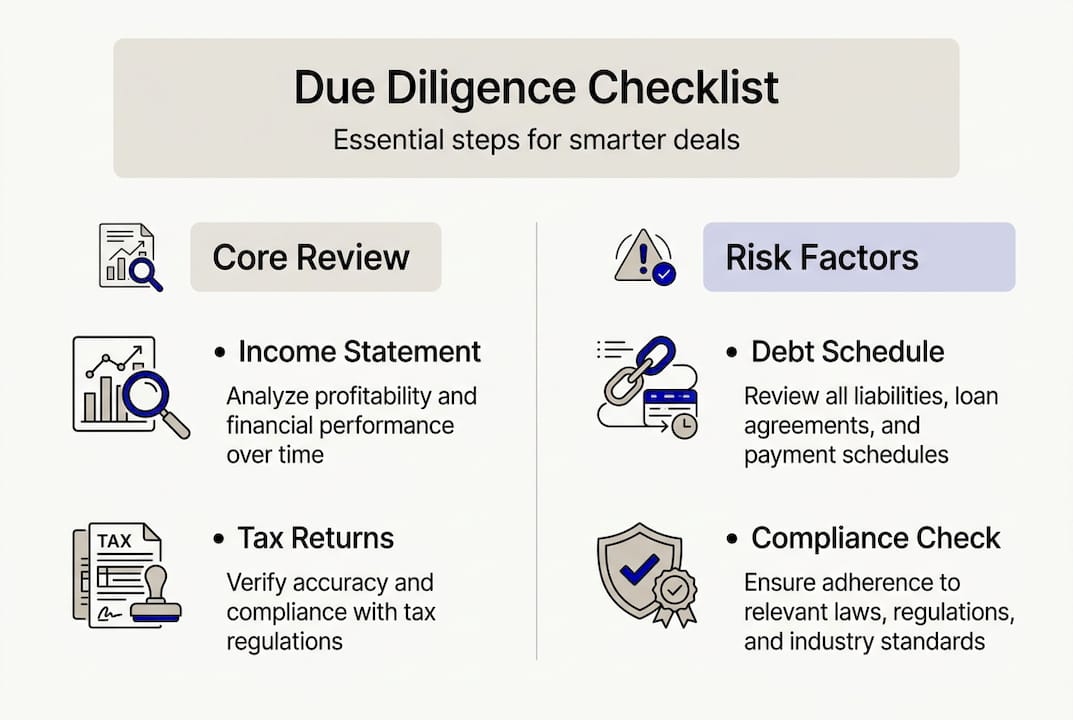
- Income statement review: Verify revenue trends over at least three years. Look for consistency and question any unusual spikes.
- Balance sheet analysis: Check assets, liabilities, and equity. Confirm that assets are real and liabilities are fully disclosed.
- Cash flow statement: Assess whether the business generates actual cash or just accounting profit.
- Tax compliance check: Request SARS tax clearance certificates and confirm all VAT, PAYE, and income tax submissions are current.
- Debt schedule review: List all loans, overdrafts, and finance agreements. Confirm repayment terms and outstanding balances.
- Asset verification: Physically verify key assets. Cross-check the asset register with depreciation schedules.
- Contingent liabilities: Ask directly about pending litigation, guarantees, or disputed claims not shown on the balance sheet.
- Management accounts: Review recent monthly or quarterly management accounts to understand current trading performance.
The example financial statements for South African SMEs show what properly structured documents should look like, which makes it easier to spot when something is missing or unusual.
| Checklist item | Purpose in SA context |
|---|---|
| Income statement review | Confirms sustainable revenue, not inflated figures |
| SARS tax clearance | Verifies no outstanding SARS debt transfers to buyer |
| Debt schedule | Exposes hidden financing obligations |
| Asset register check | Validates what is actually owned vs. what is claimed |
| Contingent liabilities | Surfaces off-balance-sheet risks like legal claims |
| Cash flow statement | Distinguishes profit from actual cash generation |
Pro Tip: Bring in a chartered accountant for at least the tax compliance and debt schedule steps. These areas carry the highest risk for SMBs and require specialist interpretation. Knowing how to read financial statements correctly also speeds up the entire review process significantly.
How to review financial statements and uncover red flags
Having a checklist is one thing. Knowing what to look for inside the documents is another. Financial statements can hide problems in plain sight if you do not know where to focus.

Start with the income statement. Look at gross profit margins year on year. A sudden improvement without an obvious reason, like a new product or price increase, deserves scrutiny. Then move to the balance sheet and check whether receivables have grown faster than revenue. That pattern often signals collection problems or fictitious sales. The guidance on analyzing financial statements provides a structured approach for South African businesses specifically.
| Red flag | What it might mean |
|---|---|
| Receivables growing faster than revenue | Possible fictitious sales or poor collections |
| Sudden drop in creditors | Cash flow pressure or supplier disputes |
| Unexplained asset write-offs | Possible fraud or asset deterioration |
| Inconsistent tax submissions | SARS risk and potential penalties |
| Revenue spikes in final months | Window dressing before sale |
Here are the top financial warning signs to watch for during any review:
- Missing or incomplete financial statements for any period
- Significant related-party transactions not disclosed upfront
- Loans to directors or shareholders with no repayment terms
- Cash sales that cannot be reconciled to bank statements
- Sudden changes in accounting policies between periods
Understanding financial statements at a deeper level helps you ask the right questions when something looks off. The integrated reporting standards from SAICA also offer useful benchmarks for what good financial disclosure looks like.
Pro Tip: Request bank statements directly and reconcile them against the income statement. This one step catches more problems than any other single check in the review process.
Beyond the numbers: Assessing financial controls and compliance
Financial statements only tell part of the story. The systems and controls behind those numbers matter just as much. Weak internal controls mean the numbers themselves may not be reliable, even if they look clean on the surface.
Internal controls are the policies, procedures, and checks a business uses to protect its assets and ensure accurate reporting. When these are absent or poorly designed, errors and fraud become far more likely. The importance of financial controls is often underestimated by SMB owners until something goes wrong.
Here is what to assess beyond the financial statements:
- Separation of duties: Is the same person approving payments and reconciling bank accounts? That is a serious control gap.
- Audit trails: Can every significant transaction be traced back to source documents?
- SARS compliance: Are all tax registrations current? Are there any outstanding audits or disputes?
- Payroll records: Are employee records and payslips consistent with PAYE submissions?
- Informal payment systems: Are there cash transactions or side arrangements not captured in the accounting system?
- FAIS obligations: If the business provides financial advice or services, check FAIS compliance status.
“Non-compliance with SARS obligations is one of the most common and costly surprises buyers encounter in South African SMB transactions. It is also one of the most preventable.”
A solid monthly bookkeeping checklist is a good indicator of how disciplined the business has been with record-keeping. If the seller cannot produce clean monthly records, that tells you something important about the quality of their financial management overall.
Our take: Why checklists are only the beginning
We have seen many SMB owners walk into deals armed with a checklist and still come out on the wrong side. The checklist tells you what to look for. It does not tell you what to do when the answers do not add up.
The real skill in financial due diligence is knowing when to push back, when to ask for more, and when to walk away. That requires judgment, not just a list. South African SMB transactions often involve sellers who are emotionally attached to their business and may unconsciously minimize problems. A checklist cannot navigate that dynamic.
Common failures we see are not from missing checklist items. They come from accepting vague answers, skipping verification steps under time pressure, or assuming goodwill covers financial gaps. Knowing when to hire an accountant is itself a critical decision in this process.
Pro Tip: If a seller resists providing documents or gives inconsistent explanations, treat that as a red flag in itself. Transparency is a reasonable expectation in any legitimate transaction.
Ready to simplify your due diligence?

Financial due diligence does not have to be overwhelming. At Ready Accounting, we help South African SMBs work through every step of the process with clarity and confidence. From reviewing financial statements to assessing SARS compliance and internal controls, our team provides the expert support you need to make informed decisions. We also help businesses leverage cloud accounting benefits to maintain cleaner records that make future due diligence far simpler. Explore our cloud accounting guide or learn what cloud accounting can do for your business. Book a consultation with us today and take the guesswork out of your next deal.
Frequently asked questions
What documents should be included in a financial due diligence checklist?
Include recent financial statements, tax returns, asset registers, debt schedules, and proof of SARS compliance. Reviewing example financial statements for South African SMEs helps you understand what complete documentation looks like.
How long does a typical financial due diligence process take for an SMB?
It usually takes two to four weeks, but complex deals may need more time for thorough reviews. The essential steps in due diligence outline what drives the timeline for each stage.
Can I do financial due diligence without an accountant?
You can start the process, but getting an accountant or auditor involved ensures accuracy and reduces risk. Understanding when to hire an accountant helps you decide at which point professional support becomes essential.
What are the most common red flags in financial due diligence?
Missing documents, unexplained liabilities, inconsistent cash flows, and overdue SARS liabilities are major warning signs. Guidance on analyzing financial statements explains how to identify and interpret these signals.
Are there checklists specific to South African compliance requirements?
Yes, reputable accounting resources provide checklists tailored to South African laws and tax rules for SMBs. The importance of financial controls includes guidance on compliance-specific checks relevant to local regulations.
Recommended
- What is financial due diligence: a guide for SMB owners – Ready Accounting
- Understanding Financial Health Indicators for Businesses – Ready Accounting
- How to Interpret Financial Ratios for Better Business Decisions – Ready Accounting
- Financial Statement Basics: A Guide for Business Owners – Ready Accounting
- Due Diligence Readiness Guide – Meticq – SaaS CFO