

Financial forecasting: a practical guide for SA SMEs
Executive Summary
- Financial forecasting helps SMEs manage cash flow, secure funding, and make growth decisions.
- Regularly updating forecasts enables proactive planning and avoidance of cash shortages.
- Choosing the right method, such as rolling forecasts, enhances accuracy and agility for volatile markets.
Financial forecasting is not a luxury reserved for large corporations with full accounting departments. It is one of the most powerful tools a small or medium business owner can use to stay ahead of cash flow problems, secure funding, and make confident growth decisions. Forecasting drives SME growth by enabling proactive cash management, funding readiness, and risk mitigation. If you have ever been caught off guard by a slow month, an unexpected tax bill, or a supplier payment that drained your account, this guide will show you exactly how to change that.
Table of Contents
- Understanding financial forecasting: definition and fundamentals
- The business case: why forecasting powers growth and survival
- Core forecasting methods: choosing the right approach for your SME
- Practical steps to build and use financial forecasts
- Why smart forecasting is the true competitive edge for South African SMEs
- Take your next step with smarter financial forecasting
- Frequently asked questions
Key Takeaways
| Point | Details |
|---|---|
| Forecasting prevents problems | Regular forecasting helps you avoid cash flow issues and plan for business growth. |
| Simple tools = big impact | You can improve your financial outlook with basic forecasting, even before investing in advanced software. |
| Cloud solutions offer advantages | Cloud-based tools streamline forecasting and empower better decision-making for small businesses. |
| Adopt a forecasting habit | Updating your forecast monthly keeps your strategy agile and your SME resilient. |
Understanding financial forecasting: definition and fundamentals
Financial forecasting is the process of estimating your business’s future financial performance based on historical data, current trends, and reasonable assumptions about what lies ahead. Think of it like GPS navigation for your business. You know where you are now, you know where you want to go, and the forecast calculates the most realistic route while flagging potential roadblocks before you hit them.
For South African SMEs, why forecasting matters for SA SMEs goes beyond theory. Load shedding cycles, rand volatility, seasonal consumer spending shifts, and unpredictable supply chain costs all create a business environment where surprises are expensive. A forecast gives you a structured way to anticipate and manage these variables.
There are three core types of financial forecasts every SME owner should understand:
- Cash flow forecast: Projects when money will come in and go out. This is the most critical forecast for day-to-day survival.
- Revenue forecast: Estimates future sales based on historical performance, market conditions, and sales pipeline data.
- Profit and loss (P&L) forecast: Projects income minus expenses over a period, showing whether your business will be profitable.
A common misconception is that forecasting requires a finance degree or expensive software. It does not. It requires three things: reliable historical data (even 6 to 12 months of records is enough to start), a clear set of assumptions about the future (like expected sales growth or upcoming expenses), and a consistent process for updating your projections.
“Forecasting enables proactive cash management and risk mitigation for small businesses, turning reactive fire-fighting into strategic leadership.”
Another misconception is that forecasting is only for businesses seeking funding from banks or investors. While a strong forecast absolutely makes you more attractive to lenders and funders, its real power lies in the clarity it gives you. It helps you decide when to hire, when to hold back on spending, and when market conditions are ripe for expansion. Forecasting is a decision-making engine, not just a compliance document.
The foundational components of any forecast are simple: gather your historical financial data, define your assumptions (growth rate, seasonal dips, planned expenses), and project those numbers forward, usually on a monthly basis for the next 12 months. Start simple. You can always refine the model as your business grows.
The business case: why forecasting powers growth and survival
Now that you understand what forecasting is, let us explore why it is a game-changer for your business.
The most immediate benefit is avoiding cash flow disasters. Many profitable businesses fail not because they are not making money, but because cash does not arrive when it is needed. Poor forecasting leads to cash crunches and failed expansions that could have been prevented with a simple 90-day cash projection. When you can see three months ahead, you can negotiate better payment terms with suppliers, chase debtors earlier, or arrange a short-term credit facility before the gap appears.
Consider a practical local example. A Cape Town-based catering company relied on corporate events for 70% of its revenue. Without a forecast, the owner had no early warning when corporate bookings slowed in the second quarter. By the time the cash shortage hit, the business could not cover payroll. A 12-month rolling forecast would have flagged the seasonal dip four months earlier, giving the owner time to target private events and online catering packages to fill the gap.
Here is what robust forecasting does for your business:
- Secures funding more easily: Lenders and investors want to see that you understand your numbers. A well-built forecast shows financial maturity and reduces perceived risk.
- Enables smarter hiring decisions: Knowing your projected revenue for the next six months tells you exactly when you can afford to bring on a new team member without straining your payroll.
- Guides marketing spend: Instead of guessing which months need a marketing push, your forecast shows you when revenue typically dips and when to invest.
- Prepares you for tax obligations: Regular forecasting keeps SARS payments from blindsiding you by ensuring you set aside the right amounts throughout the year.
For managing cash flow effectively, forecasting is the foundation. Without it, cash flow management is reactive. With it, you are making moves before problems develop. Your cash flow KPI guide is a powerful companion to your forecast, helping you measure whether your projections are tracking against reality.
Pro Tip: Do not treat forecasting as a January exercise. Build a habit of reviewing and updating your forecast at the end of every month. Thirty minutes of monthly review can save you from a six-figure crisis.
Core forecasting methods: choosing the right approach for your SME
With the “why” clear, let us move to “how.” The practical methods you can use for forecasting range from simple to sophisticated, and the best one for your business depends on your data, your goals, and your available time.
Different forecasting approaches serve specific business needs, so choosing methods based on your SME’s unique goals and resources is essential rather than copying what a larger competitor does.
Here is a comparison of the four main methods:
| Method | Best for | Simplicity | Reliability |
|---|---|---|---|
| Historical forecasting | Established businesses with 12+ months of data | High | High for stable markets |
| Qualitative forecasting | New businesses or new products with little data | Medium | Medium (depends on expertise) |
| Quantitative forecasting | Data-rich businesses wanting statistical accuracy | Low | High when data is clean |
| Rolling forecasts | Any SME wanting ongoing, adaptive planning | Medium | Very high for dynamic markets |
Historical forecasting uses past performance to project future results. If your revenue grew 15% year on year for the past three years, you project similar growth and adjust for known changes. It is the easiest starting point.
Qualitative forecasting relies on expert judgment, market research, and industry knowledge rather than raw numbers. It is especially useful when launching a new product or entering a new market where no historical data exists.
Quantitative forecasting uses statistical models and formulas to project future performance. This is more advanced but incredibly accurate when you have clean, consistent data. Tools like Xero, Sage, or QuickBooks can automate much of this.
Rolling forecasts replace the traditional annual budget model with a continuous 12-month outlook that updates every month. As one month closes, you add a new month to the end. This is the most agile method and the one we recommend most for South African SMEs operating in unpredictable conditions.
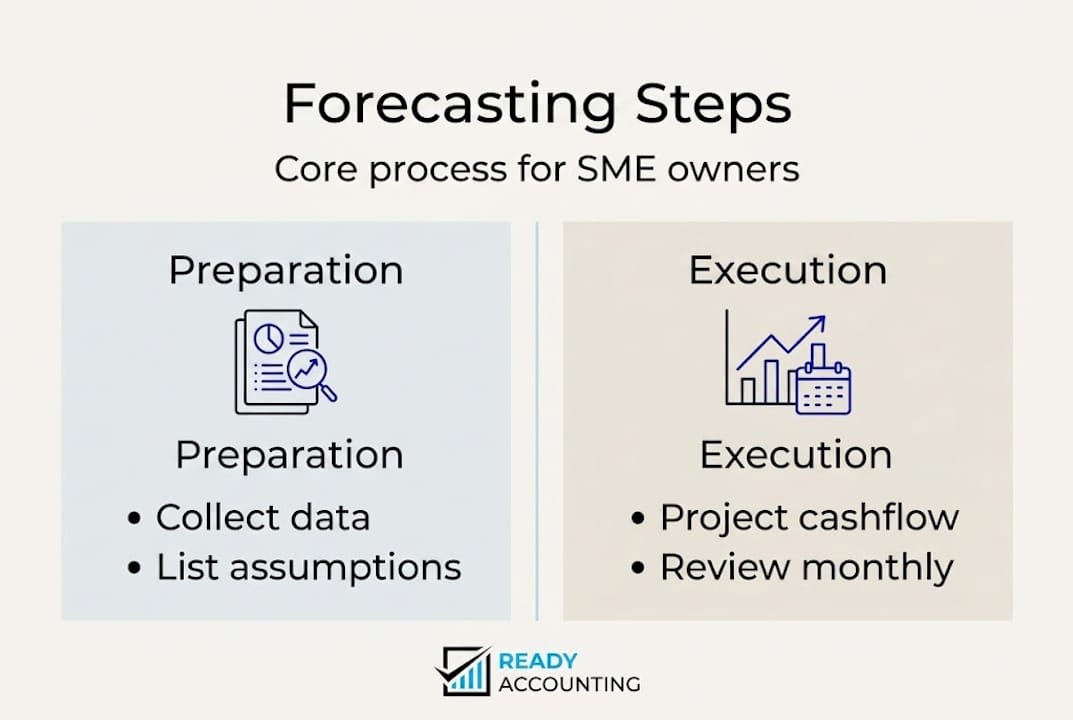
Here is how to start your first forecast in five steps:
- Gather your data. Pull 12 months of actual revenue, expenses, and cash flow from your accounting software or bank statements.
- Identify patterns. Look for seasonal peaks, slow months, and recurring expenses like rent, insurance, and staff costs.
- Set your assumptions. Decide on a realistic growth rate, factor in known upcoming costs, and account for any planned changes like new hires or a marketing campaign.
- Build your projections. Use a spreadsheet or cloud-based tool to project monthly figures for the next 12 months.
- Review and adjust monthly. Compare your actual results to your projections and update your assumptions accordingly.
For a detailed walkthrough, creating a cashflow forecast step by step is covered thoroughly in our resource library. Understanding budgeting for small businesses alongside forecasting will sharpen your overall financial planning, and brushing up on financial statement basics ensures your source data is solid before you project forward.
Practical steps to build and use financial forecasts
After choosing your method, here is how you actually build and make the most of your forecast.
Start with data gathering. Pull your income statements, bank statements, and expense records for the past 12 months. If you use cloud accounting software, this step takes minutes. If you are still on manual spreadsheets, this is the moment to consider upgrading. Cloud-based forecasting tools make planning and monitoring finances more dynamic and far less time-consuming for SMEs compared to manual processes.

Once your historical data is in place, set your assumptions clearly. Write them down. Assumptions like “revenue will grow 10% next quarter” or “diesel costs will increase by 8% due to fuel price hikes” make your forecast transparent and easy to challenge if circumstances change. Vague assumptions create unreliable forecasts.
Here is a simplified monthly revenue and expense projection table to illustrate the structure:
| Month | Projected revenue ® | Projected expenses ® | Net cash position ® |
|---|---|---|---|
| January | 85,000 | 62,000 | 23,000 |
| February | 78,000 | 61,000 | 17,000 |
| March | 92,000 | 65,000 | 27,000 |
| April | 70,000 | 61,500 | 8,500 |
| May | 74,000 | 62,000 | 12,000 |
| June | 68,000 | 61,000 | 7,000 |
This simple table immediately shows that April and June are tight months. Knowing this in January gives you five to six months to plan: boost sales activity, defer non-critical expenses, or arrange a short-term credit facility.
Once you have your baseline forecast, use it for scenario planning. Build three versions: a conservative scenario (things go slower than expected), a base scenario (things go as planned), and an optimistic scenario (things go better). This gives you a decision framework rather than a single rigid number.
Key actions to take with your forecast:
- Monitor variances monthly. If actual revenue is consistently 20% below projection, your assumptions need updating.
- Share it with your accountant or CFO. A second pair of eyes often catches assumptions that are too aggressive or too conservative.
- Use it before making big decisions. Before signing a new lease or hiring a senior staff member, run the numbers through your forecast to see the impact.
Pro Tip: Connect your forecast directly to your invoicing and banking data through automation for cash flow. Automated data feeds remove human error and keep your forecast current without hours of manual updating. The cloud accounting benefits for SMEs in terms of forecasting accuracy are significant, especially when you are managing a growing business with limited admin time.
Why smart forecasting is the true competitive edge for South African SMEs
Here is an uncomfortable truth most financial advice glosses over. Most South African SMEs that fail do not fail because of bad products or poor service. They fail because their owners were flying blind financially. Forecasting was treated as something to do when applying for a loan, not as a core business habit.
We see this pattern repeatedly with scaling businesses. The owner is talented, the market is real, the product sells. But without a forward-looking financial picture, the business runs into a cash wall at the worst possible moment, often right when growth is accelerating and cash is being consumed fastest.
The businesses that consistently outperform in volatile markets share one habit: they forecast proactively, not reactively. They use their insights on forecasting for SA SMEs to make decisions three to six months before those decisions become urgent.
Here is the contrarian angle most people miss. Forecasting does not just protect you from downturns. It frees up mental bandwidth. When you know your numbers three months ahead, you stop worrying about whether payroll will clear next week. That freed-up attention goes into building client relationships, developing new revenue streams, and leading your team. Forecasting is not just a financial tool. It is a leadership tool.
Take your next step with smarter financial forecasting
Building a reliable forecast is the first step. The real competitive advantage comes when your forecasting is connected to automated data flows, real-time dashboards, and cloud-based infrastructure that updates as your business moves. At Ready Accounting, we help South African SMEs replace manual guesswork with engineered financial clarity. Whether you are starting your first forecast or want to upgrade to a Fractional CFO model with full automation, explore how automation improves cash flow for growing businesses, discover the power of cloud accounting for growth, and read our full accounting automation guide to see what modern financial management looks like for ambitious SMEs.
Frequently asked questions
How often should I update my financial forecast as an SME owner?
Review and update your forecast monthly to capture changing realities and support better decisions. Ongoing proactive management through regular updates keeps your forecast relevant rather than outdated.
What is the difference between budgeting and forecasting?
A budget sets targets for spending and income over a period, while a forecast predicts your actual results based on real-time emerging data. Budgets are plans; forecasts are dynamic projections that adjust as conditions change.
Can I use Excel or do I need cloud-based software for forecasting?
You can absolutely start with Excel, but cloud-based forecasting tools simplify, automate, and improve accuracy significantly, especially as your transaction volume and complexity grows.
Is financial forecasting necessary if my business is profitable?
Yes, profitability does not protect you from cash timing mismatches or sudden market shifts. Good forecasting is critical for growth planning and risk mitigation even during your strongest trading periods.