

Execution Framework: Analyze Financial Statements for South African Businesses 2025
Analyzing financial statements is something every South African business owner faces if they want to understand where their money is going. Most people just skim through numbers or look for profit, thinking that is enough. But the numbers alone do not tell the whole story. Nearly 60 percent of SME owners misread at least one key metric in their financial statements each year. So if you are only focusing on the income line, you might be missing the factors that make or break your business.
Table of Contents
- Understanding Key Financial Statements
- Essential Ratios for Business Insight
- Common Mistakes When Analyzing Statements
- Cloud-Based Tools for Easier Analysis
Quick Summary
| Takeaway | Explanation |
|---|---|
| Understand key financial statements | Analyze the income statement, balance sheet, and cash flow statement for a complete financial overview. |
| Utilize essential financial ratios | Employ liquidity, efficiency, and profitability ratios to assess your business’s health and performance. |
| Avoid common analysis mistakes | Stay vigilant about pitfalls like ignoring footnotes and misinterpreting metrics to improve accuracy in analysis. |
| Leverage cloud-based tools | Use cloud accounting for real-time insights, automated reporting, and increased data security to enhance financial management. |
| Master holistic ratio interpretation | Interpret ratios in context with industry benchmarks and historical data for informed strategic decision-making. |
Understanding Key Financial Statements
Analyzing financial statements is a critical skill for south-african business owners seeking to understand their company’s financial health and make strategic decisions. By examining three primary financial documents, entrepreneurs can gain deep insights into their business performance, profitability, and financial stability.
The Three Fundamental Financial Statements
Every south-african business, whether a small startup in Cape Town or a medium enterprise in Johannesburg, relies on three core financial statements to communicate their financial story. Explore our comprehensive guide to financial reporting to understand these essential documents.
According to the South African Journal of Business Management, understanding these statements involves examining multiple financial ratios that provide nuanced insights into business performance. The three fundamental statements include:
- Income Statement: Reveals your business’s profitability by showing revenues, expenses, and net income over a specific period.
- Balance Sheet: Provides a snapshot of your company’s financial position, detailing assets, liabilities, and shareholders’ equity.
- Cash Flow Statement: Tracks how cash moves in and out of your business, highlighting liquidity and financial flexibility.
Here’s a table summarizing the key aspects and purposes of the three fundamental financial statements discussed above, to help business owners quickly differentiate between them:
| Financial Statement | Key Purpose | Information Provided |
|---|---|---|
| Income Statement | Shows profitability over a period | Revenues, Expenses, Net Income |
| Balance Sheet | Snapshot of financial position at a given time | Assets, Liabilities, Shareholders’ Equity |
| Cash Flow Statement | Details cash inflow and outflow | Operating, Investing, Financing Cash Flows |
Interpreting Financial Performance Metrics
Financial statements are more than just numbers on a page. They tell a story about your business’s financial journey. Statistics South Africa emphasizes the importance of ratio analysis in understanding these metrics. Key performance indicators entrepreneurs should examine include:
- Profitability Ratios: Measure your business’s ability to generate earnings compared to expenses, sales, and balance sheet assets.
- Liquidity Ratios: Assess your company’s capacity to meet short-term obligations and manage cash flow effectively.
- Efficiency Ratios: Evaluate how well your business uses its assets and resources to generate revenue.
The African Journal of Inter/Multidisciplinary Studies highlights that proper financial statement analysis can significantly impact small and medium enterprises’ sustainability. By understanding these documents, south-african business owners can make informed decisions about investments, cost management, and strategic planning.
Mastering financial statement analysis requires practice, attention to detail, and a willingness to dive deep into your business’s financial narrative. Each statement provides unique insights, working together to paint a comprehensive picture of your company’s financial health.
Essential Ratios for Business Insight
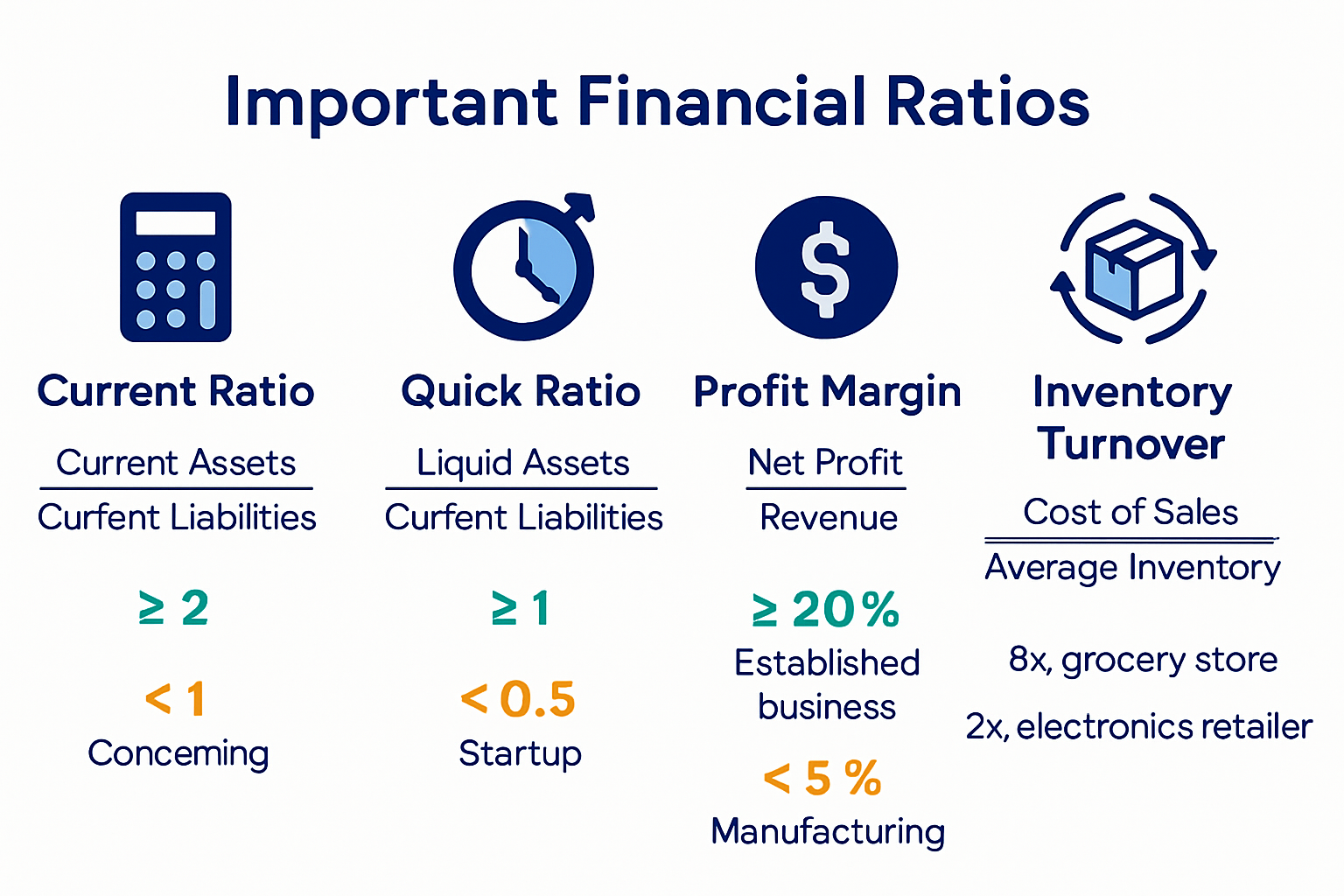
Financial ratios are powerful diagnostic tools that transform raw financial data into meaningful insights for south-african business owners. These numerical indicators help entrepreneurs understand their company’s financial performance, identify potential risks, and make strategic decisions with confidence.
Liquidity and Efficiency Ratios
Dive deeper into financial analysis techniques to unlock comprehensive business understanding. According to OpenStax’s Introduction to Business, liquidity ratios provide critical insights into a company’s short-term financial health.
Key liquidity and efficiency ratios include:
- Current Ratio: Measures a company’s ability to pay short-term obligations by comparing current assets to current liabilities.
- Quick Ratio: A more stringent measure of liquid assets, excluding inventory from current assets.
- Accounts Receivable Turnover: Evaluates how effectively a business collects payments from customers.
- Inventory Turnover: Assesses how quickly a company sells and replaces inventory.
Profitability and Financial Health Indicators
Virginia Tech’s financial management publication emphasizes the importance of understanding financial health through strategic ratio analysis. Profitability ratios offer insights into a company’s earning potential and operational efficiency.
Critical profitability and financial health ratios include:
- Gross Profit Margin: Demonstrates the percentage of revenue remaining after direct production costs.
- Net Profit Margin: Shows the percentage of revenue converted into actual profit after all expenses.
- Return on Assets (ROA): Measures how efficiently a company uses its assets to generate earnings.
- Debt-to-Income Ratio: Evaluates the company’s financial leverage and risk of overextension.
Below is a summary table outlining key types of financial ratios described above, their main purpose, and what they reveal about your business:
| Ratio Type | Example Metrics | Main Purpose | What It Reveals |
|---|---|---|---|
| Liquidity Ratios | Current Ratio, Quick Ratio | Assess ability to meet short-term obligations | Financial flexibility, short-term health |
| Efficiency Ratios | Accounts Receivable Turnover, Inventory Turnover | Evaluate asset and resource utilisation | Operational efficiency |
| Profitability Ratios | Gross Profit Margin, Net Profit Margin | Measure profit generation vs costs and sales | Profit margin, cost control |
| Financial Health/Leverage | Return on Assets (ROA), Debt-to-Income Ratio | Assess risk, leverage, and earnings from assets | Long-term sustainability and risk |
Strategic Ratio Interpretation
OpenStax’s Principles of Financial Accounting highlights that ratio analysis is not about individual numbers but understanding their interconnected story. South-african business owners should consider these ratios as a holistic diagnostic tool.
Effective ratio interpretation requires:
- Comparing ratios against industry benchmarks
- Tracking ratio changes over multiple reporting periods
- Understanding the context behind numerical fluctuations
- Recognizing that no single ratio tells the complete financial story
Mastering financial ratios empowers business owners to move beyond basic number crunching. These metrics transform complex financial data into actionable insights, enabling more informed strategic planning and risk management for south-african enterprises.
Common Mistakes When Analyzing Statements
Financial statement analysis requires precision and a comprehensive approach. South-african business owners often fall into common analytical traps that can lead to misguided strategic decisions. Understanding these potential pitfalls is crucial for accurate financial interpretation.
Overlooking Critical Financial Details
Learn more about comprehensive financial analysis to avoid critical errors. According to the CFA Institute, many analysts commit fundamental mistakes by neglecting essential financial nuances.
Common oversights include:
- Ignoring Footnotes: Financial statement footnotes contain critical contextual information that can dramatically alter numerical interpretations.
- One-Time Item Blindness: Failing to adjust for non-recurring financial events like asset sales or extraordinary expenses can distort true financial performance.
- Incomplete Comparative Analysis: Analyzing financial statements in isolation without comparing them across multiple periods or industry benchmarks.
Misinterpreting Financial Performance Metrics
GSI Associates emphasizes the importance of holistic financial understanding. Business owners frequently misinterpret financial metrics by:
- Overemphasizing Net Income: Focusing exclusively on profit figures without examining underlying cash flow dynamics.
- Neglecting Cash Flow Statements: Assuming profitability automatically means strong financial health.
- Misunderstanding Ratio Contexts: Applying financial ratios without understanding their specific industry or business model implications.
Complex Analytical Misconceptions
Aicountly highlights deeper analytical challenges that south-african businesses encounter. Critical misconceptions include:
- Confirmation Bias: Seeking financial information that confirms preexisting beliefs rather than objectively analyzing data.
- Oversimplifying Complex Financial Relationships: Reducing intricate financial ecosystems to simplistic interpretations.
- Ignoring External Economic Factors: Analyzing financial statements without considering broader economic contexts and industry trends.
Successful financial statement analysis demands a nuanced, comprehensive approach. Business owners must develop critical thinking skills, maintain objectivity, and understand the intricate narratives hidden within financial documents. By recognizing and avoiding these common mistakes, south-african entrepreneurs can transform financial statements from mere numerical records into strategic decision-making tools.
Cloud-Based Tools for Easier Analysis
Cloud-based financial analysis tools have revolutionized how south-african businesses approach financial reporting and strategic decision-making. These innovative platforms provide unprecedented accessibility, accuracy, and real-time insights that transform traditional financial management approaches.
Technological Advantages of Cloud Accounting
Discover the power of modern financial technologies for your business growth. According to The Journal of Academic Science, cloud accounting systems significantly reduce manual errors and improve financial reporting transparency.
Key technological benefits include:
- Real-Time Data Synchronization: Instant updates across multiple devices and user platforms.
- Automated Reporting: Generating comprehensive financial reports with minimal manual intervention.
- Enhanced Data Security: Advanced encryption and secure cloud storage protections.
- Scalable Infrastructure: Flexible systems that grow alongside your business needs.
Advanced Financial Analysis Features
Business, Marketing, and Finance Open Research highlights the transformative potential of cloud-based financial tools. These platforms offer sophisticated analysis capabilities that go beyond traditional spreadsheet limitations.
Critical features for south-african businesses include:
- Integrated Ratio Analysis: Automatic calculation of financial performance metrics.
- Predictive Financial Modeling: AI-powered forecasting and scenario planning.
- Cross-Platform Compatibility: Seamless integration with existing accounting systems.
- Customizable Dashboard Reporting: Personalized financial insights tailored to specific business needs.
Strategic Decision Support Systems
Applied Mathematics and Nonlinear Sciences emphasizes how cloud accounting supports comprehensive enterprise financial decision-making. Modern tools provide more than just number crunching they offer strategic insights that drive business growth.
Strategic capabilities include:
- Big Data Integration: Comprehensive financial analysis using extensive data sets.
- Machine Learning Insights: Intelligent pattern recognition and trend analysis.
- Compliance Monitoring: Automatic tracking of regulatory and tax requirements.
- Collaborative Financial Planning: Enabling team-wide financial strategy development.
Cloud-based financial analysis tools represent a significant leap forward for south-african businesses. By leveraging these advanced technologies, entrepreneurs can transform complex financial data into actionable insights, enabling more informed and strategic decision-making. The future of financial management is here, offering unprecedented transparency, efficiency, and strategic capability for businesses of all sizes.

Frequently Asked Questions
What are the three fundamental financial statements that every south-african business should analyze?
The three fundamental financial statements are the income statement, balance sheet, and cash flow statement. These documents provide insights into profitability, financial position, and cash flow management.
How can south-african businesses interpret financial performance metrics effectively?
Businesses can interpret financial performance metrics by analyzing profitability, liquidity, and efficiency ratios. Comparing these ratios against industry benchmarks and historical data enhances understanding of financial health.
What common mistakes should south-african business owners avoid when analyzing financial statements?
Common mistakes include overlooking critical financial details like footnotes, misinterpreting financial performance metrics, and failing to consider the context of financial ratios. Avoiding these pitfalls leads to more accurate analyses.
How can cloud-based tools help south-african businesses in financial analysis?
Cloud-based tools improve financial analysis by offering real-time data synchronization, automated reporting, advanced security features, and integrated analytics, thus enabling better decision-making and financial management.
Transform Your Financial Analysis Into Real Business Growth
Struggling to make sense of your financial statements or worried you might be overlooking critical details? Many South African business owners get overwhelmed by complex ratios, miss important footnotes, or risk cash flow issues because they are not seeing the full financial picture. If you recognise the frustration of analysing profit margins, liquidity, or efficiency with uncertainty, you are not alone. As discussed in this article, missing just one key metric can have long-term effects on your business stability and growth.
Let Ready Accounting turn your financial confusion into confident decision-making. Our team specialises in cloud accounting and hands-on consulting tailored to South African businesses just like yours. From in-depth financial statement preparation to keeping your numbers clear and audit-ready, we address those pain points before they hold you back. Explore how our expertise in automation, reporting, and compliance can help you avoid common mistakes and gain real-time financial insight.
Ready for a clearer financial future? Visit Ready Accounting now and book a personalised consultation. Take charge of your business performance today—because every decision counts.
Recommended
- Annual Financial Statements in South Africa: What Business Owners Need to Know for 2025 – Ready Accounting
- How to Prepare Financial Statements for South African Businesses in 2025 – Ready Accounting
- How to Read Financial Statements: Easy Guide for 2025 – Ready Accounting
- What Is Financial Reporting? Guide for South African Businesses 2025 – Ready Accounting