

Execution Framework: create a budget for SA Scaling Companies: step-by-step
Most small businesses don’t fail because they lack a great idea or a willing market. They fail because they run out of cash. 82% of business failures are linked to cash flow problems, not poor products or weak sales. For South African SME owners, a well-structured budget is the single most powerful tool you have to prevent this. It tells you where your money is going, when gaps will appear, and how to plan around them. This guide walks you through every step, from gathering your numbers to reviewing your budget regularly, so you can run your business with confidence.
Table of Contents
- Why every South African SME needs a budget
- Preparation: What you need before building your budget
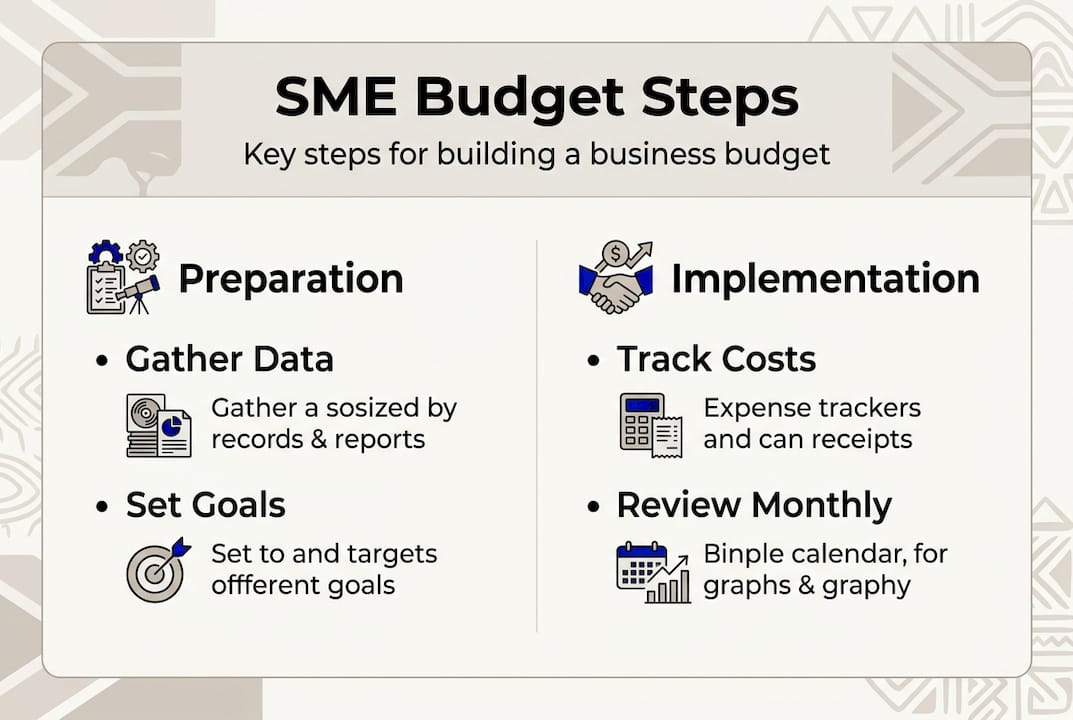
- How to create a budget step by step
- Reviewing, refining, and avoiding common budgeting mistakes
- Our perspective: Budgets as enablers, not constraints
- Ready to upgrade your business budgeting?
- Frequently asked questions
Key Takeaways
| Point | Details |
|---|---|
| Budget proactively | A well-structured budget helps you avoid cash flow surprises and plan for growth. |
| Update regularly | Budgets deliver value only when updated weekly or monthly with real figures. |
| Use digital tools | Platforms like Xero and QuickBooks help reduce errors and enable real-time oversight. |
| Plan for seasonality | If your income is variable, review and adjust cash flows more frequently and build reserves. |
Why every South African SME needs a budget
Running a business without a budget is like driving at night with no headlights. You might know the road, but you won’t see the obstacle until it’s too late. For South African SMEs, the stakes are especially high. 56% of SA SMEs name cash flow as their top business concern, and it’s easy to see why.
When cash flow tightens, owners are often forced to dip into personal savings just to keep the lights on. Most SA SMEs have used personal funds at some point to cover business shortfalls. That’s not a sustainable strategy. It blurs the line between your personal finances and your business, and it puts your household at risk.
Understanding the business budgeting importance goes beyond just knowing your numbers. A budget forces you to confront reality: what you actually earn, what you actually spend, and what’s left over. Without that clarity, you’re making decisions based on guesswork.
Here are the main dangers of operating without a budget:
- Missed payments: You may not anticipate when large expenses hit and fail to have funds ready.
- Overestimating revenue: Optimism is natural, but it leads to overspending when sales don’t arrive on schedule.
- No reserves: Without planning, there’s nothing set aside for slow months, equipment failures, or economic shocks.
- Reactive decisions: You end up firefighting instead of growing.
“A budget isn’t a restriction on your ambition. It’s the map that shows you how to get there without running out of fuel.”
Learning the small business budgeting basics early saves you from these traps. The good news is that building a budget doesn’t require a finance degree. It requires honesty, consistency, and the right process.
Now that we’ve established the need for a budget, let’s look at what you need to get started.
Preparation: What you need before building your budget
Before you open a spreadsheet or accounting tool, you need the right raw material. Garbage in, garbage out. If your input data is incomplete or inaccurate, your budget will mislead you rather than guide you.
Start by gathering these key documents:
- Last 12 months of bank statements
- All invoices issued and received
- Payroll records and tax submissions
- Utility bills, rent agreements, and recurring contracts
- Any outstanding loan or credit facility statements
Once you have your data, choose a tool that fits your business. Here’s a quick comparison:
| Tool | Best for | Key feature |
|---|---|---|
| Microsoft Excel | Simple, low-cost setup | Fully customisable templates |
| Xero | Growing SMEs | Real-time bank feeds and reporting |
| QuickBooks | Multi-user businesses | Automated expense categorisation |
| Sage | SA-specific compliance | VAT and payroll integration |
Understanding the full business budgeting process also means recognising that your budget is a living document. It should be updated as your business changes, not filed away after January and forgotten.
If your business is seasonal, for example a tourism operator, a wedding supplier, or a retail shop with peak holiday trade, your approach needs to be more granular. Seasonal businesses need weekly cash flow budgets to manage the dramatic swings between busy and quiet periods. A monthly view simply won’t give you enough warning.
Pro Tip: Always build an operating reserve into your budget. Aim for at least one to two months of fixed costs held in a separate account. And resist the urge to overestimate your revenue. Use your lowest recent monthly income as your baseline, not your best month.
With your background in place, it’s time to walk through the budgeting process itself.
How to create a budget step by step
Building a budget is not complicated, but it does require discipline. Follow these steps in order and you’ll have a working budget within a few hours.
- List all income sources. Include sales revenue, service fees, rental income, and any government grants or subsidies. Use actual figures from the past year, not projections.
- Map all fixed expenses. These are costs that don’t change month to month: rent, salaries, insurance, and loan repayments.
- Map all variable expenses. These shift with your activity level: stock purchases, freelancer fees, marketing spend, and fuel.
- Calculate your net position. Subtract total expenses from total income. If it’s negative, you need to cut costs or find new revenue.
- Build your cash flow forecast. This is different from your profit and loss. It shows exactly when money arrives and when it leaves. A cashflow forecast walkthrough can help you structure this correctly.
- Run scenario planning. What happens if a major client pays 60 days late? What if load shedding increases your diesel costs by 20%? Build a best case, base case, and worst case version.
Budgets integrated with cash flow outperform static annual plans every time. Here’s why:
| Budget type | Cash flow visibility | Adaptability | Risk detection |
|---|---|---|---|
| Static annual budget | Low | Rigid | Slow |
| Dynamic, cash flow-integrated | High | Flexible | Early warning |
Knowing your burn rate (how much cash you spend each month) and your operating runway (how many months you can survive without new income) gives you real power. These two numbers should always be visible. Automation for cash flow tracking makes this much easier to maintain consistently.

Pro Tip: Forecast your cash inflows and outflows on a weekly basis, especially during your first year or during growth phases. Monthly forecasting often misses short-term gaps that can catch you off guard.
Whether your numbers are penciled out or digital, the real test is making sure the budget is actually working for your business.
Reviewing, refining, and avoiding common budgeting mistakes
Creating a budget is only half the job. The other half is using it. Too many SME owners build a budget in January and look at it again in December, wondering why the year went sideways.
Budgets reviewed weekly or monthly consistently outperform those that are left untouched. Regular reviews let you catch problems early, adjust for unexpected costs, and make smarter decisions in real time.
Here’s a simple review checklist to follow each month:
- Compare actual income to budgeted income. Note any variance above 10%.
- Check that all expenses are correctly categorised.
- Review outstanding invoices and flag any overdue payments.
- Update your cash flow forecast with the latest bank balance.
- Adjust next month’s projections based on what you’ve learned.
Common mistakes SA SME owners make include:
- Ignoring delayed client payments. If your customers pay on 60-day terms, your budget must reflect that delay, not the invoice date.
- Over-optimism on revenue. Build your budget on conservative estimates and treat any upside as a bonus.
- Neglecting the budget after setup. A static budget is nearly useless after 90 days in a changing economy.
Choosing the right tool matters too. A detailed QuickBooks vs Xero comparison can help you decide which platform fits your workflow. Both offer live dashboards that make monthly reviews faster and more accurate. The broader benefits of cloud accounting solutions go well beyond budgeting, including automated reconciliation and real-time reporting.
“The best budget is the one you actually look at. Frequency beats perfection every time.”
If your business has complex revenue streams, multiple cost centres, or rapid growth, consider working with an advisor. A professional can help you build scenario models and interpret variances before they become crises.
Even with reviews and the best tools, there’s debate on whether budgets really empower business growth or feel restrictive. Here’s our perspective.
Our perspective: Budgets as enablers, not constraints
There’s a persistent myth in entrepreneurial circles that budgets kill creativity. That they box you in, slow you down, and make your business feel like a government department. We disagree, strongly.
In our experience working with South African SMEs, the businesses that grow fastest are almost always the ones with the clearest financial picture. When you know your numbers, you make faster decisions, not slower ones. You don’t need to wait for month-end reports to know whether you can afford to hire someone or launch a campaign.
The problem isn’t budgeting. The problem is how most people budget. A rigid annual template that never gets updated is not a budget. It’s a wish list. A real budget is dynamic. It reflects what’s actually happening in your business and gives you the insight to act on it.
We encourage every SME owner to stop thinking of their budget as a compliance task and start treating it as their primary decision-making tool. Understanding the true budgeting importance shifts your mindset from reactive to strategic. That shift is where real growth begins.
Ready to upgrade your business budgeting?
If this guide has shown you anything, it’s that effective budgeting is less about spreadsheets and more about visibility. When you can see your cash position clearly, you make better calls, faster. At Ready Accounting, we help South African SMEs move from guesswork to clarity using modern cloud tools and hands-on financial support.
Explore how cloud accounting for SMEs can automate your tracking and keep your budget current without the manual effort. Our cloud accounting guide is a great starting point if you’re evaluating platforms. Or, if you’d prefer a conversation, book a consultation with our team and we’ll help you build a budget that actually works for your business.
Frequently asked questions
How often should SMEs review their business budgets?
Review your budget weekly or monthly to keep it aligned with real cash flow changes and shifting business conditions. Frequent reviews catch problems early before they become costly.
What is the most common budgeting mistake for small businesses?
The most common mistake is treating a budget as a static document. Budgets not integrated with live cash flow quickly become irrelevant and misleading.
Is budgeting different for seasonal or project-driven SMEs?
Yes. Seasonal businesses need weekly cash flow budgets and should set aside reserves during peak periods to cover quieter months without liquidity stress.
How can digital tools help with SME budgeting?
Tools like Xero and QuickBooks offer real-time bank feeds, automated categorisation, and live dashboards that make budget updates faster and far less prone to human error.