

Execution Framework: Outsource Accounting for Small South African Businesses
South African small businesses are always juggling costs and compliance headaches. Outsourced accounting has become a lifeline for thousands, with businesses that outsource saving up to 40 percent on financial management costs compared to traditional hiring. Most people think it is only about saving money. What actually sets successful businesses apart is how outsourcing gives them access to high-level expertise and tech tools that would normally be out of reach.
Table of Contents
- Benefits Of Outsourcing Accounting Services
- Choosing The Right Accounting Partner
- Integrating Cloud-Based Solutions And Local Compliance
- Tips For Managing Tax, Payroll, And Financial Reporting
Quick Summary
| Takeaway | Explanation |
|---|---|
| Outsource to save costs | Reducing fixed overhead costs by outsourcing accounting allows businesses to redirect resources towards growth initiatives. |
| Choose credible partners | Verify that accounting firms are registered with professional bodies for compliance and expertise. |
| Leverage cloud technology | Integrating cloud solutions enhances real-time insights and data security while meeting local compliance requirements. |
| Prioritize tax compliance | Develop proactive tax strategies to maintain compliance and optimize deductions, ensuring financial health. |
| Implement robust payroll systems | Accurate payroll management systems are essential to handle statutory obligations and avoid compliance issues. |
Benefits of Outsourcing Accounting Services
Small businesses in South Africa face numerous financial challenges that can drain valuable time and resources. Outsourcing accounting services emerges as a strategic solution that transforms how companies manage their financial operations. By partnering with professional accounting experts, businesses can unlock significant advantages that drive growth and operational efficiency.
Cost-Effective Financial Management
Outsourcing accounting services provides an immediate financial advantage for small businesses. According to research on organizational strategies, outsourcing non-core functions allows organizations to focus on their primary business objectives while accessing specialized expertise. The cost savings are substantial. Companies can eliminate expenses related to full-time staff salaries, benefits, training, and office infrastructure.
Traditional in-house accounting requires substantial investment. You need to consider salary packages, computer equipment, accounting software licenses, continuous professional development, and potential recruitment costs. By contrast, outsourced accounting services offer a more predictable and often lower-cost alternative. Businesses can convert fixed overhead costs into flexible, scalable expenses that directly align with their current financial needs.
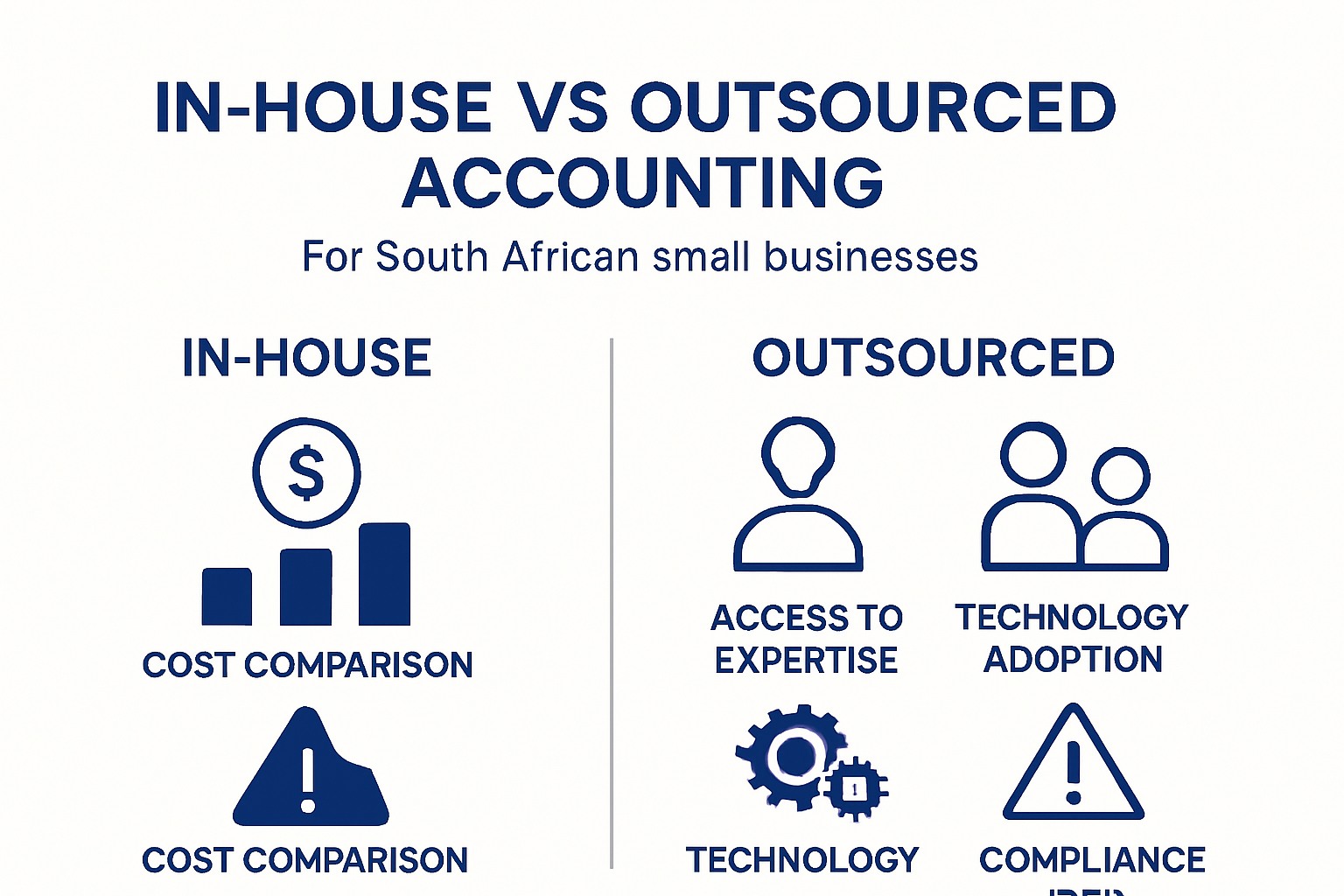
To help you compare the key differences between in-house and outsourced accounting for small South African businesses, refer to the table below. This summary can assist in making informed financial management decisions.
| Aspect | In-House Accounting | Outsourced Accounting |
|---|---|---|
| Cost | High (salaries, benefits, infrastructure, training) | Lower, flexible (pay for services as needed) |
| Access to Expertise | Limited to internal staff skills | Broad expertise across multiple professionals |
| Technology Requirements | Business must purchase and maintain software | Firm typically provides latest tech tools |
| Scalability | Slow and expensive to scale | Easily scalable based on business needs |
| Compliance Management | Risk depends on internal knowledge | Experts keep up with latest regulations |
| Business Focus | Owners manage accounting tasks | Owners focus on growth and core activities |
Access to Advanced Accounting Expertise
Professional accounting firms bring comprehensive knowledge of South African financial regulations, SARS compliance requirements, and tax legislation. These experts stay updated with the latest changes in financial reporting standards, ensuring your business remains compliant and avoids potential penalties. Accounting professionals provide specialized skills that might be challenging and expensive to maintain internally.
Outsourced accounting teams typically include professionals with diverse expertise across different industry sectors. This means you gain access to strategic financial insights, advanced reporting capabilities, and proactive financial planning that goes beyond basic bookkeeping. They can help identify cost-saving opportunities, improve cash flow management, and provide financial forecasting tailored to your specific business context.
Enhanced Business Focus and Operational Efficiency
By delegating complex accounting tasks to external experts, business owners can redirect their energy towards core business activities. This strategic approach allows entrepreneurs to concentrate on product development, customer relationships, and growth strategies. The time saved from managing intricate financial processes can be invested in driving business innovation and expanding market presence.
Moreover, our comprehensive guide on cloud accounting solutions demonstrates how modern outsourced accounting integrates seamlessly with advanced technological platforms. This means real-time financial insights, improved data security, and accessibility from anywhere in South Africa.
Outsourcing accounting is not just a cost-cutting measure. It represents a strategic decision to enhance financial management, reduce risks, and position your business for sustainable growth. For small South African businesses navigating complex financial landscapes, professional accounting services offer a pathway to greater financial clarity and operational excellence.
Choosing the Right Accounting Partner
Selecting the ideal accounting partner represents a critical decision for small South African businesses. The right partnership can transform your financial management, while an unsuitable choice might lead to compliance risks and operational inefficiencies. Understanding how to evaluate potential accounting service providers requires strategic insight and careful consideration.
Evaluating Professional Credentials and Expertise
When searching for an accounting partner, professional credentials become your first critical checkpoint. Look for firms and professionals registered with recognized south-african professional bodies such as the South African Institute of Chartered Accountants (SAICA) or the South African Institute of Professional Accountants (SAIPA). Learn more about the key differences between accounting professionals to ensure you select the right expertise for your business needs.
According to guidance from business experts, businesses should conduct thorough background checks on potential accounting partners. This involves verifying professional qualifications, checking client references, and understanding their experience with businesses similar to yours. Pay special attention to their track record with SARS compliance, tax planning, and financial reporting specific to your industry sector.
Choosing the right accounting partner involves evaluating several important criteria. The following checklist table summarises the key evaluation points for South African small businesses to consider when selecting an accounting firm.
| Evaluation Criteria | Description | Status (Yes/No) |
|---|---|---|
| Registered with SAICA or SAIPA | Confirm professional body membership | |
| Proven industry experience | Verify expertise in your specific business sector | |
| SARS & Tax compliance knowledge | Demonstrates up-to-date tax legislation compliance | |
| Proficient in cloud accounting tech | Able to work with/implement cloud-based solutions | |
| Clear communication and alignment | Engages in transparent, proactive communication | |
| Scalable and flexible service offer | Services can adapt to business growth and change |
Technology and Service Capabilities
Modern accounting partnerships extend far beyond traditional number-crunching. Your ideal accounting partner should demonstrate proficiency in cloud-based accounting technologies, real-time financial reporting, and integrated digital solutions. Look for providers offering comprehensive services including bookkeeping, payroll management, tax consulting, and financial strategy development.
A government report highlighting successful outsourcing strategies emphasizes the importance of clearly defining service expectations and understanding how external partnerships align with organizational goals. Discuss potential technological integrations, reporting frequencies, communication protocols, and specific deliverables before finalizing any partnership. Ensure the accounting firm can provide scalable solutions that can adapt to your business’s growth and changing financial complexities.
Cultural and Communication Alignment
Beyond technical capabilities, the right accounting partner must understand the unique landscape of south-african small businesses. Look for a team that demonstrates genuine interest in your business model, shows proactive communication, and can provide contextualized financial insights.
Effective partnerships are built on transparent communication, mutual understanding, and aligned business values. During initial consultations, assess how well the accounting team listens to your specific challenges, asks insightful questions, and demonstrates a commitment to your financial success. The ideal partner should feel less like a service provider and more like a strategic financial ally.
Choosing the right accounting partner is not just about outsourcing a function it is about building a relationship that supports your business’s financial health and growth trajectory. Take time to research, ask detailed questions, and select a partner who brings both technical expertise and a genuine commitment to your business’s success.
Integrating Cloud-Based Solutions and Local Compliance
Cloud-based accounting solutions have revolutionized financial management for small South African businesses, offering unprecedented flexibility and efficiency. However, successful integration requires more than simply adopting new technology it demands a strategic approach that balances technological innovation with strict local regulatory requirements.
Understanding South African Digital Accounting Regulations
Navigating the complex landscape of south-african digital accounting regulations requires careful consideration. Explore our guide on accounting best practices to understand the critical compliance requirements for digital financial management. According to the Organisation for Economic Co-operation and Development, cloud computing solutions must align precisely with national tax compliance standards.
Key regulatory considerations include ensuring data privacy in line with Protection of Personal Information Act (POPIA), maintaining accurate digital records for SARS auditing purposes, and implementing robust cybersecurity measures. Businesses must choose cloud solutions that provide secure, encrypted platforms compliant with south-african financial reporting standards and capable of generating reports compatible with local tax requirements.
Technological Integration and Data Security
Cloud-based accounting platforms offer more than just convenience they represent a comprehensive approach to financial management. When selecting a cloud solution, prioritize platforms that provide real-time financial reporting, seamless bank integrations, and automated compliance tracking. Look for systems that can generate VAT returns, produce annual financial statements, and maintain comprehensive digital audit trails.
Data security remains paramount in cloud accounting. Choose providers offering multi-factor authentication, end-to-end encryption, and regular security updates. Ensure the platform allows granular access control, enabling you to manage who can view or modify financial information within your organization.
Practical Implementation Strategies
Successful cloud accounting integration requires a methodical approach. Begin by conducting a comprehensive audit of your current financial processes and identifying specific technological requirements. Develop a phased implementation strategy that allows gradual adoption and minimal disruption to existing workflows.
Consider engaging a professional accounting partner experienced in digital transformation who can guide you through the technical and regulatory complexities. They can help select appropriate cloud solutions, configure systems to meet your specific business needs, and provide ongoing support during the transition.
Transitioning to cloud-based accounting solutions represents more than a technological upgrade it is a strategic decision that can significantly enhance your business’s financial management capabilities. By carefully balancing technological innovation with rigorous compliance requirements, south-african small businesses can leverage digital platforms to drive efficiency, transparency, and strategic financial insights.

Tips for Managing Tax, Payroll, and Financial Reporting
Effective management of tax, payroll, and financial reporting represents a critical challenge for small South African businesses. Navigating these complex financial responsibilities requires strategic planning, precise documentation, and a comprehensive understanding of local regulatory requirements.
Strategic Tax Compliance and Planning
Tax compliance is more than just submitting annual returns it is about developing a proactive approach to financial management. Explore our comprehensive payroll tax guide to understand the nuanced landscape of south-african tax obligations. Small businesses must maintain meticulous records, understand various tax deductions, and stay current with SARS regulations.
Key strategies include maintaining separate business and personal financial accounts, tracking all business expenses for potential tax deductions, and setting aside funds regularly for tax payments. Consider working with a tax professional who can help identify legal tax optimization strategies, ensuring you maximize available deductions while remaining fully compliant with south-african tax legislation.
Payroll Management Best Practices
Payroll management demands precision and careful attention to detail. Our payroll management guide offers comprehensive insights into managing employee compensation effectively. Businesses must navigate complex calculations involving income tax, unemployment insurance fund (UIF) contributions, and potential retirement fund allocations.
Implement robust payroll systems that can automatically calculate statutory deductions, generate accurate payslips, and maintain comprehensive employee payment records. Ensure timely submission of employee tax (EMP) documents to SARS and maintain clear documentation of all payroll transactions. Regular audits and reconciliations can help prevent potential errors and ensure ongoing compliance.
Financial Reporting and Documentation
Comprehensive financial reporting goes beyond meeting regulatory requirements it provides critical insights into your business’s financial health. Develop a systematic approach to documenting financial transactions, maintaining clear and organized records that can withstand potential SARS audits.
Key documentation should include detailed income statements, balance sheets, cash flow reports, and supporting documentation for all financial transactions. Leverage cloud-based accounting platforms that offer automated reporting features, enabling real-time financial insights and simplified record-keeping. Regular financial reviews can help identify potential cash flow issues, track business performance, and support strategic decision-making.
Successful financial management requires a holistic approach that combines technological solutions, professional expertise, and a proactive mindset. By implementing robust systems, staying informed about regulatory changes, and maintaining meticulous financial records, south-african small businesses can transform financial management from a complex challenge into a strategic advantage.
Frequently Asked Questions
What are the benefits of outsourcing accounting for small businesses in South Africa?
Outsourcing accounting can save costs, provide access to advanced expertise, enhance operational efficiency, and allow business owners to focus on core activities instead of financial management.
How do I choose the right accounting partner for my small business?
Look for firms with professional credentials, industry-specific experience, knowledge of SARS compliance, and strong communication skills. Evaluate their technical capabilities and ensure they can adapt to your business’s growth needs.
What should I consider regarding cloud-based accounting solutions?
Ensure that the cloud solutions comply with South African financial regulations, offer real-time reporting, maintain data security, and are user-friendly. Choose platforms that provide seamless integration with existing business processes.
How can I manage tax and payroll effectively when outsourcing?
Implement robust payroll systems to handle statutory obligations and maintain compliance. Develop proactive tax strategies to stay updated on SARS regulations and optimize tax deductions by keeping detailed records of all business expenses.
Outsource Your Accounting with Confidence and Gain Back Your Focus
Struggling to keep up with taxes, payroll, and compliance while trying to grow your small business? If managing financial records feels overwhelming or you worry about falling behind on regulations, you are not alone. Our team at Ready Accounting understands how critical accuracy, expertise, and smart technology can be for South African entrepreneurs facing these pressures. We specialise in cloud accounting and automation—so you get access to up-to-date financial information, SARS compliance, and transparent reports, without the stress or high fixed costs discussed in the article.
Let us help you outsource accounting the right way, using secure, modern processes tailored for your business. Visit our home page to discover how our bookkeeping, payroll, and tax consulting solutions can solve your top financial challenges. Ready to take action today? Simply book your consultation and experience the personalised support your business deserves.