

Execution Framework: Outsource Payroll for 2025 Success in South Africa
Outsourcing payroll in South Africa is picking up speed as local companies search for ways to save time and avoid mistakes. Here is a surprising fact. Manual payroll errors can cost businesses up to 8% of their total payroll expense each year. Most business owners think hiring out payroll is just about dodging paperwork. The real value lies in freeing up your time and protecting your business from penalties that could cripple your growth.
Table of Contents
- Step 1: Evaluate Your Payroll Needs And Objectives
- Step 2: Research And Select Payroll Service Providers
- Step 3: Gather Necessary Employee And Financial Data
- Step 4: Set Up And Integrate Payroll Software
- Step 5: Test The Payroll System For Accuracy
- Step 6: Establish A Regular Review Process And Communication
Quick Summary
| Key Point | Explanation |
|---|---|
| 1. Assess payroll needs thoroughly | Understand your unique payroll challenges and objectives to guide outsourcing strategies effectively. |
| 2. Choose providers with local expertise | Select payroll service providers familiar with South African regulations and industry-specific needs for optimal compliance. |
| 3. Compile detailed employee data | Gather complete employee and financial information to ensure accurate payroll processing and regulatory compliance. |
| 4. Conduct rigorous system testing | Test the payroll system with real scenarios to confirm accurate calculations and compliance with South African tax laws. |
| 5. Establish ongoing review protocols | Develop a regular communication and review process to maintain alignment and address potential issues proactively. |
Step 1: Evaluate Your Payroll Needs and Objectives
Successfully outsourcing payroll begins with a comprehensive understanding of your business’s unique financial management requirements. This initial step is crucial for identifying the specific challenges and objectives that will guide your payroll outsourcing strategy.
Starting your evaluation requires a deep dive into your current payroll processes, company size, and financial complexity. Small businesses in South Africa often struggle with time-consuming manual payroll tasks that drain valuable resources. You’ll want to carefully assess how much time your team currently spends on payroll administration, calculating tax deductions, managing employee records, and ensuring SARS compliance.
Consider creating a detailed inventory of your existing payroll challenges. This might include tracking inconsistent payment processing, managing complex tax calculations, handling employee classification, or addressing compliance with South African labour regulations. Key areas to examine include employee headcount, payroll frequency, current software limitations, and the complexity of your compensation structures.
Financial leaders should conduct a thorough cost analysis comparing your current in-house payroll management expenses against potential outsourcing solutions. This analysis helps determine the financial viability and potential return on investment for outsourcing. Factors to consider include staff time allocation, software costs, potential compliance penalties, and the opportunity cost of managing payroll internally.
Additionally, assess your technological infrastructure and readiness for cloud-based payroll solutions. Compatibility with existing financial systems, data security requirements, and integration capabilities are critical considerations. Learn more about streamlining your payroll management to understand the technological aspects of modern payroll outsourcing.
Successful evaluation culminates in a clear, documented set of objectives that will serve as your roadmap for selecting the right payroll outsourcing partner. These objectives should be specific, measurable, and aligned with your broader business strategy, ensuring that your chosen solution delivers tangible value and supports your company’s financial management goals.
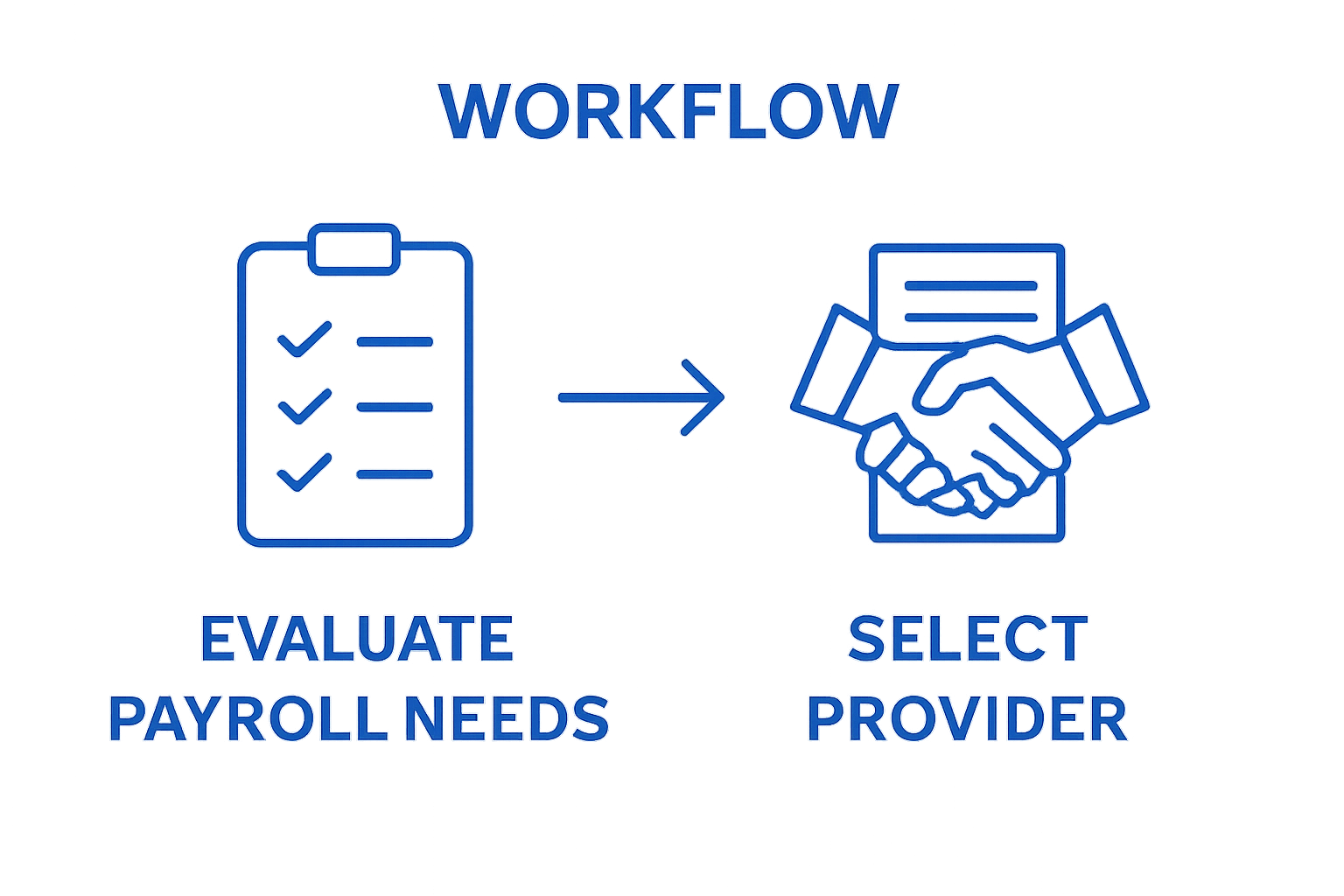
Step 2: Research and Select Payroll Service Providers
Researching and selecting the right payroll service provider represents a critical milestone in your outsourcing journey. This step transforms your initial evaluation into actionable strategy, requiring methodical investigation and strategic decision-making tailored to South African business environments.
Begin your research by developing a comprehensive list of potential payroll service providers specializing in South African compliance requirements. Professional associations like the Payroll Authors Group of South Africa (PAGSA) offer excellent starting points for identifying credible providers. Focus on organizations demonstrating deep understanding of local tax regulations, SARS reporting standards, and employment legislation nuances.
Your selection process should prioritize providers with proven track records in your specific industry and company size. Examine each potential partner’s technological capabilities, reporting mechanisms, and integration potential with existing financial systems. Request detailed service proposals that transparently outline pricing structures, compliance management approaches, and specific deliverables. Pay special attention to their experience handling payroll complexities unique to South African businesses, such as managing multiple payment schedules, navigating complex tax calculations, and ensuring precise statutory deductions.
Learn more about managing payroll efficiently to understand the critical evaluation criteria. Conduct thorough due diligence by requesting client references, reviewing case studies, and scheduling comprehensive consultation meetings. During these interactions, assess the provider’s communication style, responsiveness, and commitment to ongoing support.
Critical verification steps include confirming the provider’s legal compliance credentials, checking their data security protocols, and understanding their disaster recovery mechanisms. Validate their ability to handle potential complications like employee classification, benefits administration, and real-time tax reporting. A robust payroll service provider should demonstrate flexibility, technological sophistication, and a proactive approach to regulatory changes.
Your selection process culminates in a strategic decision that balances cost-effectiveness, technological capability, and comprehensive compliance management. Choose a partner who not only meets your current payroll requirements but also demonstrates potential to scale and adapt alongside your business’s evolving financial management needs.
Step 3: Gather Necessary Employee and Financial Data
Gathering comprehensive employee and financial data represents the foundation of a successful payroll outsourcing transition. This critical step transforms raw information into a structured framework that enables seamless payroll processing and ensures absolute compliance with South African regulatory requirements.
Commence by compiling a meticulous inventory of employee information that extends beyond basic personal details. Your documentation must include complete personal records, tax identification numbers, employment contracts, salary structures, bank account details, and current employment classifications. Pay special attention to capturing nuanced compensation elements such as bonuses, commissions, overtime rates, and any sector-specific allowances that impact total remuneration calculations.
Financial documentation requires equal precision. Collect recent payroll records, tax payment histories, employee classification documents, and comprehensive salary schedules. This includes generating detailed reports from your existing financial systems that demonstrate payment patterns, statutory deduction calculations, and historical compensation trends. Learn more about preparing for tax season to understand the intricate documentation requirements for accurate financial reporting.
Addressing potential data management challenges demands a systematic approach. Verify the accuracy of each employee record, cross-referencing information against official documents like identity cards, employment contracts, and SARS tax certificates. Implement robust data validation processes that flag inconsistencies, incomplete records, or potential compliance risks before transferring information to your chosen payroll service provider.
Secure data transmission represents another crucial consideration. Develop a comprehensive data transfer protocol that prioritizes confidentiality and regulatory compliance. This involves creating encrypted communication channels, establishing clear data sharing agreements, and implementing strict access controls that protect sensitive employee information.
Successful data gathering culminates in a comprehensive, validated dataset that serves as the cornerstone of your outsourced payroll strategy. Your final verification should confirm that every employee record is complete, accurate, and ready for seamless integration with your selected payroll service provider’s systems.
Below is a checklist table summarising the essential employee and financial data needed when preparing to outsource payroll in South Africa.
| Data Category | Required Information | Verification Step |
|---|---|---|
| Personal Details | Full name, address, ID/passport number | Cross-check with official documents |
| Tax Information | SARS tax reference number, tax status | Validate with SARS tax certificates |
| Employment Contracts | Signed contract, start date, employment type | Confirm employment classification |
| Salary Structures | Salary amount, bonus/commission details, overtime rates | Compare to original employment agreements |
| Bank Account Details | Employee banking information | Secure, direct confirmation from employee |
| Previous Payroll Data | Recent payroll records, tax deduction history | Audit against historical payroll documentation |
| Allowances & Deductions | Sector-specific allowances, UIF, statutory deductions | Verify in alignment with South African payroll regulations |
Step 4: Set Up and Integrate Payroll Software
Setting up and integrating payroll software marks a pivotal moment in your outsourcing journey, transforming theoretical planning into practical implementation. This critical phase demands strategic technical configuration that aligns seamlessly with your business’s unique operational requirements and South African regulatory landscape.
Initiate the integration process by conducting a comprehensive system compatibility assessment. Your chosen payroll software must demonstrate robust capabilities for handling complex South African tax calculations, statutory deductions, and real-time reporting requirements. Collaborate closely with your selected payroll service provider to ensure their technological platform can smoothly import your meticulously gathered employee and financial data without compromising information integrity.
Establish secure data migration protocols that prioritize confidentiality and accuracy. This involves creating encrypted data transfer channels, implementing multi-factor authentication, and developing comprehensive backup mechanisms to protect sensitive employee information. Learn more about registering and using payroll software to understand the technical nuances of successful system implementation.
Careful configuration extends beyond technical setup. Customize your payroll software to reflect your organization’s specific compensation structures, including nuanced elements like performance bonuses, sector-specific allowances, and variable pay components. Configure reporting templates that align with SARS requirements, ensuring seamless generation of mandatory documents like IRP5 certificates and employer reconciliation declarations.
Rigorous testing represents the cornerstone of successful software integration. Conduct comprehensive parallel processing, running your new payroll system alongside existing systems to verify calculation accuracy, validate data migration, and identify potential discrepancies. This methodical approach allows for incremental adjustments and minimizes the risk of payroll processing errors during the transition.
Successful software integration culminates in a fully functional, compliant system that transforms payroll management from a complex administrative task into a streamlined, efficient process. Your final verification should confirm precise data synchronization, accurate tax calculations, and seamless reporting capabilities that position your business for enhanced financial management in 2025.

Step 5: Test the Payroll System for Accuracy
Testing your payroll system for accuracy represents the critical checkpoint that separates successful implementation from potential financial disasters. This comprehensive verification process ensures that your meticulously configured payroll solution performs precisely as expected, protecting your business from costly errors and compliance risks.
Comprehensive testing demands a multi-layered approach that simulates real-world payroll scenarios with forensic attention to detail. Begin by creating a series of test scenarios that mirror your actual workforce complexity. This includes generating test payrolls for different employee categories, capturing variations in salary structures, overtime calculations, tax deductions, and statutory contributions unique to South African employment regulations.
Employ a systematic testing methodology that involves parallel processing. Run your new payroll system simultaneously with your existing systems, comparing results across multiple pay periods to identify even the most subtle discrepancies. Verify calculations for gross earnings, net pay, tax withholdings, UIF contributions, and other mandatory deductions with surgical precision. Each test iteration should meticulously cross-reference results against original source documents, employment contracts, and current tax tables.
Learn how to prepare comprehensive financial documentation to understand the intricate details crucial for accurate payroll testing. Focus on specific validation checkpoints that include:
- Precise employee personal information matching
- Accurate tax code applications
- Correct calculation of pro-rata payments
- Seamless handling of variable compensation elements
- Compliance with current SARS reporting requirements
Develop a structured testing protocol that involves multiple stakeholders. Engage your finance team, HR department, and selected payroll service provider representatives to collectively review test results. This collaborative approach ensures a comprehensive examination that leverages diverse perspectives and technical expertise.
Successful system testing culminates in a comprehensive validation report demonstrating the payroll system’s reliability, accuracy, and full compliance with South African regulatory standards. Your final verification should confirm that every calculation, deduction, and reporting mechanism functions flawlessly, providing you with the confidence to transition fully to your new outsourced payroll solution.
Step 6: Establish a Regular Review Process and Communication
Establishing a robust review process and communication framework transforms your payroll outsourcing strategy from a transactional arrangement into a dynamic, collaborative partnership. This critical step ensures continuous alignment, proactive problem-solving, and sustained operational excellence throughout your payroll management journey.
Develop a structured communication protocol that defines clear expectations, reporting mechanisms, and performance evaluation criteria. Schedule monthly comprehensive review meetings with your payroll service provider that go beyond surface-level discussions. These sessions should involve detailed performance assessments, compliance audits, and strategic planning conversations that address both immediate operational needs and long-term financial management objectives.
Create a comprehensive performance tracking dashboard that captures key payroll metrics and compliance indicators. This dynamic tool should provide real-time insights into critical areas such as processing accuracy, statutory compliance, turnaround times, and potential risk areas. Implement a standardized reporting template that allows for consistent, quantifiable performance evaluation across multiple dimensions of payroll management.
Learn more about preparing comprehensive financial documentation to understand the intricate details of maintaining robust financial communication. Your review process should include specific focal points:
- Quarterly compliance audits with SARS reporting standards
- Monthly accuracy verification of payroll calculations
- Periodic review of employee classification and compensation structures
- Systematic assessment of data security and privacy protocols
- Proactive identification of potential legislative or regulatory changes
Establish clear escalation protocols that define how potential issues or discrepancies will be addressed. Develop a collaborative approach that emphasizes transparent communication, rapid problem resolution, and continuous improvement. This means creating predefined communication channels, response time expectations, and resolution frameworks that ensure minimal disruption to your payroll operations.
Successful implementation of a regular review process culminates in a dynamic, responsive payroll management ecosystem. Your final verification should confirm that you have a comprehensive, forward-looking communication strategy that transforms payroll outsourcing from a transactional service into a strategic business partnership.
Here is a table outlining the key review and communication steps to ensure your payroll outsourcing partnership remains compliant and effective.
| Review Area | Frequency | Key Focus | Responsible Party |
|---|---|---|---|
| Compliance Audit | Quarterly | SARS reporting, statutory updates | Payroll Provider & Client |
| Payroll Accuracy Review | Monthly | Calculation checks, payslip validation | Finance/HR Team |
| Employee Data Update | Monthly | Classification, new hires, changes | HR Department |
| Data Security Assessment | Bi-annually | Data access, privacy, backups | Payroll Provider |
| Regulatory Updates | Ongoing | Labour law, tax amendments | Payroll Provider |
| Issue Escalation | As-needed | Address discrepancies or system errors | Payroll Provider & Client |
Ready to Eliminate Payroll Hassles in 2025?
Are you overwhelmed by manual payroll tasks, compliance headaches, or the complexity of shifting to cloud-based solutions? If you relate to these challenges highlighted in our guide for 2025 success, you are not alone. Small and medium businesses in South Africa often wrestle with time-consuming payroll administration, uncertain SARS compliance, and the need for technology that actually works for them. You deserve a proactive solution that turns payroll outsourcing from a risk into a powerful advantage. Learn how our payroll management expertise takes the stress out of everything from gathering accurate employee data to integrating secure payroll software, giving you peace of mind with regular reviews and open communication.

Let Ready Accounting help you transform payroll from a pain point into a business asset. Book a free consultation today or explore our practical guides on how to manage payroll and streamline your payroll management for 2025. Get in touch via https://readyaccounting.co.za and enjoy expert support tailored for South African business owners—take control of your financial future now.
Frequently Asked Questions
How can I evaluate my payroll needs before outsourcing?
To evaluate your payroll needs, conduct a comprehensive assessment of your current payroll processes, employee headcount, and financial complexity. Identify specific challenges, such as tax compliance or payment processing issues, and analyze the costs of in-house payroll management versus potential outsourcing options.
What should I look for in a payroll service provider?
When selecting a payroll service provider, prioritize their understanding of South African compliance requirements, technological capabilities, and proven track record in your industry. Assess their pricing structures, compliance management approaches, and ability to handle complex payroll scenarios specific to your business.
What types of employee data do I need to gather for payroll outsourcing?
Gather comprehensive employee data, including personal details, tax identification numbers, employment contracts, salary structures, and bank account details. Ensure to include components like bonuses or allowances that affect compensation calculations for accurate payroll processing.
How can I ensure the accuracy of my new payroll system?
To ensure accuracy, conduct thorough testing with real-world payroll scenarios, employing parallel processing with existing systems to compare results. Validate calculations against source documents and engage relevant team members to collaboratively review results and ensure compliance with South African regulations.