

How to prepare for a SARS audit: your 2026 guide
Executive Summary
- Preparing for a SARS audit involves organizing financial records, understanding review triggers, and responding within 21 days. Maintaining accurate, current records and engaging a registered tax practitioner can prevent penalties and facilitate a smooth process. Proactive compliance and using tools like cloud accounting help businesses stay audit-ready at all times.
SARS audit preparation is the process of organizing your financial records, understanding what triggered the review, and responding to SARS within the required timeframes to protect your business from penalties. For South African SMEs, a SARS audit is not a sign that something is wrong. It is a formal compliance check that any registered taxpayer can face, whether through a random selection or a specific discrepancy flag. Knowing how to prepare for a SARS audit before the notification arrives puts you in control. This guide covers every step, from reading your audit letter to avoiding the mistakes that turn a simple review into a costly dispute.
How to prepare for a SARS audit: understanding the process first
SARS audit preparation starts with knowing what type of review you are dealing with. Verification and formal audits are two distinct processes, and treating both with equal seriousness prevents escalation. A verification is a quick, often automated check of a specific figure on your return. A formal audit is an intensive review of your records across one or more tax years.

The most common audit triggers include discrepancies between your VAT returns and income tax return, late or amended filings, unusually large deductions relative to turnover, and random selection. SARS also uses third-party data from banks, employers, and the Companies and Intellectual Property Commission (CIPC) to cross-reference your submissions. If any figure does not match, a flag is raised.
Your SARS audit notification letter specifies exactly which tax years, income streams, or deductions are under review. Reading it carefully is the first step in effective audit management. Many business owners make the mistake of assuming the entire business is under scrutiny when SARS may only be querying one VAT period or a single expense category.
Key audit triggers to watch for:
- Discrepancies between VAT 201 returns and income tax submissions
- Significant changes in turnover or expenses year on year
- Late or corrected tax returns filed via SARS eFiling
- Deductions that fall outside industry norms
- Random selection as part of SARS compliance programmes
- Third-party data mismatches from banks or CIPC records
What documents does SARS require during an audit?
The legal requirement is clear: retain all financial records for a minimum of 5 years from the date of your tax return submission. Many tax practitioners recommend keeping records longer, because SARS can reopen prior years under certain circumstances. The 5-year rule is the floor, not the ceiling.
Typical audit document requests include tax returns, IRP5 and IT3 certificates, invoices, bank statements, and proof of expenses. For VAT-registered businesses, SARS will also want your VAT input and output schedules, supplier invoices, and proof that goods or services were received. For PAYE, expect requests for payroll records, EMP201 returns, and employee contracts.
Organizing these documents digitally in clearly labelled folders speeds up the audit process significantly. A folder structure by tax year, then by document type, works well. Cloud-based accounting software that integrates with your banking feeds and SARS eFiling keeps your figures aligned across ledgers and makes document compilation far less stressful. Tools like Xero, Sage Business Cloud, and QuickBooks all support this kind of integration for South African businesses.
Your SARS audit documentation checklist:
- Signed income tax returns (ITR14 for companies, ITR12 for individuals)
- IRP5 and IT3(a) certificates for all employees
- VAT 201 returns and supporting schedules
- Bank statements for all business accounts
- Supplier invoices and proof of payment
- Customer invoices and delivery notes
- Payroll records and EMP201 submissions
- Lease agreements, loan agreements, and asset registers
- Business correspondence related to disputed transactions
Pro Tip: Create a dedicated audit folder in your cloud storage at the start of each tax year. Label subfolders by month and document type. When an audit notification arrives, you pull the folder, not the filing cabinet.
What are the steps to respond to a SARS audit notification?
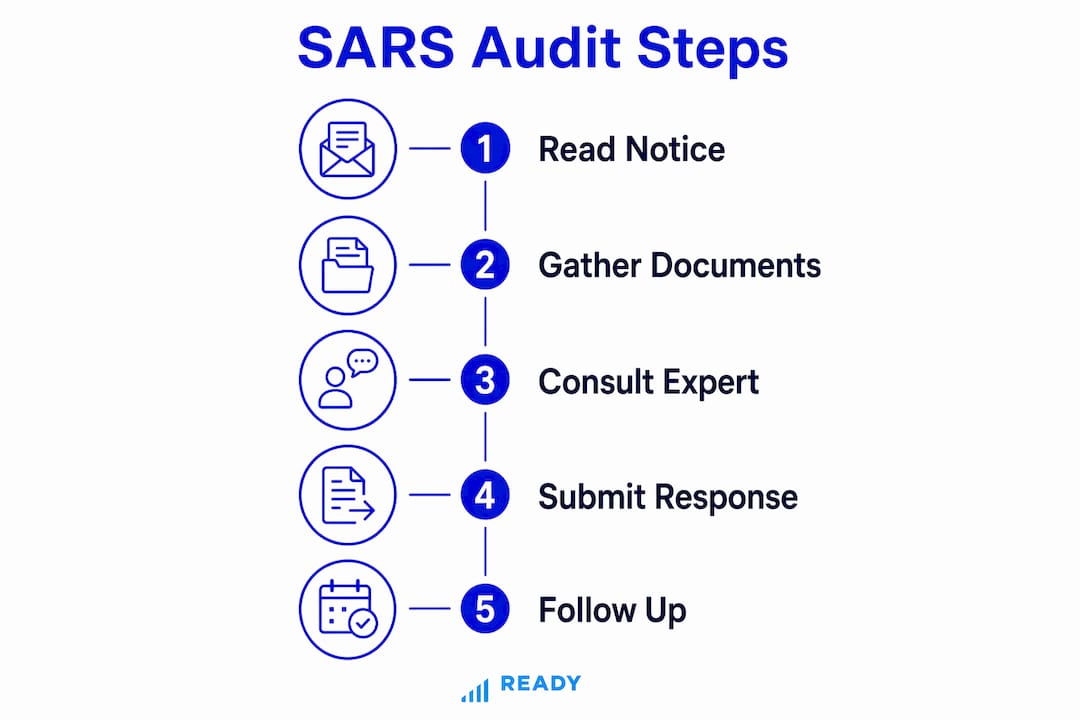
The response timeline is fixed. Taxpayers must respond to SARS audit notifications and supply requested documents within 21 business days. Missing this deadline can result in an estimated assessment, where SARS calculates your tax liability based on incomplete information. That number is almost always higher than your actual liability.
| Step | Action | Timeline |
|---|---|---|
| 1. Read the notification | Identify tax years, document types, and specific queries | Day 1 |
| 2. Engage a tax practitioner | Brief your advisor and assign document collection tasks | Days 1–3 |
| 3. Compile documents | Gather all requested records from your cloud archive | Days 3–10 |
| 4. Review for gaps | Check for missing invoices, unreconciled entries, or errors | Days 10–14 |
| 5. Upload via eFiling | Submit all documents through the SARS eFiling portal | By day 21 |
| 6. Confirm receipt | Save the SARS acknowledgement and log the submission date | Day 21 |
Working with a registered tax practitioner early in the process produces accurate submissions and professional representation if a dispute arises. SARS recognizes registered practitioners from SAICA, SAIPA, and the South African Institute of Tax Professionals (SAIT). Their involvement signals to SARS that you are taking the process seriously.
If your review uncovers historical errors before SARS does, the Voluntary Disclosure Programme (VDP) allows you to correct those errors proactively. Entering the VDP before SARS notifies you reduces penalties significantly. This is one of the most underused tools available to South African business owners.
Pro Tip: Keep a communication log for every SARS interaction. Record the date, the SARS agent’s name or reference number, and a summary of what was discussed. This log becomes critical evidence if a dispute escalates to the Tax Court.
Common SARS audit mistakes and how to avoid them
Ignoring SARS correspondence or submitting incomplete documents triggers estimated assessments and penalties. This is the single most damaging mistake South African business owners make during an audit. SARS does not chase you. If you do not respond, they assess.
Monthly reconciliations of your VAT accounts, PAYE liabilities, and bank accounts reduce the discrepancies that trigger audits in the first place. Regular internal reviews catch errors before SARS does. A business that reconciles monthly arrives at an audit with clean, consistent records. A business that reconciles annually often finds errors it cannot explain.
Cloud-based accounting software integrated with banking feeds and SARS eFiling reduces errors and simplifies document compilation. Modern tools maintain alignment of figures across ledgers, which is exactly what SARS auditors look for. Manual bookkeeping creates gaps that are hard to close under audit pressure.
Mistakes that make audits harder than they need to be:
- Failing to respond to SARS letters within 21 business days
- Submitting documents without a clear index or reference list
- Mixing personal and business expenses in the same account
- Claiming VAT on invoices that do not meet SARS requirements (missing VAT number, incorrect date)
- Not keeping proof of delivery or service for expense claims
- Relying on memory instead of documented records for deductions
- Waiting until an audit arrives to organize years of records
Audit readiness is a year-round discipline, not a once-off event. Businesses that treat tax compliance as ongoing governance face audits with confidence. Those that treat it as an annual filing exercise face audits with panic.
Key takeaways
Passing a SARS audit requires organized records, a fast response within 21 business days, and professional support from a registered tax practitioner.
| Point | Details |
|---|---|
| Retain records for 5 years minimum | Keep all financial documents from the tax return submission date, longer if possible. |
| Respond within 21 business days | Missing the deadline leads to estimated assessments that are almost always unfavorable. |
| Read the audit letter carefully | The notification specifies exactly which years and documents are under review. |
| Use cloud accounting tools | Integrated software keeps figures aligned and makes document compilation faster. |
| Treat preparation as ongoing | Monthly reconciliations and internal reviews reduce audit risk before SARS arrives. |
What I have learned from watching businesses face SARS audits
The businesses that handle SARS audits well share one trait: they were not surprised. Their records were current, their reconciliations were done, and their tax practitioner already knew their numbers. The audit was an inconvenience, not a crisis.
The businesses that struggle are the ones that treated compliance as a filing deadline rather than a financial discipline. They scrambled for invoices from three years ago. They could not explain why a figure on their VAT return did not match their bank statement. They had no communication log. By the time they engaged a tax practitioner, they were already behind the 21-day clock.
My honest view is that a SARS audit is one of the best stress tests a business can face. It forces you to look at your records the way an outsider would. If that process reveals gaps, those gaps existed before the audit. The audit just made them visible. Businesses that understand auditing principles treat this as useful information, not a threat.
The Voluntary Disclosure Programme is another tool that too few business owners use. If you know there are errors in prior returns, correcting them proactively is always better than waiting for SARS to find them. The penalty reduction is real and the process is manageable with the right support.
Audit preparation is governance. Build it into your monthly routine and the audit itself becomes the easiest part.
— Johan
How Readyaccounting keeps South African SMEs audit-ready
Readyaccounting works with South African SMEs and VC-backed startups to replace manual bookkeeping with cloud-based financial infrastructure that keeps records accurate, current, and audit-ready at all times. The firm handles VAT submissions, PAYE reconciliations, and SARS eFiling as part of an integrated compliance system, not as separate tasks. When a SARS audit notification arrives, Readyaccounting clients already have their documents organized and their figures reconciled. For business owners who want to understand how accounting automation reduces audit risk and administrative friction, Readyaccounting’s resources cover the full picture. You can also explore how cloud accounting benefits translate directly into audit readiness for growing South African businesses.
FAQ
What triggers a SARS audit for a small business?
SARS audits are triggered by discrepancies between VAT returns and income tax submissions, late or amended filings, unusually large deductions, and random selection. Third-party data from banks and CIPC also flags mismatches automatically.
How long do I have to respond to a SARS audit notification?
Taxpayers must respond within 21 business days of receiving the audit notification. Missing this deadline can result in an estimated assessment based on incomplete information, which is almost always higher than the actual tax liability.
What is the difference between a SARS verification and a formal audit?
A verification is a quick, often automated check of a specific figure on your return. A formal audit is an intensive review of your records across one or more tax years. Both require a serious, timely response.
How long must I keep financial records for SARS?
SARS requires you to retain all financial and supporting documentation for a minimum of 5 years from your tax return submission date. Tax practitioners recommend keeping records longer, as prior years can be reopened under certain circumstances.
What is the Voluntary Disclosure Programme and when should I use it?
The Voluntary Disclosure Programme (VDP) allows taxpayers to correct historical errors before SARS identifies them. Entering the VDP proactively reduces penalties significantly and is the right step if your internal review uncovers past filing mistakes.