

Execution Framework: register a company in South Africa: 5 steps
Executive Summary
- Choosing the right company structure, like a Private Company, simplifies compliance and growth.
- Company registration involves online steps with required documents, typically costing R125-R175.
- Post-registration, immediate tax registrations and ongoing compliance are crucial to avoid penalties.
Registering a company in South Africa stops many aspiring founders in their tracks. Between conflicting advice online, confusing CIPC portals, and unclear compliance requirements, it is easy to lose momentum before you even begin. This guide cuts through that noise. Whether you are launching your first venture or formalising an existing operation, we walk you through every step: from choosing the right company structure, to CIPC registration, to staying legally compliant once you are up and running. No jargon, no guesswork. Just a practical, sequenced breakdown built for South African entrepreneurs who want to get it right from day one.
Table of Contents
- Understanding South African company types and requirements
- Step-by-step guide to registering your company
- Key compliance steps after registration
- Common mistakes and expert tips for successful registration
- Why clarity, not complexity, drives South African business success
- Get professional support for a smooth registration and growth journey
- Frequently asked questions
Key Takeaways
| Point | Details |
|---|---|
| Name reservation optional | You don’t have to reserve a name to register a new company in South Africa. |
| Typical costs | Expect to pay around R175 total, including optional name reservation for most company registrations. |
| Compliance actions | Register for tax, keep financial records, and file annual returns after setup to stay compliant. |
| Common pitfalls | Avoid document errors and missed deadlines by following a step-by-step process and setting reminders. |
| Expert support available | You can simplify the entire process with professional help for registration and accounting. |
Understanding South African company types and requirements
Choosing the right legal structure is the most important decision you will make before registration. Get it wrong and you could face unnecessary tax burdens, limited growth options, or personal liability for business debts. Get it right and everything from funding to compliance becomes significantly easier.
South Africa recognises several main business types:
- Private Company (Pty) Ltd: The most popular choice for SMEs. It limits owner liability, allows for multiple shareholders, and is widely recognised by banks and investors.
- Sole Proprietor: Simple and cheap to set up, but the owner carries full personal liability for all debts.
- Partnership: Two or more individuals share profits and liabilities. No separate legal identity from the partners.
- Non-profit Company (NPC): Designed for organisations with a public benefit or charitable purpose rather than profit generation.
For most entrepreneurs, the Private Company (Pty) Ltd is the logical starting point. It separates your personal assets from business risk and gives you credibility with suppliers and clients from day one. You can explore the full range of business structure options to match your specific goals.
| Company type | Liability | Shareholders | Best for |
|---|---|---|---|
| Private (Pty) Ltd | Limited | 1 to 50 | Most SMEs, startups |
| Sole Proprietor | Unlimited | N/A | Freelancers, micro-businesses |
| Partnership | Unlimited | 2 or more | Professional practices |
| Non-profit (NPC) | Limited | N/A | Charities, NGOs |
Once you have settled on a structure, you need to understand the compliance basics. All registered companies must submit annual returns to CIPC, register for income tax with SARS, and comply with B-BBEE reporting if applicable. Choosing tax-efficient company structures from the start can save you significantly as you scale.
One decision that trips up many founders is whether to reserve a company name first. According to CIPC guidelines, name reservation is optional: you can register with or without a reserved name. If you are still deciding on a trading name, you can register with a system-generated number and update it later.
Pro Tip: Choose a structure that matches where you want to be in three years, not just where you are now. A (Pty) Ltd costs slightly more to set up but saves you from restructuring headaches as you grow.
Step-by-step guide to registering your company
Having settled on a legal structure, you are ready to register. Here is how to do it, step by step, with no guesswork.
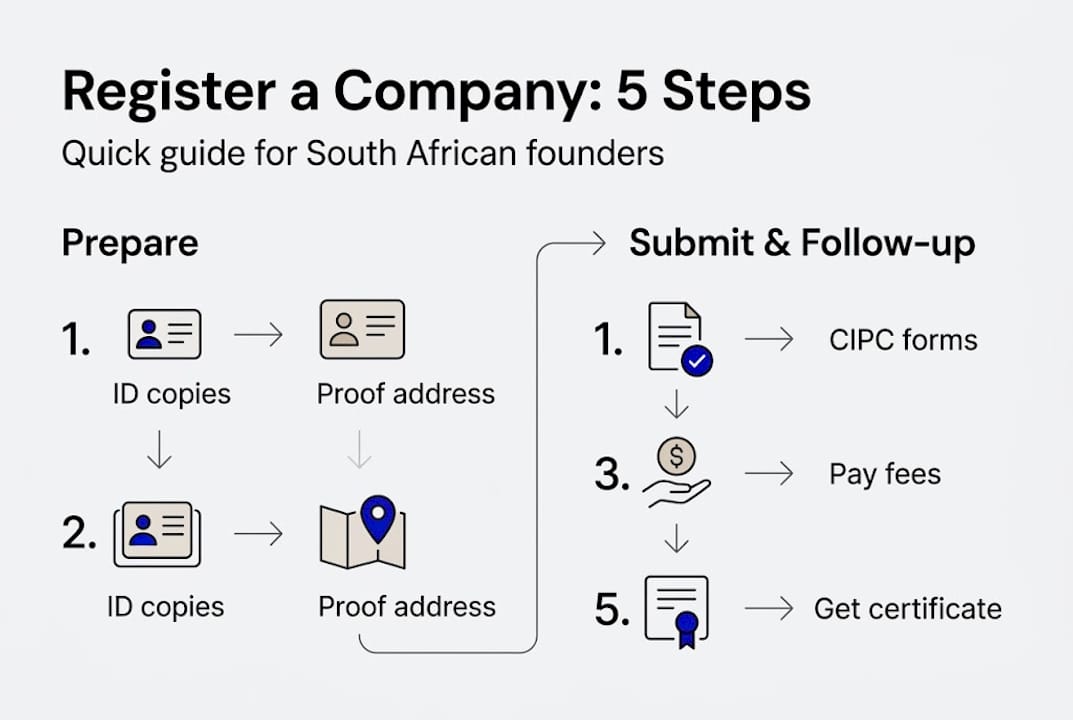
The entire process happens online through the CIPC e-Services portal. Before you log on, gather the following:
- Certified copies of ID for all directors
- Residential and postal addresses for all directors
- A working email address for CIPC correspondence
- Your chosen company name (or be prepared to use a number)
- Completed CoR14.1 (Memorandum of Incorporation, if applicable)
Now follow these steps:
- Create a CIPC e-Services account at the official CIPC website and verify your email address.
- Reserve your company name (optional). Submit up to four name choices and pay the R50 reservation fee. CIPC approves or rejects within a few business days.
- Complete the registration form (CoR14.1 and CoR14.1A for director details) directly on the portal.
- Upload supporting documents, including certified ID copies and proof of address for each director.
- Pay the registration fee online. The total cost sits around R175 when you include optional name reservation, making this one of the most affordable formal registrations in the region.
- Receive your registration certificate (CoR14.3) via email, usually within 5 to 7 business days if all documents are in order.
| Requirement | Details |
|---|---|
| Director IDs | Certified copies required |
| Proof of address | For each director |
| Name reservation | Optional, R50 fee |
| Registration fee | Approximately R125 |
| Processing time | 5 to 7 business days |
For a deeper understanding of what these costs mean for your tax position, our 2026 small business tax guide is a helpful companion resource.
Pro Tip: If you are undecided on a trading name, skip name reservation entirely. Register with a company number now, start operating, and update your name once you are certain. You save time and avoid the risk of rejection.
Key compliance steps after registration
Registration is not the finish line. It is the starting gun. Once your CoR14.3 certificate lands in your inbox, several critical obligations kick in immediately.
Here is what you need to action without delay:
- Register for income tax with SARS. This is mandatory for all registered companies. SARS will issue a tax reference number.
- Register for VAT if your taxable turnover exceeds or is expected to exceed R1 million per year. Voluntary registration is possible from R50,000.
- Register for PAYE, UIF, and SDL if you are employing staff. This registers you as an employer with SARS.
- Submit annual returns to CIPC every year on your registration anniversary. Failure to do so results in deregistration.
- Keep proper financial records for at least five years, as required by the Companies Act and SARS.
- Comply with B-BBEE requirements if you supply government or large corporates, as they may request your B-BBEE certificate.
Understanding your obligation around filing annual financial statements is especially important in your first year, when many founders mistakenly think they can delay this task.
Critical compliance warning: Missing your CIPC annual return deadline can lead to automatic deregistration, which puts all your contracts, bank accounts, and tax registrations at risk. Set a calendar alert the moment you receive your registration date.
Solid SMB tax compliance from the start protects you from penalties that are easy to avoid with the right systems in place.

Pro Tip: Use cloud accounting software to automate reminders for annual return deadlines, VAT submission dates, and provisional tax periods. One missed deadline can cost you more than a year of software subscriptions.
Common mistakes and expert tips for successful registration
Once you know the compliance basics, it is important to avoid the registration mistakes that catch out many first-time founders.
These are the most common errors we see:
- Uploading uncertified documents. CIPC will reject your application if ID copies are not correctly certified. Every page must be stamped.
- Incorrect director information. A typo in a name or ID number can delay your registration by weeks.
- Skipping the compliance calendar. Many founders register and immediately focus on sales, completely forgetting about annual returns or provisional tax deadlines.
- Choosing the wrong structure for short-term tax savings without considering long-term growth needs.
- Assuming registration equals trading readiness. You still need a business bank account, tax registration, and in many cases a sector-specific licence before you can legally trade.
- Overlooking name reservation implications. As CIPC confirms, name reservation is optional, meaning you do not need to delay registration just because you are unsure of your name.
Expert help is often underestimated at this stage. An accountant or business consultant can check your documents before submission, flag structure issues early, and set up your compliance calendar correctly from day one. The cost of that advice is almost always lower than the cost of fixing avoidable mistakes later. The outsourcing accounting benefits become especially clear during your first compliance cycle.
Digital tools also make a significant difference. Using Xero for company setup gives you a live view of your financial position from the moment you register, so compliance never sneaks up on you.
Pro Tip: Create a simple checklist document after registration that tracks every compliance deadline for the next 12 months. Share it with your accountant so nothing falls through the cracks.
Why clarity, not complexity, drives South African business success
Here is something most registration guides will not tell you: the founders who get stuck are rarely stuck because the process is too hard. They are stuck because they are trying to optimise too early.
We see it constantly. Entrepreneurs spend weeks researching holding structures, offshore options, and trust arrangements before they have even invoiced their first client. They want the perfect setup before they begin. The result? Delayed starts, wasted advisory fees, and in some cases, no business at all.
The truth is that efficient company setups almost always start simple. A clean (Pty) Ltd, a SARS tax number, a business bank account, and a reliable accountant. That is enough to trade legally and grow fast. Complexity can come later, once you understand your revenue model, your margins, and your actual tax exposure.
Our experience working with South African SMEs shows that clarity on the basics consistently outperforms clever structuring in the early stages. Start simple. Stay compliant. Grow smart. Then optimise.
Get professional support for a smooth registration and growth journey
If you want to avoid admin hassles and ensure confidence beyond the CIPC, here is professional help worth considering.
At Ready Accounting, we support South African entrepreneurs at every stage: from choosing the right company structure to managing your books, tax filings, and annual compliance. Many of our clients discover that the real advantage comes after registration, when having the right financial systems in place means they can focus on growth instead of paperwork. The cloud accounting benefits are particularly powerful for newly registered companies that want real-time visibility without a full-time finance team. Explore our cloud accounting for SMBs resource to see how it fits your new business. Book a consultation today and let us handle the financial complexity while you build your vision.
Frequently asked questions
Is it mandatory to reserve a company name in South Africa?
No, name reservation is optional. You can register a company without reserving a name and simply use the CIPC-assigned company number as your registered name until you decide.
How much does company registration usually cost?
Expect to pay around R125 to R175 in total. The R175 estimate includes the optional R50 name reservation fee plus the standard registration cost.
Which documents do I need to register a company?
You need certified ID copies and proof of address for all directors, plus completed CIPC registration forms. If you skip name reservation, the process is even leaner since you use a company number instead.
What are the key tax registrations after setting up my company?
You must register for income tax immediately, VAT if your turnover will exceed the threshold, and PAYE if you plan to hire employees. Each registration is done through SARS eFiling and should be completed within the required timeframes to avoid penalties.