

Execution Framework: save tax in South Africa: smart strategies for Scaling Companies in 2026
Running a small business in South Africa means juggling countless responsibilities, and tax compliance often feels overwhelming. Many SME owners miss valuable deductions and fail to leverage retirement savings tools, leaving thousands of rands on the table each year. This guide walks you through proven, lawful tax-saving strategies updated for 2026, helping you maximize deductions, optimize retirement contributions, and avoid costly SARS penalties while keeping more profit in your business.
Table of Contents
- Introduction To Tax Saving In South Africa For SMEs
- Prerequisites: What You Need Before You Start Saving Tax
- Step 1: Leveraging Retirement Annuities For Tax Relief
- Step 2: Maximizing Tax-Free Savings Accounts (TFSA)
- Step 3: Claiming Legitimate Business Deductions
- Step 4: Navigating The Two-Pot Retirement System
- Step 5: Avoiding Common Tax Mistakes And Penalties
- Expected Results And Success Metrics
- Discover Ready Accounting’s Tax And Accounting Solutions For SMEs
- Frequently Asked Questions
Key takeaways
| Point | Details |
|---|---|
| 2026 tax reliefs | Inflation-indexed brackets and increased rebates reduce SME tax burden significantly. |
| Maximize retirement savings | Contribute up to R430,000 annually to retirement annuities for immediate tax deductions. |
| Use TFSA benefits | Annual R46,000 TFSA limit offers tax-free growth with flexible withdrawals. |
| Claim all deductions | Document expenses carefully and claim legitimate business costs to lower taxable income. |
| Accurate record-keeping | Maintain digital records and use SARS eFiling to minimize errors and audit risks. |
Introduction to tax saving in South Africa for SMEs
The 2026 tax landscape brings welcome relief for South African SME owners. Tax brackets and rebates were fully indexed to inflation, preventing taxpayers from moving into higher brackets due to inflation alone. The primary rebate increased to R17,820, easing the overall tax burden for business owners operating as sole proprietors or earning salaries from their companies.
Understanding SARS’s expectations helps you plan effectively and reduce liabilities before they accumulate. Proactive tax strategies prevent year-end surprises and optimize cash flow throughout the year. Accurate tax knowledge forms the foundation for implementing effective saving measures.
Key 2026 tax environment features include:
- Inflation-adjusted tax brackets reducing bracket creep impact
- Increased primary rebate providing immediate relief for lower earners
- Enhanced retirement contribution limits offering greater tax deduction potential
- Stricter SARS digital filing requirements improving compliance accuracy
Our year-end tax planning guide for small businesses offers additional strategic planning insights. For comprehensive expense tracking, review the small business tax deductions checklist. Implementing accounting best practices for SA businesses ensures your financial foundation supports effective tax planning.
Prerequisites: what you need before you start saving tax
Effective tax saving requires solid groundwork. Start by maintaining accurate, up-to-date financial records with detailed documentation of every expense and income transaction. This foundation enables you to claim legitimate deductions and respond confidently to SARS queries.
Understand the tax brackets relevant to your business income level. Knowing where you sit within the marginal tax rate structure helps you plan contributions and deductions strategically. Set up and regularly use the SARS eFiling platform for streamlined, accurate tax filing that reduces processing delays.
Open retirement annuity and tax-free savings accounts early in the tax year. Early establishment allows you to spread contributions across months, improving cash flow management while maximizing annual limits. Good bookkeeping reduces audit risk and ensures you capture every deductible expense.
Essential preparation steps:
- Organize digital copies of invoices, receipts, and bank statements monthly
- Review current tax bracket positions and marginal rates quarterly
- Register for SARS eFiling if not already active
- Open RA and TFSA accounts with reputable registered providers
- Implement cloud accounting software for real-time financial tracking
Learn detailed requirements through SARS record-keeping rules for businesses. Follow step-by-step setup instructions in how to register on SARS eFiling. Avoid pitfalls outlined in common bookkeeping mistakes and how to avoid them.
Step 1: leveraging retirement annuities for tax relief
Retirement annuity contributions offer immediate, substantial tax relief for SME owners. Contributions up to R430,000 annually are deductible against your taxable income, subject to the cap of 27.5% of taxable income or R350,000, whichever is lower in most cases. The 2026 limit increase provides enhanced saving opportunities for higher earners.

RAs reduce your current taxable profit directly, lowering your tax liability in the same year you contribute. This immediate benefit improves cash flow management when timed strategically before year-end. Carefully select registered providers with transparent fee structures and strong fund performance histories.
Regular monthly contributions work better than lump sums for most SMEs, spreading the financial impact while ensuring you maximize annual limits without cash flow strain. Review your contribution levels quarterly to align with income fluctuations common in small businesses.
Contribution mechanics:
- Deductible amount reduces taxable income dollar for dollar up to limits
- Excess contributions above limits carry forward to future tax years
- Withdrawals before retirement age trigger tax penalties and charges
- Multiple RA accounts allowed but total contributions still capped
Pro Tip: Contribute heavily in high-income years and scale back during lean periods, using the carry-forward provisions to smooth tax benefits across variable business cycles.
Maximize your strategy using insights from our year-end tax planning guide for small businesses. Cross-reference allowable deductions in the small business tax deductions checklist.
Step 2: maximizing tax-free savings accounts (TFSA)
TFSAs complement retirement annuities by offering tax-free growth without the strict withdrawal restrictions. The annual TFSA contribution limit increased to R46,000 in 2026, with a lifetime maximum of R500,000. Investment growth, dividends, and withdrawals remain completely tax-free, creating powerful long-term wealth accumulation.
Unlike RAs, TFSAs provide flexibility for emergency withdrawals without penalties, making them suitable for SMEs with variable cash flow needs. Multiple provider types exist, including banks, investment brokers, and retirement annuity linked TFSAs, each offering different investment options and fee structures.
Exceeding contribution limits triggers 40% penalties on excess amounts plus potential tax charges, so careful tracking is essential. Monitor contributions across all your TFSA accounts since limits apply to total contributions regardless of provider number.
| Feature | Retirement Annuity | Tax-Free Savings Account |
|---|---|---|
| Annual limit | R430,000 (27.5% cap applies) | R46,000 |
| Lifetime limit | None | R500,000 |
| Tax benefit | Deduction reduces taxable income | Growth and withdrawals tax-free |
| Withdrawal flexibility | Restricted until retirement | Anytime without penalty |
| Contribution carry-forward | Yes, excess amounts | No carry-forward allowed |
Pro Tip: Use TFSAs for medium-term business reserves you might need access to, while directing long-term retirement savings into RAs where higher contribution limits and immediate tax deductions provide greater value.
Enhance your savings strategy through our year-end tax planning guide for small businesses.
Step 3: claiming legitimate business deductions
Accurate expense deduction claims directly reduce your taxable income, lowering your final tax bill substantially. Common deductible expenses include office rentals, supplies, travel costs, employee benefits, utilities, and professional fees. Each deduction must meet SARS requirements for business necessity and proper documentation.
Depreciation allows spreading asset costs over multiple years, providing ongoing tax deductions for equipment, vehicles, and property used in your business. Methods include straight-line depreciation (equal amounts yearly) and reducing balance (higher deductions early). Choose the method that best matches your asset usage patterns and tax planning needs.
Maintain receipts, invoices, and digital records aligned with SARS guidelines to prevent disallowance during audits. Document the business purpose for each expense, especially for items that could have personal use components like vehicles or home office spaces.
| Deductible expenses | Non-deductible expenses |
|---|---|
| Office rent and utilities | Personal living costs |
| Business travel and fuel | Commuting to primary workplace |
| Employee salaries and benefits | Owner’s personal expenses |
| Professional fees and subscriptions | Entertainment and gifts over limits |
| Equipment and software | Capital improvements (depreciate instead) |
| Marketing and advertising | Fines and penalties |
Key documentation practices:
- Digitize receipts immediately using mobile scanning apps
- Categorize expenses weekly in accounting software
- Maintain separate bank accounts for business transactions
- Record business mileage and purpose for vehicle deductions
- Keep supplier invoices showing VAT separately for VAT claims
Proper expense management boosts cash flow while reducing taxable profit legally. Review comprehensive deduction categories in the small business tax deductions checklist. Ensure compliance using SARS record-keeping rules for businesses.
Step 4: navigating the two-pot retirement system
The two-pot retirement system introduced in South Africa splits your retirement savings into accessible and preservation components. The accessible pot allows limited withdrawals before retirement, while the preservation pot remains locked until retirement age, protecting long-term savings.
Partial withdrawals from the accessible pot must be reported accurately in your tax returns as taxable income. These amounts face standard income tax rates based on your marginal bracket, potentially pushing you into higher tax territory if withdrawals are substantial.
Misreporting withdrawal amounts triggers SARS assessments, penalties, and interest charges that quickly accumulate. SMEs must plan withdrawals carefully, considering the immediate tax impact against urgent cash needs. Integrate two-pot withdrawals into your year-end tax filing strategy to avoid surprises.
Compliance essentials:
- Obtain withdrawal certificates from your retirement fund provider immediately
- Declare all accessible pot withdrawals on your ITR12 return
- Calculate estimated tax on withdrawals before taking distributions
- Consider spreading withdrawals across tax years to manage bracket impact
- Maintain records linking withdrawals to specific financial needs if queried
Accurate reporting avoids costly surprises and enables strategic retirement fund use without jeopardizing your long-term security. Common questions addressed in top tax questions small business owners ask cover two-pot scenarios.
Step 5: avoiding common tax mistakes and penalties
Poor record-keeping tops the list of SME tax mistakes, leading to missed deductions and SARS queries that waste valuable time. Misdocumented deductions get disallowed during audits, triggering additional tax assessments and penalties. Incorrect eFiling submissions delay refunds and increase compliance risks.
Use digital bookkeeping tools to maintain continuous, organized records that feed directly into tax returns. Cloud accounting software reduces manual data entry errors and provides real-time financial visibility. SARS eFiling integration speeds submissions and minimizes documentation mistakes.
Understand penalties for late filing (fixed amounts plus percentage-based charges), under-declaration (percentage of underpaid tax), and non-compliance (escalating fines). These costs quickly erode the savings you’ve worked to achieve through legitimate tax planning.
Common error categories:
- Mixing personal and business expenses without proper allocation
- Claiming non-deductible items like entertainment over limits
- Missing filing deadlines due to poor calendar management
- Failing to reconcile bank statements with accounting records
- Ignoring SARS correspondence leading to default assessments
Pro Tip: Schedule monthly reconciliation sessions where you review all transactions, categorize expenses, and verify documentation completeness, preventing year-end scrambles that increase error rates.
Regular reconciliations and professional advice improve filing accuracy substantially. Understand compliance risks through why 90% of SA small businesses fail due to poor tax compliance. Review SARS record-keeping rules for businesses and simplify processes using how to register on SARS eFiling.
Expected results and success metrics
Successful tax saving shows up in measurable outcomes you can track throughout the year. Maximizing RA and TFSA contributions annually unlocks full tax relief benefits, creating quantifiable savings in your tax liability. Aim to achieve at least 15% reduction in taxable income through legitimate deductions compared to gross business profit.
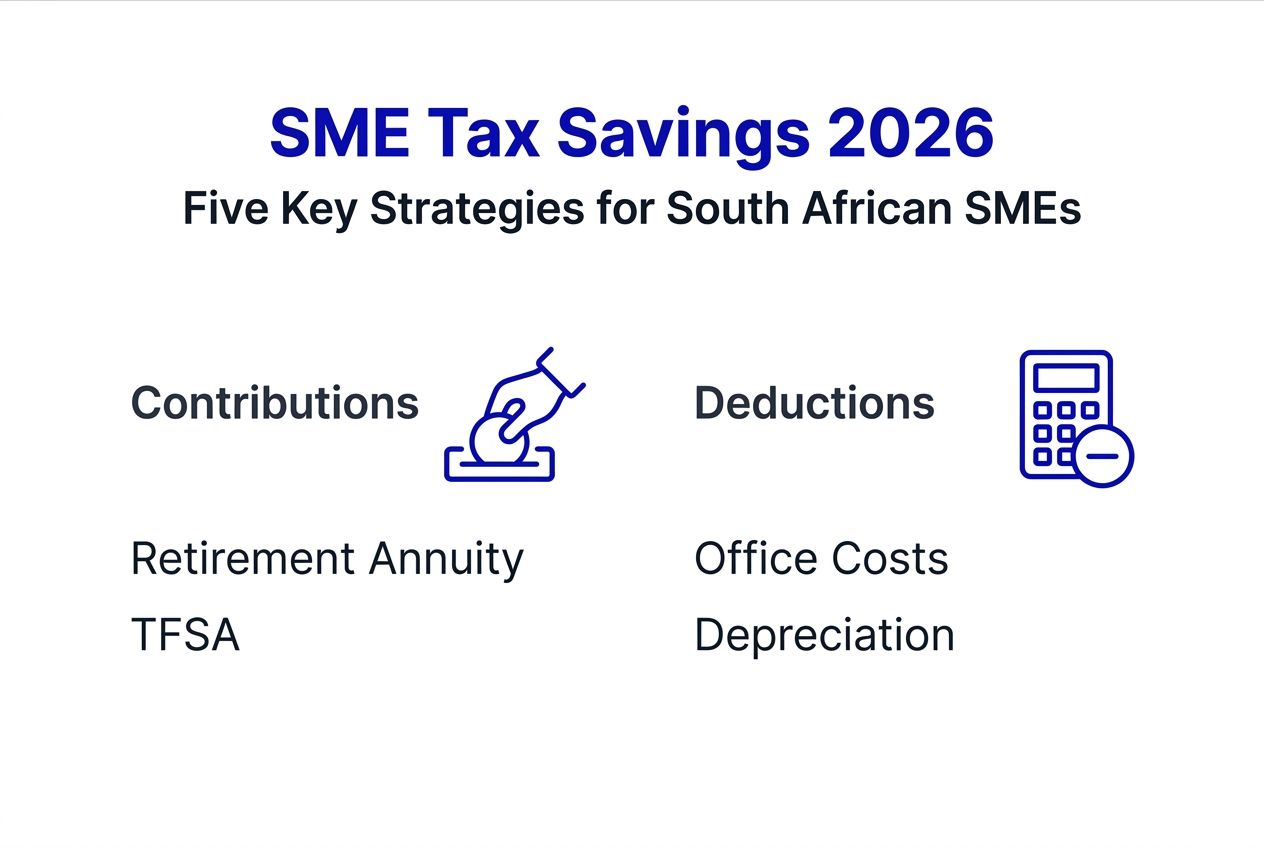
Maintain zero or minimal SARS audit penalties or queries, indicating clean compliance and accurate filing. Use digital tools to consistently file with zero to two errors per cycle, demonstrating professional-grade accuracy. Improved cash flow and reinvestment ability signal successful tax saving, as reduced tax payments free capital for business growth.
Key performance indicators:
- RA contributions reaching annual maximum or 27.5% cap
- TFSA contributions hitting R46,000 annual limit
- Documented deductions exceeding 15% of gross income
- Zero late filing penalties across tax years
- Refund processing within SARS standard timeframes
Track these metrics quarterly rather than annually, allowing mid-year corrections that optimize your final tax position. Regular monitoring prevents last-minute contribution rushes that strain cash flow.
Discover Ready Accounting’s tax and accounting solutions for SMEs
Implementing these strategies becomes significantly easier with professional support tailored for South African SMEs. Cloud accounting simplifies tax record keeping and compliance, automatically categorizing transactions and preparing documentation for SARS submissions. Expert consulting helps optimize your tax savings while avoiding costly mistakes that trigger audits.
Access tailored resources through the benefits of cloud accounting for small businesses, keeping you current with SARS rule changes. Review the complete tax deductions checklist for comprehensive expense tracking. Specialized tax consulting services in Johannesburg provide personalized guidance addressing your unique business situation, helping you navigate complex regulations confidently while maximizing legitimate tax relief opportunities.
Frequently asked questions
What is the maximum annual retirement annuity contribution deductible for SMEs in 2026?
The maximum deductible contribution is R430,000 annually, capped at 27.5% of your taxable income. Contributions exceeding these limits carry forward to future years but provide no immediate tax benefit. Ensure contributions stay within both thresholds to gain full current-year tax deductions.
How much can SMEs contribute annually to tax-free savings accounts in 2026?
The annual TFSA contribution limit for 2026 is R46,000, with a lifetime cap of R500,000 across all accounts. Exceeding these limits triggers 40% penalties on excess amounts plus tax on deemed income. Regular monitoring across all your TFSA providers prevents costly overcontributions.
What are common tax filing mistakes SMEs should avoid?
Common mistakes include poor record-keeping, incorrect expense categorization, missed deductions, and late submissions. Mixing personal and business expenses without proper allocation triggers SARS queries. Using digital accounting tools and maintaining monthly reconciliations dramatically reduces these errors while improving filing accuracy.
How does the two-pot retirement system affect SME tax reporting?
The two-pot system requires detailed reporting of accessible fund withdrawals as taxable income in your returns. Withdrawals face standard income tax rates based on your marginal bracket. Accurate declaration prevents SARS penalties and supports correct tax liability assessment, protecting you from unexpected assessments and interest charges.
Recommended
- Types of Accounting Services for SMEs in 2025: Your Guide – Ready Accounting
- Year-End Tax Planning Guide for Small Businesses – Ready Accounting
- Top Tax Questions Small Business Owners Ask in 2025 – Ready Accounting
- Top Tax Planning Strategies for South African Businesses 2025 – Ready Accounting
- Gestion comptable TPE BTP : évitez 15% d’erreurs fatales