

Income tax returns for SA Scaling Companies: What owners must know
Executive Summary
- Filling the ITR14 is crucial for compliance, funding access, and government tenders.
- Timely, correct submissions prevent hefty penalties and preserve business growth opportunities.
- Choosing the appropriate tax regime and maintaining proper records safeguards your SME from sanctions.
Many South African business owners treat the annual income tax return as a box-ticking exercise, something to deal with once the accountant calls. That mindset is expensive. The ITR14 is not just a formality; it is a statutory obligation that directly affects your company’s compliance status, access to funding, and ability to win government tenders. Miss a deadline or file incorrect information, and the consequences compound fast. This guide breaks down exactly what the ITR14 involves, who must file, which tax regime suits your business, and how to stay on the right side of SARS every year.
Table of Contents
- Defining income tax returns for South African businesses
- Timeline and deadlines for filing ITR14
- Choosing the right tax regime: SBC vs turnover tax
- Provisional tax and supporting documentation requirements
- Compliance, penalties, and business impact
- Why mastering income tax returns is business-critical: Our take
- How we help South African SMEs streamline tax compliance
- Frequently asked questions
Key Takeaways
| Point | Details |
|---|---|
| ITR14 is the SME standard | South African companies file ITR14 to report their annual income and determine final tax liability. |
| Deadlines prevent penalties | Missing submission dates triggers steep penalties and blocks business opportunities. |
| SBC and Turnover Tax options | SMEs can optimise tax regime by choosing between Small Business Corporation rates and Turnover Tax. |
| Provisional tax matters | Paying provisional tax throughout the year helps avoid underestimation penalties. |
| Record-keeping is crucial | Keep tax records for five years to stay compliant and enable future audits. |
Defining income tax returns for South African businesses
Now that we have highlighted the importance and misconception surrounding tax returns, let us break down exactly what the process involves for your business.
The ITR14 form is the annual income tax return submitted to SARS by all registered companies in South Africa, including small and medium enterprises. It reports your company’s income, expenses, assets, and liabilities, and it calculates your final tax liability after accounting for any provisional tax already paid during the year. Every incorporated business must file it, whether you made a profit or not.
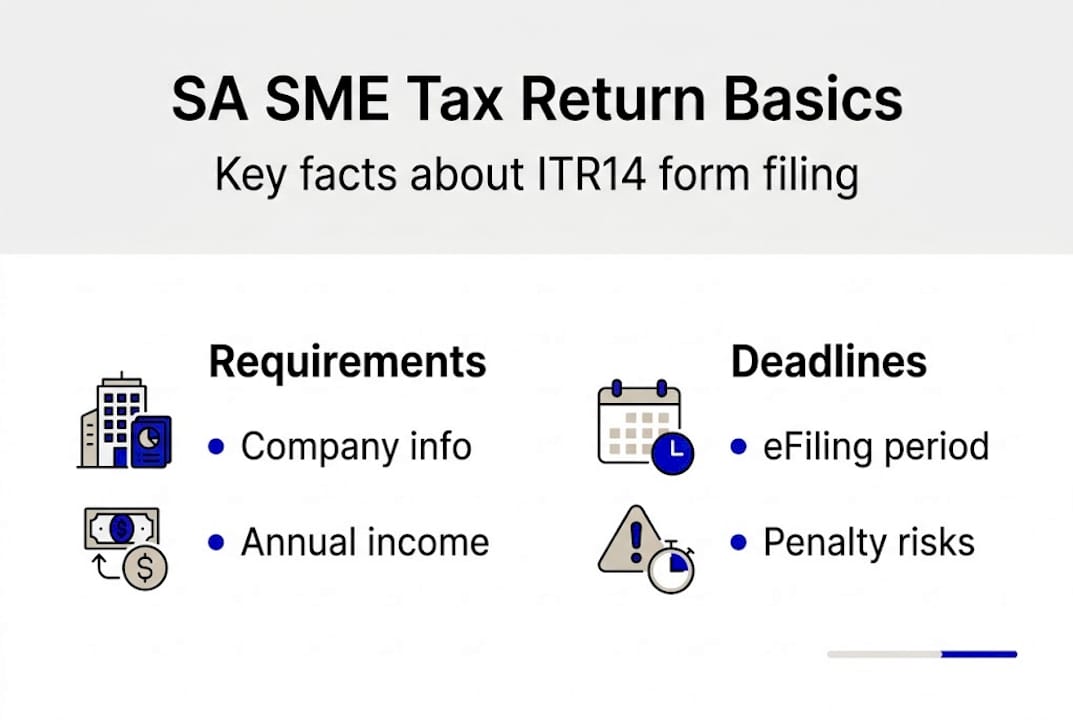
Sole proprietors and trusts use different forms, so the ITR14 applies specifically to companies, close corporations, and co-operatives. If you are unsure which entity type your business falls under, getting that clarity first prevents costly form errors down the line. The form is customised based on your company’s characteristics, so two businesses in the same industry may see different schedules.
Here is what you will typically need to report:
- Annual turnover and gross income
- Operating expenses and allowable deductions
- Asset schedules and depreciation
- Liabilities and loan accounts
- Provisional tax payments already made
- Supporting financial statements
The ITR14 is filed through SARS eFiling. If your business is not yet set up on the platform, SARS eFiling registration is the starting point. For businesses already using accounting software, the eFiling integration guide explains how to connect your records directly to the platform, saving significant time.
| Information required | Purpose on ITR14 |
|---|---|
| Annual income and turnover | Calculates gross taxable income |
| Allowable expenses | Reduces taxable income |
| Asset and depreciation schedules | Supports IT10B submission |
| Liabilities and equity | Reflects balance sheet position |
| Provisional tax paid | Reconciles final liability |
Pro Tip: The ITR14 form is dynamically generated, meaning SARS tailors the questions to your company type. A personal service company will see different fields than a manufacturing SME. Always verify your company classification before you start filling in the return.
Timeline and deadlines for filing ITR14
Once you understand what goes into an income tax return, it is crucial to know exactly when and how to file, on time.
The ITR14 deadline is 12 months after your company’s financial year-end. For companies with a February year-end, the return is due by 28 February of the following year of assessment. Companies with other year-ends follow the same 12-month rule, so a March year-end business files by the end of March the following year.
Here is a step-by-step walkthrough of the filing process:
- Finalise your annual financial statements before attempting to complete the return.
- Log in to SARS eFiling using your company’s registered credentials.
- Request the ITR14 from the returns section; SARS generates a customised form.
- Complete all required fields, including income, expenses, and asset schedules.
- Attach supporting documents such as financial statements and IT10B schedules.
- Review and submit the return, then save your submission confirmation.
Important: Admin penalties for late ITR14 submission range from R250 to R16,000 per month, recurring, based on your taxable income. Non-compliance also affects your Tax Compliance Status (TCS), which can block your business from government tenders and formal funding applications.
A lost TCS is not just a fine. It is a closed door. Many SMEs only discover this when they are mid-way through a tender application or a bank loan process. Proactive year-end tax planning is the most effective way to avoid this trap. Building the ITR14 preparation into your year-end financial close process means you are never scrambling at the last minute.
For businesses that have already received penalties, understanding how to avoid tax penalties going forward is the priority. The key is treating the deadline as fixed, not flexible.
Choosing the right tax regime: SBC vs turnover tax
Understanding the timeline helps with compliance, but choosing the right tax regime can optimise your tax outcome.
Not all SMEs pay the same rate of tax. South Africa offers two preferential regimes for qualifying small businesses: the Small Business Corporation (SBC) dispensation and the Turnover Tax system.
SBC qualification requires your business to be a private company, close corporation, or co-operative with gross income of R20 million or less. All shareholders must be natural persons, no shareholder may hold more than 20% in another company, and no more than 20% of income may come from investment or personal service activities unless you employ three or more full-time staff. When you qualify, you benefit from graduated tax rates: 0% on the first R95,750 of taxable income, 7% on R95,751 to R365,000, 21% on R365,001 to R550,000, and 27% above that, compared to the flat 27% standard corporate rate.
Turnover Tax is available to businesses with annual turnover of R1 million or less. It replaces income tax, VAT, and capital gains tax with a single simplified levy, making it attractive for micro-businesses with low expenses and minimal complexity.
| Feature | SBC | Turnover Tax |
|---|---|---|
| Turnover limit | R20 million | R1 million |
| Tax basis | Taxable income (graduated) | Turnover (flat) |
| Expense deductions | Yes, fully deductible | Not separately deducted |
| Best for | Expense-heavy SMEs | Micro, low-expense businesses |
| Replaces VAT | No | Yes (if not VAT registered) |
Scenarios where each regime makes sense:
- SBC suits businesses with significant deductible expenses, multiple employees, and taxable income above R95,750.
- Turnover Tax suits micro-businesses with very low overheads and turnover well below R1 million.
For more nuanced SBC tax questions or to explore tax efficient structures for your specific situation, the right regime choice can save tens of thousands of rands annually.
Pro Tip: If your business has high operating costs, SBC almost always wins over Turnover Tax because you can deduct those expenses before calculating tax. Turnover Tax ignores your costs entirely.
Provisional tax and supporting documentation requirements
Selecting your tax regime is strategic, but the paperwork and provisional payments play an equally critical role in staying compliant and accurate.
Provisional tax is how SARS collects corporate income tax during the year, before you file the ITR14. You pay it in two mandatory instalments via the IRP6 form: the first payment is due six months into your financial year, and the second is due at your financial year-end. A voluntary third payment (top-up) is available after year-end to avoid underestimation penalties.
The IRP6 and ITR14 work together. Your provisional payments are credits against your final tax liability. When you file the ITR14, SARS calculates what you actually owe and reconciles it against what you already paid. If you underpaid, you owe the difference plus potential penalties. If you overpaid, SARS refunds you.
Underestimating provisional tax by a material amount triggers a 10% penalty plus interest. This catches many SMEs off guard, especially in a growth year when profits jump unexpectedly.
Steps to prepare your documentation:
- Compile annual financial statements, including income statement and balance sheet.
- Prepare the IT10B schedule, which details your company’s assets and liabilities.
- Gather all expense invoices and supporting records for deductions claimed.
- Reconcile your IRP6 payments to confirm provisional tax credits.
- Review your fixed asset register to confirm depreciation calculations.
Required documents at a glance:
- Signed annual financial statements
- IT10B asset and liability schedule
- Fixed asset register
- Loan account reconciliations
- Provisional tax payment confirmations
For a complete business tax deductions checklist or guidance on reading financial statements, having these resources at hand before you start the ITR14 process saves significant back-and-forth.
Pro Tip: Use your prior year’s taxable income as a baseline for provisional tax estimates. Estimating too low to preserve cash flow is a common trap that results in penalties larger than the cash you saved.
Compliance, penalties, and business impact
Finally, knowing the risks and compliance requirements ensures you safeguard your business and unlock growth opportunities.
SARS requires businesses to keep records for five years. This includes invoices, bank statements, contracts, payroll records, and any documents supporting your tax return figures. A SARS audit can go back five years, so gaps in your records become gaps in your defence.
Common compliance mistakes SMEs make:
- Filing late because financial statements were not ready in time.
- Underreporting income due to poor bookkeeping or cash transactions not captured.
- Missing provisional tax deadlines, triggering penalties before the ITR14 is even filed.
- Incorrect entity classification, leading to wrong form completion.
- Failing to update SARS on changes to registered details or year-end dates.
Admin penalties for late ITR14 submission are recurring monthly charges. A business with taxable income above R1 million can face R16,000 per month until the return is filed and accepted. Over six months, that is R96,000 in penalties for a single missed return.
Beyond the financial cost, a compromised Tax Compliance Status blocks your business from government contracts, formal bank lending, and some supplier relationships. For growing SMEs, this is often a bigger threat than the fine itself.
For a full breakdown of your obligations, the SARS record-keeping rules guide covers exactly what to keep and for how long. Pairing that with a proactive approach to avoiding tax penalties gives your business the best chance of staying clean.
Pro Tip: Request your Tax Compliance Status PIN from SARS eFiling quarterly. It takes two minutes and immediately tells you if something has slipped through the cracks before it becomes a problem with a client or funder.
Why mastering income tax returns is business-critical: Our take
Here is what we have learned working with SMEs on tax compliance over many years: the biggest risk is not the penalty itself. It is the opportunity you lose when your compliance status is compromised at exactly the wrong moment.
Most SME tax failures we see are not caused by complex issues. They come from simple timing mistakes, missing one provisional payment, or submitting the ITR14 a month late because the financial statements were delayed. These are entirely preventable.
The businesses that handle tax well treat the ITR14 as a strategic process, not an annual scramble. They close their books on time, review their tax regime annually, and keep their records current throughout the year. That discipline does not just keep SARS happy. It produces better financial visibility, stronger funding applications, and a business that can move quickly when opportunities arise.
Our tax compliance guide for South African SMEs goes deeper on building that kind of system inside your business.
How we help South African SMEs streamline tax compliance
If you are ready to make income tax returns simpler and safer for your SME, here is how our solutions can help.
At Ready Accounting, we support South African SMEs with end-to-end tax compliance, from provisional tax calculations to ITR14 preparation and submission. Our cloud accounting benefits approach means your records are always current and audit-ready, so year-end is never a crisis. We help clients understand how to avoid penalties before they happen, not after. Our team also handles business record-keeping compliance, ensuring you meet the five-year retention requirement without the admin burden. Book a consultation and let us build a tax process that protects your business and supports your growth.
Frequently asked questions
What is the ITR14 form and who must file it in South Africa?
The ITR14 is the annual income tax return for South African companies, submitted to SARS by all incorporated businesses. Sole proprietors and trusts use different forms and are excluded from this requirement.
What supporting documents are required for an ITR14 submission?
You need signed annual financial statements, an IT10B asset and liability schedule, and any additional SARS-required schedules based on your specific company type and size.
How can late submission of ITR14 affect my business?
Late submission triggers recurring monthly penalties between R250 and R16,000 and can revoke your Tax Compliance Status, which blocks access to government tenders and formal business funding.
How does provisional tax relate to the final income tax return?
Provisional tax paid via IRP6 during the year is credited against your final liability when you file the ITR14. Underestimating provisional tax by a material amount triggers a 10% penalty plus interest on the shortfall.