

Outsourced accounting for startups: streamline finances 2026
Outsourced accounting for startups: streamline finances 2026
Managing finances as a startup founder in South Africa means juggling tax compliance, cash flow tracking, and regulatory updates while trying to grow your business. Many founders quickly discover that internal accounting becomes a bottleneck, consuming time and resources better spent on product development and customer acquisition. Outsourced accounting reduces errors and compliance risks by placing financial management in expert hands, freeing you to focus on what matters most. This guide walks you through preparing for, implementing, and optimizing outsourced accounting services designed specifically for South African startups in 2026.
Table of Contents
- Why Startups Need Outsourced Accounting In South Africa In 2026
- Preparing To Outsource Your Startup’s Accounting: Requirements And Considerations
- Implementing Outsourced Accounting With Cloud-Based Tools For Startups
- Monitoring, Verifying, And Optimizing Your Outsourced Accounting Results
- Explore Expert Outsourced Accounting Services For South African Startups
Key takeaways
| Point | Details |
|---|---|
| Focus on growth | Outsourced accounting handles complex financial tasks professionally, letting founders concentrate on business development and strategy. |
| Real-time visibility | Cloud-based tools provide instant access to financial data, improving decision-making and cash flow management. |
| Simplified compliance | Expert providers navigate South African tax regulations including VAT and SARS requirements, reducing compliance risks. |
| Strategic selection | Choosing the right partner requires evaluating service scope, technology compatibility, and proven expertise in local regulations. |
Why startups need outsourced accounting in South Africa in 2026
Startup founders face a unique challenge: building a business while managing increasingly complex financial obligations. Most early-stage companies lack dedicated accounting staff, leaving founders to navigate tax deadlines, payroll calculations, and regulatory changes themselves. This DIY approach creates bottlenecks that slow growth and increase the risk of costly errors.
South African startups must comply with specific tax requirements that demand specialized knowledge. VAT registration thresholds, SARS submission deadlines, and evolving tax legislation require constant attention. When founders handle these tasks internally, they often miss optimization opportunities or make mistakes that trigger penalties. Understanding what outsourced accounting offers helps you see how professional support addresses these pain points systematically.
Outsourcing transforms accounting from a burden into a strategic advantage. Expert providers bring specialized knowledge of South African regulations, reducing compliance risks while improving accuracy. They implement proven systems that catch errors before they become problems, maintaining clean records that satisfy auditors and investors alike.
Key accounting challenges South African startups face in 2026:
- Meeting quarterly VAT submissions and annual tax return deadlines without missing critical dates
- Monitoring cash flow accurately to prevent shortfalls that threaten operations
- Managing payroll complexity including PAYE, UIF, and SDL calculations for growing teams
- Adapting to regulatory changes in tax law and reporting requirements
- Maintaining audit-ready records that satisfy investors and compliance bodies
Pro Tip: Establish clear communication channels with your outsourced provider from day one, including preferred contact methods, response time expectations, and escalation procedures for urgent matters.
“Startups that outsource accounting early gain a significant advantage. They avoid the costly mistakes that come from inexperience while building financial systems that scale with growth. The time saved allows founders to focus on revenue generation rather than reconciliation.” – Financial consulting expert
Preparing to outsource your startup’s accounting: requirements and considerations
Successful outsourcing starts with thorough preparation. Before engaging a provider, gather your existing financial records and organize them systematically. This groundwork ensures a smooth transition and helps potential partners assess your needs accurately.
Essential documents to compile before outsourcing:
- Bank statements for all business accounts covering the past 12 months
- Invoices issued and received, organized by date and payment status
- Payroll records including employee details, salary information, and tax withholdings
- Previous tax returns and SARS correspondence
- Business registration documents and compliance certificates
- Existing financial statements if available
Selecting the right accounting partner requires evaluating multiple factors beyond price. Understanding the cost structures helps you compare options effectively, but service quality and cultural fit matter equally.
Criteria checklist for choosing your provider:
- Verify experience specifically with South African startups in your industry
- Confirm expertise in current SARS regulations and VAT compliance
- Assess technology stack compatibility with your preferred cloud platforms
- Review service scope to ensure it covers your current and anticipated needs
- Evaluate communication style and responsiveness during initial consultations
- Check professional certifications and membership in recognized accounting bodies
- Request detailed pricing breakdowns showing what each tier includes
| Pricing Model | Typical Range (Monthly) | Best For | Considerations |
|---|---|---|---|
| Fixed monthly fee | R3,000 - R8,000 | Predictable transaction volumes | May require renegotiation as you scale |
| Hourly billing | R500 - R1,200/hour | Variable workload needs | Costs can escalate unexpectedly |
| Tiered packages | R2,500 - R12,000 | Growing startups | Ensure smooth transitions between tiers |
| Transaction-based | R15 - R50 per transaction | High-volume businesses | Calculate total cost based on activity |
Pro Tip: Ask potential providers for client references from startups at similar growth stages, then contact those references to learn about responsiveness, accuracy, and how the provider handles problems.
Request detailed proposals from at least three providers. Compare not just pricing but service levels, technology platforms, reporting frequency, and support availability. The cheapest option rarely delivers the best value, especially when compliance mistakes can cost thousands in penalties.
Implementing outsourced accounting with cloud-based tools for startups
Transitioning to outsourced accounting requires careful coordination between your team and the new provider. A structured implementation plan minimizes disruption while establishing workflows that support long-term success.
Step-by-step implementation process:
- Complete data handover by providing all financial records and system access credentials
- Configure cloud accounting software with your chart of accounts and reporting preferences
- Align workflows by documenting approval processes, invoice handling, and payment schedules
- Train your team on new procedures for submitting expenses, receipts, and financial requests
- Establish reporting cadence including monthly close timelines and review meetings
- Test integration points between accounting software and other business systems
- Conduct initial reconciliation to verify accuracy and resolve any discrepancies
Cloud accounting platforms form the backbone of modern outsourced services. Comparing Xero, SageOne, and QuickBooks reveals important differences in features, pricing, and South African tax compliance capabilities.

| Platform | Monthly Cost | SA Tax Features | Best For | Mobile App Quality |
|---|---|---|---|---|
| Xero | R349 - R899 | Strong VAT automation | Multi-user collaboration | Excellent |
| SageOne | R199 - R499 | Built-in SARS integration | Budget-conscious startups | Good |
| QuickBooks | R450 - R1,200 | Comprehensive reporting | Inventory management needs | Excellent |
| FreshBooks | $15 - $50 USD | Limited SA features | Service-based businesses | Good |
Successful collaboration depends on clear communication protocols. Define how you’ll share information, who approves transactions, and when you’ll review financial reports. Many startups schedule brief weekly check-ins during implementation, transitioning to monthly reviews once workflows stabilize.
Pro Tip: Schedule quarterly strategic reviews beyond routine bookkeeping discussions to analyze financial trends, identify cost-saving opportunities, and adjust accounting processes as your business model evolves.
Integration extends beyond basic bookkeeping. Connect your accounting platform to payment processors, invoicing systems, and inventory management tools. These integrations eliminate manual data entry, reducing errors while providing real-time financial visibility. Your outsourced provider should guide you through setting up these connections and troubleshooting any sync issues.
Monitoring, verifying, and optimizing your outsourced accounting results
Outsourcing doesn’t mean abandoning oversight. Regular monitoring ensures your provider delivers accurate, timely results while identifying opportunities to improve efficiency and reduce costs.
Key performance indicators to track:
- Timeliness of monthly close completion and financial statement delivery
- Accuracy measured by reconciliation discrepancies and correction frequency
- Responsiveness to questions and requests for information
- Compliance adherence including on-time tax submissions and regulatory filings
- Value-added insights provided beyond basic transaction processing
Monthly review checklist:
- Verify bank reconciliations show zero unexplained differences
- Confirm all invoices and bills are recorded in the correct period
- Review expense categorization for accuracy and consistency
- Check cash flow projections against actual results
- Validate payroll calculations and tax withholdings
- Examine aged receivables and payables for collection issues
Reading financial statements effectively empowers you to spot problems early and ask informed questions. Understanding basic financial metrics helps you evaluate whether your outsourced provider is delivering the insights you need for strategic decisions.
Annual comprehensive review steps:
- Compare actual financial performance against budgets and forecasts
- Assess whether current service tier still matches your transaction volume
- Evaluate technology platform effectiveness and consider upgrades
- Review security protocols and access controls for financial systems
- Benchmark pricing against current market rates for similar services
- Solicit feedback from your team about working with the provider
Common pitfalls to avoid during oversight:
- Ignoring small discrepancies that signal larger systematic issues
- Failing to update the provider about business changes affecting accounting needs
- Accepting generic reports instead of requesting customized insights
- Overlooking opportunities to automate repetitive manual processes
- Neglecting to verify that backup and disaster recovery procedures are current
When you identify issues, address them promptly through structured conversations. Document concerns specifically, propose solutions, and establish timelines for resolution. Most problems stem from miscommunication rather than incompetence, making clear dialogue the most effective remedy.
Cost-benefit evaluation process:
- Calculate total monthly investment including software and service fees
- Estimate time saved by founders and staff no longer handling accounting tasks
- Quantify error reduction by comparing pre and post-outsourcing accuracy
- Assess compliance risk mitigation value based on penalty avoidance
- Measure strategic value of insights gained for business decisions
- Compare against alternative scenarios like hiring internal staff
Renegotiation becomes necessary as your startup scales. Transaction volumes increase, complexity grows, and your needs evolve. Proactively discuss service adjustments before you outgrow your current tier, ensuring pricing and scope remain aligned with value delivered.
Explore expert outsourced accounting services for South African startups
Ready Accounting specializes in cloud-based financial solutions designed specifically for South African startups navigating growth while maintaining compliance. Our team understands the unique challenges founders face, from managing limited resources to meeting SARS requirements without dedicated finance staff. We combine deep expertise in local tax regulations with cutting-edge cloud technology to deliver accounting services that scale with your business.
Our tailored approach adapts to your specific industry and growth stage. Whether you’re pre-revenue and need basic bookkeeping or scaling rapidly and require sophisticated financial analysis, we configure services that match your current needs and budget. Discover cloud accounting benefits that transform financial management from a burden into a competitive advantage. Learn how cloud-based systems support growth while maintaining the accuracy and compliance investors demand. Explore what cloud accounting means for your business and schedule a consultation to discuss your specific requirements.
FAQ
What are the main benefits of outsourced accounting for startups?
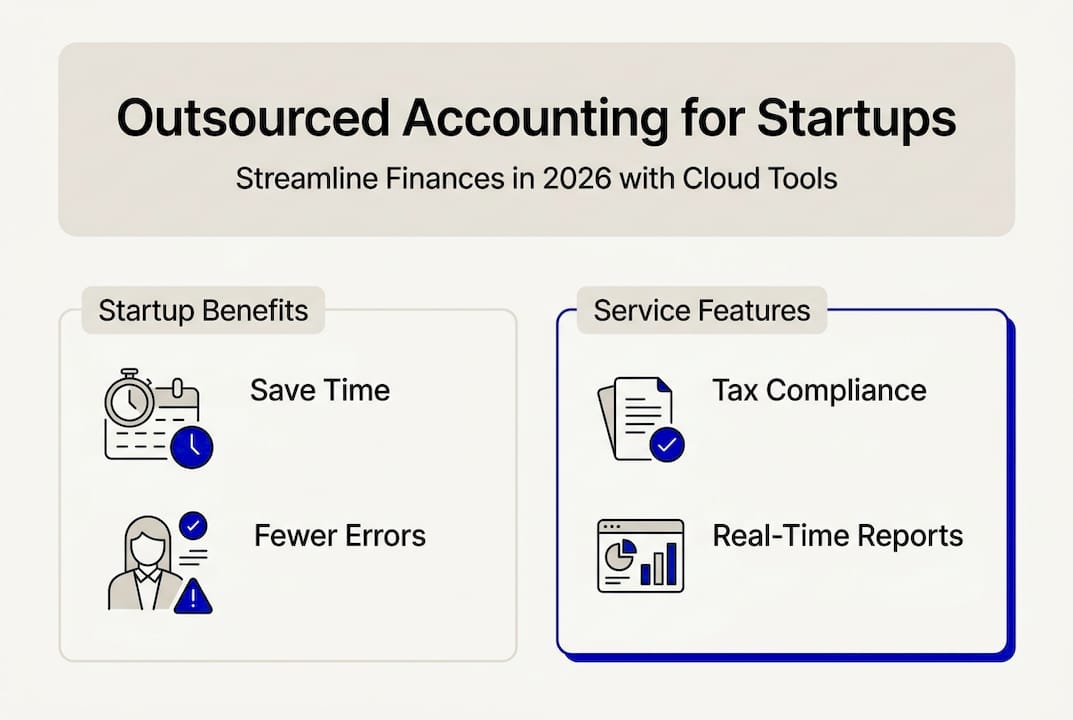
Outsourced accounting delivers three core advantages for startups. First, it dramatically reduces errors through professional expertise and proven systems, protecting you from costly mistakes and compliance penalties. Second, it saves significant time that founders can redirect toward revenue-generating activities like product development and customer acquisition. Third, it ensures compliance with South African tax regulations including VAT and SARS requirements, giving you confidence that financial obligations are handled correctly.
How do I choose the best outsourced accounting service for my startup in South Africa?
Start by comparing pricing models and service scope to understand what different providers offer at various price points. Validate that candidates have specific expertise in South African tax regulations and experience working with startups in your industry. Request client references from businesses at similar growth stages, then contact those references to verify reliability, responsiveness, and problem-solving capabilities. Ensure the provider uses cloud technology compatible with your preferred platforms.
What cloud accounting software works best with outsourced accounting?
Xero, SageOne, and QuickBooks Online dominate the South African startup market, each offering strong features balanced with local compliance capabilities. Compare these platforms to understand which aligns best with your specific needs, considering factors like transaction volume, team size, and industry requirements. Your outsourced provider should recommend the platform that integrates most smoothly with their workflows while supporting your growth trajectory.
How long does it take to implement outsourced accounting for a startup?
Implementation typically takes two to four weeks depending on your financial record quality and business complexity. The process includes data handover, software configuration, workflow alignment, and team training. Startups with organized records and simple transaction patterns often complete setup faster, while those requiring cleanup or multiple system integrations need additional time. Plan for an initial adjustment period where you’ll communicate frequently with your provider to refine processes.
Can outsourced accounting scale as my startup grows?
Quality outsourced providers design services specifically to scale with your business. They offer tiered packages that accommodate increasing transaction volumes, additional entities, and more sophisticated reporting needs. As you grow, you can add services like financial forecasting, investor reporting, and strategic advisory without changing providers. Discuss your growth plans during initial conversations to ensure your chosen partner has the capacity and expertise to support your long-term trajectory.
Recommended
- What Is Outsourced Accounting? Simplified Guide for 2025 - Ready Accounting
- Ultimate Guide to Accounting Automation in 2025 - Ready Accounting
- How to Outsource Accounting for Small South African Businesses - Ready Accounting
- Why Outsource Accounting: Simplify Finances for SA Businesses - Ready Accounting
- Planification lancement startup 2026 : guide stratégique complet