

Payroll compliance checklist: Easy steps for SA SMEs
Executive Summary
- Payroll compliance in South Africa involves complex tax, UIF, and SDL regulations with strict deadlines.
- Automating payroll processes reduces errors, saves time, and ensures compliance with SARS requirements.
- Proper record-keeping and regular internal audits are essential to avoid penalties and build business trust.
Payroll compliance is one of those back-office tasks that feels manageable until it suddenly isn’t. SMBs spend over 80 hours yearly on compliance tasks, and that number climbs steeply once you factor in South Africa’s specific SARS requirements, tax table updates, and multi-form submission cycles. Get one step wrong and you are not just looking at paperwork headaches. You are looking at penalty fees, employee disputes, and potential audits. This checklist cuts through the complexity and gives South African SME owners a clear, practical path to payroll compliance without the stress.
Table of Contents
- Why payroll compliance matters for South African SMEs
- Step-by-step payroll compliance checklist for South Africa
- Automation vs in-house payroll: Which solution fits your business?
- Essential record-keeping and audit practices
- Our take: What most compliance guides miss for South African SMEs
- Streamline your payroll compliance with Ready Accounting
- Frequently asked questions
Key Takeaways
| Point | Details |
|---|---|
| Compliance saves money | Following a payroll checklist reduces fines and financial risk. |
| Automation is key | Automated payroll tools make compliance easier and help prevent errors. |
| Record-keeping matters | Keeping audit-ready payroll records is essential for ongoing SARS compliance. |
| Choose the right solution | Decide between automation and in-house processing based on your team size and risk tolerance. |
Why payroll compliance matters for South African SMEs
Payroll compliance is not just a box-ticking exercise. It sits at the heart of how your business is perceived by employees, by SARS, and by potential investors or acquirers. When your payroll runs cleanly, on time, and accurately, it signals that your business is well-managed. When it doesn’t, the consequences stack up quickly.
The most immediate risk is financial. 25% of SMBs are fined for payroll compliance errors every year. In South Africa, SARS has a structured penalty framework that applies to late EMP201 submissions, incorrect PAYE (Pay As You Earn) calculations, and failures to register for UIF (Unemployment Insurance Fund) or SDL (Skills Development Levy). These are not small administrative slaps. Penalties can be calculated as a percentage of the outstanding amount, and interest accrues on unpaid tax from the first day it was due.
Beyond the financial hit, there is the reputational angle. Employees who receive incorrect payslips, late payments, or wrong tax certificates lose trust fast. That trust is extremely difficult to rebuild, and in a competitive talent market, it can affect your ability to retain skilled staff. Poor payroll management also creates complications for your annual financial statements, which matters enormously if you are seeking funding or planning to scale.
Here are the key risk areas every South African SME owner needs to watch:
- Late or incorrect PAYE submissions to SARS, which trigger automatic penalties
- UIF under-declaration, where employee contributions are calculated on the wrong salary base
- SDL miscalculation, particularly for businesses hovering near the R500,000 annual payroll threshold
- Failure to issue IRP5 certificates correctly at year-end, which affects employees’ personal tax returns
- Missing the EMP501 reconciliation deadline, which creates a backlog that SARS will flag and investigate
A good payroll management guide will walk you through these risks in detail, but the core message is simple: non-compliance is far more expensive than doing it right the first time.
“Payroll compliance is not just about paying employees. It’s about fulfilling your obligations as an employer to the state and to your workforce. Errors compound and rarely fix themselves.”
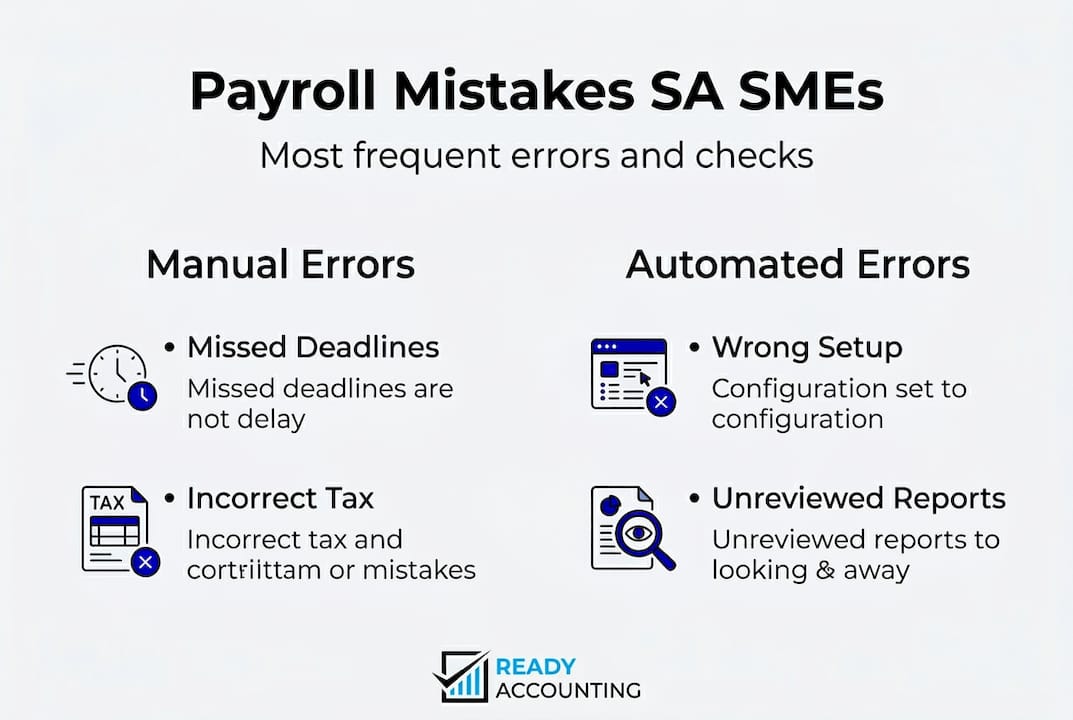
Understanding common payroll mistakes is the first line of defense. Most SME payroll errors are not caused by bad intentions. They come from outdated processes, incorrect tax table references, and manual calculations that introduce human error. Knowing where others have stumbled gives you a real advantage before you even start building your compliance checklist.
Step-by-step payroll compliance checklist for South Africa
Now that you understand the stakes, here is a practical checklist for compliant payroll operations in South Africa. Work through these steps in order, especially if you are setting up payroll for the first time or auditing your current process.
-
Register with SARS as an employer. Before you process a single payslip, you must be registered as an employer on SARS eFiling. This registration links your EMP201 submissions and gives you an employer tax reference number.
-
Verify every employee’s personal and tax details. Collect each employee’s ID number, tax number (or apply for one if they don’t have it), banking details, and signed employment contract. Errors at this stage cause cascading problems down the line.
-
Calculate PAYE correctly using the latest tax tables. PAYE is calculated on each employee’s gross remuneration, minus allowable deductions. SARS updates tax tables annually, usually in March. Using the previous year’s tables is one of the most common and costly mistakes in South African payroll.
-
Calculate UIF and SDL contributions accurately. UIF is 1% from the employer and 1% from the employee, capped at a monthly salary of R17,712 as of the current period. SDL is 1% of total payroll for businesses with an annual payroll exceeding R500,000.
-
Issue payslips every pay cycle. The Basic Conditions of Employment Act (BCEA) requires that every employee receive a written payslip. This must include gross pay, all deductions, and net pay.
-
Submit your EMP201 return by the seventh of every month. The EMP201 is your monthly declaration of PAYE, UIF, and SDL. Late submission triggers immediate penalties, so calendar reminders and automated submissions are not optional extras, they are essentials.
-
Reconcile your EMP501 bi-annually. The EMP501 submission reconciles all monthly EMP201 payments with the actual amounts paid to employees. Submissions are due in May and October each year.
-
Update your tax tables every March. Budget season brings changes to tax brackets, rebates, and thresholds. Your payroll system must reflect these changes from the first pay cycle in the new tax year.
-
Maintain audit-ready records for at least five years. Store payslips, EMP forms, tax declarations, and employment contracts securely and in an easily retrievable format.
-
Automate wherever possible. SMBs spend over 80 hours yearly on compliance. Automation cuts that number dramatically while reducing the risk of manual errors.
Here’s a quick comparison of what manual vs automated payroll looks like in practice:
| Task | Manual payroll | Automated payroll |
|---|---|---|
| Tax table updates | Must be done manually each March | Updated automatically by the software |
| EMP201 submission | Filed manually via eFiling | Submitted directly through payroll system |
| Error detection | Relies on manual checking | Flagged in real time by the system |
| Audit trail | Paper-based and fragmented | Digital, timestamped, and centralised |
| Time per pay cycle | 4 to 8 hours for medium teams | 30 to 60 minutes for most SMEs |
A detailed payroll tax guide will give you the specific calculations behind PAYE, UIF, and SDL. And if your current process feels heavy, the practical steps in streamlining payroll management will help you cut the time and effort involved significantly.
Pro Tip: Set a recurring internal calendar reminder for the 1st of every month to begin payroll preparation. By the time you reach the 7th (the EMP201 deadline), everything should already be reviewed and ready to submit.
Automation vs in-house payroll: Which solution fits your business?
With the checklist in hand, consider which approach best helps you stay compliant consistently. This is one of the most practical decisions an SME owner will make, and it has real consequences for your risk exposure.
Automation is strongly recommended for tax table updates, audit trails, and EMP filings. In-house manual payroll is only truly viable for very small teams, and even then, the margin for error is uncomfortable. Here is why the comparison matters.
In-house payroll works reasonably well when you have fewer than five employees, a stable and straightforward salary structure, and someone with solid accounting knowledge managing the process. The risk grows almost exponentially as your headcount increases, because each additional employee adds more variables: different tax brackets, varying leave accruals, variable commission structures, and potentially different UIF contribution bases.
Automated payroll software removes most of these variables from human hands. Reputable South African payroll platforms handle tax table updates automatically, generate EMP201 and EMP501 submissions directly, and maintain a complete, timestamped audit trail of every change made to the payroll data. This matters enormously during a SARS audit.
| Factor | In-house payroll | Automated payroll software |
|---|---|---|
| Upfront cost | Low (no software subscription) | Monthly subscription required |
| Error risk | High, especially at scale | Low, with system validation |
| Time required | High (manual input and checking) | Significantly reduced |
| SARS compliance | Dependent on human diligence | Built into the software logic |
| Audit readiness | Often incomplete | Centralised and retrievable |
| Scalability | Poor beyond 5 to 10 employees | Scales with your business |
Popular South African payroll platforms include SimplePay, Sage Payroll, and PaySpace. Each offers different features, and the right choice depends on your team size, integration needs, and budget. A detailed guide to registering SimplePay is a useful starting point if you are exploring that option.
Key considerations when choosing a solution:
- Does the software integrate with your accounting platform (e.g., Xero or Sage)?
- Does it automatically update SARS tax tables without manual intervention?
- Does it generate EMP201 and EMP501 reports in the format SARS requires?
- Does it store payslips and supporting documents securely for five or more years?
- What happens to your data if you cancel the subscription?
Pro Tip: Before committing to any payroll software, run a free trial during a quiet month and process a full pay cycle as a test. This reveals gaps in functionality before they become real compliance problems.
Essential record-keeping and audit practices
Whether you automate or manage payroll in-house, robust record-keeping completes a solid compliance strategy. This is the part most SME owners underestimate until SARS comes knocking.

The Basic Conditions of Employment Act and SARS both require that you retain payroll records for a minimum of five years. That means payslips, tax deduction records, UIF contribution records, EMP201 submissions, EMP501 reconciliations, and employment contracts must all be stored and retrievable on demand. Saying “we lost it in a computer crash” is not a defense that SARS accepts.
Audit trails are essential for compliance, especially when using automation. Every change made to an employee’s salary, tax code, or deduction must be logged with a timestamp and the identity of who made the change. This is not just good housekeeping. It is your primary evidence in the event of a dispute or audit.
Here is what your record-keeping system must include:
- Signed employment contracts for every employee, updated whenever terms change
- Monthly payslips for all employees, including those who have since left the company
- Tax deduction certificates (IRP5) issued at the end of every tax year
- EMP201 submission confirmations for every month of the tax year
- EMP501 reconciliation reports for each bi-annual submission period
- Leave records and any changes to variable pay, bonuses, or allowances
- UIF contribution records, including registration confirmation from the Department of Labour
“Good record-keeping is not just about staying out of trouble. It is a sign of a professionally managed business that respects its employees and its obligations to the state.”
Internal audits are your early warning system. Scheduling a payroll audit every quarter allows you to catch errors before they compound into a full year of miscalculations. During a quarterly audit, you should check that tax codes are current, that all new employees are correctly registered, and that any employees who left during the period have been correctly handled for UIF and final PAYE purposes.
Understanding payroll taxes for SMBs and the fundamentals of payroll tax basics will sharpen your ability to spot discrepancies during these internal reviews. The more fluent you are in the numbers, the faster you will catch a problem before it becomes a penalty.
Our take: What most compliance guides miss for South African SMEs
Most payroll compliance guides treat compliance as a checklist to complete once and file away. That misses the real danger. A single miscalculation in one pay cycle, a wrong tax code on one employee’s file, or a missed EMP201 deadline in one month can snowball into a significant liability by year-end. SARS interest on late payments is not trivial, and it starts from day one.
The guides also rarely mention proactive communication with SARS. If you realise you have made an error, contacting SARS before they contact you almost always results in a more manageable outcome. Voluntary disclosure is treated very differently from discovered non-compliance.
We also strongly recommend building “mini audits” into your monthly routine, not just quarterly. A 30-minute payroll review at the end of each cycle catches transposition errors, missing tax numbers, and incorrect deductions before they propagate. Pair that with a payroll platform that sends compliance alerts when something is off, and you have a genuinely resilient system.
Understanding common payroll mistakes is the fastest way to build this awareness. Most errors follow predictable patterns, which means they are also predictably preventable.
Streamline your payroll compliance with Ready Accounting
Putting this checklist into practice is significantly easier with the right infrastructure behind you. Ready Accounting helps South African SMEs replace fragmented, manual payroll processes with automated cloud systems that keep you compliant, audit-ready, and penalty-free year-round. From identifying which accounting automation tasks will save you the most time, to building a proactive strategy for reducing tax liability and avoiding tax penalties, our team acts as your Fractional CFO. We turn payroll compliance from a monthly stress point into a seamless, automated process that protects your business and frees you to focus on growth.
Frequently asked questions
What are the main payroll compliance deadlines for South African businesses?
EMP201 returns must be filed by the seventh of every month, and EMP501 reconciliations are due bi-annually in May and October to SARS.
How can SMEs avoid payroll compliance mistakes?
Automating calculations and filings, running regular internal audits, and staying updated on annual SARS tax table changes are the three most effective measures.
What are the consequences of payroll non-compliance?
25% of SMBs face fines for compliance errors annually, and in South Africa those fines come with accruing interest, potential legal exposure, and reputational damage with employees.
Is in-house payroll compliance safe for small teams?
In-house payroll is only viable for very small teams with simple salary structures, because the complexity and error risk grow sharply as employee numbers and variable pay components increase.