

Role of Accountants in Business: Essential Support for SA Companies 2025
Accountants are more than number crunchers in South African business. They are quietly steering companies with deep financial expertise and sharp technology skills. Here is a shocker. Firms that use professional accountants can cut their tax compliance risks by up to 60 percent and improve their long-term sustainability by as much as 45 percent. Most would think accountants just keep the books balanced. That view misses how they actually help businesses grow smarter, stay legal, and tap into modern tools like cloud accounting that give every rand real power.
Table of Contents
- Key Functions of Accountants in Business
- Helping Small Businesses With Tax and Payroll
- Cloud Accounting for Modern South African Firms
- Simplifying Company Registration and Compliance
Quick Summary
| Takeaway | Explanation |
|---|---|
| Accountants provide strategic financial planning. | They analyze financial data to forecast revenues and create cost-saving strategies for sustainable growth. |
| Compliance ensures regulatory adherence and reduces risks. | Accountants help businesses navigate complex laws, manage tax obligations, and prepare necessary documentation to avoid penalties. |
| Cloud accounting enhances operational efficiency. | This technology automates financial processes, reduces errors, and offers real-time data access, benefiting small businesses significantly. |
| Professional tax management optimizes savings. | Accountants assist with strategic tax planning and compliance, minimizing liabilities and maximizing deductions for small businesses. |
| Streamlined company registration simplifies compliance. | Accountants guide businesses through the registration process, ensuring documentation is accurate, which aids in long-term government adherence. |
Key Functions of Accountants in Business
Accountants serve as critical financial architects for businesses, providing far more than simple number crunching. Their role encompasses strategic financial management, compliance, and business intelligence that directly impacts a company’s sustainability and growth in the competitive South African market.
Financial Planning and Strategic Guidance
At the core of an accountant’s responsibilities is financial planning. These professionals do more than record transactions they transform raw financial data into strategic insights. They analyze financial statements, identify potential cost savings, and develop comprehensive financial strategies that align with a business’s long term objectives. Learn more about financial strategy insights.
For South African businesses navigating complex economic landscapes, accountants provide crucial predictive analysis. By examining historical financial performance, they can forecast potential revenue streams, anticipate cash flow challenges, and recommend proactive financial interventions. According to SAICA Research, strategic financial planning can improve business sustainability by up to 45% in emerging markets.
Compliance and Risk Management
Navigating South Africa’s intricate regulatory environment requires specialized expertise. Accountants ensure businesses remain compliant with SARS regulations, tax laws, and financial reporting standards. They manage critical processes like VAT registration, annual financial statement preparation, and tax return submissions.
Risk management is another pivotal function. Accountants conduct thorough financial audits, identify potential financial vulnerabilities, and develop robust internal control mechanisms. By implementing systematic checks and balances, they protect businesses from potential financial misconduct and regulatory penalties.
Technology and Financial Reporting
Modern accountants leverage advanced technological tools to streamline financial processes. Cloud accounting platforms, automated reporting systems, and sophisticated financial software enable more efficient and accurate financial management. These technological capabilities allow accountants to provide real time financial insights, helping businesses make informed decisions quickly.
Financial reporting goes beyond mere documentation. Professional accountants translate complex financial data into comprehensible reports that guide strategic decision making. They prepare detailed income statements, balance sheets, and cash flow analyses that offer clear visibility into a company’s financial health.
By combining deep financial expertise with technological proficiency, accountants have become indispensable strategic partners for South African businesses seeking sustainable growth and financial optimization.
Helping Small Businesses With Tax and Payroll
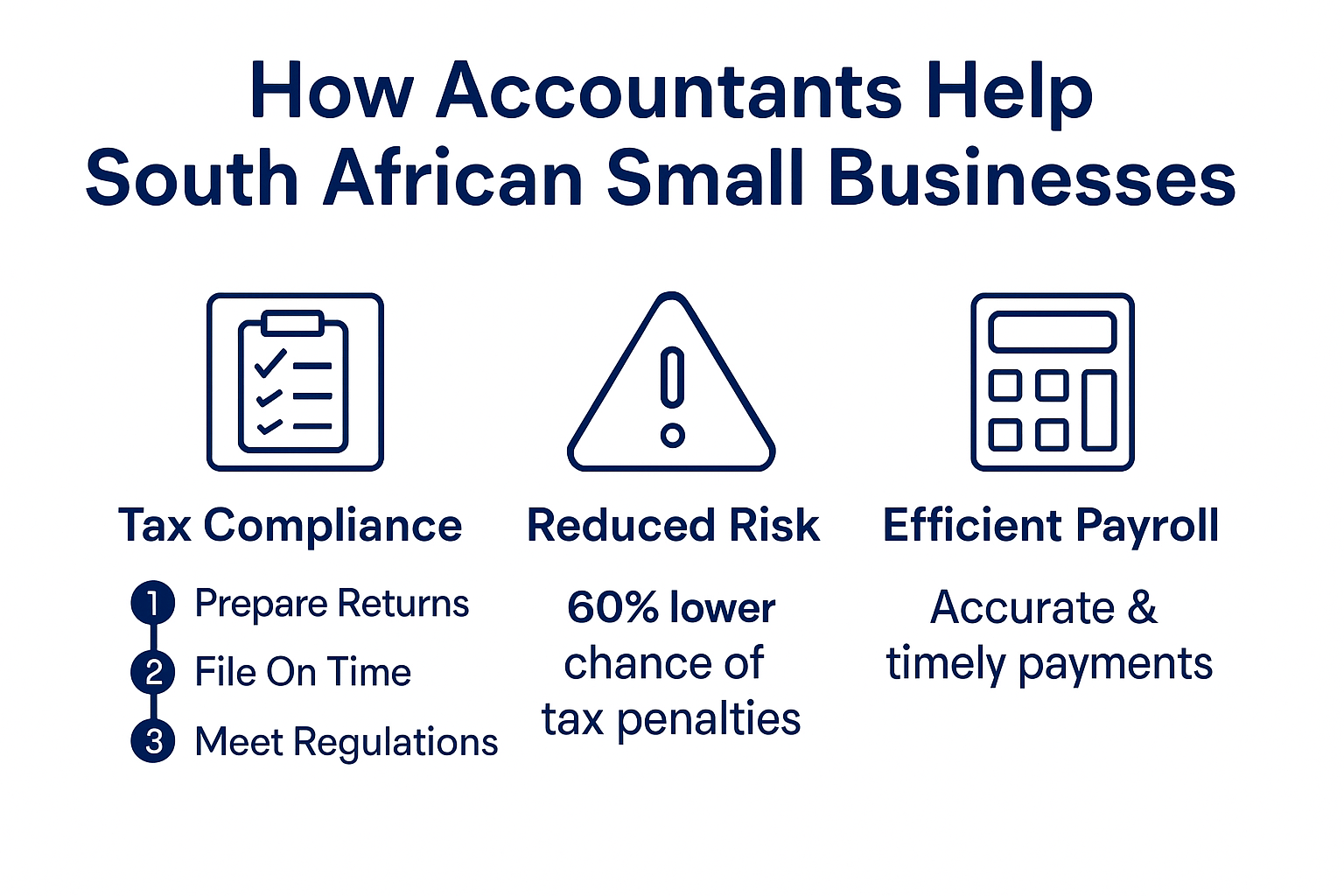
Small businesses in South Africa face complex financial challenges, particularly when managing tax obligations and payroll processes. Accountants play a critical role in navigating these intricate financial requirements, providing essential support that enables businesses to remain compliant while focusing on core operational growth.
Strategic Tax Management and Compliance
Tax management represents a significant burden for small businesses. Professional accountants offer comprehensive support by ensuring accurate tax calculations, timely submissions, and strategic tax planning. According to ADP Research, businesses that leverage professional accounting services reduce their tax compliance risks by up to 60%.
Accountants help businesses understand complex tax regulations, identify potential deductions, and develop proactive tax strategies. They manage critical processes like VAT registration, income tax returns, and PAYE submissions. Learn more about effective tax planning strategies.
For South African businesses, this means minimizing tax liabilities while maintaining full compliance with SARS regulations. By staying updated on the latest tax legislation, accountants help businesses avoid costly penalties and optimize their financial position.
Payroll Management and Employee Compliance
Payroll processing extends far beyond simple salary calculations. Accountants ensure businesses meet all legal requirements related to employee compensation, tax withholdings, and statutory contributions. They manage complex payroll calculations, including overtime, leave payments, and statutory deductions.
According to Enterprise Nation Research, professional payroll management helps businesses maintain accurate financial records, ensure timely employee payments, and reduce administrative burdens. This allows business owners to concentrate on strategic growth and core business activities.
Technology and Efficient Financial Processes
Modern accountants leverage advanced technological solutions to streamline tax and payroll processes. Cloud-based accounting platforms and specialized payroll software enable more accurate and efficient financial management. These tools allow for real time tracking of financial transactions, automated reporting, and seamless compliance monitoring.
Explore our comprehensive payroll software guide to understand how technology transforms financial management for small businesses. By integrating sophisticated technological solutions, accountants help businesses reduce manual errors, improve data accuracy, and enhance overall financial efficiency.
For South African small businesses, partnering with a professional accountant means more than just meeting regulatory requirements. It represents a strategic investment in financial expertise that supports sustainable business growth, reduces risk, and provides clear financial insights for informed decision making.
To clarify the advantages accountants bring to small business tax and payroll, the following table summarizes their main contributions and benefits for South African companies:
| Accountant’s Service Area | Key Activities | Benefit to Small Businesses |
|---|---|---|
| Tax Management | Accurate tax calculations, timely submissions, tax planning | Reduced compliance risk, lower penalties |
| Regulations & Deductions | Identifying deductions, navigating SARS requirements | Optimized savings, increased compliance |
| Payroll Processing | Salary, overtime, and statutory calculations | Timely payments, legal adherence |
| Statutory Submissions | PAYE, VAT, income tax returns | Avoidance of costly late submission fines |
| Technology Adoption | Cloud accounting, payroll software | Improved efficiency, reduced manual errors |
Cloud Accounting for Modern South African Firms
Cloud accounting has emerged as a transformative technology for South African businesses, offering unprecedented flexibility, efficiency, and strategic financial management. As companies navigate increasingly complex economic landscapes, cloud-based accounting solutions provide critical tools for sustainable growth and competitive advantage.
Technology Adoption and Business Transformation
Cloud accounting represents more than just a technological upgrade it is a fundamental shift in how businesses manage financial processes. Research from the University of South Africa reveals that smaller firms are particularly agile in adopting cloud accounting technologies, recognizing their potential to streamline operations and reduce administrative burdens.
According to a comprehensive cloud computing study, South African small and medium enterprises perceive cloud technologies as having significant relative advantages. These advantages include real time financial data access, reduced infrastructure costs, and enhanced collaboration capabilities. For modern South African firms, cloud accounting means breaking free from traditional, location-bound financial management systems.
Operational Efficiency and Cost Management
Cloud accounting platforms enable businesses to automate complex financial processes, reducing manual data entry and minimizing human error. By integrating advanced software solutions, companies can generate instant financial reports, track expenses, and manage cash flow with unprecedented precision. Explore our guide on optimizing accounting services to understand how cloud technologies are reshaping financial management.
The cost benefits are substantial. Traditional accounting methods require significant investments in physical infrastructure, software licenses, and dedicated IT support. Cloud accounting eliminates these barriers, offering scalable solutions that grow alongside the business. Small businesses can access enterprise-grade financial tools without prohibitive upfront investments.
Security and Compliance in the Digital Age
Contrary to initial concerns, cloud accounting platforms offer robust security measures that often surpass traditional financial management systems. Advanced encryption, multi factor authentication, and continuous system updates provide comprehensive protection against cyber threats. For South African businesses navigating complex regulatory environments, these platforms ensure consistent compliance with SARS regulations and financial reporting standards.
Modern cloud accounting solutions integrate seamlessly with existing business systems, providing real time insights that enable proactive financial decision making. They offer automatic backups, remote access, and collaborative features that traditional accounting methods cannot match. Businesses can securely access financial data from anywhere, at any time, ensuring continuous operational flexibility.
As South African firms continue to embrace digital transformation, cloud accounting stands at the forefront of technological innovation. By combining advanced software capabilities with strategic financial expertise, businesses can create more agile, responsive, and competitive financial management ecosystems.
To better illustrate the differences between traditional and cloud accounting methods, here is a comparison table that highlights their main features and advantages:
| Feature | Traditional Accounting | Cloud Accounting |
|---|---|---|
| Accessibility | On-premises, location-based | Remote, accessible from anywhere |
| Infrastructure Cost | High (hardware, software upkeep) | Low (subscription-based, scalable) |
| Real-time Data | Usually delayed, manual updates | Real-time access and updates |
| Collaboration | Limited, often onsite only | Easy, multi-user, simultaneous access |
| Automation | Limited manual processes | Automated workflows, error reduction |
| Security & Backups | Local security, risk of data loss | Advanced encryption, automatic backups |
Simplifying Company Registration and Compliance
Company registration and compliance represent complex challenges for entrepreneurs in South Africa. Accountants play a pivotal role in demystifying these processes, providing critical guidance that transforms bureaucratic hurdles into strategic business opportunities.
Navigating CIPC Registration Requirements
Registering a company with the Companies and Intellectual Property Commission (CIPC) involves intricate legal and financial documentation. Professional accountants offer comprehensive support by guiding businesses through each registration stage, ensuring accurate submission of required documents and minimizing potential errors.
Explore our detailed CIPC registration guide to understand the nuanced process. Accountants help entrepreneurs select the most appropriate business structure, whether it is a Proprietary Limited Company, Personal Liability Company, or Non-Profit Organization, based on specific business goals and regulatory requirements.
The complexity of company registration extends beyond mere paperwork. Accountants provide strategic advice on tax implications, shareholder agreements, and initial financial planning that can significantly impact a business’s long term success.
Regulatory Compliance and Risk Management
Compliance is not a one time event but an ongoing process. Accountants serve as vigilant guardians, helping businesses maintain adherence to South African regulatory frameworks. They monitor changes in legislation, ensure timely filing of annual returns, and help businesses avoid potential penalties.
According to the U.S. Small Business Administration, professional accounting support is crucial in navigating complex regulatory environments. For South African businesses, this means having a knowledgeable partner who understands the intricate landscape of SARS regulations, employment laws, and corporate governance standards.
Strategic Financial Documentation
Beyond registration, accountants assist businesses in preparing essential financial documentation that demonstrates regulatory compliance. This includes developing comprehensive financial statements, maintaining accurate records, and preparing documentation for potential investors or financial institutions.
The Government Accountability Office highlights that access to professional accounting support significantly improves compliance rates and reduces administrative burdens. South African entrepreneurs can leverage this expertise to transform compliance from a potential obstacle into a strategic business advantage.
By partnering with professional accountants, businesses can convert the complex journey of company registration and compliance into a streamlined, strategic process. These financial experts provide not just administrative support, but a comprehensive roadmap for sustainable business development, ensuring entrepreneurs can focus on their core business objectives while maintaining full regulatory alignment.
Frequently Asked Questions
Why are accountants important for businesses in South Africa?
Accountants provide essential support by offering strategic financial planning, ensuring compliance with tax laws, and helping businesses optimize their operations using modern technologies, such as cloud accounting.
How can accountants reduce tax compliance risks for companies?
Professional accountants can cut tax compliance risks by up to 60% by accurately managing tax submissions, identifying potential deductions, and ensuring adherence to current regulations, thus minimizing liabilities and avoiding penalties.
What role do accountants play in payroll management for small businesses?
Accountants help small businesses manage payroll by calculating salaries, ensuring compliance with employment laws, and processing statutory deductions. This allows business owners to focus on growth while ensuring timely and accurate payments to employees.
How does cloud accounting benefit South African businesses?
Cloud accounting offers businesses real-time financial data access, improved operational efficiency, and reduced costs associated with traditional accounting methods. It also enhances collaboration and security in financial management, making it a strategic advantage for modern firms.
Transform Your South African Business with Trusted Accounting Expertise
Feeling unsure about navigating complex tax rules or managing compliance? This article has shown how professional accountants do far more than balance books. They cut tax compliance risks, offer sharp cloud accounting skills, and make sure your business thrives even as regulations change. At Ready Accounting, we understand these challenges. We specialise in helping South African businesses streamline everything from tax submissions to payroll, all while embracing cloud solutions for real-time insights and peace of mind.
Do not let outdated systems or compliance worries hold you back. Get the tailored support your business deserves from financial experts who put your goals first. Visit Ready Accounting to discover our full range of solutions, or Book a Consultation Now and start building a stronger financial foundation today.
Recommended
- Accounting Best Practices for SA Businesses in 2025 – Ready Accounting
- How to Prepare Financial Statements for South African Businesses in 2025 – Ready Accounting
- Types of Accounting Services for SMEs in 2025: Your Guide – Ready Accounting
- Annual Financial Statements in South Africa: What Business Owners Need to Know for 2025 – Ready Accounting