
How to save on taxes: Practical strategies for South African SMEs
How to save on taxes: Practical strategies for South African SMEs
Executive Summary
- Many South African SMEs overpay taxes due to missed deductions and incorrect structures.
- Choosing the right tax regime, such as SBC or Turnover Tax, can save thousands annually.
- Cloud-based accounting is essential for automation, real-time tracking, and maximized tax efficiency.
Most South African SME owners overpay tax every single year, not because they make mistakes, but because they never discover the strategies they qualify for. The difference between a business that thrives and one that constantly feels squeezed often comes down to a few thousand rand lost quietly to missed deductions, wrong structures, and outdated accounting methods. This article walks you through the exact tax categories, structures, and tools that can legally shrink your tax bill in 2026, starting with a clear look at what SARS actually offers SMEs, and finishing with practical steps you can implement this week.
Table of Contents
- Understanding the South African tax landscape for SMEs
- Choosing the right business tax structure
- VAT strategies: Registration, deregistration, and claiming input VAT
- Leveraging cloud-based accounting for tax efficiency
- The uncomfortable truth about SME tax savings: Automation is now essential
- Take your tax savings to the next level with Ready Accounting
- Frequently asked questions
Key Takeaways
| Point | Details |
|---|---|
| Understand your SME tax reliefs | Identify which tax categories and reliefs you qualify for to maximize legal savings. |
| Choose the optimal tax structure | Assess eligibility for SBC, Turnover Tax, and VAT to minimise your tax bill. |
| Track VAT registration carefully | Monitor the new VAT thresholds for compulsory and voluntary registration to avoid unnecessary admin and lost input claims. |
| Embrace cloud accounting | Automate tax compliance and expense tracking to capture every deduction and reduce errors. |
| Annual review is essential | Revisit your structure and tools every year to adapt to new rules and business growth. |
Understanding the South African tax landscape for SMEs
South Africa’s tax system gives qualifying SMEs genuine relief through several distinct mechanisms. The problem is that most business owners either do not know they qualify, or they do not understand how to access those reliefs correctly. Let us break down the three main categories that directly affect you.
Small Business Corporation (SBC) status is the most powerful relief available to qualifying companies. To qualify, your company must have gross income below R20 million, all shareholders must be natural persons (meaning no corporate shareholders), and no more than 20% of income can come from personal services or investments. If you tick those boxes, the progressive tax rates for years ending 1 April 2026 to 31 March 2027 look like this:
| Taxable income | Tax rate |
|---|---|
| R0 to R99,000 | 0% |
| R99,001 to R365,000 | 7% |
| R365,001 to R550,000 | 21% |
| Above R550,000 | 27% |
Compare that to the standard 27% corporate tax rate that applies from the first rand of profit, and you can see immediately why SBC status is worth pursuing.
Turnover Tax is designed for micro-businesses with annual turnover at or below R2.3 million. It is a simplified system that replaces multiple taxes including income tax, provisional tax, and capital gains tax, with a single calculation based on turnover rather than profit. The rates start at 0% up to R600,000 and climb in steps from there. This makes Turnover Tax an attractive option for businesses with tight margins where calculating deductible expenses adds complexity without saving much money.
VAT sits alongside these income-based systems and requires its own strategy, which we cover in detail below.
Here is why the choice between these structures matters so much in practice. A business with R400,000 taxable income under SBC status pays roughly R42,350 in tax. The same income under the standard corporate rate would cost R108,000. That is a difference of over R65,000 that either stays in your pocket or goes to SARS, based purely on whether you structured your business correctly.
For those exploring smart tax strategies for SMEs, the foundational step is always understanding which category your business falls into. Many business owners operating under standard corporate rates are actually eligible for SBC status but have never applied. Others are registered for VAT unnecessarily, adding admin burden without any real benefit.
One area many SMEs miss is the connection between business structure and long-term efficient tax structures. Sole proprietors, partnerships, and companies are taxed differently, and moving from one to another as your business grows can unlock significant savings. Getting this right early avoids a costly restructure later.
For a broader view of 2026 tax tips for small businesses, the single most common finding is that businesses leave money on the table simply by not reviewing their status annually.
Key takeaway: Qualifying for SBC status or Turnover Tax is not automatic. You must meet eligibility criteria and actively register or confirm your status with SARS each year.
Choosing the right business tax structure
Knowing your eligibility is step one. Choosing correctly is step two. The following comparison helps you see which structure fits your situation best.
| Feature | SBC | Turnover Tax | Standard corporate |
|---|---|---|---|
| Turnover limit | R20 million | R2.3 million | None |
| Based on | Taxable profit | Total turnover | Taxable profit |
| Best for | Growing, profitable SMEs | Low-margin micro-businesses | Large or complex companies |
| Replaces other taxes | No | Yes (partially) | No |
| Capital allowances | Yes | Limited | Yes |
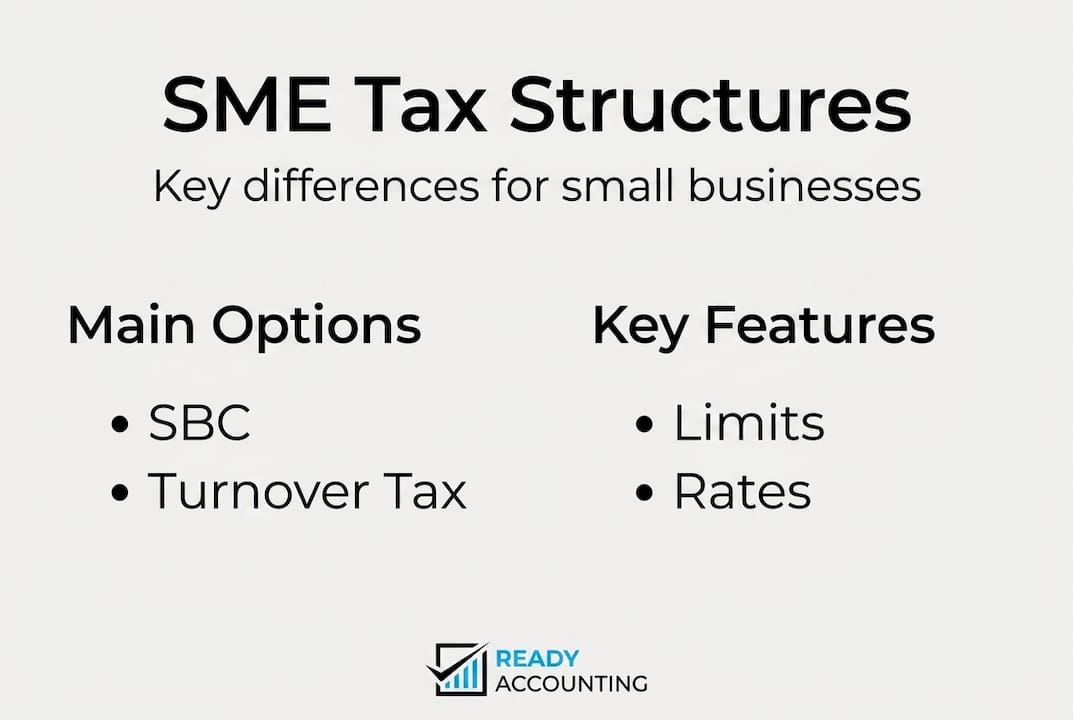
The SBC progressive tax rates favour businesses that have meaningful deductible expenses, because your taxable profit is what gets taxed rather than gross turnover. Turnover Tax, by contrast, taxes your revenue directly regardless of expenses, which is why micro-businesses with low margins often benefit more from it, while high-margin businesses find SBC more favourable.
Here is a practical step-by-step process to choose and apply your structure:
- Calculate your last 12 months of gross income. If it is under R2.3 million and your margins are thin, Turnover Tax deserves a serious look. If it is between R2.3 million and R20 million, focus on SBC eligibility.
- Review your shareholder structure. SBC requires all shareholders to be natural persons. If a trust or company holds shares, you are disqualified until you restructure.
- Calculate your income split. If more than 20% of income comes from professional services rendered by a shareholder, you may not qualify for SBC. This applies to many consultants and service businesses.
- Run a side-by-side calculation. Use your projected taxable income to model the tax under each regime. The structure that saves more is not always obvious without actual numbers.
- Register or confirm with SARS. Turnover Tax requires a separate registration. SBC status is confirmed through your income tax return but must be correctly declared each year.
- Review annually. As your turnover grows or your shareholder structure changes, your optimal structure changes too.
Pro Tip: Do not assume last year’s structure is still the right one. A business that crossed the R2.3 million turnover mark mid-year may need to exit Turnover Tax and move to SBC, and the timing of that switch can significantly affect your total tax bill.
Pairing structure selection with proactive year-end tax planning is one of the highest-return activities a business owner can do in Q4. Decisions made before your financial year-end about equipment purchases, prepaid expenses, and salary structures can legally reduce your taxable income before it is locked in.
VAT strategies: Registration, deregistration, and claiming input VAT
VAT is where many SMEs either over-complicate their tax position or miss out on real savings. The 2026 changes are significant and affect every business in South Africa with growing turnover.
The compulsory VAT registration threshold has been raised to R2.3 million effective 1 April 2026, up from R1 million, and voluntary registration is now possible from R120,000 turnover, up from R50,000. This is a major shift that creates real decisions for businesses sitting near those thresholds.
Here is what to consider before you register or deregister:
Reasons to register for VAT voluntarily (above R120,000 turnover):
- You can claim back input VAT on business purchases, which improves cash flow
- Your suppliers and clients may prefer dealing with VAT-registered vendors
- It positions you as a more established business, which can support contract negotiations
- If most of your clients are VAT-registered businesses, they can claim the VAT you charge, so it does not cost them more
Reasons to deregister if you are now below R2.3 million:
- You eliminate the administrative burden of bi-monthly VAT returns
- If your clients are mostly end consumers (not VAT-registered businesses), removing the 15% VAT charge can make you more competitive
- You reduce your exposure to SARS audits triggered by VAT discrepancies
What you lose when you deregister:
- The ability to claim input VAT on your business expenses going forward
- Potentially favourable cash-flow from your VAT return refunds
- VAT vendor status, which some contracts or tenders may require
Pro Tip: Use cloud accounting software to track every business purchase against your deductible expenses list. Most SMEs claim input VAT on obvious items like equipment and rent, but miss smaller recurring items like software subscriptions, bank charges, and professional development costs. These add up significantly over a 12-month period.
Before deciding to register or deregister, run a 12-month projection of your input VAT claims versus the admin cost of compliance. For many growing SMEs, voluntary registration above R120,000 is well worth it because the input claims outweigh the extra admin cost. For businesses predominantly serving the public, the calculation often tips the other way.
Leveraging cloud-based accounting for tax efficiency
Manual accounting is not just slow. It is expensive. Every hour your team spends capturing receipts, reconciling bank statements by hand, or chasing missing invoices is time not spent growing your business, and every error in that process is a potential tax liability waiting to surface.

Cloud-based accounting changes this equation entirely. The shift to cloud systems is not just about convenience. It is about building a finance function that captures more deductions, automates compliance, and protects you from costly penalties.
Here is what a properly configured cloud accounting system automates for your SME:
- Bank feeds: Transactions import automatically from your bank account daily, eliminating manual entry and reducing the chance of missing a deductible expense
- Receipt capture: Mobile apps let you photograph receipts on the spot, attaching them to transactions in real time so nothing gets lost
- VAT return preparation: The system calculates your output and input VAT automatically, populating your return with figures that match your records exactly
- Payroll integration: Salaries, PAYE, and UIF reconcile against your income statement without a separate spreadsheet
- Real-time profit visibility: You can see your taxable income at any point in the year, allowing you to make tax-saving decisions before year-end rather than after
The new VAT thresholds effective April 2026 make accurate record-keeping even more critical, because businesses sitting near the R2.3 million mark need to monitor their cumulative turnover in real time to know whether they are approaching compulsory registration.
“The businesses that come to us having lost the most money are almost always using spreadsheets or desktop accounting software. The moment they move to cloud infrastructure, they typically find 15 to 20 percent more in legitimate deductions they were not capturing before.”
A cloud accounting guide will show you the core platforms available in South Africa, how they integrate with SARS eFiling, and what setup actually involves. Most businesses are surprised at how quickly they can migrate without disrupting operations.
For a practical breakdown of the savings involved, the cloud accounting benefits for SMEs go well beyond tax efficiency. You also gain real-time cash-flow visibility, automated payroll, and a clear audit trail that protects you if SARS ever requests supporting documents.
Pro Tip: When evaluating cloud accounting platforms, prioritise those with a direct integration to the SARS eFiling portal. Platforms that push your VAT and income tax data directly to SARS eliminate a whole category of transcription errors that often trigger verification requests and audits.
The uncomfortable truth about SME tax savings: Automation is now essential
Here is something most tax articles will not tell you: the gap between SMEs that save on taxes and those that overpay is almost never about knowledge. Most business owners know they should claim more deductions and review their tax structure. The gap is operational. It is the stack of receipts that never gets captured, the VAT return that gets rushed because the books are not up to date, and the year-end tax planning conversation that never happens because nobody has reliable figures.
Manual and paper-based accounting does not just create admin burden. It creates systematic blind spots. You cannot claim what you cannot see, and you cannot see what has not been recorded. The accounting automation guide lays this out clearly: businesses running automated systems consistently capture more deductions, file more accurately, and face fewer SARS queries than those relying on manual processes.
In 2026, automation is not a competitive advantage. It is the baseline. SARS is increasingly data-driven, cross-referencing third-party data sources to flag discrepancies. If your records do not match what your bank, suppliers, and clients are reporting, you will hear about it. A cloud system that maintains a clean, real-time audit trail is your best protection.
The businesses we see scaling successfully are not necessarily the ones with the best tax advice. They are the ones with the infrastructure to act on that advice consistently, month after month, without relying on memory or manual effort.
Take your tax savings to the next level with Ready Accounting
Understanding the strategies is one thing. Putting them into practice in a way that actually sticks requires the right infrastructure and expert support behind you. Ready Accounting works with South African SMEs to replace manual accounting friction with cloud-based systems that automatically protect your tax position year-round. Whether you need to reduce your tax liability, access the full suite of cloud accounting benefits, or put systems in place to avoid tax penalties before they become a problem, our team acts as your Fractional CFO to turn your finance function from a cost centre into a competitive advantage.
Frequently asked questions
Who qualifies for Small Business Corporation tax rates?
South African companies with gross income below R20 million, all shareholders being natural persons with no corporate shareholders, and no more than 20% of income derived from personal services or investment income qualify for SBC rates.
What is the new VAT registration threshold in 2026?
The compulsory registration threshold increased to R2.3 million effective 1 April 2026, while voluntary registration is now available from R120,000 annual turnover, both up significantly from previous limits.
Is Turnover Tax better for low-margin businesses?
Yes. Turnover Tax benefits micro-businesses with turnover below R2.3 million and thin margins, because it taxes revenue at low rates rather than requiring complex expense tracking to arrive at a taxable profit figure.
How can cloud accounting help with tax efficiency?
Cloud accounting captures deductible expenses in real time, automates VAT calculations, and maintains a clean audit trail that both maximises your legitimate claims and protects you if SARS requests supporting documentation.
What happens if I deregister for VAT below the new threshold?
Deregistering means you lose the ability to claim input VAT on business expenses, which can be costly if your purchases are significant. Weigh that loss against the admin savings and competitive pricing advantages before making the decision.