

Set financial goals for SME growth: a South African guide
Executive Summary
- Setting clear financial goals improves decision-making, funding access, and risk reduction for SMEs.
- Effective goal-setting requires thorough preparation, realistic benchmarks, and regular review.
- Using SMART criteria and building a supporting budget enhances SME growth and financial stability.
South Africa’s small business landscape is unforgiving. Up to 80% of SA SMEs fail within their first few years, a rate higher than the global average. One of the most consistent reasons is the absence of clear, written financial goals. Without a target, you are managing by reaction rather than by design. This guide walks you through exactly how to set financial goals that are practical, measurable, and built for the realities of running a business in South Africa. Whether you are just starting out or trying to scale, the steps here will give you a structure that works.
Table of Contents
- Why financial goals matter for South African SMEs
- Preparing to set effective financial goals
- How to set SMART financial goals for your business
- Building your business budget to support financial goals
- Tracking progress and adjusting your financial goals
- A local accountant’s perspective on successful goal-setting
- Expert support for setting and reaching your financial goals
- Frequently asked questions
Key Takeaways
| Point | Details |
|---|---|
| SMART goals work | Using the SMART framework makes financial goals actionable and easier to track for business owners. |
| Budget for resilience | A well-constructed budget shields your business from unexpected expenses and economic challenges. |
| Regular reviews are vital | Checking progress quarterly helps you adapt goals for sustained growth and better decision making. |
| Written plans boost funding | Clear, documented financial goals improve your access to loans and other business finance. |
Why financial goals matter for South African SMEs
Setting financial goals is not a bureaucratic exercise. It is one of the most direct actions you can take to improve your odds of survival and growth. The numbers back this up clearly.
Fast-growing businesses with written plans that are used frequently are 71% more likely to exist among high performers compared to only 35% of smaller, slower-growing businesses. More striking still, those businesses generate twice the profit of their less-structured counterparts. That is not a marginal advantage. That is the difference between a business that grows and one that barely survives.
The stakes are especially high in South Africa. SMEs contribute 91% of all formal businesses, account for 60% of employment, and generate 34% of GDP. Yet many of these businesses struggle with rising costs, limited access to funding, and unpredictable cash flow. In fact, 38% of SME owners believe their business would not survive more than a year without external support.
Here is what clear financial goals actually do for your business:
- Improve decision-making by giving you a benchmark to measure choices against
- Unlock funding because lenders want to see structured financial plans before approving credit
- Reduce financial risk by forcing you to anticipate costs and shortfalls in advance
- Boost accountability by creating targets your team can work toward
- Support tax planning by helping you forecast liabilities before they arrive
Understanding why financial planning matters goes beyond just knowing the theory. It is about recognising that without a plan, every financial decision is a guess. And in a market where business loan challenges are already significant for SMEs, guessing is a risk you cannot afford.
| Business type | Has written financial goals | Profit outcome |
|---|---|---|
| Fast-growing SME | 71% | Twice the average |
| Smaller, slower SME | 35% | Below average |
Preparing to set effective financial goals
Before you write a single goal, you need to do some groundwork. Rushing into goal-setting without preparation leads to targets that are either too vague or completely disconnected from your actual business reality.
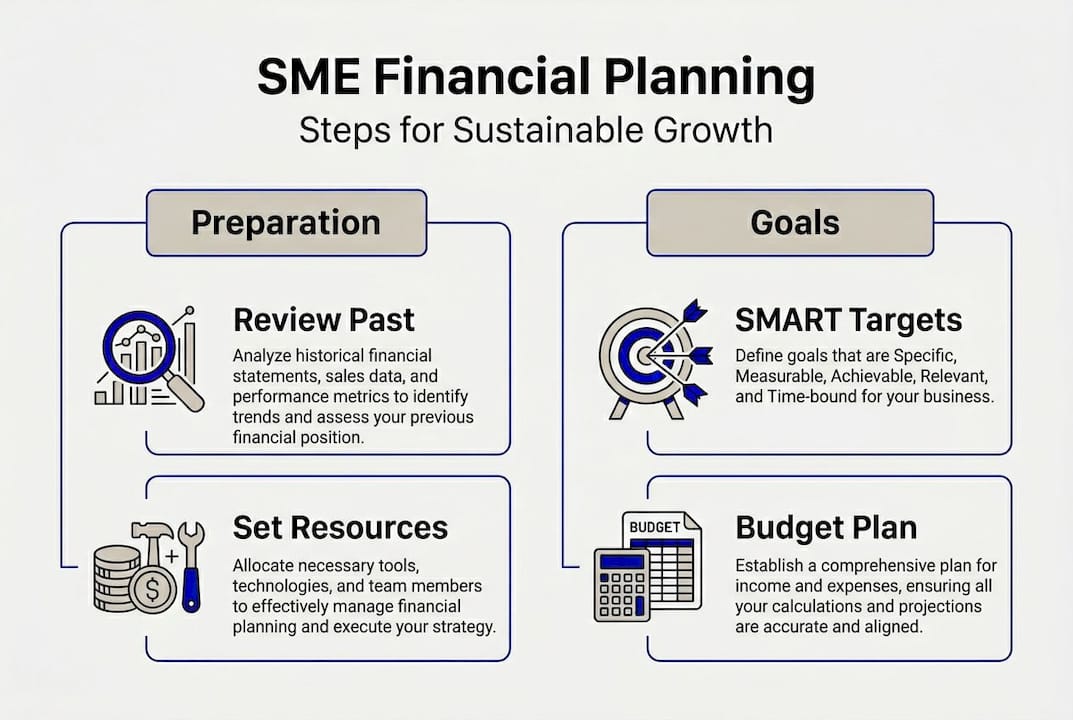
Start by reviewing your past performance. Reflect on the previous year including what financial goals you set, which ones you achieved, and where you fell short. This is not about self-criticism. It is about gathering data. What was your average monthly revenue? Where did unexpected costs appear? Did your cash flow hold up during slow months?

Next, identify your key financial needs and risks. South African SMEs face a specific set of pressures that many generic business guides overlook. Loadshedding adds operational costs. Fuel price increases affect delivery and logistics. Currency fluctuations impact imported goods. These are not abstract risks. They are line items you need to account for when setting realistic targets.
Here is a practical preparation sequence to follow:
- Pull your income statements and bank statements from the past 12 months
- Identify your three biggest expense categories
- Note any months where cash flow was negative and understand why
- List any upcoming costs not yet in your budget (equipment, staff, compliance)
- Research sector-specific benchmarks for businesses like yours
Pro Tip: Use a simple spreadsheet to map your actual income against your projected income for the past year. The gap between those two numbers is your starting point for setting more accurate goals going forward.
Good goal setting for entrepreneurs always starts with honesty about where you currently stand. You also need the right tools. A cloud accounting platform, a reliable bookkeeper, and a basic budget template will make the process far more manageable. If you have never built a budget before, learning how to create a business budget is a logical first step before moving into goal-setting.
The SME sector stats confirm that 70 to 80% of SA SMEs fail within the first few years. Most of those failures share a common thread: the owner did not have a clear picture of where their money was going or where it needed to go.
| Preparation step | Why it matters |
|---|---|
| Review past financials | Identifies real patterns, not assumptions |
| Identify key risks | Prevents goal-setting in a vacuum |
| Gather the right tools | Makes tracking and adjustment easier |
| Research benchmarks | Ensures goals are realistic for your sector |
How to set SMART financial goals for your business
The SMART framework is the most practical structure for setting financial goals that actually get used. SMART stands for Specific, Measurable, Achievable, Relevant, and Time-bound. Each element removes a layer of vagueness from your targets.
Here is what each element means in practice for an SME:
- Specific: “Increase revenue” is not a goal. “Increase product sales revenue by R150,000” is.
- Measurable: Attach a number. Revenue rand amounts, expense percentages, profit margins.
- Achievable: Base targets on your actual capacity. Doubling revenue in 90 days with no new staff is not achievable.
- Relevant: Goals must connect to your broader business strategy. A retail shop focusing on export revenue may not be relevant yet.
- Time-bound: Every goal needs a deadline. “By end of Q2 2026” is a deadline. “Soon” is not.
Here are sample SMART financial goals for a South African SME:
- Increase monthly revenue from R80,000 to R100,000 by 30 June 2026
- Reduce operating expenses by 10% within the next quarter
- Build a three-month emergency fund of R45,000 by December 2026
- Achieve a gross profit margin of 35% by end of financial year
Pro Tip: Write your goals down and keep them somewhere visible. Business owners who document and regularly revisit their goals are significantly more likely to achieve them than those who keep goals only in their heads.
“A goal without a plan is just a wish.” The same applies to financial targets. Document them, share them with your accountant, and review them on a fixed schedule.
Reviewing financial statement examples can help you understand what realistic numbers look like for businesses similar to yours. If you are new to reading financial reports, a financial statements guide will give you the foundation to interpret your own numbers with confidence. Strong money management strategies also complement your goal-setting process by keeping daily financial decisions aligned with your bigger targets.
Building your business budget to support financial goals
A financial goal without a budget is just an aspiration. The budget is the mechanism that turns your targets into a working financial plan.
A solid business budget should include the following key sections:
- Revenue forecast: What you realistically expect to earn each month
- Fixed costs: Rent, salaries, insurance, subscriptions
- Variable costs: Stock, utilities, fuel, commissions
- Tax provisions: Set aside for VAT, income tax, and PAYE
- Loan repayments: Any existing debt obligations
- Growth spending: Marketing, equipment, staff development
- Emergency fund: Aim for 5 to 10% of monthly revenue set aside
- Net profit target: What remains after all costs
Scenario planning is one of the most underused tools in SME budgeting. Build at least two versions of your budget: a conservative scenario and an optimistic one. The conservative version assumes loadshedding disruptions, a slow sales month, or a key client delay. The optimistic version assumes everything goes to plan. Operating somewhere between the two is realistic.
Pro Tip: Review your budget against your actual figures every month, not just at year-end. A monthly comparison takes less than 30 minutes and will catch problems before they become crises.
| Budget section | Purpose |
|---|---|
| Revenue forecast | Sets your income target |
| Fixed costs | Identifies unavoidable obligations |
| Emergency fund | Protects against unexpected shortfalls |
| Net profit target | Measures overall financial health |
Common budget mistakes to avoid include underestimating variable costs, ignoring tax provisions, and failing to account for seasonal dips. Using forecasting tools can help you build more accurate projections. Pairing your budget with sustainable growth strategies ensures your financial plan supports long-term business health, not just short-term survival.
Tracking progress and adjusting your financial goals
Setting goals and building a budget is only half the work. The other half is showing up consistently to measure where you stand and making smart adjustments when things shift.
Break your goals into actionable steps and monitor them quarterly or bi-annually at minimum. Quarterly reviews give you enough data to spot trends without waiting so long that a problem becomes unrecoverable.
Here is a simple tracking process to follow:
- Set a fixed review date each quarter (e.g., last Friday of March, June, September, December)
- Pull your income statement, cash flow statement, and expense report
- Compare actuals against your SMART goal targets
- Identify which goals are on track, which are behind, and which need to be revised
- Update your budget and goals based on what the data shows
Tools that help with tracking:
- Cloud accounting software (real-time financial visibility)
- Automated bank feeds to reduce manual data entry
- Monthly management reports from your accountant
- Simple dashboards that show key metrics at a glance
“Tracking is not about catching yourself failing. It is about catching problems early enough to fix them.”
Using digital accounting tools makes this process faster and more accurate, especially for small teams without a dedicated finance department. If cash flow is consistently a problem, understanding solving cash flow problems will help you address the root cause rather than just the symptoms. For broader guidance, exploring resources on overcoming financial management challenges can sharpen your overall approach.
A local accountant’s perspective on successful goal-setting
Here is something most business guides will not tell you: the majority of SME owners we work with focus on profit when they should be focused on cash flow first. Profit is what your income statement shows. Cash flow is what keeps your business alive. You can be profitable on paper and still be unable to pay your suppliers next week.
The clients who succeed are not always the ones with the most ambitious goals. They are the ones who set realistic targets, check in on them regularly, and call us before things go wrong rather than after. Early advice from an accountant is not a luxury. It is one of the highest-return investments a small business owner can make.
Digital tools have genuinely changed what is possible for under-resourced businesses. Cloud accounting gives you real-time visibility that used to require a full-time finance team. Understanding expert advice on financial planning early in your business journey can prevent the kind of financial blind spots that sink otherwise good businesses.
Expert support for setting and reaching your financial goals
Setting financial goals is a skill that improves with the right support. At Ready Accounting, we work with South African SMEs every day to build budgets, set realistic targets, and track progress using modern cloud-based tools. The cloud accounting benefits for small businesses are significant, from real-time reporting to automated reconciliations that save hours each month. Our cloud accounting guide explains how to get started even if you have never used accounting software before. If you are ready to move from guesswork to a structured financial plan, book a consultation with our team today.
Frequently asked questions
What are the most important financial goals for an SME owner?
Top financial goals include maintaining positive cash flow, building an emergency fund of 5 to 10% of monthly revenue, growing revenue consistently, and planning ahead for tax obligations.
How often should you review your business financial goals?
Review your financial goals at least quarterly. Monitor goals quarterly or bi-annually and adjust them whenever significant changes occur in your business or market conditions.
Are financial goals required for accessing business funding in South Africa?
Yes. Many lenders require written financial plans and a minimum R50,000 monthly turnover for six consecutive months. Financial plans enhance bankability and make your application significantly stronger.
What is the SMART framework?
SMART stands for Specific, Measurable, Achievable, Relevant, and Time-bound. These five criteria make financial goals clearer, more actionable, and far easier to track over time.
Why do so many SMEs in South Africa struggle with financial goals?
Most struggle because of a lack of structured planning, underestimating local risks, and not revisiting their goals as the business evolves. Up to 80% of SA SMEs fail within their first few years, often because financial targets were never clearly defined or consistently tracked.
Recommended
- Sustainable financial growth: practical guide for SA SMEs - Ready Accounting
- Goal setting for entrepreneurs: strategies to boost success - Ready Accounting
- How to create a budget for SA SMEs: step-by-step - Ready Accounting
- Why financial planning matters for SA SMB success - Ready Accounting
- Digital marketing for South African SMEs: 2026 guide