
South Africa tax season: strategies that actually work
Executive Summary
- Understanding and choosing the correct tax structure like SBC or Turnover Tax can save significant money.
- Automation tools streamline compliance, reducing errors and ensuring timely submission of documents and taxes.
- Proactive year-round tax management minimizes stress, prevents penalties, and maximizes business savings.
Tax season does not have to feel like a crisis. For many South African small and medium business owners, the months leading up to SARS submission deadlines bring dread, scrambled paperwork, and last-minute panic. But that experience is not inevitable. The reality is that a structured approach, combined with the right automation tools, can turn tax season into a straightforward process you control. This article walks you through the South African tax landscape, the documents and deadlines that matter, actionable savings strategies, and how finance automation removes the friction that makes compliance feel so overwhelming.
Table of Contents
- Understanding South Africa’s small business tax landscape
- Key documents and deadlines you must not miss
- Smart tax strategies for maximum savings
- Using finance automation to simplify compliance
- Why the smartest tax prep is proactive, not reactive
- Partner with experts to streamline your next tax season
- Frequently asked questions
Key Takeaways
| Point | Details |
|---|---|
| Know your tax options | Small businesses can choose between standard, SBC, and Turnover Tax paths to optimize their tax position. |
| Stay organized year-round | Keeping essential documents updated and accessible avoids last-minute panic and costly penalties. |
| Leverage automation tools | Automation streamlines tax compliance, reduces human error, and helps you focus on growing your business. |
| Proactive planning pays | Preparing early and using the right strategies leads to substantial tax savings and less stress. |
Understanding South Africa’s small business tax landscape
Many business owners assume tax optimization is a luxury reserved for large corporations with entire finance departments. That assumption costs real money. South Africa’s tax system actually includes frameworks specifically designed to reduce the burden on smaller businesses, and understanding which one applies to you is the first step toward meaningful savings.
The two most relevant structures for SMEs are the Small Business Corporation (SBC) regime and Turnover Tax (TOT). Each serves a different type of business, and choosing the right one can significantly reduce what you owe SARS each year.
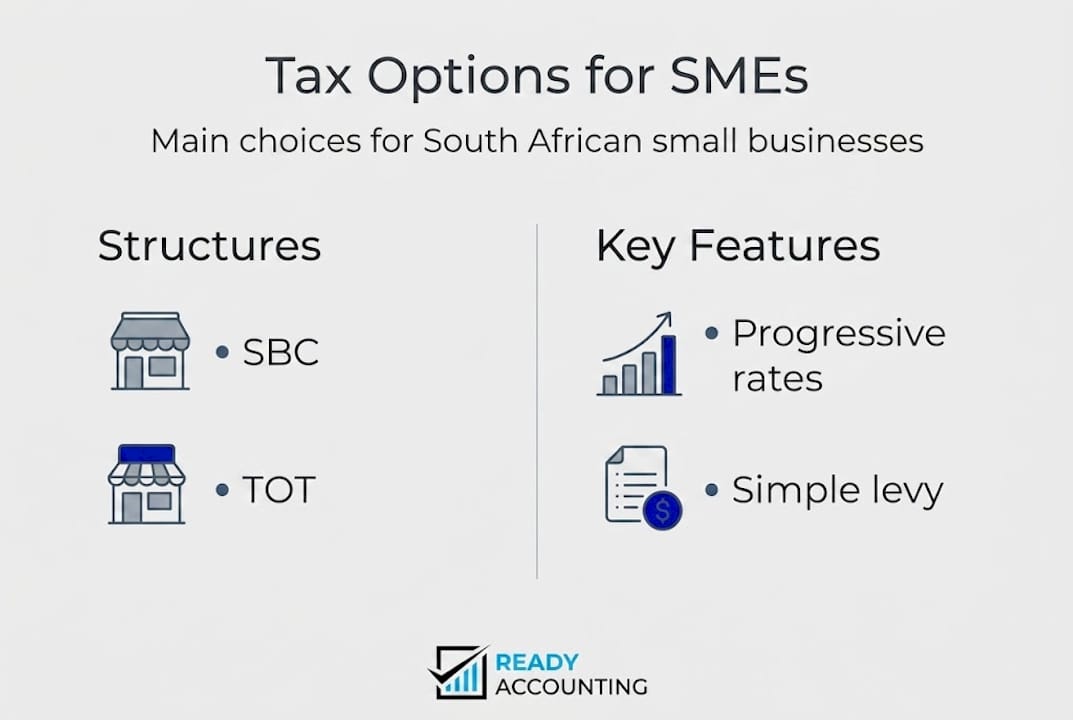
Small Business Corporations are companies that meet specific SARS criteria: gross income must not exceed R20 million, all shareholders must be natural persons, and no more than 20% of income can come from investment or personal services activities (unless the business employs at least three full-time employees). When you qualify, you access progressive tax rates instead of the flat 27% corporate income tax rate applied to standard companies. The 2025/26 rates for SBCs are as follows:
| Taxable income ® | Rate |
|---|---|
| R0 to R95,750 | 0% |
| R95,751 to R365,000 | 7% on amount above R95,750 |
| R365,001 to R550,000 | 21% on amount above R365,000 |
| Above R550,000 | 27% on amount above R550,000 |
The difference is substantial. A qualifying SBC can save up to R91,000 compared to paying the flat 27% corporate income tax rate. That is not a rounding error. That is capital you can reinvest in your business.
“The most expensive tax mistake a small business makes is failing to claim the structure it already qualifies for. The SBC regime is not a loophole. It is a framework SARS built for you.”
For businesses at the micro end of the spectrum, Turnover Tax replaces income tax, provisional tax, capital gains tax, and dividends tax with a single levy calculated on your gross turnover. Currently, TOT applies to businesses with a turnover below R1 million, though the qualifying threshold is expected to rise to R2.3 million, which will open this simplified system to significantly more businesses. The appeal of TOT is compliance simplicity. Instead of managing multiple tax obligations throughout the year, you deal with one calculation.
Understanding which regime fits your business is not always obvious. A business operating as a sole proprietor, a private company, or a close corporation may each reach different conclusions. Exploring small business tax essentials gives you a practical starting point for assessing your position. Getting this foundational decision right unlocks every other strategy that follows, so it deserves careful attention before you focus on anything else. You can also look at maximize deductions tips for practical guidance on what to claim once your structure is in place.
Key documents and deadlines you must not miss
Once you understand your tax structure, the next challenge is execution. Specifically, gathering the right documents, staying ahead of deadlines, and avoiding the small errors that attract unwanted attention from SARS.
Here is what you need to have ready before tax season begins:
- Annual financial statements including your income statement and balance sheet
- Proof of business expenses such as receipts, invoices, and bank statements
- Payroll records including IRP5s for employees and any UIF documentation
- VAT returns if your business is VAT registered (turnover exceeding R1 million)
- Provisional tax return copies (IRP6) from both the first and second provisional submissions
- Asset registers for depreciation calculations
- Tax registration certificates and entity documentation
- Industry-specific compliance records where applicable, such as certificates for professional services firms
Missing any one of these creates delays and can trigger queries from SARS. For businesses operating under Turnover Tax, the documentation burden is lighter because TOT consolidates multiple tax obligations into one annual return, but accurate income records remain non-negotiable.
Provisional tax is often where SMEs fall short. South African businesses that earn income not subject to PAYE must submit two provisional returns each year: the first by the end of August and the second by the end of February. Missing these deadlines results in penalties, interest, and potential underestimation charges if your estimate falls too far below actual tax owed. The penalties for non-compliance are not trivial. SARS charges a 10% late payment penalty on top of interest at the official rate, which compounds quickly.
Pro Tip: Set calendar reminders for your provisional tax dates at the start of each financial year. Better yet, use your accounting software to automate these alerts so nothing slips through during busy operational periods.
Good record keeping is not just about compliance. It is about having the evidence to defend every claim you make. SARS requires you to retain business records for five years from the date of submission. Missing receipts are one of the most common reasons deductions get disallowed during an audit. Digitising your records throughout the year rather than scrambling at tax time removes this risk entirely. Reviewing a solid tax planning guide before the year closes helps you identify gaps and fix them while there is still time.
One important compliance consideration for property-owning business owners: if your business has rental income, ensure your documentation aligns with SARS’s reporting expectations, which is a topic covered in detail through resources like this landlord compliance guide.
Smart tax strategies for maximum savings
Now we move from structure and compliance into active strategy. Knowing your obligations is the baseline. Reducing your tax liability legally and deliberately is where real financial advantage lives.

1. Choose the right tax structure from the start. If your business qualifies as an SBC, operating as a standard company and paying the flat 27% rate is simply leaving money behind. The progressive SBC rates mean you could save up to R91,000 annually, which is money that stays in your business and compounds over time.
2. Maximise your allowable deductions. SARS allows deductions for expenses incurred in the production of income. Common categories include:
- Home office expenses (where the space is used exclusively and regularly for business)
- Vehicle costs (actual costs or the deemed cost method for travel)
- Depreciation (wear and tear) on business assets using SARS-approved rates
- Staff training and development costs
- Professional fees including accounting, legal, and consulting services
- Start-up costs in the year of assessment they were incurred
3. Time your income and expenses strategically. If you know your taxable income is approaching a higher bracket, consider whether certain invoices can be issued after your financial year-end. Similarly, prepaying allowable expenses before year-end can reduce your taxable income in the current period. This is not tax evasion. It is responsible cash flow management.
4. Avoid common audit triggers. SARS’s systems are increasingly automated, and certain patterns draw attention. Claiming unusually large home office deductions without supporting documentation, inconsistent VAT returns, or sudden drops in reported income relative to prior years are red flags. Maintaining clean, consistent records through a tax deductions checklist is your best defence.
Here is a direct comparison of the tax impact across structures for a business with R500,000 taxable income:
| Tax structure | Tax payable on R500,000 | Effective rate |
|---|---|---|
| Standard company (27% flat) | R135,000 | 27% |
| SBC (progressive 2025/26) | R68,800 | 13.76% |
| TOT (on R1M turnover, example) | Approx R13,500 | 1.35% |
Pro Tip: Before your financial year closes, schedule a 90-minute review with your accountant to stress-test your deduction claims, confirm your SBC qualification criteria, and model the impact of any large purchases you are considering.
Exploring tax efficient structures for your specific entity type, and learning exactly how to reduce tax liability within SARS rules, gives you a competitive advantage that compounds year after year.
Using finance automation to simplify compliance
Strategy without execution is wishful thinking. Automation is what turns a good tax plan into a consistently repeatable process that does not depend on memory, spreadsheets, or frantic searches for receipts in January.
Modern accounting automation tools handle the operational weight of compliance so you can focus on running your business. Here is what to look for in a solution:
- Automated bank feeds that categorise transactions in real time, removing the need for manual data entry
- Receipt scanning and digital storage so every expense is captured and searchable from day one
- Tax calculation engines that apply the correct rates for your structure automatically
- VAT return preparation with direct submission capability to SARS eFiling
- Payroll integration that generates IRP5s, calculates UIF and PAYE, and feeds directly into your tax return
- Provisional tax reminders and estimates based on real-time income data
For businesses operating under Turnover Tax, automation is particularly powerful because your levy is calculated directly on turnover. When your accounting system captures every transaction automatically, your TOT calculation is always accurate and always ready. There is no year-end scramble to reconstruct months of income records.
The guide to accounting automation explains how these systems work in practice and what implementation looks like for a growing SME. If you are still managing your books in spreadsheets or using desktop accounting software with no cloud connectivity, the gap between where you are and where you could be is significant.
Cloud accounting means your financial data is accessible in real time, from any device, with automatic backups and audit trails. This directly reduces the risk of data loss, which is one of the most damaging events a small business can face during a SARS audit. The cloud accounting benefits for small businesses extend beyond compliance to real-time visibility into your cash flow, profitability, and runway.
Pro Tip: Integrate your payroll and VAT modules within the same platform as your core accounting. Disconnected systems create reconciliation gaps that cost time to fix and create errors that attract scrutiny during compliance reviews.
Scalability matters too. A solution that works for R500,000 in annual turnover should handle R10 million without requiring a platform migration. Choose software that grows with you rather than something you outgrow within two years.
Why the smartest tax prep is proactive, not reactive
Here is what years of working with South African SMEs has taught us: the business owners who stress the most at tax season are almost never the ones with the most complex tax situations. They are the ones who treated tax preparation as a once-a-year event rather than an ongoing process.
Reactivity is expensive. When you scramble to compile records in the weeks before submission, you miss deductions that required better documentation. You make estimates under pressure. You pay penalties that could have been avoided with a simple calendar reminder set six months earlier. And you operate from a position of anxiety rather than confidence.
The businesses we have seen save the most, year over year, share one habit: they address common tax questions as they arise throughout the year rather than saving them all for deadline season. They review their structure annually. They automate what can be automated and spend their cognitive energy on decisions that actually require judgment.
Proactive tax management is not more work. It is more consistent work, distributed across the year in small doses. The result is less stress, fewer errors, and more money staying in your business where it belongs.
Partner with experts to streamline your next tax season
The strategies and tools in this article give you a strong foundation. But applying them correctly to your specific business structure, turnover profile, and growth stage is where expert support makes the real difference. Ready Accounting works with South African SMEs to replace manual compliance processes with automated cloud infrastructure, ensuring you are never caught off guard by a deadline or a SARS query. Whether you want to explore the accounting automation guide in depth, take action to reduce your tax liability with the right structure, or simply talk through your current situation, the Ready Accounting team is ready to help you engineer a finance function that works for you year-round.
Frequently asked questions
What is the difference between SBC and Turnover Tax for small businesses?
SBCs qualify for progressive rates applied to taxable income, while Turnover Tax is a single levy calculated on gross turnover, making it simpler but only available to qualifying micro-businesses.
What are the essential documents to prepare before tax season?
You should gather your annual financial statements, proof of all business expenses, payroll records including IRP5s, provisional tax return copies, and your official tax registration documentation.
How can automation help with tax compliance in South Africa?
Automation captures transactions in real time, eliminates manual data entry errors, and prepares compliant returns automatically, which is especially valuable for TOT’s simplified levy structure where accurate turnover tracking is everything.
What happens if I miss the tax submission deadline?
Missing a deadline triggers a 10% late payment penalty from SARS plus compounding interest, and repeated non-compliance can result in a formal audit or legal enforcement action.
Can all businesses benefit from tax automation?
Yes. Whether you operate under TOT, the SBC regime, or as a standard company, automating your financial processes reduces risk, saves time, and gives you real-time visibility that paper-based or spreadsheet systems simply cannot match.