
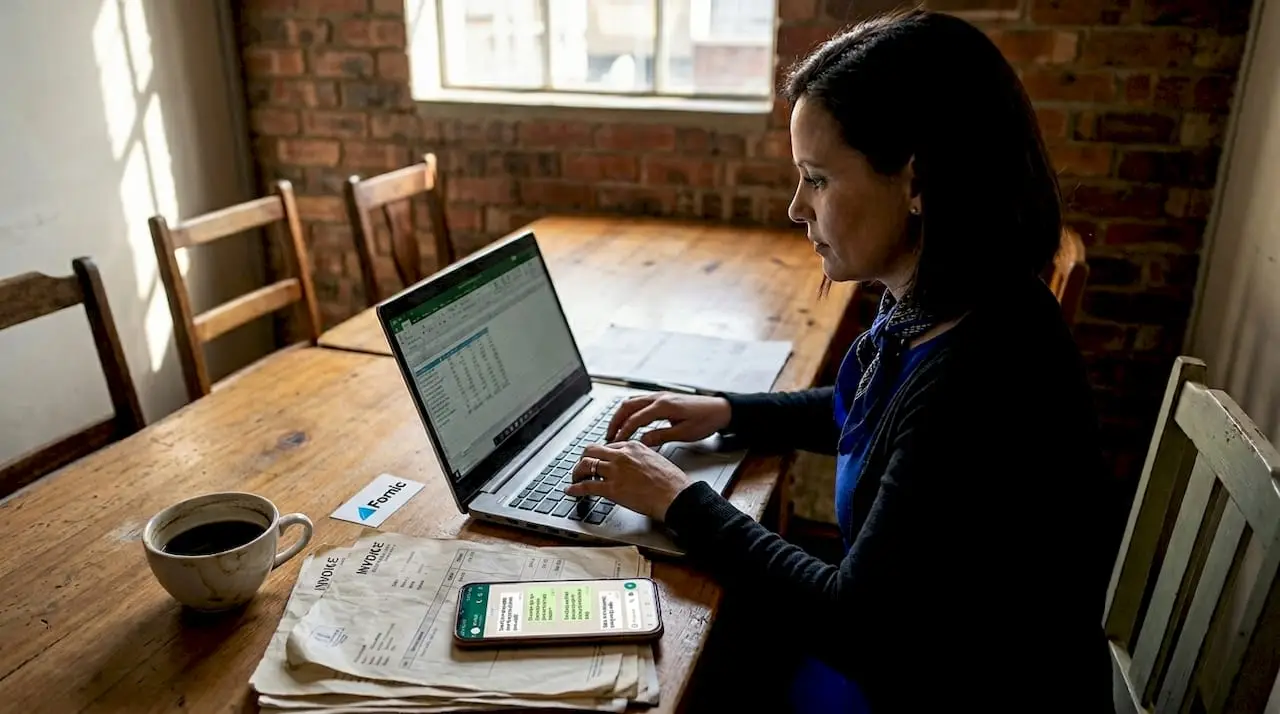
Sustainable financial growth: practical protocol for SA Scaling Companies
Executive Summary
- Cloud adoption can generate up to R186 billion in economic value for South African SMEs by 2030.
- Digital tools like cloud accounting improve efficiency, reduce errors, and enhance funding access.
- Embracing change and data-driven decision-making are key to sustainable growth beyond just technology.
South African SMEs have a remarkable opportunity in front of them, yet most are not taking it. Cloud adoption could generate up to R186 billion in economic value for local SMMEs between 2023 and 2030, but the gap between ambition and action remains wide. Sustainable financial growth is not just about staying profitable. It is about building a business that can weather economic shocks, access new funding, and operate with confidence. This guide gives you the practical steps, local data, and honest perspective you need to move from aspiring to actually growing.
Table of Contents
- What is sustainable financial growth in South Africa?
- Why cloud accounting and automation are game changers
- The role of digital tools and sustainability reporting
- Personalized financial consulting: Turning systems into strategy
- Common roadblocks and how to overcome them
- The overlooked truth about sustainable financial growth for South African SMEs
- Take the next step towards sustainable growth
- Frequently asked questions
Key Takeaways
| Point | Details |
|---|---|
| Tech powers growth | Cloud and digital accounting unlock measurable efficiency, savings, and new funding opportunities for South African SMEs. |
| Sustainability means results | Formal sustainability reporting boosts SME eligibility for green finance and strengthens long-term business resilience. |
| Expert help matters | Local consultants and personalized advice transform digital tools into practical, sustainable SME business strategies. |
| Start small, scale up | Begin with one automated process, then expand—overcoming barriers is possible with phased adoption and the right support. |
What is sustainable financial growth in South Africa?
Sustainable financial growth, in the South African SME context, means more than just increasing revenue year on year. It combines long-term profitability with operational resilience, regulatory compliance, and the ability to adapt when conditions shift. It also increasingly includes environmental and social responsibility, which now directly influences funding access.
For most small business owners, the word “sustainable” can feel abstract. Think of it this way: a business that grows fast but collapses when a single client leaves, or when load shedding disrupts operations for a week, has not achieved sustainable growth. True sustainability means your financial systems, reporting, and strategy can hold up under pressure.
The five key pillars of sustainable financial growth for South African SMEs are:
- Profitability: Consistent margins, not just revenue spikes
- Compliance: Meeting SARS, CIPC, and sector-specific requirements
- Resilience: Systems and cash flow buffers that survive disruption
- Funding access: The ability to attract investors, grants, and green finance
- Sustainability reporting: Formal tracking of environmental and social impact
That last pillar is more important than most owners realise. Businesses that invest in modernizing financial management and adopt smart digital tools are gaining a measurable funding advantage.
SMEs using AI-powered accounting or carbon-tracking tools are 1.6 times more likely to secure green finance and 2.4 times more likely to have formal sustainability reporting than those without.
This is not a marginal gain. It is a structural advantage that compounds over time as green finance and ESG-linked funding grow in South Africa.
Why cloud accounting and automation are game changers
Legacy systems and manual bookkeeping are not just inconvenient. They actively block sustainable growth. When your financial data lives in spreadsheets, reconciliations take days, errors creep in, and you have no real-time view of your cash position. That means slower decisions and missed opportunities.
The evidence for switching is hard to ignore. 82% of studies report improvements in operational efficiency and 76% note cost savings from cloud computing adoption in SMEs. For a business running on tight margins, those numbers matter enormously. And at a national level, cloud adoption could unlock up to R186 billion in economic value for South African SMMEs by 2030.
Here is a simple comparison of what the shift looks like in practice:
| Feature | Manual or legacy system | Cloud or automated system |
|---|---|---|
| Data access | End-of-month reports | Real-time dashboards |
| Error rate | High, human-dependent | Low, automated checks |
| Compliance updates | Manual, often missed | Automatic software updates |
| Cost over time | Rising admin costs | Predictable subscription fees |
| Scalability | Limited | Grows with your business |
| Reporting for funding | Time-consuming | Fast and structured |
A common concern is security and local compliance. Reputable cloud platforms used in South Africa are POPIA-aware and store data with strong encryption. The risk of losing a physical file or having a corrupted hard drive is far greater than the risk of a well-managed cloud system.
Pro Tip: Do not try to automate everything at once. Start with one high-volume task, such as recurring invoices or payroll, and build confidence before expanding. You can explore a detailed cloud accounting guide to map out the right sequence for your business.
The biggest win from automation is not the time saved on admin, though that is real. It is the mental bandwidth you get back to focus on strategy, clients, and growth. Read more about the cloud accounting benefits that matter most for small businesses.
The role of digital tools and sustainability reporting
Automation and cloud accounting are the foundation, but the next level is using digital tools to track and report on sustainability. This is where many South African SMEs are still behind, and where the biggest funding gaps exist.
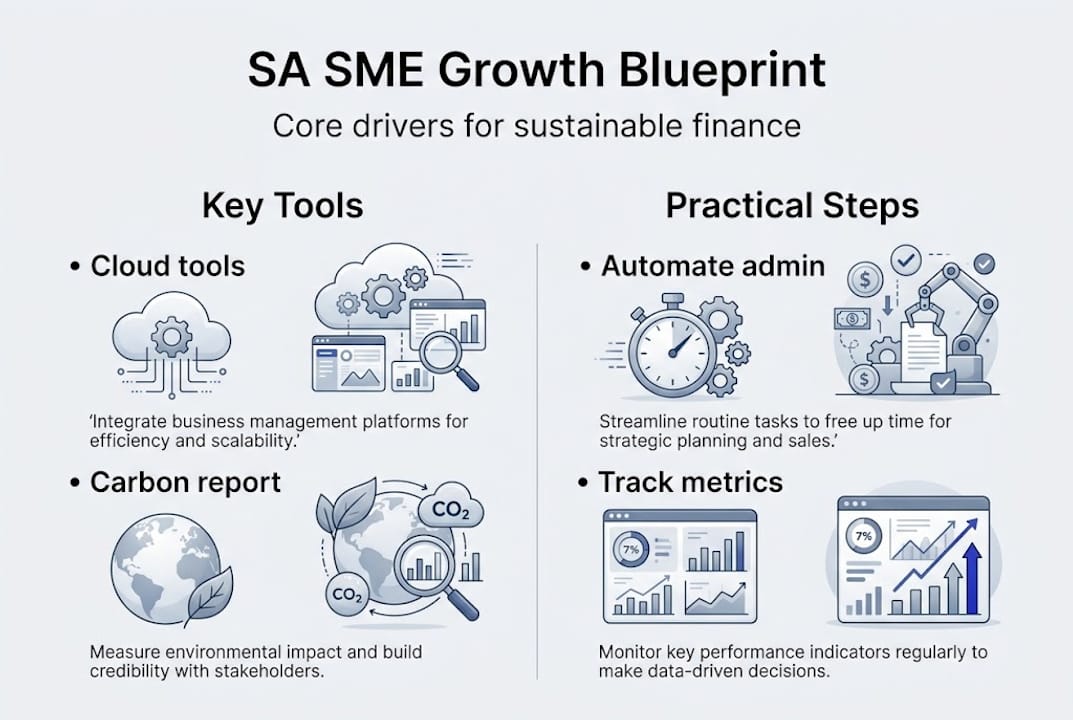
The current adoption picture is telling:
| Tool type | SA SME adoption rate |
|---|---|
| Digital accounting software | 31% |
| Carbon calculators | 9% |
| Integrated ESG reporting tools | Below 10% |
Only 31% of South African SMEs use digital accounting tools, and just 9% use carbon calculators. The ambition is there. The tools are available. The gap is awareness and implementation.
Why does this matter for funding? Green loans, government grants, and impact investors increasingly require formal sustainability data before approving finance. Without a system to track and report this information, you are invisible to a growing pool of capital.
Here is how to start building your sustainability reporting capability:
- Choose a tool: Start with your existing accounting software. Many platforms now include basic carbon or ESG tracking modules.
- Define your KPIs: Pick three to five metrics that reflect your business impact, such as energy use, waste, or supplier diversity.
- Link to financial reports: Integrate sustainability data into your regular financial statements so funders see the full picture.
- Report consistently: Even a simple quarterly summary builds credibility over time.
Understanding what cloud accounting actually is is the first step before layering sustainability tools on top. Get the foundation right, then expand.
Personalized financial consulting: Turning systems into strategy
Technology can process data faster than any human. But it cannot tell you whether to expand into a new market, how to restructure debt ahead of a rate change, or which funding application is worth your time. That is where personalized financial consulting becomes essential.
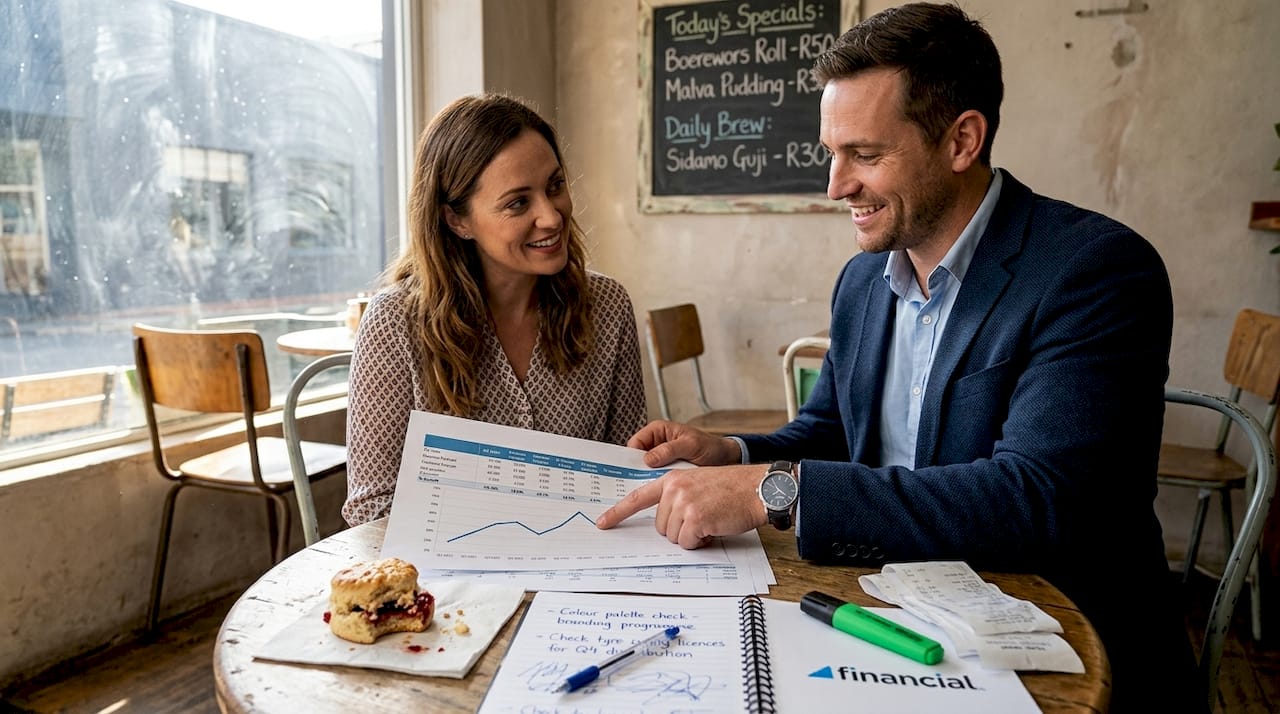
The gap between having good data and making good decisions is where most SMEs lose ground. A consultant bridges that gap. They take the output from your cloud accounting system and translate it into a strategy that fits your specific business, your sector, and the South African regulatory environment.
Here is how a skilled financial consultant typically works through your situation:
- Review your financial data: Identify trends, gaps, and risks that automated reports flag but do not interpret.
- Map your compliance position: Check that your VAT, PAYE, and CIPC obligations are current and optimized.
- Identify funding opportunities: Match your financial profile to available grants, green loans, or investor criteria.
- Build a growth plan: Set realistic targets with clear milestones, using your actual numbers as the baseline.
- Monitor and adjust: Review progress quarterly and adapt the plan as conditions change.
The data backs this up. Businesses that pair smart tools with expert guidance and use AI-powered accounting tools are 1.6 times more likely to secure green finance. The tools create the evidence. The consultant helps you use it.
Pro Tip: When choosing a financial advisor, look for someone who understands both local SME realities and modern accounting technology. An advisor still recommending manual ledgers in 2026 is not the right partner for sustainable growth. Learn more about the value of outsourcing accounting to the right specialists.
Common roadblocks and how to overcome them
Knowing what to do and actually doing it are two different things. Most South African SME owners face real, practical barriers when trying to modernize their financial management. Recognizing them is the first step to moving past them.
The most common roadblocks include:
- Cost fears: Many owners assume cloud tools are expensive. Most modern platforms offer tiered pricing that costs less than a part-time bookkeeper.
- Lack of time: Owners are already stretched. The irony is that automation saves time, but setting it up feels like another task on an already full plate.
- Staff resistance: Employees used to manual processes can push back on new systems. This is a change management challenge, not a technology problem.
- Over-reliance on manual bookkeeping: Familiarity with spreadsheets creates a false sense of control. The risk is not in the tool, it is in the data gaps it creates.
- Low awareness: With only 31% of SA SMEs using digital accounting tools, many business owners simply do not know what is available.
Pro Tip: Use a phased approach. In month one, migrate your invoicing. In month two, connect your bank feeds. In month three, set up payroll automation. Small wins build momentum and reduce resistance from your team.
Training is available and often free or subsidized. SEDA, SARS eFiling workshops, and software vendors like Xero and Sage all offer onboarding support. You do not have to figure it out alone. Reviewing accounting best practices for 2025 and 2026 gives you a clear benchmark to measure your current setup against.
Overcoming these hurdles does not just improve your day-to-day operations. It directly unlocks access to sustainability funding, formal reporting credibility, and the kind of financial clarity that attracts investors and partners.
The overlooked truth about sustainable financial growth for South African SMEs
Most guides on this topic focus heavily on tools. Adopt this software. Automate that process. Track these metrics. And while all of that matters, it misses the deeper driver of lasting financial growth: the willingness to change how you think about your business.
South African SMEs operate in one of the most challenging environments in the world. Load shedding, currency volatility, regulatory complexity, and skills gaps are daily realities. Yet this environment has also produced some of the most adaptable, resourceful business owners anywhere. That adaptability is a genuine competitive advantage, and technology amplifies it rather than replacing it.
The businesses we see thrive long-term are not always the ones with the most sophisticated tools. They are the ones where the owner has made a clear decision to stop managing by gut feel and start managing by data. The importance of financial planning is not about predicting the future. It is about building the discipline to respond to it well.
Technology gives you the data. Consulting gives you the interpretation. But the courage to act on what you learn, to change a process that has always been done a certain way, is entirely yours. That is what separates businesses that survive from businesses that grow.
Take the next step towards sustainable growth
If this article has shown you anything, it is that sustainable financial growth is within reach for South African SMEs. The tools exist, the data is clear, and the funding opportunities are growing. What you need now is the right support to execute. Ready Accounting helps SMEs like yours move from manual processes to modern, cloud-based financial management with expert guidance every step of the way. Explore the cloud accounting benefits that apply directly to your business, work through our comprehensive cloud accounting guide, and build a foundation with solid financial planning for growth. Book a consultation and let us turn your ambition into a clear, actionable plan.
Frequently asked questions
What is the main benefit of cloud accounting for South African SMEs?
Cloud accounting gives you real-time visibility into your finances while cutting admin time and errors. 82% of studies show efficiency gains and 76% report cost savings from cloud adoption in SMEs.
How does sustainability reporting help small businesses secure funding?
Formal sustainability tracking signals credibility to green lenders and impact investors. SMEs with these systems are 1.6 times more likely to secure green finance than those without.
Is digital transformation expensive for small businesses?
The upfront cost is manageable, especially with tiered subscription pricing. The 76% cost savings reported from cloud adoption mean most businesses recover the investment quickly.
Why do many SMEs still avoid automation and digital tools?
Cost fears, time pressure, and low awareness are the main barriers. Notably, only 31% of SA SMEs currently use digital accounting tools, which shows how much room there is to gain a competitive edge.