

Tax compliance protocol for South African Corporate Assets in 2026
Over 90% of South African small businesses fail within their first year, with poor tax compliance being a leading cause. Tax compliance means meeting all your legal obligations to SARS, from accurate record keeping to timely filing and payment. Many SMB owners underestimate the complexity of these requirements, risking penalties, audits, and even business closure. This guide clarifies what tax compliance truly means, outlines your specific obligations as a South African business owner, explains the consequences of non-compliance, and provides practical strategies to keep your business legally sound and financially healthy.
Table of Contents
- Key takeaways
- Understanding tax compliance and its importance for South African SMBs
- Key tax compliance requirements and record keeping practices
- Common consequences and risks of poor tax compliance for SMBs
- Practical strategies and tools to improve tax compliance for your business
- How Ready Accounting supports your tax compliance efforts
- Frequently asked questions
Key Takeaways
| Point | Details |
|---|---|
| Compliance is essential | Avoid penalties, audits, and business disruption by meeting SARS obligations on time and accurately. |
| Understand obligations | Identify the tax types and filing duties that apply to your business structure to prevent costly mistakes. |
| Maintain record keeping | Retain all essential documents for at least five years to satisfy SARS and support filings. |
| Use technology and support | Leverage accounting tools and expert help to simplify compliance and stay ahead of deadlines. |
Understanding tax compliance and its importance for South African SMBs
Tax compliance refers to your business meeting every requirement set by SARS. This includes registering for the correct tax types, maintaining accurate financial records, submitting returns by deadlines, and paying what you owe promptly. For South African SMBs, this typically involves income tax, Value Added Tax (VAT), and payroll taxes like PAYE and UIF.
The stakes are remarkably high. Poor tax compliance causes 90% of SMB failures in South Africa, making it the single biggest threat to your business survival. Yet many owners treat compliance as an afterthought, assuming they can catch up later or that SARS won’t notice small mistakes.
South African SMBs face several tax obligations:
- Income tax: All businesses must register and pay tax on profits, with rates varying by business structure
- VAT registration: Mandatory once turnover exceeds R1 million annually, with monthly or bi-monthly filing requirements
- PAYE and payroll taxes: Required for any business with employees, including monthly submissions and annual reconciliation
- Provisional tax: Self-employed individuals and companies must make advance payments twice yearly
Non-compliance doesn’t just mean penalties. SARS audits disrupt operations, damage your reputation with suppliers and customers, and create stress that distracts from growing your business. Banks may refuse loans to businesses with tax issues. Potential buyers will walk away from acquisition deals when due diligence reveals compliance problems.
Understanding your specific obligations is the foundation of protection. Different business structures face different requirements. Sole proprietors have simpler filing than companies, but both must maintain meticulous records. The complexity increases with employee count, turnover levels, and business activities. Investing time to understand these nuances now prevents costly mistakes later.
Key tax compliance requirements and record keeping practices
SARS has explicit expectations for how you document and report your business activities. Record keeping rules mandate that you retain all financial documents for at least five years from the date of submission. This isn’t a suggestion; it’s a legal requirement with penalties for non-compliance.
Essential documents you must maintain include:
- All sales invoices and receipts showing income earned
- Purchase invoices and expense receipts with VAT breakdowns where applicable
- Bank statements for all business accounts, reconciled monthly
- Payroll records including employee contracts, timesheets, and payment schedules
- Asset registers tracking depreciation for capital equipment
- Tax certificates and correspondence from SARS
Filing deadlines vary by tax type and business structure. Missing these triggers automatic penalties and interest charges that compound quickly:
| Tax type | Filing frequency | Typical deadline | Required documentation |
|---|---|---|---|
| Income tax (companies) | Annually | 12 months after year end | Financial statements, tax computation, supporting schedules |
| Provisional tax | Twice yearly | August and February | Estimated taxable income calculation |
| VAT | Monthly or bi-monthly | 25th of following month | Tax invoices, input/output VAT reconciliation |
| PAYE/UIF | Monthly | 7th of following month | Payroll records, EMP201 declaration |
| Annual PAYE reconciliation | Annually | May for February year end | IRP5/IT3 certificates, EMP501 reconciliation |
Pro Tip: Set calendar reminders two weeks before each deadline to allow time for preparation and unexpected issues. Last-minute rushing increases error rates dramatically.
Your record keeping system should make retrieval easy during audits. Organize documents by month and tax type, whether physical or digital. Cloud storage with automated backups protects against loss while enabling access from anywhere. Consistency matters more than perfection; a simple system maintained religiously beats a complex one used sporadically.
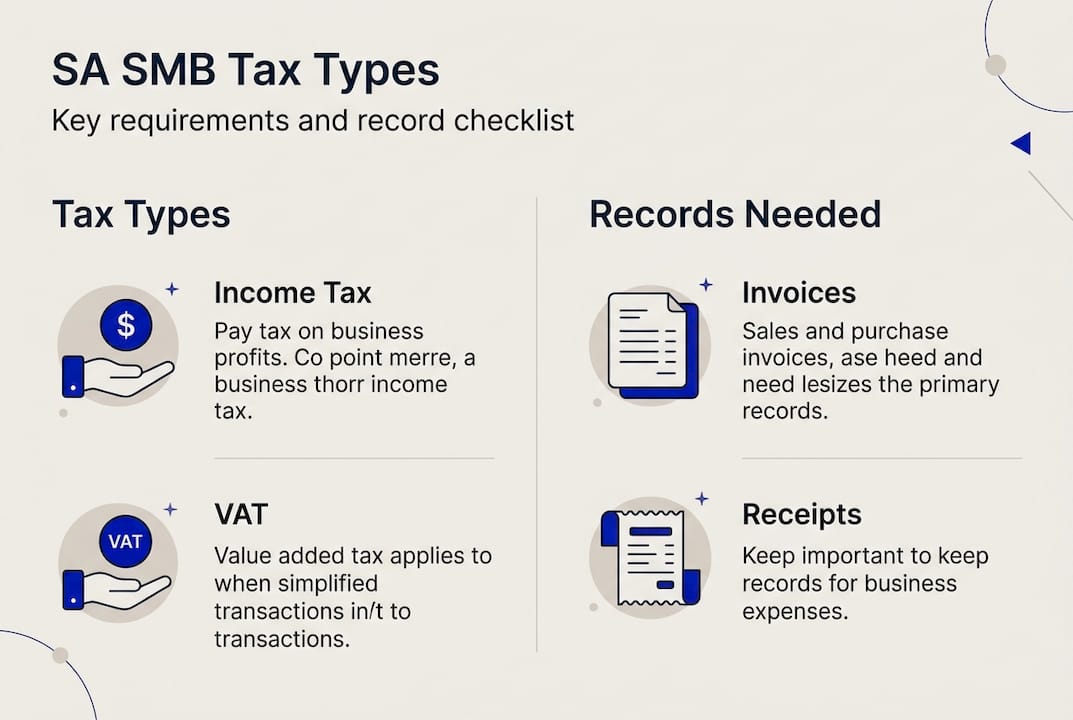
Understanding different business tax types helps you prepare appropriate documentation. Each tax has specific substantiation requirements. VAT claims need tax invoices with supplier details and VAT registration numbers. Expense deductions require proof of business purpose. Payroll taxes demand signed employment contracts and accurate timekeeping.
Common consequences and risks of poor tax compliance for SMBs
The financial impact of non-compliance extends far beyond the taxes you owe. SARS imposes penalties calculated as percentages of the tax due, with rates increasing for repeated violations. Interest accrues monthly on unpaid amounts at rates that can exceed 10% annually. A small oversight can balloon into a major liability within months.
Non-compliance leads to severe penalties and interest charges that threaten the survival of small and medium businesses across South Africa.
SARS has extensive audit powers. They can request detailed information, visit your premises, and examine any records they deem relevant. Audits consume significant time and resources, pulling you away from revenue-generating activities. If SARS finds discrepancies, they can issue assessments for additional taxes plus penalties, which you must pay or dispute through lengthy objection processes.
Legal consequences escalate with the severity of non-compliance:
- Administrative penalties for late filing or incomplete returns
- Criminal prosecution for tax evasion or fraud, carrying potential imprisonment
- Business deregistration preventing you from operating legally
- Director liability where company officers become personally responsible for tax debts
Reputational damage often proves more costly than financial penalties. Suppliers may demand cash on delivery instead of offering credit terms. Customers question your stability and reliability. Talented employees hesitate to join businesses with compliance issues. Your business valuation plummets if you ever seek investment or plan an exit.
Common pitfalls leading to compliance failures include mixing personal and business finances, losing receipts, misclassifying expenses, and underreporting cash sales. Many SMB owners assume they can handle everything themselves, only to discover tax law complexity when facing an audit. Others delay addressing problems, hoping they’ll resolve themselves, which only worsens the situation.
The psychological toll shouldn’t be underestimated. Tax stress affects your health, relationships, and decision making. Business owners facing compliance issues report anxiety, sleep problems, and difficulty focusing on strategic priorities. This creates a vicious cycle where stress impairs judgment, leading to more mistakes.
Practical strategies and tools to improve tax compliance for your business
Modern technology has transformed tax compliance from a manual nightmare into a manageable process. Cloud accounting solutions enable real-time tax monitoring, automatic calculations, and seamless SARS integration. These platforms reduce human error, provide audit trails, and generate reports at the click of a button.
Key strategies for maintaining compliance include:
- Implement cloud accounting software that integrates with your bank accounts for automatic transaction imports
- Schedule monthly reconciliation sessions to review finances and catch errors early
- Separate business and personal finances completely with dedicated accounts and cards
- Engage a qualified tax professional for annual reviews and strategic planning
- Create a compliance calendar with all deadlines and required actions clearly marked
Choosing the right tools depends on your business size, complexity, and budget:
| Software | Best for | Key compliance features | Monthly cost range |
|---|---|---|---|
| Xero | Growing SMBs | VAT tracking, payroll integration, SARS filing | R300 – R850 |
| QuickBooks | Service businesses | Expense categorization, receipt capture, tax reports | R250 – R750 |
| Sage Business Cloud | Established companies | Multi-user access, inventory management, compliance alerts | R400 – R1200 |
| Wave | Startups and freelancers | Free basic accounting, simple invoicing, receipt scanning | R0 – R300 |
Pro Tip: Most accounting software offers free trials. Test multiple options with your actual business data to find the best fit before committing to annual subscriptions.
Develop a monthly compliance checklist:
- Reconcile all bank and credit card accounts
- Categorize and file all receipts and invoices
- Review VAT input and output calculations
- Process payroll and submit PAYE declarations
- Update cash flow forecasts and tax provision estimates
- Back up all financial data to secure cloud storage
Yearly activities require more intensive effort. Schedule these during slower business periods:
- Conduct full financial statement preparation
- Complete annual tax returns with all supporting schedules
- File PAYE reconciliation and employee tax certificates
- Review tax planning opportunities with your accountant
- Update business registrations and licenses as needed
- Assess whether current systems and processes remain adequate
Professional support provides value beyond basic compliance. Tax consultants identify planning strategies that legally minimize your tax burden. They stay current with regulation changes that you might miss. During audits, having expert representation protects your interests and ensures proper procedure.
Consider your compliance approach an investment, not an expense. The cost of software subscriptions and professional fees is minuscule compared to penalties, interest, and lost opportunities from poor compliance. Businesses with robust systems spend less time on administration and more time serving customers and growing revenue.
How Ready Accounting supports your tax compliance efforts
Navigating South African tax regulations doesn’t have to feel overwhelming. Ready Accounting specializes in helping SMBs establish and maintain robust compliance systems tailored to your specific needs. Our team combines deep tax expertise with practical business understanding to deliver solutions that work in the real world.
We integrate cloud accounting platforms seamlessly with your operations, automating routine tasks while maintaining the accuracy SARS demands. Our proactive approach identifies potential issues before they become problems, keeping you ahead of deadlines and regulation changes. From record keeping systems to strategic tax planning, we provide comprehensive support that transforms compliance from a burden into a competitive advantage. Schedule a consultation to discover how we can simplify your tax obligations while optimizing your financial position.
Frequently asked questions
What exactly does tax compliance mean for my small business?
Tax compliance means fulfilling all legal obligations to SARS, including accurate record keeping, timely filing of returns, and prompt payment of taxes owed. It covers income tax, VAT, payroll taxes, and any other levies applicable to your specific business activities. Compliance requires maintaining proper documentation and meeting all deadlines consistently.
How long must I keep business tax records in South Africa?
SARS requires businesses to retain all tax records for at least five years from the date of submission. This includes invoices, receipts, bank statements, payroll documents, and any correspondence with SARS. Electronic records are acceptable if properly backed up and easily retrievable during audits.
What happens if I miss a tax filing deadline?
Missing deadlines triggers automatic penalties calculated as a percentage of the tax due, plus interest charges that accrue monthly. Repeated violations result in higher penalty rates and increased audit risk. SARS may also suspend your good standing status, affecting your ability to obtain tax clearance certificates needed for contracts and tenders.
How can I check if my business is fully tax compliant?
Review your SARS eFiling profile to verify all registrations are current and no outstanding returns exist. Check that you’ve filed all required submissions on time and paid amounts due. Consider engaging a tax professional for a compliance audit if you’re uncertain. Regular reconciliation of your accounting records against SARS statements helps identify discrepancies early.
What are the most common tax compliance mistakes SMBs make?
Common errors include mixing personal and business finances, losing receipts and documentation, misclassifying expenses, underreporting cash income, and missing filing deadlines. Many businesses fail to register for VAT when reaching the threshold or incorrectly calculate provisional tax payments. Poor record keeping practices and attempting to handle complex tax matters without professional guidance also frequently lead to compliance failures.
Recommended
- Small business tax in South Africa: essential 2026 guide – Ready Accounting
- Top Tax Questions Small Business Owners Ask in 2025 – Ready Accounting
- Year-End Tax Planning Guide for Small Businesses – Ready Accounting
- How to save tax in South Africa: smart strategies for SMEs in 2026 – Ready Accounting