

VAT registration requirements: A guide for SA SMEs
Executive Summary
- The VAT registration threshold in South Africa rises to R2.3 million in 2026, offering more growth flexibility.
- Businesses must register within 21 days of exceeding the threshold to avoid penalties and backdated liabilities.
- Strategic VAT planning and automated financial systems help SMEs manage compliance, cash flow, and growth opportunities.
Many South African SME owners believe VAT registration is a large-business problem. It is not. From 1 April 2026, the compulsory VAT threshold rises to R2.3 million in taxable supplies over any consecutive 12-month period, up from R1 million. That shift changes the compliance landscape dramatically, giving growing businesses more room but also creating new strategic decisions. Whether you are approaching the threshold, sitting below it, or already registered, understanding the rules and the opportunities around VAT can protect your business and accelerate your growth.
Table of Contents
- Understanding VAT and registration thresholds
- Step-by-step VAT registration process
- The pros and cons of voluntary VAT registration
- Strategic VAT planning: threshold, deregistration, and compliance
- A fresh perspective: Getting VAT right for lasting SME growth
- Take control of your VAT compliance today
- frequently asked questions
Key Takeaways
| Point | Details |
|---|---|
| New VAT threshold is R2.3 million | SMEs must register for VAT once taxable supplies exceed R2.3 million in a consecutive 12-month period. |
| Voluntary VAT offers strategic advantages | Registering voluntarily can unlock input VAT recovery and boost B2B credibility, though admin costs may outweigh benefits for some. |
| Diligent bookkeeping prevents penalties | Proactive revenue tracking and document preparation are critical for smooth VAT registration and ongoing compliance. |
| Plan for deregistration if turnover dips | Strategic review can help SMEs decide when to deregister and balance input VAT loss against compliance savings. |
| Expert support streamlines compliance | Partnering with accounting professionals helps SMEs avoid errors, maximize tax efficiency, and support business growth. |
Understanding VAT and registration thresholds
VAT, or Value Added Tax, is an indirect tax levied on the supply of goods and services in South Africa. It is currently charged at 15% on most standard-rated supplies. The business collects VAT from customers, claims back VAT paid on business expenses (called input VAT), and pays the difference to the South African Revenue Service (commonly known as tax compliance for SMBs).
There are two ways a business becomes a VAT vendor. The first is compulsory registration, which applies when your taxable supplies exceed the legal threshold. The second is voluntary registration, which allows businesses below the threshold to register if they choose. Both carry real consequences for cash flow, pricing, and admin.
The big news for 2026 is straightforward. The compulsory registration threshold is now R2.3 million from 1 April 2026, nearly doubling from the previous R1 million. This means businesses that were previously required to register now have more breathing room. But it also means that if your revenue is climbing toward R2.3 million, you need a plan.
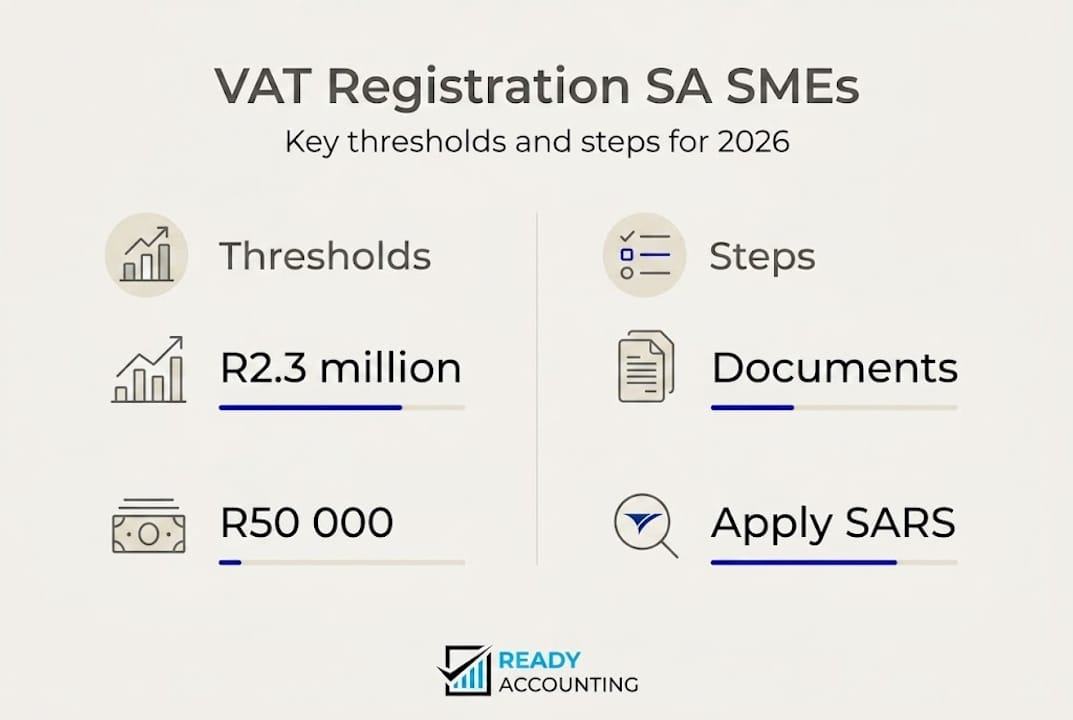
Here is what changes and what stays the same under the new rules:
| Registration type | Old threshold | New threshold (2026) | Timeline to register | VAT rate applied |
|---|---|---|---|---|
| compulsory | R1 million | R2.3 million | 21 business days | 15% standard rate |
| voluntary | R50 000 minimum | R50 000 minimum | At application | 15% standard rate |
Key rules to know before you grow past the threshold:
- You must register within 21 business days of exceeding R2.3 million
- The 12-month period is any consecutive 12 months, not just a financial year
- Future expected turnover can also trigger registration
- A signed contract that will push supplies above the threshold is enough to require registration
For a full breakdown of your ongoing obligations once you are registered, our VAT compliance guide covers every requirement in detail.
Pro tip: Many SMEs miscalculate their 12-month taxable supply figure because they exclude VAT-exempt income but include non-taxable grants. Track only taxable supplies, including zero-rated ones, in your threshold calculation.
Step-by-step VAT registration process
Once you know registration is required or desired, the process itself is relatively straightforward. What trips businesses up is timing and documentation. Missing the 21-business-day window after exceeding the threshold can result in penalties, back-dated VAT liability, and interest charges from the South African Revenue Service.
Here is a clear sequence to follow:
- Monitor your taxable supplies monthly. Do not wait until year-end. If your trailing 12-month figure crosses R2.3 million, your registration clock starts immediately.
- Your documents before you apply. You will need your company registration certificate, certified ID of all directors or members, proof of business address, three months of bank statements, and your most recent financial statements or projections.
- Log in to the small business tax guide resources and then onto the South African Revenue Service’s official online platform, known as top SME tax questions answered via https://www.sars.gov.za, and navigate to the VAT registration section on https://efiling.sars.gov.za. Complete the VAT101 form online or visit a branch.
- Submit and await confirmation. Processing typically takes 5 to 21 business days. South African Revenue Service may request supporting documents during review.
- Once approved, display your VAT registration number on all tax invoices immediately.
Pro tip: Apply through https://efiling.sars.gov.za rather than a branch wherever possible. Online submissions are processed faster and create an electronic audit trail that protects you if South African Revenue Service ever queries your registration date.
Common mistakes businesses make during registration:
- Missing the 21-day deadline because no one was tracking monthly revenue closely
- Using outdated financial statements when South African Revenue Service expects recent bank statements
- Not updating the registration when business details change after approval
- Using the wrong entity details if the business structure changed since initial registration
Registering correctly the first time matters more than most owners realise. A late registration means South African Revenue Service can back-date your VAT liability and charge output VAT on every invoice you issued after the date you should have registered, even if you never collected it from your clients.
The pros and cons of voluntary VAT registration
Voluntary registration is available to any business making or intending to make taxable supplies of at least R50 000 in the next 12 months. It is a strategic decision, not just a compliance checkbox. Getting it right depends heavily on your business model, your customer base, and your cost structure.

Here is a direct comparison to guide your decision:
| Factor | Business with high input costs | Low-margin B2C retailer** ** |
|---|---|---|
| Input VAT recovery | Strong benefit | Limited benefit |
| Price competitiveness | Less affected | Price increase risks sales |
| B2B tender eligibility | Often required | Not usually relevant |
| Admin and compliance cost | Worth it | May exceed the savings |
| Cash flow impact | Can be positive | Often negative |
The clearest advantages of voluntary registration are:
- Input VAT recovery on every rand you spend on business inputs, equipment, and services
- B2B credibility because many large corporates and government entities prefer or require VAT vendors
- Cash flow benefits when you collect VAT from clients before paying it to South African Revenue Service
The risks are equally real. For businesses selling directly to consumers, adding 15% VAT to your prices can reduce competitiveness overnight. If your margins are thin and your input VAT is low, reducing SME tax liability through other means may be more cost-effective than voluntary VAT registration.
“The key question is not whether you can register voluntarily, but whether the input VAT you recover will outweigh the admin burden and any pricing impact on your customer base.” Consider your revenue mix carefully before deciding.
A practical example: A graphic design studio spends R40 000 per month on software, equipment, and subcontractors. At 15%, that is R6 000 in claimable input VAT monthly. Over 12 months, that is R72 000 recovered. For that business, voluntary registration pays for itself quickly. A corner café with low input costs and price-sensitive walk-in customers faces a very different tax-efficient structure decision.
Strategic VAT planning: threshold, deregistration, and compliance
VAT planning is not a once-off event. It is a rolling process that should sit inside your monthly financial rhythm. As your business grows toward R2.3 million in taxable supplies, the strategy changes and so does the risk profile.
Start tracking these metrics before you need to act:
- Monthly taxable revenue tracked against a rolling 12-month total
- Input VAT paid on business purchases, captured invoice by invoice
- Output VAT collected from clients, reconciled to your bank deposits
- Net VAT position showing whether you are in a refund or payment position each period
Pro tip: When your trailing 12-month taxable supplies hit R1.8 million, treat it as a trigger to begin registration preparation. By R2.1 million, your application should already be submitted. The 21-day window is short and South African Revenue Service does not issue grace period extensions.
Deregistration is equally important and often overlooked. If your turnover drops below the threshold after a difficult trading period, you can apply to deregister. But the math matters. Before deregistering, you need to model what you lose in input VAT recovery versus what you save in admin and compliance costs. For many businesses, the saving is smaller than expected, especially if they rely on VAT vendor status for company-related tax decisions and supplier relationships.
To prepare for a compliance audit at any time, keep the following in order:
- Tax invoices for every transaction above R50
- Monthly VAT returns filed on time, even in nil periods
- Bank statements reconciled to your VAT returns
- A clear record of all exempt and zero-rated supplies separately accounted for
- A register of fixed assets on which input VAT was claimed
Building this habit early means that when South African Revenue Service does knock, your books speak for themselves.
A fresh perspective: Getting VAT right for lasting SME growth
Here is the insight most VAT articles skip. The businesses that get hurt by VAT are rarely the ones that registered too early. They are the ones that treated VAT as a compliance event rather than a financial planning tool.
We have seen owners delay VAT decisions for months, convinced they are avoiding complexity, only to find that they missed a major tender because they could not issue a valid tax invoice. Or they get hit with backdated VAT liability because no one was watching the threshold. Both outcomes are expensive and entirely avoidable.
The smarter move is to model your VAT position before you need to make the decision. What does your cash flow look like if you register now? What B2B doors open? What happens if you cross the threshold unexpectedly in month nine and have 21 days to comply? These are the questions that addressing tax questions early can answer.
Cloud accounting platforms change this equation entirely. When your income and expenses feed automatically into a live dashboard, threshold monitoring becomes automatic and deregistration modelling takes minutes instead of days. VAT stops being a surprise and starts being a lever.
Take control of your VAT compliance today
VAT registration does not have to be stressful or reactive. With the right systems in place, it becomes a predictable, manageable part of your business operations. At Ready readyaccounting.co.za, we help South African SMEs replace manual guesswork with cloud-powered financial infrastructure that tracks VAT thresholds in real time, flags risks before they become penalties, and positions your business to reduce tax liability strategically. From registration to ongoing compliance, our team acts as your fractional CFO. Find out how accounting automation can remove the admin friction that is slowing you down.
frequently asked questions
What is the compulsory VAT registration threshold for South African SMEs in 2026?
The compulsory threshold is R2.3 million in taxable supplies over any consecutive 12-month period, effective from 1 April 2026. SMEs must register within 21 business days of exceeding this amount.
Can small businesses register for VAT voluntarily below the threshold?
Yes, voluntary registration is available to businesses with taxable supplies of at least R50 000 per year. It can offer input VAT recovery and B2B credibility, making it worthwhile for businesses with significant input costs.
What documents are required for VAT registration in South Africa?
You need your company registration certificate, director ID documents, proof of business address, three months of bank statements, and proof of taxable income. You must register within 21 business days of exceeding the threshold, so prepare your documents in advance.
How can SMEs plan for VAT compliance as turnover approaches the threshold?
Track your monthly taxable revenue against a rolling 12-month total and start preparing bookkeeping early once you approach R1.8 million. Early preparation prevents late registration penalties and positions you to make an informed decision about timing.
Recommended
- The Ultimate VAT Compliance Protocol for South African South African Enterprises in 2025 | Ready Accounting
- Small business tax in South Africa: essential 2026 guide - Ready Accounting
- Tax compliance guide for South African SMBs in 2026 - Ready Accounting
- Cloud accounting guide for South African SMB growth - Ready Accounting