

What are financial statements: protocol for South African Corporate Assets
Many South African SMB owners view financial statements as complex documents meant only for accountants or large corporations. This misconception keeps business owners from leveraging powerful tools that reveal their company’s true financial position and growth potential. Understanding financial statements is essential for making informed decisions, ensuring compliance, and building a sustainable business in 2026. This guide demystifies core financial statements and shows you how to use them effectively for your South African business.
Table of Contents
- Core Types Of Financial Statements And What They Reveal
- Understanding Context And Nuances In Financial Statements For South African SMBs
- Using Financial Statements To Assess Business Health And Drive Growth
- Best Practices And Resources For South African SMBs On Financial Statements 2026
Key takeaways
| Point | Details |
|---|---|
| Four core statements | Balance sheet, income statement, cash flow statement, and equity statement each reveal different aspects of business health |
| IFRS for SMEs relevance | Simplified international standards apply to South African SMBs but adoption remains below 50% due to complexity |
| Beyond compliance | Financial statements enable strategic planning, performance tracking, and growth decisions when interpreted correctly |
| Local challenges | South African SMBs face high failure rates that proper financial analysis and literacy can help prevent |
| Professional support | Cloud accounting tools and expert advisors simplify statement preparation and unlock actionable business insights |
Core types of financial statements and what they reveal
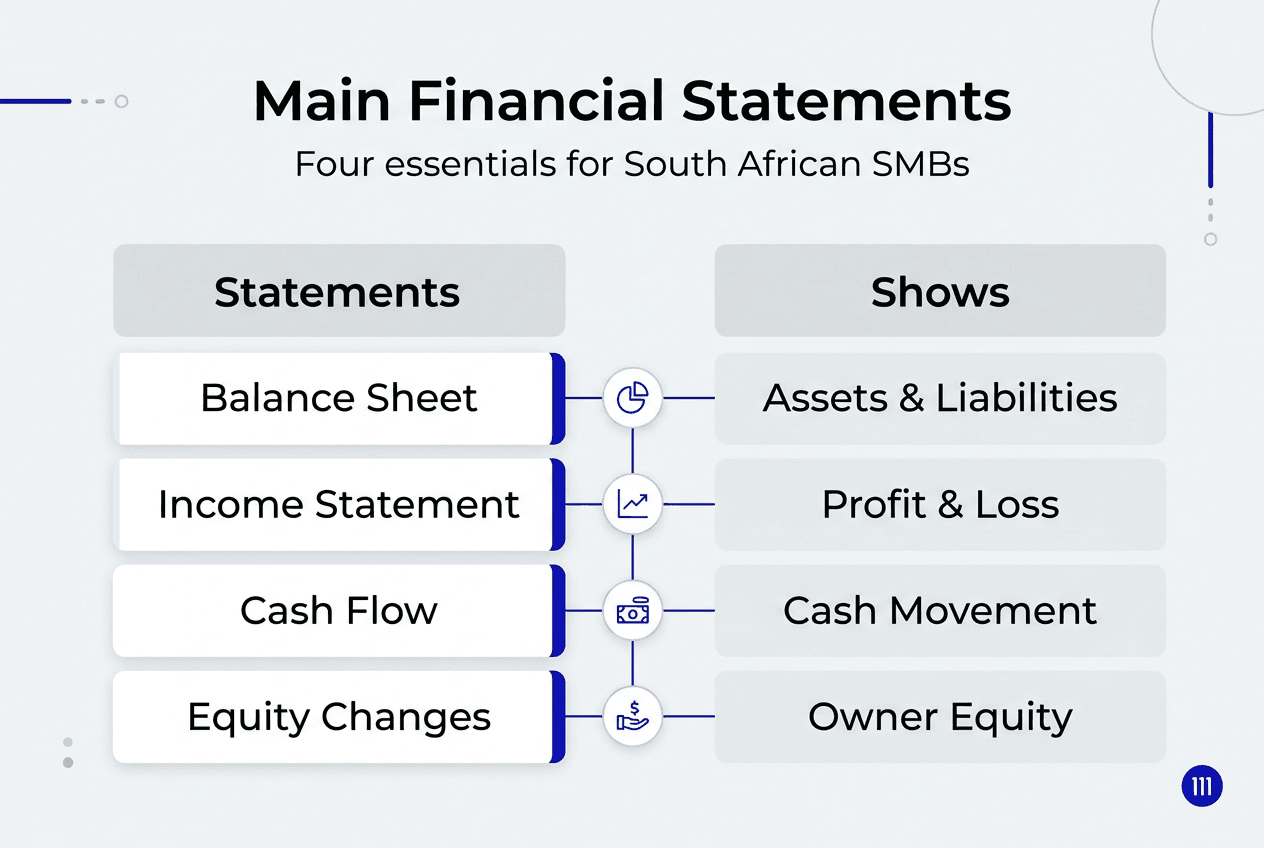
Every South African SMB needs four fundamental types of financial statements to understand their business comprehensively. The Statement of Financial Position shows what your business owns (assets), owes (liabilities), and the residual value belonging to owners (equity) at a specific point in time. Think of it as a financial snapshot capturing your company’s net worth on a particular date.

The Statement of Comprehensive Income, commonly called the income statement or profit and loss statement, tracks revenues earned and expenses incurred over a period. This statement reveals whether your business operations generated profit or loss during the month, quarter, or year. It answers the fundamental question: is your business model making money?
The Statement of Cash Flows categorizes actual cash movements into three activities: operating (day to day business), investing (equipment and asset purchases), and financing (loans and owner contributions). This statement is critical because profitable businesses can still fail from poor cash management. You might show profit on paper while running out of money to pay suppliers or staff.
The Statement of Changes in Equity tracks movements in owner equity, including profit retained in the business, dividends paid out, and additional capital invested. This statement connects the other three by showing how profits flow into equity and how ownership stakes evolve over time.
| Statement | Primary Purpose | Key Elements | Timing |
| — | — |
| Statement of Financial Position | Shows financial position and net worth | Assets, liabilities, equity | Specific date (snapshot) |
| Statement of Comprehensive Income | Measures profitability and performance | Revenues, expenses, profit/loss | Period (monthly, yearly) |
| Statement of Cash Flows | Tracks liquidity and cash movements | Operating, investing, financing cash | Period (monthly, yearly) |
| Statement of Changes in Equity | Records ownership value changes | Opening equity, profit, dividends, closing equity | Period (yearly) |
Each statement serves distinct business decision needs:
- The balance sheet helps assess whether you have sufficient assets to cover liabilities and whether your business is financially stable
- The income statement identifies which products or services drive profitability and where expenses need control
- The cash flow statement reveals whether operations generate enough cash to sustain and grow the business without constant external funding
- The equity statement shows how effectively the business builds owner value over time
Pro Tip: While all four statements matter, CEOs should prioritize the cash flow statement for survival. Profit is an accounting concept, but cash pays salaries and suppliers. A business can be profitable on paper yet collapse from cash shortages.
Understanding context and nuances in financial statements for South African SMBs
South African SMBs operate under IFRS for SMEs, a simplified version of full International Financial Reporting Standards designed specifically for smaller entities. The 2025 edition updated revenue recognition to align with the five step model used in full IFRS, refined business combination accounting, and enhanced fair value guidance while maintaining the simplified approach SMBs need. These updates make statements more comparable internationally while keeping preparation less burdensome than full IFRS.
Despite simplification efforts, adoption challenges persist. Research shows fewer than 50% of eligible South African SMBs properly implement IFRS for SMEs due to perceived complexity, cost of compliance, and limited financial literacy among business owners. Many small businesses still use cash basis accounting or inconsistent methods that undermine statement reliability and comparability.
Consistent accounting policies are non negotiable for producing meaningful financial statement basics. You cannot compare this year’s performance to last year if you change how you recognize revenue or value inventory between periods. Transparency through proper disclosure builds trust with lenders, investors, and regulators who rely on your statements.
Key disclosure requirements and common challenges include:
- Related party transactions must be disclosed to prevent conflicts of interest and ensure arm’s length pricing
- Contingent liabilities like pending lawsuits or guarantees need notation even though amounts are uncertain
- Post balance sheet events that occur after year end but before statement finalization require disclosure if material
- Accounting policy choices and significant judgements must be explained so readers understand your approach
- Many SMBs struggle with these disclosures due to limited accounting expertise and see them as unnecessary paperwork
Despite IFRS for SMEs simplification, adoption rates among South African SMBs remain below 50% due to complexity perceptions, compliance costs, and insufficient financial literacy among business owners.
These challenges directly impact how effectively SMB owners use financial statements. When statements lack consistency or proper disclosure, they become unreliable for decision making. Owners miss opportunities to spot trends, benchmark performance, or identify problems early. The gap between producing statements for compliance versus using them strategically for growth remains wide in the South African SMB landscape.
Using financial statements to assess business health and drive growth
Financial statements become powerful when you move beyond compliance to strategic analysis. Analyzing financial statements reveals patterns and ratios that quantify business health in ways gut feeling cannot match. South African SMBs face sobering statistics: 72% fail within 3 to 4 years. Proper financial analysis helps you avoid becoming part of that statistic.
Key financial ratios translate statement numbers into actionable insights. Current ratio (current assets divided by current liabilities) measures whether you can pay short term obligations. A ratio below 1.0 signals potential liquidity problems. Gross profit margin (gross profit divided by revenue) shows how much you earn after direct costs, revealing pricing power and operational efficiency. Debt to equity ratio indicates financial leverage and risk exposure.
South African SMBs face a challenge: limited published ratio benchmarks specific to local industries and business sizes. Unlike larger markets with extensive industry data, you often cannot easily compare your ratios to sector averages. Instead, compare your ratios to your own budgets and track trends over time. Are margins improving or declining? Is debt growing faster than equity?
Follow this step by step approach to extract insights from your statements:
- Review your income statement to identify revenue trends and expense categories consuming disproportionate resources
- Calculate key profitability ratios and compare them to prior periods to spot improvement or deterioration
- Examine your cash flow statement to ensure operating activities generate positive cash, not just accounting profit
- Check your balance sheet liquidity ratios to confirm you maintain adequate working capital buffers
- Analyze equity changes to understand whether the business builds value or merely survives month to month
- Document findings and create action plans addressing weaknesses or capitalizing on strengths revealed by the analysis
| Ratio | Formula | Suggested Range | What It Reveals |
| — | — | — |
| Current Ratio | Current Assets / Current Liabilities | 1.5 to 3.0 | Short term liquidity and ability to pay obligations |
| Gross Profit Margin | (Revenue – Cost of Sales) / Revenue × 100 | 30% to 50% (varies by industry) | Pricing power and production efficiency |
| Net Profit Margin | Net Profit / Revenue × 100 | 5% to 15% (varies by industry) | Overall profitability after all expenses |
| Debt to Equity | Total Liabilities / Total Equity | Below 2.0 | Financial leverage and solvency risk |
| Return on Equity | Net Profit / Average Equity × 100 | 15% to 25% | How effectively equity generates returns |
Research identifies market orientation (understanding customer needs) and information communication technology adoption as critical success factors that boost South African SMB performance. These factors improve how you interpret and act on financial data. Technology enables real time financial tracking instead of waiting months for year end statements.
Pro Tip: Align your financial analysis with market realities. Strong ratios mean little if your products no longer meet customer needs or if competitors offer better value. Combine financial metrics with market intelligence for complete business insight.
Remember that numbers alone tell an incomplete story. A declining profit margin might result from strategic price cuts to gain market share, not operational failure. Rising debt could fund expansion that generates future returns. Context matters. Use financial statements as diagnostic tools that raise questions requiring deeper investigation, not as definitive verdicts on business health.
Best practices and resources for South African SMBs on financial statements 2026
Establishing consistent financial statement practices separates thriving businesses from struggling ones. Preparing financial statements should become routine, not a last minute scramble before tax deadlines. Monthly statement preparation keeps you informed and enables course corrections before small problems become crises.
Implement these best practices to maximize statement value:
- Maintain consistent accounting policies year over year so statements remain comparable and trends become visible
- Reconcile bank accounts and balance sheet accounts monthly to catch errors early and ensure accuracy
- Document significant transactions and judgements contemporaneously rather than reconstructing details months later
- Use cloud accounting software that automates data entry, reduces errors, and generates statements on demand
- Schedule quarterly reviews with your accountant or financial advisor to interpret results and plan strategically
- Create written financial policies covering revenue recognition, expense categorization, and asset valuation for consistency
Financial literacy dramatically impacts how effectively you use statements. Research shows contrasting views exist: some see financial statements as reactive historical records with limited forward value, while others recognize them as proactive tools enabling informed decisions and growth strategies. Low financial literacy keeps many South African SMB owners trapped in the reactive mindset, using statements only for compliance while missing strategic opportunities.
Investing in your financial knowledge pays dividends. Understanding what ratios mean, how cash flow differs from profit, and which metrics matter most for your industry transforms statements from intimidating documents into management dashboards. Online courses, workshops, and advisory relationships build this capability over time.
Pro Tip: Maintain a financial calendar synchronizing statement preparation with statutory deadlines, tax filing dates, and business planning cycles. Schedule monthly closes by the 10th of the following month, quarterly reviews mid month after quarter end, and annual planning sessions in November for the coming year. Consistency creates discipline and ensures financial management never falls through the cracks.
South African SMBs can access various resources beyond their accountants. Industry associations often provide benchmarking data and best practice guides. Government agencies like SEDA (Small Enterprise Development Agency) offer business support including financial management training. Cloud accounting platforms include educational content and automated compliance features tailored for South African regulations.
Leveraging modern technology removes technical barriers. Cloud accounting tools automatically categorize transactions, generate compliant statements, and provide real time dashboards showing key metrics. You gain financial visibility without becoming an accounting expert. The investment in proper tools and occasional professional advice costs far less than the consequences of flying blind financially.
Discover accounting solutions tailored for South African SMB growth
Mastering financial statements requires the right combination of knowledge, tools, and expert guidance. Ready Accounting specializes in helping South African SMBs transform financial management from a compliance burden into a competitive advantage. Our cloud accounting benefits approach ensures your financial statements are accurate, accessible, and actionable whenever you need them.
We understand the unique challenges South African SMBs face with IFRS for SMEs adoption and financial literacy gaps. Our team provides hands on support preparing compliant financial statements while explaining what the numbers mean for your specific business. Whether you need bookkeeping cleanup, monthly statement preparation, or strategic financial advisory, we tailor solutions to your growth stage and industry.
Explore our comprehensive cloud accounting guide to discover how modern technology simplifies financial management. Ready to take control of your business finances with confidence? Visit Ready Accounting to schedule a consultation and learn how we can support your financial success in 2026.
What are financial statements?
What are the main types of financial statements my business needs?
Your business needs four core financial statements: the Statement of Financial Position (balance sheet) showing assets, liabilities, and equity; the Statement of Comprehensive Income (income statement) tracking revenues and expenses; the Statement of Cash Flows categorizing cash movements; and the Statement of Changes in Equity recording ownership value changes. Together, these statements provide a complete picture of financial health, profitability, liquidity, and value creation. Most South African SMBs prepare these quarterly or annually, though monthly preparation offers better management insight.
How do financial statements help me manage my business better?
Financial statements transform abstract business activity into measurable metrics you can track and improve. They reveal which products or services generate profit, whether you maintain adequate cash reserves, and how efficiently you use resources. Reading financial statements regularly helps you spot problems early, make data driven decisions about pricing or expansion, and demonstrate financial credibility to lenders or investors. Businesses that actively use financial analysis grow faster and survive longer than those relying on intuition alone.
Are South African SMBs required to follow IFRS for SMEs in 2026?
IFRS for SMEs is not legally mandatory for all South African SMBs, but it represents best practice and is often required by lenders, investors, or larger clients who need reliable financial information. Companies Act requirements vary based on public interest score, with higher scoring entities facing stricter compliance obligations including audited IFRS statements. Even if not legally required, adopting IFRS for SMEs improves statement quality, comparability, and credibility. Many accounting professionals recommend it for any SMB seeking growth funding or planning eventual sale.
What common mistakes should I avoid when preparing financial statements?
Avoid changing accounting policies between periods, which destroys comparability and hides trends. Never mix personal and business transactions, as this distorts true business performance and creates tax complications. Failing to reconcile accounts monthly leads to accumulated errors that become difficult to untangle. Ignoring the difference between cash and profit causes many SMBs to run out of money despite showing paper profits. Finally, preparing statements only annually for compliance misses the management value of regular financial monitoring that enables proactive decisions.
Where can I find professional help to understand and use my financial statements better?
Professional accounting firms like Ready Accounting specialize in helping South African SMBs with financial statement preparation and interpretation. Cloud accounting platforms often include advisory services and educational resources tailored to your needs. Industry associations provide workshops and peer learning opportunities. For comprehensive support, consider establishing an ongoing relationship with a qualified accountant who understands your business and can translate annual financial statements into actionable strategies. The investment in professional guidance typically pays for itself through better decisions and avoided mistakes.
Recommended
- How to Read Financial Statements: Easy Guide for 2025 – Ready Accounting
- Financial Statement Basics: A Guide for Business Owners – Ready Accounting
- Annual Financial Statements in South Africa: What Business Owners Need to Know for 2025 – Ready Accounting
- What Is Financial Reporting? Guide for South African Businesses 2025 – Ready Accounting
- SOC 1 Certified: Ensuring Financial Data Trust