

Why 90% of South African South African Enterprises Fail Due to Poor Tax Compliance (And Execution Framework: Avoid It)
South african small businesses face a steep uphill battle trying to keep up with tax rules, and many never make it out the starting blocks. Nearly 90% of small businesses in the country fail because they struggle with tax compliance. You might think a late tax submission is just a slap on the wrist, but this simple misstep can set off a domino effect that cripples your business and could force your doors shut for good.
Table of Contents
- Understanding Tax Compliance Challenges In South Africa
- Common Tax Mistakes Small Businesses Make
- How Poor Tax Compliance Leads To Business Failure
- Practical Steps To Improve Tax Compliance For SMEs
Quick Summary
| Takeaway | Explanation |
|---|---|
| Understand tax compliance challenges | South African small businesses face a complex tax landscape, making compliance crucial for success. |
| Avoid common tax mistakes | Mismanaging records, missing deadlines, and misunderstanding obligations can lead to severe penalties. |
| Implement robust financial systems | Investing in comprehensive financial management systems streamlines tax processes and improves compliance efficiency. |
| Develop a proactive tax strategy | Regularly update financial documentation and consult professionals to prevent compliance issues before they arise. |
| Leverage technology and support | Utilize cloud accounting software and engage tax professionals to simplify compliance burdens and maintain accurate records. |
Understanding Tax Compliance Challenges in South Africa
Navigating the complex landscape of tax compliance can be a daunting challenge for south african small businesses. The stark reality is that 90% of these enterprises struggle with meeting their tax obligations, ultimately leading to potential business failure. Understanding the intricate tax environment is crucial for survival and success.
The Regulatory Maze of SARS Compliance
Small businesses in South Africa face a formidable challenge with tax regulations that are both complex and unforgiving. Research by Smulders and Naidoo highlights the significant compliance burdens that entrepreneurs encounter. The South African Revenue Service (SARS) requires meticulous record-keeping, timely submissions, and comprehensive financial documentation that can overwhelm many business owners.
The compliance costs are particularly devastating for small enterprises. An empirical study revealed that the average annual tax compliance cost for small businesses is approximately R7,030. More critically, VAT returns prove to be the most time-consuming and costly aspect of tax compliance. This financial and administrative burden creates a significant barrier for emerging businesses trying to establish themselves in a competitive market.
The Economic Impact of Tax Non-Compliance
The consequences of tax non-compliance extend far beyond simple financial penalties. Research by Matarirano et al. demonstrates that tax compliance challenges are particularly acute in sectors like construction, where the regulatory burden can be disproportionately challenging for small businesses. These challenges often result in:
- Increased Financial Strain: Unexpected penalties and legal complications
- Operational Disruptions: Time spent managing complex tax requirements
- Potential Business Closure: Persistent non-compliance can lead to complete business shutdown
Entrepreneurs must recognize that tax compliance is not just a legal requirement but a critical component of business sustainability. The complexity of south african tax laws demands a proactive approach. Business owners need to invest time in understanding their tax obligations, maintain accurate financial records, and potentially seek professional guidance on tax planning strategies.
The path to successful tax compliance requires education, preparation, and a systematic approach to financial management. Small businesses must view tax compliance not as a burden, but as an essential aspect of their operational strategy. By developing robust financial systems, staying informed about regulatory changes, and seeking professional advice when needed, entrepreneurs can transform tax compliance from a challenge into a competitive advantage.
Understanding these challenges is the first step toward building a resilient and financially sound business in the south african economic landscape.
Common Tax Mistakes Small Businesses Make
Tax compliance represents a minefield for south african small businesses, with numerous potential pitfalls that can derail financial stability and operational success. Understanding and avoiding these common mistakes can mean the difference between business survival and catastrophic failure.
Mismanaging Financial Records and Documentation
One of the most critical errors south african small businesses commit is poor record-keeping. The IRS’s Publication 334 emphasizes the importance of maintaining comprehensive and accurate financial documentation. Entrepreneurs often underestimate the complexity of tracking expenses, income, and tax-relevant transactions.
Businesses frequently make mistakes such as:
- Mixing Personal and Business Expenses: Blending personal and professional financial activities creates significant accounting challenges
- Inadequate Receipt Management: Failing to retain and properly categorize financial receipts
- Inconsistent Bookkeeping: Irregular or incomplete financial record maintenance
These documentation errors can lead to substantial penalties during SARS audits and create significant financial risks. Learn more about avoiding common bookkeeping mistakes.
Overlooking Critical Tax Submission Deadlines
Tax submission deadlines are unforgiving in the south african business landscape. According to IRS guidelines, small businesses frequently fail by:
- Underpaying estimated taxes
- Missing employment tax deposit deadlines
- Filing tax returns late
- Neglecting to separate business and personal financial activities
Each missed deadline or incorrect submission can result in compounding penalties, interest charges, and potential legal complications. These financial burdens can quickly overwhelm small businesses with limited cash reserves.
Misunderstanding Tax Obligations and Regulations
Navigating the complex landscape of south african tax regulations requires continuous education and professional guidance. Many small business owners operate under misconceptions about their tax responsibilities, leading to unintentional non-compliance.
Key areas of misunderstanding include:
- VAT registration thresholds
- Provisional tax calculations
- Employee tax and payroll obligations
- Deductible business expenses
Small businesses must invest time in understanding their specific tax obligations or risk severe financial consequences. Exploring common tax questions can provide valuable insights into navigating these complex requirements.
By recognizing and proactively addressing these common tax mistakes, south african small businesses can significantly improve their financial management and increase their chances of long-term success. Professional consultation, continuous learning, and meticulous financial practices are essential strategies for maintaining robust tax compliance.
To help small business owners quickly identify and avoid common pitfalls, the following table summarises the most frequent tax mistakes highlighted in the article and their associated consequences:
| Common Tax Mistake | Description | Potential Consequences |
|---|---|---|
| Mixing personal and business expenses | Blending accounts instead of keeping them separate | Accounting challenges, audit issues |
| Inadequate receipt management | Not retaining or organising financial receipts | Penalties during SARS audits |
| Inconsistent bookkeeping | Irregular or incomplete recording of financial information | Financial risks, penalty exposure |
| Missing tax submission deadlines | Failing to file returns or make deposits on time | Compounding penalties, legal complications |
| Misunderstanding tax obligations | Lack of knowledge on VAT, payroll, or deductible expenses | Financial loss, non-compliance fines |
How Poor Tax Compliance Leads to Business Failure
In the unforgiving landscape of south african business, tax non-compliance represents a silent killer of entrepreneurial dreams. The path from potential success to complete business failure is often paved with seemingly minor tax-related mistakes that compound into catastrophic financial consequences.
The Hidden Costs of Tax Non-Compliance
Research from the Urban Institute reveals that small businesses bear a disproportionate share of tax compliance costs. For south african entrepreneurs, these costs go far beyond simple monetary penalties. The Tax Foundation reports that businesses spend an average of 120 hours annually on tax-related administrative tasks, with costs exceeding R150,000 for many small enterprises.
The financial burden manifests through multiple devastating channels:
- Unexpected Penalties: Accumulating fines that drain critical business resources
- Legal Complications: Potential legal actions that consume time and money
- Reputation Damage: Loss of credibility with financial institutions and potential partners
Operational Paralysis Through Compliance Challenges
A critical study published in the South African Journal of Business Management highlights how tax compliance costs directly impact business performance. Entrepreneurs find themselves trapped in a cycle of administrative complexity that prevents them from focusing on core business growth strategies.
The time and resources diverted to managing tax obligations create a ripple effect of operational challenges:
- Reduced capacity for strategic planning
- Diminished ability to invest in business development
- Increased stress and potential burnout for business owners
Financial Erosion and Business Viability
Poor tax compliance triggers a devastating domino effect that can quickly destroy business viability. Get insights into year-end tax planning strategies to mitigate these risks.
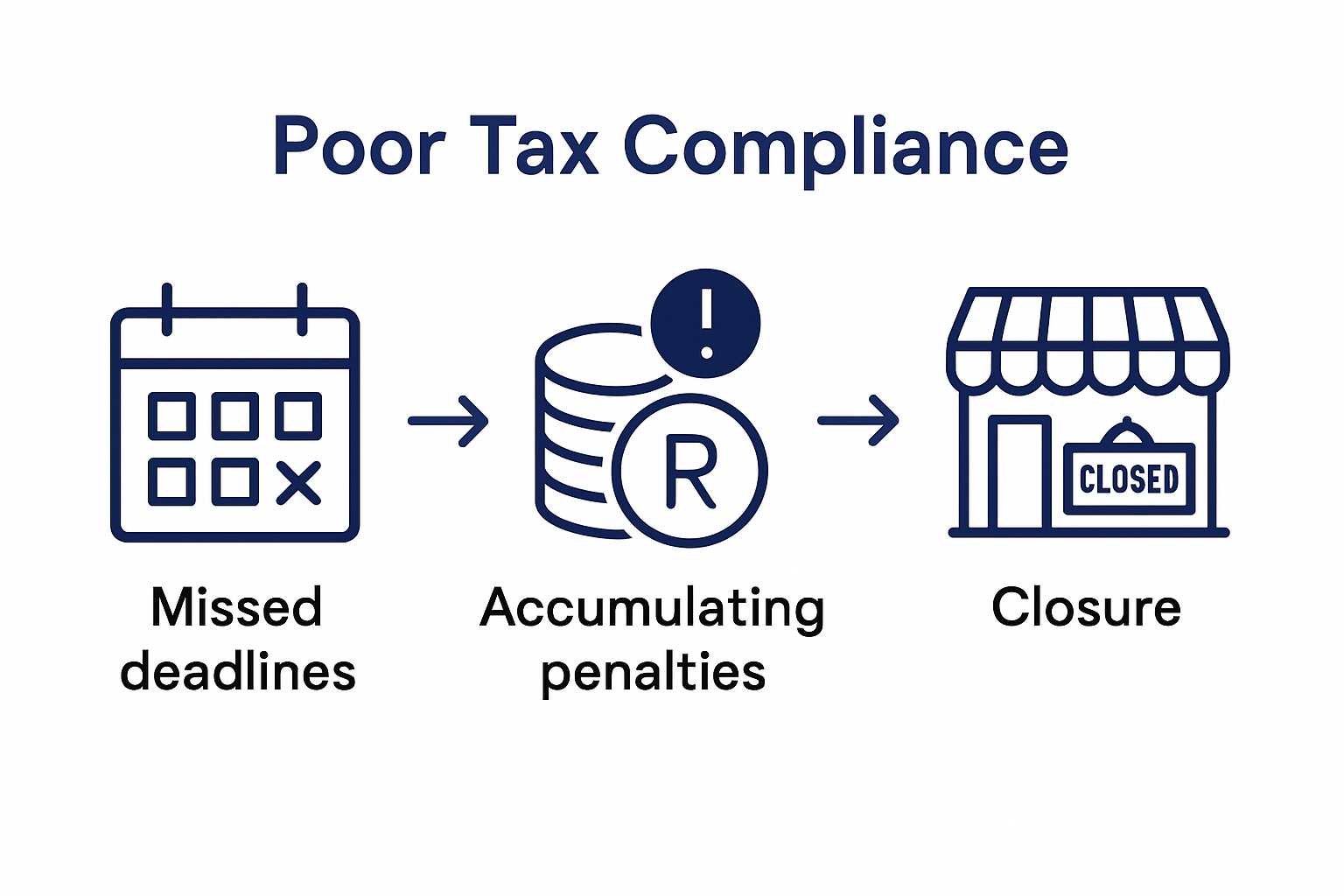
The progression of failure typically follows a predictable pattern:
To highlight how poor tax compliance can set off a chain reaction leading to business collapse, here’s a step-by-step table summarising the failure progression described in the article:
| Step | Stage of Non-Compliance | Effect on Business |
|---|---|---|
| 1 | Initial non-compliance | Small penalties incurred |
| 2 | Accumulated fines | Increasing financial strain |
| 3 | Restricted cash flow | Difficulty covering expenses/investing |
| 4 | Reduced adaptability | Unable to respond to market changes |
| 5 | Operational shutdown | Forced to close the business |
- Initial tax non-compliance leads to small penalties
- Accumulated fines create financial strain
- Cash flow becomes increasingly restricted
- Business loses ability to invest or respond to market changes
- Complete operational shutdown becomes inevitable
Most critically, south african small businesses often lack the financial buffer to withstand prolonged tax compliance challenges. A single significant tax-related issue can transform a promising enterprise into a cautionary tale of entrepreneurial failure.
The stark reality is that tax compliance is not an optional administrative task but a fundamental survival strategy. Businesses must view comprehensive tax management as a critical investment in their long-term sustainability, not a burdensome expense to be minimized or avoided.
Entrepreneurs who recognize the strategic importance of proactive tax compliance position themselves to navigate the complex south african business landscape successfully. Those who ignore these critical financial responsibilities are essentially writing their own business’s obituary.
Practical Steps to Improve Tax Compliance for SMEs
Tax compliance represents a critical survival strategy for south african small and medium enterprises. Navigating the complex regulatory landscape requires a strategic approach that transforms tax obligations from a potential burden into a manageable business process.
Implementing Robust Financial Management Systems
The European Commission’s research emphasizes the importance of creating stable regulatory environments and integrated tax registration processes for small businesses. South african SMEs must invest in comprehensive financial management systems that streamline record-keeping and reporting.
Key strategies for effective financial management include:
- Digital Accounting Solutions: Adopting cloud-based accounting platforms
- Automated Record-Keeping: Implementing systems that track expenses and income automatically
- Regular Financial Reconciliation: Establishing monthly review processes

Explore our year-end tax planning guide to understand how systematic financial management can transform your business approach.
Developing a Proactive Tax Compliance Strategy
Research from the European Commission highlights the critical importance of simplifying tax obligations for small businesses. South african SMEs must develop a proactive approach to tax compliance that goes beyond mere reactive reporting.
Essential components of a proactive tax strategy include:
- Maintaining accurate and up-to-date financial documentation
- Understanding current SARS regulations and reporting requirements
- Creating a dedicated financial compliance calendar
- Setting aside funds for potential tax obligations
- Seeking professional tax consultation regularly
Leveraging Technology and Professional Support
Technology and professional support are game-changers for south african SMEs struggling with tax compliance. Learn about advanced tax planning strategies that can simplify your financial management.
Critical technological and professional support strategies:
- Utilizing cloud-based accounting software
- Engaging with certified tax professionals
- Attending regular tax compliance workshops
- Implementing real-time financial tracking systems
- Developing a comprehensive understanding of digital tax submission processes
Successful tax compliance is not about perfection but about consistent, systematic approach. South african SMEs that view tax obligations as a strategic business function rather than an administrative burden will significantly improve their chances of long-term survival and growth.
By investing time, resources, and potentially professional support in developing robust tax compliance processes, small businesses can transform what seems like a complex challenge into a competitive advantage. The key is preparation, education, and a commitment to maintaining transparent and accurate financial records.
Frequently Asked Questions
Why do many small businesses in South Africa struggle with tax compliance?
Many small businesses in South Africa face a complicated tax environment that includes strict regulations from the South African Revenue Service (SARS). This complexity can lead to mistakes in tax reporting and submission, which can result in penalties and financial strain.
What are some common tax mistakes made by small businesses in South Africa?
Common tax mistakes include mismanaging financial records, mixing personal and business expenses, missing critical tax submission deadlines, and misunderstanding tax obligations like VAT and provisional tax requirements.
How can small businesses improve their tax compliance?
Small businesses can improve tax compliance by implementing robust financial management systems, developing a proactive tax compliance strategy, maintaining accurate financial records, and seeking professional tax consultation to stay informed of regulations and deadlines.
What are the consequences of poor tax compliance for small businesses?
Poor tax compliance can lead to severe consequences, including accumulating penalties, operational disruptions, financial strain, legal complications, and even potential business closure due to accumulated non-compliance issues.
Stop Tax Problems from Derailing Your Small Business
Are you feeling overwhelmed by tax rules and compliance headaches, worried you might become part of the 90 percent of South African businesses that close because of tax mistakes? The article showed how quickly poor tax compliance can spiral into costly penalties, missed deadlines and even business closure. If you are struggling to keep clean financial records, manage constant updates from SARS, or just want more confidence in your business financial management, you do not have to face these challenges alone.

Our team at Ready Accounting specialises in helping small businesses just like yours take control of their tax and accounting obligations. With our in-depth tax consulting solutions and expert guidance on bookkeeping cleanup, we turn complicated compliance requirements into a simple, stress-free process. Do not let one missed deadline ruin your hard work. Book a consultation today and secure your business’s future.