

Fix agency cash flow in 90 days with South African agency accounting
Fix agency cash flow in 90 days with South African agency accounting
The right accounting marketing agency solution for a South African creative shop isn’t a generalist bookkeeper who does your books the same way they’d do a plumber’s. It’s a specialist outsourced accounting partner who understands retainers, WIP, and client-level margins, and who delivers cloud automation plus fractional CFO advisory on top. That combination fits agencies with five to eighty staff, multiple client contracts running at once, and a founder who’s tired of guessing at cash flow. The payoff is SARS-compliant reporting, real-time visibility into what’s actually profitable, and forecasts you can plan hiring around.
Executive Summary
- Agencies require specialized bookkeeping to accurately track retainers, work-in-progress, and client-level margins, preventing hidden unbilled work from distorting profitability.
- A specialist accounting partner must handle SARS compliance and CIPC registration properly, as lapses can disqualify agencies from client renewals or cause delays.
- Integration of cloud systems with time-tracking and billing tools is crucial for accurate profitability analysis and faster month-end closing.
- Pricing varies based on transaction volume, API integrations, and scope, with automation offering significant cost savings over in-house staffing.
- A thorough 90-day onboarding process involving document collection, reconciliation, and system setup is essential for switching providers smoothly.
Table of Contents
- Why marketing and creative agencies need specialist outsourced accounting
- Core services an agency should expect from a specialist accounting partner
- How do you choose the right outsourced accounting partner?
- What does outsourced accounting cost for an agency?
- Implementation checklist for switching providers
- Why Ready Accounting fits marketing and creative agencies
- Author note from Johan
- Sources
Why marketing and creative agencies need specialist outsourced accounting
Agency finances break generalist bookkeeping in ways most accountants never see coming. A law firm bills hourly. A retailer sells stock. An agency does both, sometimes in the same month, for the same client, on the same invoice. Retainer income needs to sit separately from project fees, and work in progress (WIP), the value of hours delivered but not yet billed, has to be tracked or it vanishes into thin air on your income statement.
Get that wrong and your margins lie to you. An agency that looks profitable in March might actually be carrying two months of unbilled creative work that nobody flagged. That’s how owners end up hiring a new account manager off a number that was never real. Specialist packages separate retainer revenue from project revenue and build a proper WIP schedule into the monthly close, so unbilled delivery doesn’t masquerade as cash in the bank.
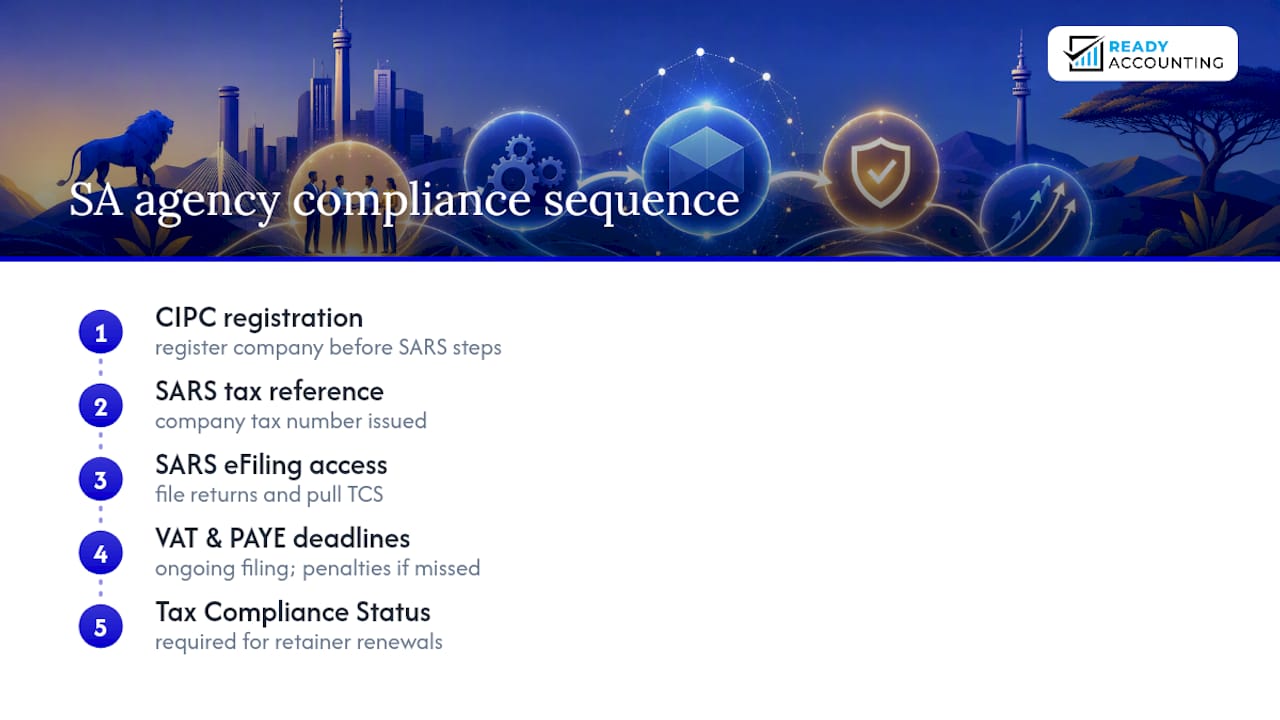
Then there’s SARS. Every South African agency, whether a two-person design studio or a forty-person digital shop, has to register with the Companies and Intellectual Property Commission (CIPC) before SARS can issue a company tax reference number, and you need SARS eFiling access to file returns and pull a Tax Compliance Status (TCS). Miss a VAT or PAYE deadline and you’re not just facing penalties. A lapsed TCS can quietly disqualify you from a retainer renewal with a corporate client whose procurement team checks it every year.
Core services an agency should expect from a specialist accounting partner
Before you sign anything, get specific about scope. Agency accounting isn’t generic bookkeeping with a different logo, and the deliverables should reflect that.
- Agency-specific bookkeeping: WIP schedules, deferred income handling for retainers paid upfront, and client-level margin reports that show which accounts are actually worth keeping.
- Full statutory compliance: VAT registration and returns, PAYE, provisional tax, and Annual Financial Statements, filed through eFiling with proper CIPC alignment.
- Monthly management accounts: not just a trial balance, but a cash-flow forecast, a runway dashboard, and fractional CFO commentary on what the numbers mean for hiring and pricing.
- Cloud setup and API integration: your accounting platform bridged to time-tracking, CRM, and ad-spend passthrough tools like Xero, Sage, or Intacct, so numbers move automatically instead of getting re-typed.
That last point matters more than most agencies realize going in. Integrating time tracking, billing, and accounting systems is what actually produces accurate client-level profitability and a faster month-end close, rather than a spreadsheet somebody rebuilds every 30 days. Ask a prospective provider for a sample management account before you sign. If they can’t produce one that splits retainer from project revenue, that’s your answer.
How do you choose the right outsourced accounting partner?
Vetting an accounting partner is a lot like vetting a media buyer: past performance and specific, checkable claims beat a slick pitch deck every time.
- Ask for agency-specific experience. Have they worked with creative or marketing shops before, and can they show a WIP schedule from a real (anonymised) engagement?
- Get pricing in writing. Fixed-fee packages should state exactly what’s included, what triggers an extra charge, and how pricing scales if headcount or transaction volume grows.
- Check the software stack. Confirm which platforms they run (Xero, Sage, Intacct or similar) and whether they build API bridges for time and billing tools, or expect you to do manual exports.
- Request a sample management account. A real one, not a template, showing retainer versus project revenue and a margin column by client.
- Confirm SARS and CIPC track record. Ask how many eFiling registrations and TCS applications they’ve handled directly, not through a subcontractor.
On the first call, push on turnaround times: how many business days for monthly management accounts, and what’s the service level agreement (SLA) if a VAT deadline is tight. Watch for red flags. Hourly-only billing with no fixed-fee option, an inability to produce a sample report, or vague answers about SARS experience should end the conversation fast.
Pro Tip: Ask any shortlisted provider for a 30-day pilot before signing a full retainer. A real pilot, run on your actual data, will expose whether their reports and integrations work for your agency, not just whether their sales pitch sounds good.
What does outsourced accounting cost for an agency?
Pricing shapes vary more than most owners expect, and the cheapest option on paper isn’t always the cheapest one in practice.
- Fixed monthly packages cover core bookkeeping, VAT, and payroll at a flat rate, scaling by transaction volume and headcount.
- Tiered pricing adds management accounts, cash-flow forecasting, and fractional CFO advisory at higher tiers, similar to the structure outsourced agency accounting providers commonly use elsewhere, where entry tiers cover compliance and top tiers add FD-level strategic input.
- One-off cleanup fees apply when books are behind or WIP hasn’t been tracked properly, usually priced by the number of months to reconcile.
The main cost drivers are transaction count, payroll and contractor complexity, whether you need multi-entity consolidation, and how many bespoke API integrations you want. Automation cuts ongoing cost significantly compared to hiring in-house, since a fixed-fee outsourced package typically runs well below the fully loaded cost of a junior bookkeeper once you add medical aid, UIF, and other on-costs. A fair engagement includes a clear SLA on turnaround and a cancellation clause that doesn’t lock you in for a year with no exit.
Implementation checklist for switching providers
Switching accounting providers mid-year sounds risky, but a disciplined 90-day plan keeps it painless.
- Gather documents before the first meeting: CIPC registration certificate, SARS reference number, bank statements and payroll history, current client contracts, and billing rules for retainers versus project work.
- Days 1 to 30: reconciliations, WIP clean-up, and confirming or registering eFiling access if the previous provider held it. This is also when you’ll want your SARS record-keeping house in order.
- Days 30 to 90: dashboard build, API bridges to time and billing tools, a recurring monthly reporting cadence, and a first cash-flow forecasting model.
Internally, someone at the agency needs to own contract and billing-rule handoff. The provider owns the technical migration, SARS eFiling registration where needed, and the reporting build. Getting the registration sequence wrong, jumping to SARS before CIPC is finalised, creates gaps that can take months to untangle, so confirm that order explicitly with whoever you hire.
Why Ready Accounting fits marketing and creative agencies
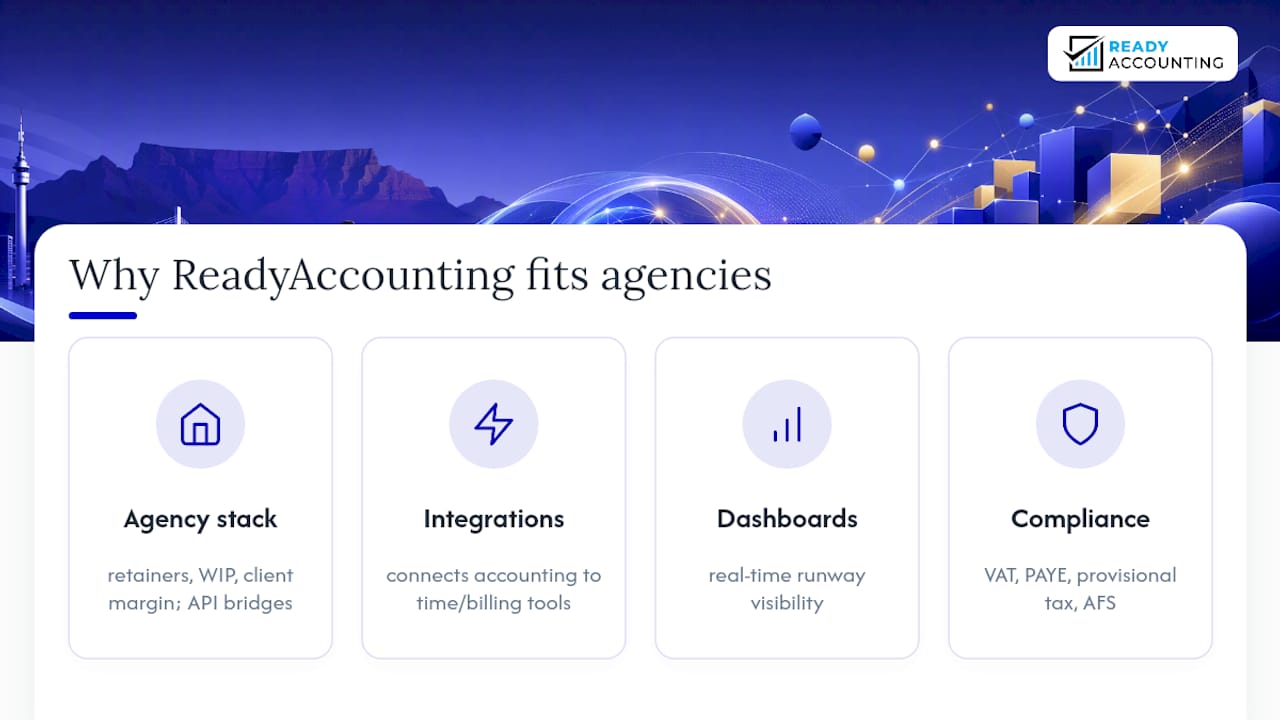
Readyaccounting is the alternative to a bookkeeper who treats your agency like any other small business: instead of manual monthly capture, you get cloud infrastructure built around retainers, WIP, and client-level margin from day one. Services map directly onto what agencies need: API bridging between your accounting platform and time or billing tools, real-time runway dashboards instead of a stale trial balance, and forensic cleanup if your books have drifted. On the compliance side, Readyaccounting handles VAT registration, PAYE, provisional tax, and Annual Financial Statements, with SARS and CIPC registration sequencing handled correctly the first time.
The fractional CFO layer is where most agencies feel the difference fastest: forecasting and margin analysis that turns your finance function from a compliance cost into a decision-making tool. If cash flow visibility is the gap holding your agency back, see how automation improves cash flow and get in touch with Readyaccounting to discuss a fixed-fee engagement built around your retainer mix.
Author note from Johan
Agency finance is a speciality, not a bookkeeping add-on. I’ve built playbooks specifically for this sector because generalist accounting misreads retainers and WIP more often than not, and that misreading costs agencies real hiring and pricing decisions. One agency client found nearly two months of unbilled work hiding in what looked like a healthy margin, once WIP was tracked properly. If that sounds familiar, book a consult or look at our cash-flow automation guide.
— Johan