

Avoid VAT Penalties: API Connected Bookkeeping Outsourcing for SA SMEs
Avoid VAT Penalties: API Connected Bookkeeping Outsourcing for SA SMEs
Yes, outsourcing bookkeeping is the right move for most small and medium businesses, and the case gets stronger every year regulators tighten the screws. You get lower costs than a full time hire, continuity around VAT and SARS deadlines, and access to expertise no single junior bookkeeper carries alone. This guide covers what outsourced services actually include, how to price a quote, how to vet a provider, and what onboarding really looks like.
Executive Summary
- Outsourcing bookkeeping is cost-effective for SMEs because it reduces expenses, offers industry expertise, and ensures timely compliance with VAT and SARS deadlines.
- Most providers automate data entry via API integrations with platforms like QuickBooks or Xero, which improves the accuracy and timeliness of financial reports.
- Proper onboarding involves a discovery phase, data migration, setting categorization rules, and a catch-up period, often taking about a month for clean records.
- Pricing models include flat retainers, hourly rates, or transaction-based packages, with additional fees common for complex structures or backlog cleanup.
- An automation-focused provider with real-time dashboards and clear SLAs provides better runway visibility and timely insights for growing businesses.
Table of Contents
- What do bookkeeping outsourcing companies actually do?
- Benefits and downsides of outsourced bookkeeping
- How do you choose a bookkeeping outsourcing partner?
- How much should you pay for outsourced bookkeeping?
- What does onboarding with a new bookkeeping provider look like?
- Ready Accounting’s approach: automation, compliance, and CFO-level insight
- Why an automation-first partner usually wins for scaling SMEs
- How Ready Accounting can help you outsource bookkeeping with confidence
- Sources
- FAQ
What do bookkeeping outsourcing companies actually do?
Bookkeeping outsourcing companies handle the recurring, rules based financial admin that keeps your business compliant and your numbers accurate. The U.S. Bureau of Labor Statistics describes the core of the job as recording transactions and reconciling accounts, and that definition holds up whether the person doing the work sits in your office or logs in from a service provider three provinces away.
In South Africa, a typical outsourced bookkeeping scope covers:
- Transaction capture — coding every sale, expense, and bank transaction into your ledger.
- Bank and credit card reconciliations, usually monthly, so your books match reality rather than guesswork.
- VAT201 preparation — pulling together the input and output VAT figures SARS expects on your submission.
- Accounts receivable and payable management — chasing invoices, tracking what you owe, flagging cash flow gaps early.
- Payroll administration, when it’s bundled in, covering payslips, PAYE, and UIF calculations.
What outsourced bookkeeping does not usually cover is worth knowing before you sign anything. Statutory audits, formal sign off on Annual Financial Statements, and complex tax structuring sit in accountant or fractional CFO territory, not standard bookkeeping retainers. If a provider promises all of that inside a basic package, ask exactly who on their team holds the relevant accounting designations.
Many providers sell tiered packages, roughly starter, growth, and SME bands, priced by transaction volume and the number of bank accounts involved. The software stack matters here too: many firms run on popular platforms like QuickBooks, Xero, or Sage, often with API integrations pulling data straight from your bank feed or point of sale system rather than relying on manual capture. That single detail, whether a provider automates data entry or still keys things in by hand, tells you a lot about how current your numbers will actually be.
Benefits and downsides of outsourced bookkeeping
The Small Business Administration frames outsourcing back office work as a way for small businesses to redirect energy toward what actually grows the business, and the logic translates directly to South African SMEs juggling compliance alongside everything else.
Benefits:
- Lower total cost than employing a full time in-house bookkeeper for most businesses under a certain transaction volume.
- Access to multi-client expertise — a provider handling dozens of SMEs has seen edge cases a single in-house hire hasn’t.
- Scalability without a hiring or firing decision every time your transaction volume shifts.
- Deadline continuity for VAT and SARS filings, since the work doesn’t stop when one staff member takes leave.
- Bundled software and automation, often included in the retainer rather than billed separately.
Downsides:
- Less daily, in-person oversight of who’s touching your books.
- Data access controls that need setting up properly, not assumed.
- Time zone or communication lag if the team works offshore hours.
- SLAs that look good on paper but don’t match your actual reporting needs.
Every one of those downsides has a fix. Clear service level agreements, dual-approval workflows for payments, restricted access permissions, and monthly management accounts reviews close most of the gap between “outsourced” and “out of sight.”
Pro Tip: Ask any prospective provider for a sample management account report before you sign. If they can’t produce one that’s clean and easy to read, that’s your answer about what your own reports will look like.
How do you choose a bookkeeping outsourcing partner?
Picking the wrong partner costs more than a bad quote. It costs missed VAT deadlines, messy handovers, and months of cleanup later. Run through this evaluation order before you commit to anyone.
- Software and API capability. Can they work inside Xero, QuickBooks, or Sage, and do they connect via API to your bank feed rather than manual uploads?
- SARS and VAT track record. Ask directly how many VAT-registered clients they currently manage and what their late-submission rate looks like.
- Security practices. Look for documented access controls, backup routines, and ideally ISO 27001 or equivalent data handling standards.
- Reporting cadence. Weekly, monthly, or only at year end? Match this to how closely you need to watch cash flow.
- Local compliance knowledge. A provider with SAICA or SAIPA affiliated staff understands South African filing quirks that generic global platforms sometimes miss.
- Sample deliverables and references. A legitimate provider hands over a redacted sample report and puts you in touch with an existing client without hesitation.
Marketplace platforms like Paro connect businesses with freelance finance talent for short-term or project based needs, which suits a specific scaling moment. A managed practice with integrated automation tends to suit businesses wanting ongoing compliance assurance and long-term reporting continuity instead. Know which one you actually need before you start comparing quotes.
When you get a provider on a call, ask these questions directly:
- What’s the average turnaround time between transaction capture and reconciliation?
- Who owns the data if we switch providers later, and how do we get it out?
- What does catch-up work cost if our books are behind when we start?
- What’s the escalation path if something goes wrong or a deadline is at risk?
- Can you show me a real (redacted) example of a monthly management account?
Red flags: vague or “it depends” pricing with no ballpark figure, no client references offered voluntarily, an inability to produce a sample reconciliation, and an onboarding process that skips discovery entirely and jumps straight to “send us your bank statements.”
Pro Tip: If a provider can’t explain their own onboarding process in under two minutes, unprompted, that’s usually a sign their internal process isn’t documented either. You’ll feel that gap later.
How much should you pay for outsourced bookkeeping?
Pricing generally runs on one of three models: a flat monthly retainer, hourly billing, or a fixed package tied to transaction volume. Retainers dominate the South African market because they give both sides predictability, hourly billing tends to show up for ad hoc or catch-up work, and packages suit businesses whose volume barely changes month to month.
South African market guides show outsourced bookkeeping retainers spanning a wide range depending on business size, with Okhantu’s 2026 cost guide providing banded estimates from micro-business starter packages up through larger SME retainers, alongside hourly rate ranges for smaller or occasional engagements.
Deadline risk is the quiet cost driver in these numbers. The same Okhantu guide notes that VAT and SARS deadline exposure is one of the main reasons SMEs choose an experienced outsourced provider over ad hoc freelance help. A missed VAT201 submission costs more in penalties than most retainers charge in a quarter.
What pushes a quote higher:
- Multiple entities or a group structure needing consolidated reporting.
- Payroll administration bundled into the same retainer.
- High monthly transaction volume across multiple bank accounts.
- Catch-up or cleanup work on books that fell behind before you signed on.
Watch for add-on fees that aren’t obvious upfront: data migration charges, VAT amendment fees when SARS queries a submission, and per-run payroll charges stacked on top of the base retainer. Ask for these line items in writing before signing, not after your first invoice. You can benchmark local quotes against a more detailed cost breakdown for South African bookkeeping services before you negotiate.
What does onboarding with a new bookkeeping provider look like?
Switching providers feels riskier than it actually is when the onboarding process is structured properly. Here’s the phase-by-phase version most reputable firms follow.
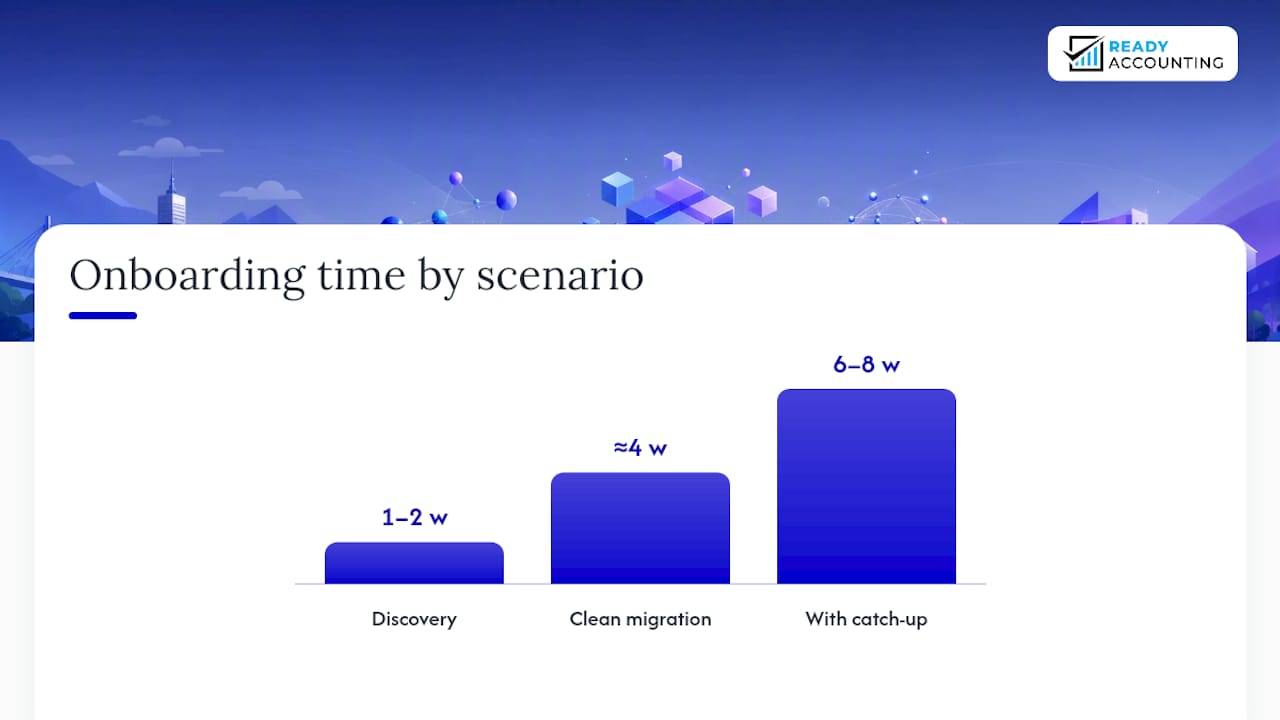
- Discovery and scope, typically one to two weeks, where the provider reviews your current setup, chart of accounts, and outstanding compliance issues.
- Access provisioning, granting the provider read or write access to your bank feeds, accounting software, and SARS eFiling profile where relevant.
- Data export and import, moving historical records into the new system, ideally through a direct software migration rather than manual re-entry.
- Categorisation rules setup, defining how recurring transactions get coded so the ledger stays consistent going forward.
- First-month catch-up and reconciliation, closing out any gap between your last clean set of books and the present.
- Recurring reporting kicks in, moving into whatever cadence your SLA specifies, weekly, monthly, or quarterly.
Full migration, from signed agreement to steady-state reporting, usually takes about a month for a business with clean records, as explained in this practical guide on document digitisation. Catch-up work extends that timeline fast; businesses with more than a few months of unreconciled transactions should expect six to eight weeks before reporting normalizes.
The most common pitfall isn’t technical, it’s paperwork. Missing source documents, an inconsistent chart of accounts carried over from a previous bookkeeper, and software limitations nobody flagged during the sales call all cause delays. A vendor who maps a simple interim chart of accounts before attempting full reclassification typically shaves real time off that first-month catch-up.
Pro Tip: Before your first call with a new provider, pull together the last six months of bank statements, your most recent VAT201 submissions, and any payroll records. Handing this over on day one instead of week three can cut your onboarding timeline nearly in half.
If your books have gaps that go back further than a few months, that’s less an onboarding job and more a reconstruction project, and it’s worth saying so upfront rather than discovering it mid-migration.
Ready Accounting’s approach: automation, compliance, and CFO-level insight
Standard bookkeeping outsourcing solves the recording and reconciling problem. It doesn’t always solve the visibility problem, knowing where your cash actually stands next month, or the compliance problem, staying ahead of SARS rather than reacting to it. That’s the gap Ready Accounting is built to close.
The service stack runs across:
- Cloud accounting, replacing manual capture with automated, API-connected bookkeeping.
- Tax consulting, focused on legal, defensible tax minimisation rather than reactive filing.
- Automated payroll, handling payslips and statutory deductions without manual runs each month.
- Accounting cleanup and reconstruction, for businesses whose books need forensic repair before anything else works.
- CFO advisory, turning monthly numbers into real runway and growth decisions.
The technical differentiator is API bridging, connecting your bank feeds, point-of-sale systems, and accounting software so numbers update in near real time rather than at month end. Paired with real-time dashboards, that gives founders and finance teams runway visibility most basic retainers never offer.
A simple bookkeeping retainer suits a stable, low-complexity business. A managed service with tax defense and CFO oversight makes more sense once you’re facing multi-entity VAT complexity, preparing investor-ready financials, or dealing with the aftermath of a SARS query you weren’t expecting.
Why an automation-first partner usually wins for scaling SMEs
Most bookkeeping comparisons stop at price per month, and that’s the wrong lens for a growing business. The real question is whether your provider gives you runway visibility before a cash crunch hits, not after. A basic retainer that reconciles transactions a month late tells you what happened. An automation-first partner tells you what’s about to happen.
VAT and SARS risk compounds quietly. One missed submission rarely sinks a business, but a pattern of reactive compliance almost always does. That’s why I weight tax defense and integrated reporting heavily when advising founders on what to require in a proposal.
Before signing anything, ask for: a sample dashboard, a written SLA on turnaround times, clarity on who owns your data, and a real answer on how they handle a SARS query, not just how they file returns.
— Johan
How Ready Accounting can help you outsource bookkeeping with confidence
If you’ve compared retainers, checked reviews, and you’re still unsure whether a standard bookkeeping firm can keep pace with your growth, that uncertainty is usually the real signal. Readyaccounting is built for South African SMEs who need more than reconciled books. You get cloud accounting with API-connected automation, tax consulting built around legal tax defense rather than reactive filing, and automated payroll that removes manual runs entirely.
Before reaching out, gather your last few months of bank statements, your current accounting software login, and a rough sense of monthly transaction volume and payroll headcount. That’s enough for a real, scoped quote rather than a generic estimate.
If your books need repair first, start with accounting cleanup and reconstruction. If they’re clean and you’re ready to move, request a scoped quote through Ready Accounting’s cloud accounting services and get a finance function that works ahead of SARS, not behind it.
Sources
- Bookkeeping, accounting, and auditing clerks (BLS)
- U.S. Small Business Administration (SBA)
- How much does a bookkeeper cost in South Africa? (Okhantu, 2026 guide)
FAQ
Is it a good idea to outsource bookkeeping?
For most SMEs, yes. It typically costs less than a full-time in-house hire, gives you access to broader expertise, and keeps VAT and SARS deadlines on track even when staff are on leave, according to SBA guidance on outsourcing back-office functions.
How much should you pay someone to do your bookkeeping?
It depends on your transaction volume, entity structure, and whether payroll is included, but South African market guides show a range from starter packages for micro-businesses up to larger SME retainers, per Okhantu’s cost breakdown. Hourly rates apply mostly to smaller or ad hoc engagements.
What does an outsourced bookkeeper do?
An outsourced bookkeeper records transactions, reconciles bank accounts, prepares VAT filings, and manages accounts receivable and payable, per the BLS occupational description of the role. Some providers extend that further into tax consulting and CFO-level reporting when a business needs it.
What’s the difference between bookkeeping outsourcing and a fractional CFO service?
Bookkeeping covers transaction recording and reconciliation. A fractional CFO service, like Ready Accounting’s CFO advisory, interprets those numbers into cash flow forecasts, runway planning, and growth strategy.
How long does it take to switch bookkeeping providers?
A clean handover typically takes about a month from signed agreement to steady-state reporting. Businesses with unreconciled books or missing records should budget six to eight weeks to allow for catch-up work before reporting normalizes.