

Cash Flow Statement Fixes: Two Phase Method and 4 Cases for SA SMEs
Cash Flow Statement Fixes: Two Phase Method and 4 Cases for SA SMEs
Most cash flow statement problems and solutions trace back to one root issue: classification and adjustment errors, not arithmetic mistakes. The fix is a disciplined two-phase process: reconcile every balance-sheet movement to a cash-flow line first, then apply neutral, non-cash adjustments on top. The worked problems below walk through that method step-by-step, so you can apply it to your own trial balance instead of just reading about it.
Executive Summary
- Most cash flow statement errors stem from misclassification of items like supplier finance, interest payments, and non-cash adjustments rather than mathematical mistakes.
- Reconciliation of balance-sheet movements before reclassification ensures accuracy and prevents the statement from balancing due to classification errors.
- Properly separating non-cash items and reclassifying them to correct activities in a two-phase process guarantees reliable and auditable cash flow statements.
- Automation tools that flag mismatched transactions, bank-feed discrepancies, and misclassified items can significantly reduce errors and improve ongoing cash flow control.
- Addressing recurring misclassifications early, especially for supplier finance and foreign currency transactions, avoids more complex restatements and ensures more accurate financial insights.
Table of Contents
- Common classification and preparation mistakes
- The two-phase compilation method that actually balances
- Worked practice problems with step-by-step solutions
- Ready Accounting’s forensic checks and automation controls
- Verification checklist and troubleshooting steps
- Why cash flow errors distort financial analysis and decisions
- Author perspective: what preparers get wrong under deadline pressure
- How Ready Accounting turns cash flow fixes into ongoing control
- Authoritative standards and guidance to consult directly
- Sources
- FAQ
Common classification and preparation mistakes
Cash flow statement errors rarely come from bad maths. They come from putting the right number in the wrong bucket, or forgetting that a number needs adjusting at all. Accountancy SA’s review of common preparation mistakes documents this pattern repeatedly: preparers under GRAP 2 and IFRS for SMEs frequently misclassify items that standards require to be shown separately, and they miss non-cash adjustments that software templates simply don’t flag.
Here’s where it usually goes wrong.
Misclassification between activities. GRAP 2 requires interest paid, dividends paid, and taxation paid to be disclosed separately, usually as distinct line items rather than buried inside operating cash flows. Preparers sometimes misclassify items under the wrong activity; for example, insurance proceeds from an asset write-off may be incorrectly treated as operating income instead of investing activities, and short-term borrowings raised to bridge a supplier payment may be incorrectly coded as operating rather than financing cash inflows.
Non-cash items that slip through. Common non-cash adjustments preparers often miss include long-service and leave provisions (non-cash adjustments rather than working-capital movements), straight-lined lease expenses where the cash paid differs from the expense recognised, goods received in kind that do not involve cash but affect the income statement, and unrealised foreign exchange gains or losses included in profit before tax.
ASB guidance on preparing the cash flow statement makes the point that supplier finance arrangements and similar third-party payment structures are among the most commonly mishandled items. A business that uses a supplier finance facility to extend payment terms is still settling a liability, but the cash effect often needs reclassifying to financing activities, along with additional disclosure. Miss that, and your operating cash flow looks stronger than it actually is.
Process failures compound the classification errors. Three habits cause most of the damage:
- Preparing the cash flow statement first, before the balance sheet and income statement are finalised, which means it inherits every later correction as an unreconciled variance
- Pulling opening and closing balances from different data sources (a general ledger export versus a signed annual financial statement) instead of one locked trial balance
- Trusting accounting software’s auto-generated cash flow statement without a manual reconciliation, since most systems don’t auto-detect straight-lining, provisions, or non-cash reclassifications
ASB’s own research notes that cash flow statements are often the last thing prepared and the least reviewed, which is exactly backwards given how closely users and auditors scrutinise it. Get this section wrong, and everything downstream, the worked problems, the reconciliation, the audit sign-off, inherits the error.
The two-phase compilation method that actually balances
There’s a reliable way to guarantee your cash flow statement balances and classifies correctly, and it isn’t “plug the difference.” Practitioner methodology described by South African accounting firms separates the mechanical mapping of balances from the presentation choices, which is exactly why it works. Mixing those two steps is what causes most classification disasters.
Phase 1: Balance-sheet reconciliation. Before you touch a single classification decision, reconcile every balance-sheet line’s movement between opening and closing periods to a preliminary cash effect.
- Take every balance-sheet account, opening balance to closing balance, and calculate the movement.
- Assign each movement a provisional cash-flow sign: an increase in an asset is a cash outflow, an increase in a liability or equity is a cash inflow (with the obvious exception of cash and cash equivalents themselves).
- Sum all movements. The total, excluding the cash and cash equivalents line, must equal the actual movement in cash and cash equivalents for the period. If it doesn’t, stop, you have an unreconciled balance-sheet item, not a cash flow statement problem yet.
- Only once this ties out exactly do you move to Phase 2.
Phase 2: Neutral adjustments. This is where you reclassify and separate items without changing the total net cash movement you locked in during Phase 1.
- Strip out non-cash items from operating activities: depreciation, provisions, unrealised forex, straight-line lease adjustments.
- Split combined balance-sheet movements into their real activities. A fixed-asset movement that includes both depreciation and a disposal needs separating into an operating add-back and an investing cash flow.
- Move misclassified items to their correct activity, interest paid, dividends paid, taxation paid, insurance proceeds, supplier finance draws, one at a time, checking that the grand total of the statement doesn’t move.
- Re-total by activity and confirm the sum of operating, investing, and financing activities still equals the Phase 1 net cash movement.
The control point that matters most: every reclassification in Phase 2 must be neutral to total net cash. If reclassifying interest paid from operating to financing changes your bottom-line cash movement, you’ve made an error, not a presentation choice.
Pro Tip: Keep a running “control total” cell in your working papers that always equals the Phase 1 net cash movement. Every adjustment you make in Phase 2 should be checked against it before you move to the next line. It turns a two-hour debugging session into a five-minute one.
Worked practice problems with step-by-step solutions
These four problems mirror the kind of scenarios used in professional practice sets and cover the classification traps preparers hit most often. Work through the reconciliation logic in each, not just the final answer.
Problem 1: Indirect-method reconciliation with depreciation and provisions
A company reports profit before tax of R850,000. The notes show depreciation of R120,000, an increase in the long-service leave provision of R35,000, and an increase in trade receivables of R60,000.
Solution steps:
- Start with profit before tax: R850,000.
- Add back depreciation (non-cash): +R120,000.
- Add back the increase in the provision (non-cash, not a working-capital movement): +R35,000.
- Adjust for the working-capital movement in receivables, an increase is a cash outflow: −R60,000.
- Cash generated from operations: R945,000.
The common error here is treating the provision increase as a working-capital movement and netting it against receivables and payables instead of ring-fencing it as a separate non-cash add-back. That distinction matters for anyone reconciling to GRAP 2’s required reconciliation of surplus or deficit to net cash flows, because provisions and working-capital items sit on different disclosure lines.
Problem 2: Asset disposal with insurance proceeds
Equipment with a carrying value of R200,000 was destroyed in a fire. The insurer paid out R250,000 in cash. The income statement shows a R50,000 gain on the claim, included in profit before tax.
Solution steps:
- In the operating section, deduct the R50,000 gain from profit before tax (it’s non-cash relative to operations and would double-count the proceeds).
- In investing activities, show the full R250,000 insurance proceeds as a cash inflow.
- Do not net the R250,000 against any capital expenditure line, it’s a separate investing inflow, not a reduction of purchases.
The typical mistake: preparers leave the R50,000 gain inside operating cash flow and never move the R250,000 to investing activities at all, because the cash simply lands in the bank account and gets coded as “other income received” in operations. That single miscode overstates operating cash flow by R250,000 and understates investing cash flow by the same amount, a material misstatement in a business of any size.
Problem 3: Supplier finance reclassification
A business draws R400,000 under a supplier finance facility during the year to extend payment terms on trade creditors. The amount is initially posted through trade payables and appears to preparers as a normal increase in the payables balance.
Solution steps:
- Separate the R400,000 supplier finance draw from the ordinary trade payables movement in your balance-sheet reconciliation (Phase 1).
- Reclassify the R400,000 from operating activities (where a payables increase normally sits) to financing activities, since it represents a financing arrangement rather than ordinary trade credit.
- Add a disclosure note describing the facility, the balance outstanding, and the classification treatment, consistent with the practice of separating supplier finance from ordinary working-capital movements.
This is the error ASB’s guidance flags specifically: treating supplier finance as ordinary trade credit inflates operating cash flow and hides a financing obligation from anyone reading the statement to assess liquidity risk.
Problem 4: Foreign-currency cash receipts
A company receives a foreign customer payment of $50,000 during the year, translated at the transaction-date spot rate into rand. At year end, no foreign cash balance remains, the full amount was converted and banked in rand.
Solution steps:
- Translate the cash receipt at the spot rate on the date of receipt for the cash flow statement, not the closing rate used for balance-sheet translation.
- If any unrealised foreign exchange gain or loss on monetary items sits in profit before tax at year end, strip it out as a non-cash adjustment in the operating section.
- Where a foreign cash balance is held at year end, show the effect of exchange-rate changes on cash and cash equivalents as a separate reconciling line, not blended into operating, investing, or financing activities.
Preparers often let the closing-rate translation used for the balance sheet flow straight into the cash flow statement, which creates an unreconciled variance in Phase 1 that has nothing to do with actual cash movement, purely an exchange-rate artefact.
Ready Accounting’s forensic checks and automation controls
Every error above is preventable with the right controls sitting in front of the preparer, not caught after the fact by an auditor. At Ready Accounting, our approach to cash flow automation is built around catching these misclassifications before they reach your Annual Financial Statement.
Our automation checkpoints include:
- Bank-feed reconciliations that flag any cash movement without a matching general-ledger classification
- API mappings that tag supplier finance draws separately from ordinary trade payables the moment they’re posted
- Automated tags for non-cash transactions, straight-lined leases, provisions, goods-in-kind, so they never accidentally land in a working-capital bucket
- A liability-reconciliation worksheet that traces every balance-sheet movement back to source documents before Phase 2 adjustments happen
On the forensic side, we run a source-document trace on every material reclassification and keep an audit trail showing why an item moved from operating to investing or financing. That trail is what SARS and auditors ask for when a cash flow statement gets challenged.
Pro Tip: If your business has drawn on a supplier finance facility this year, flag it to your accountant before year-end close, not during the audit. Reclassifying R400,000 after the fact is a lot more painful than tagging it correctly at the point of transaction.
When the errors are recurring, the same misclassification showing up audit after audit, or when supplier finance and cross-border transactions are adding real complexity, that’s the point to escalate to a fractional CFO engagement or a dedicated forensic clean-up rather than trying to patch it every February.
Verification checklist and troubleshooting steps
When your cash flow statement still won’t balance, work through this in order rather than guessing at which line is wrong.
- Confirm the balance sheet itself balances first. A cash flow statement built on an unbalanced balance sheet will never reconcile, no matter how careful your adjustments are.
- Build a trial cash-flow baseline straight from balance-sheet movements (Phase 1, described above) before applying any classification adjustments.
- If the baseline doesn’t equal the actual cash movement, isolate the account causing the variance by checking each movement individually rather than re-checking the whole statement.
- Trace the offending account back to its supporting documents, invoices, loan agreements, lease schedules, to confirm the movement is real and correctly dated.
- Cross-check every income-statement adjustment against its note disclosure. A depreciation add-back that doesn’t match the fixed-asset note is a red flag.
- Pay particular attention to foreign exchange movements and non-cash transactions, these two categories account for a disproportionate share of unexplained variances according to Accountancy SA’s review of recurring cash flow errors.
A two-phase approach that separates mechanical balancing from classification choices improves both accuracy and auditability, largely because it stops preparers from trying to fix a balancing problem by changing a classification, which almost always just creates a second error layered on the first.
Why cash flow errors distort financial analysis and decisions
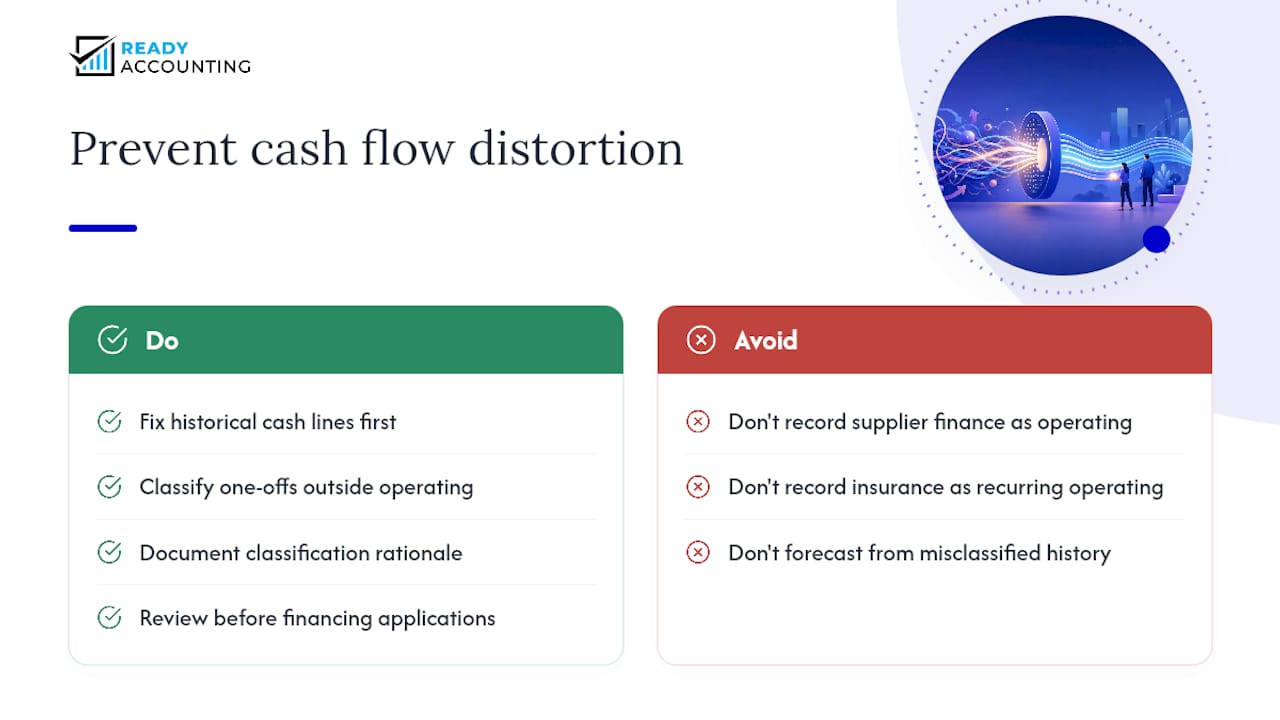
A misclassified cash flow statement doesn’t just fail an audit checklist, it actively misleads the people using it to make decisions. Overstate operating cash flow by shifting supplier finance or insurance proceeds into the wrong bucket, and a lender assessing your business’s ability to service debt from operations gets a false signal. Understate it, and you might lose access to credit you’d genuinely qualify for.
Investors and boards use operating cash flow as a sanity check against reported profit, precisely because profit can be manipulated through accruals while cash is harder to fake. When the cash flow statement itself contains classification errors, that check stops working. A business showing strong operating cash flow that’s actually inflated by a one-off insurance payout or a supplier finance draw looks healthier than it is, right up until the facility needs repaying or the equipment needs replacing without an insurance windfall to cover it.
For South African SMEs specifically, this matters at practical decision points: applying for working capital finance, negotiating supplier terms, or preparing for a SARS review. A cash flow statement that misrepresents the source of your cash can trigger exactly the kind of scrutiny you were trying to avoid. It also feeds directly into forecasting. If historical cash flow lines are misclassified, any forecast built on them inherits the same distortion, which is why accurate cash flow forecasting depends on getting the historical statement right first.
Author perspective: what preparers get wrong under deadline pressure
The mistake I see repeated most often isn’t a lack of technical knowledge. It’s sequencing. Preparers know the rules around interest paid, dividends, and supplier finance in isolation, but under month-end or year-end pressure, the cash flow statement gets treated as the last box to tick rather than a reconciliation that deserves its own dedicated review.
One pattern comes up again and again: a business draws on a supplier finance facility to smooth cash timing, and the bookkeeping team, working fast, posts it straight through trade payables. It sits there, quietly inflating operating cash flow, until someone doing a covenant review or a due diligence exercise pulls the loan agreement and asks why a R400,000 financing facility is hiding inside working capital. By then it’s not a five-minute fix, it’s a restated financial statement.
My honest pointer for anyone preparing these statements under time pressure: the moment a transaction doesn’t fit neatly into “customer paid us” or “we paid a supplier,” stop and classify it deliberately rather than letting the software default it. And if your business has more than one financing or supplier-finance arrangement running at once, that’s the point to bring in outside help before the numbers, not after.
— Johan
How Ready Accounting turns cash flow fixes into ongoing control
An alternative to fixing your cash flow statement once a year under audit pressure is to build checks into your books continuously, through automated bank-feed reconciliations, API-mapped supplier finance flags, and real-time dashboards that surface a misclassification the month it happens, not twelve months later.
Our services cover the full range a growing SME needs: cloud-based accounting and bookkeeping, forensic clean-ups when historical statements need restating, Annual Financial Statement preparation, VAT registration and ongoing SARS compliance, automated payroll, and fractional CFO advisory for businesses that need senior financial judgment without a full-time hire.
If your business has drawn on supplier finance, holds foreign-currency receivables, or has had the same cash flow misstatement flagged more than once by an auditor, that’s the signal to bring in a dedicated review rather than patching it again at year-end. Explore how automation improves cash flow accuracy and get in touch with Ready Accounting to book a review of your books.
Authoritative standards and guidance to consult directly
For jurisdiction-specific detail, work from the primary standards rather than secondary summaries:
- GRAP 2, Cash Flow Statements, for classification and disclosure requirements
- ASB’s guidance on preparing your cash flow statement, for the reconciliation approach
- Practice problem sets from Saylor Academy, for additional indirect-method drills
- Accountancy SA’s review of common preparation mistakes, for a practitioner-level view of recurring errors
This article is general information, not a substitute for advice from a qualified financial advisor. Consult a qualified financial professional about your own circumstances before acting on anything here.
Sources
- Common mistakes in preparing the cash flow statement – Accountancy SA
- Preparing your cash flow statement — Accounting Standards Board (ASB)
- The 7 Most Common Cash Flow Statement Mistakes — Leash
- Practice Problems: Statement of Cash Flows - Saylor Academy
FAQ
What causes most cash flow statement errors?
Classification errors, putting items like supplier finance, insurance proceeds, or interest paid into the wrong activity, cause more problems than arithmetic mistakes. Missed non-cash adjustments like provisions and straight-lined leases are the second most common cause.
What is the two-phase method for preparing a cash flow statement?
Phase 1 reconciles every balance-sheet movement to a provisional cash effect until the total matches the actual cash movement. Phase 2 applies non-cash adjustments and reclassifies items to their correct activity without changing that total.
How do you fix a cash flow statement that doesn’t balance?
Confirm the balance sheet itself balances first, then build a baseline directly from balance-sheet movements and isolate which account’s movement causes the variance before touching any classification.
Where should supplier finance appear on the cash flow statement?
Supplier finance draws used to extend payment terms typically belong in financing activities with a supporting disclosure note, not blended into ordinary trade payables movements in operating activities.
Can a professional accounting firm fix a cash flow statement that’s already misstated?
Yes. Forensic clean-up engagements trace misclassified items back to source documents and restate the affected periods, alongside ongoing automation to prevent the same errors recurring.