

Drive innovation in small business with cloud accounting
Executive Summary
- South African SMEs are leveraging affordable cloud-based accounting tools to automate financial processes and gain real-time insights. Unlocking the full potential of these platforms through feature utilization enhances cash flow, compliance, and operational efficiency. Most growth occurs by deepening existing system use and optimizing workflows rather than switching tools frequently.
Many South African SME owners assume that genuine financial innovation requires enterprise budgets, large IT teams, and months of implementation. That assumption is costing them real money. Cloud-based accounting platforms have fundamentally shifted this equation, making sophisticated financial automation accessible at under R300 per month. This guide covers the core drivers of SME innovation in South Africa, compares leading platforms, shows how automation improves daily operations, and walks you through a practical adoption framework so your business can start competing on a level once reserved for corporates.
Table of Contents
- What drives innovation in South African SMEs?
- Cloud-based accounting: The game-changer for SME innovation
- Streamlining operations and boosting financial growth
- How to adopt and maximize innovative accounting solutions
- A fresh perspective: Innovation is about scaling what works for you
- Transform your business with cloud innovation
- Frequently asked questions
Key Takeaways
| Point | Details |
|---|---|
| Affordable innovation | South African SMEs can access feature-rich cloud accounting solutions for under R300/month. |
| Operational efficiency | Automated payroll, reconciliation, and compliance boost daily productivity and reduce errors. |
| Financial growth | Using advanced ERP features directly improves cash cycle and competitive advantage. |
| Scalable solutions | Cloud platforms allow SMEs to scale operations easily as their business grows. |
What drives innovation in South African SMEs?
Innovation in small business rarely looks like a Silicon Valley product launch. For South African SMEs, it looks like cutting the time your bookkeeper spends on bank reconciliations from three days to thirty minutes. It looks like knowing your cash position in real time instead of waiting for a month-end report. The 2026 SME growth trends show that technology adoption is now the single biggest differentiator between businesses that scale and those that stagnate.
Several forces are pushing this change forward simultaneously. Load shedding, rising input costs, and tighter credit markets have forced South African SME owners to run leaner operations. That pressure actually accelerates innovation because there is no room to absorb inefficiency. When margins are thin, automation stops being a luxury and becomes survival infrastructure.
The key drivers of innovation in South African SMEs right now include:
- Access to affordable cloud tools that eliminate the need for on-site servers and expensive IT support
- Mobile-first banking integration, which lets platforms pull live transaction data without manual imports
- SARS compliance pressure, which is creating demand for systems that handle VAT, PAYE, and income tax automatically
- Remote work normalisation, which means finance teams expect software that works from anywhere, on any device
- API-first ecosystems that connect accounting platforms to payroll, inventory, and CRM tools without custom development
The cloud accounting benefits for growing businesses go beyond cost savings. They include faster financial close cycles, better audit trails, and real-time visibility that allows you to make decisions based on what is happening now, not what happened six weeks ago.
Research confirms this. ERP feature utilization correlates directly with improved Cash Conversion Cycles and stronger competitiveness among South African SMEs. In plain terms, the more of your accounting platform’s features you actually use, the faster you collect cash and the harder you are to compete against.
“The SMEs that pull ahead are not the ones with the biggest budgets. They are the ones that extract the most value from the tools they already have.”
AI-driven SME innovation is also playing a growing role. Machine learning inside accounting platforms now flags anomalous transactions, predicts cash flow gaps, and automates expense categorisation with accuracy levels that outperform manual entry. South African SMEs that integrate these capabilities early are building compounding advantages that widen over time.
The market need is clear. South African SMEs need tools that reduce administrative drag, improve compliance accuracy, and give owners real-time financial intelligence without requiring a qualified accountant on staff every day of the week.
Cloud-based accounting: The game-changer for SME innovation
Understanding the drivers, it is clear why cloud accounting solutions sit at the heart of SME innovation. Two platforms dominate the South African market: Sage Business Cloud and Xero. Both are cloud-native, both integrate with South African banks, and both support SARS compliance. But they serve slightly different business profiles and it is worth understanding the distinction before committing.
Sage Business Cloud is specifically designed for South African SMEs, offering local compliance features, rand-denominated pricing, and a support structure that understands the local tax environment. Xero for South African SMEs is a globally recognised platform with strong API capabilities and an extensive marketplace of add-on integrations.
| Feature | Sage Business Cloud | Xero |
|---|---|---|
| SARS VAT compliance | Built-in, automated | Available via add-on |
| Pricing (entry level) | Under R300/month | R299/month (Starter) |
| Bank feed integration | South African banks | South African banks |
| Payroll module | Included in higher tiers | Separate add-on |
| Mobile app | Yes | Yes |
| Third-party integrations | Growing marketplace | Extensive marketplace |
| Best for | Micro to medium SA SMEs | Growth-stage SMEs |
Both platforms handle automated bank reconciliations, invoice management, expense tracking, and financial reporting. The cloud accounting for SMBs guide provides a detailed breakdown of how to match platform features to your specific business size and growth stage.
What makes these tools genuine innovation drivers rather than simple software upgrades is the shift from reactive to proactive financial management. When your accounts reconcile automatically each night and your VAT return calculates in real time, you spend your mental energy on decisions instead of data capture.
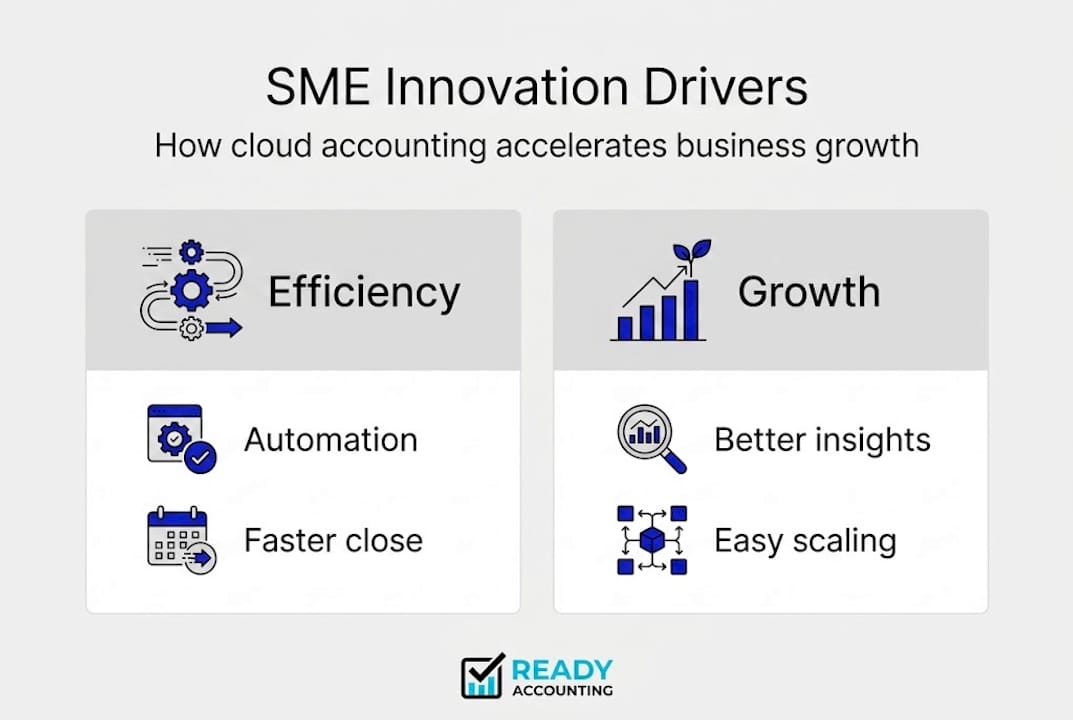
Research on ERP feature utilization confirms that improved Cash Conversion Cycle metrics follow directly from deeper platform engagement, meaning businesses that use more features collect money faster and manage costs more tightly.
Pro Tip: Most SME owners use less than 40% of their cloud accounting platform’s features. Schedule a quarterly feature audit with your accountant or bookkeeper. Identify two or three underused modules, activate them, and measure the operational improvement over the following 90 days. Compounding small gains from existing tools is faster and cheaper than switching platforms.
Streamlining operations and boosting financial growth
Now, let us explore how these platforms deliver real-world operational and financial gains. The most immediate impact for most businesses is the elimination of manual data entry. When your bank feeds pull transactions automatically, your reconciliation process goes from a weekly slog to a daily five-minute review. That time compounds. Over a year, a business processing 200 transactions per month can reclaim over 80 hours of bookkeeping time.
The top five operational improvements South African SMEs report after switching to cloud-based accounting are:
- Automated bank reconciliations reduce month-end close time by an average of 60%
- Real-time VAT tracking eliminates SARS submission errors and late penalty risk
- Integrated payroll processing removes the need for a separate payroll system and the double-entry errors that come with it
- Automated invoice reminders cut average debtor days by improving follow-up consistency
- Cloud-based financial reports give owners, investors, and lenders instant access to current performance data
Sage Business Cloud’s automation specifically supports payroll processing, tax management, and compliance reporting, which are the three areas where South African SMEs most commonly lose time and money to manual errors.
For SARS tax compliance, the stakes are high. SARS has significantly expanded its use of data matching and algorithmic auditing. If your VAT submissions do not align with your bank deposits and your income tax returns, you are a flag in their system. Automated platforms reduce this risk because every transaction is categorised consistently and every return is built from the same data set.
The financial growth impact is equally compelling. Look at how the key metrics shift when cloud accounting is properly implemented:
| Metric | Before cloud accounting | After cloud accounting |
|---|---|---|
| Month-end close time | 5 to 10 days | 1 to 2 days |
| Debtor collection period | 45 to 60 days | 28 to 35 days |
| SARS penalty incidents | 2 to 4 per year | Near zero |
| Cash flow visibility | Monthly (lagging) | Daily (real-time) |
| Bookkeeping cost | R4,000 to R8,000/month | R1,500 to R3,000/month |
Tracking your cash flow KPIs becomes dramatically easier when your platform updates automatically. You can set dashboard alerts for when your cash balance drops below a defined threshold, when a major invoice goes overdue, or when your payroll liability approaches your available balance. These are the kinds of real-time signals that separate businesses that react in time from those that discover problems too late.

Scalability is the other growth factor that gets underestimated. Cloud-based accounting grows with you. Adding a new revenue stream, a new entity, or a new team member does not require a system overhaul. It requires a configuration change that takes minutes, not weeks.
How to adopt and maximize innovative accounting solutions
With the benefits clear, it is time to see how to successfully adopt and make the most of innovative tools. Most failed cloud accounting implementations share the same root cause: the business migrated data without migrating habits. The software changes but the processes around it stay manual, and the result is a cloud platform being used as an expensive spreadsheet.
A structured adoption checklist prevents this. Work through these steps before going live:
- Assess your readiness: Audit your current bookkeeping process. Document every manual step, every spreadsheet, and every email chain that exists because your current system cannot handle it automatically.
- Clean your data before migration: Import clean, categorised historical data. Migrating messy records into a new system just makes the mess harder to find.
- Map your chart of accounts: Spend time getting your account categories right before you start processing. Reclassifying transactions after months of data entry is extremely time-consuming.
- Train before you go live: Every person who touches the system needs at least two hours of hands-on training before the switch. Resistance to change drops sharply when people feel confident using the tool.
- Set up bank feeds on day one: Live bank integration is the feature that delivers the most immediate time saving. Do not postpone it.
- Schedule a 30-day review: After your first month, sit with your accountant and identify what is working and what still feels manual. Adjust your setup accordingly.
Common pitfalls to avoid include continuing to make manual journal entries for transactions your bank feed already captures, using the platform only for invoicing while ignoring the reporting and compliance features, and failing to reconcile regularly, which allows small errors to compound into serious discrepancies.
ERP feature utilization research is unambiguous on this point: businesses that actively use more platform features show measurably better cash conversion and competitive positioning. The feature set you ignore is leaving money on the table.
Understanding which tasks to automate in accounting gives you a prioritised list of where to focus your energy first. And if the internal capacity to manage this adoption process does not exist in your team, outsourced accounting in South Africa offers a practical alternative where experienced specialists handle the migration, configuration, and ongoing management while you focus on running your business.
Pro Tip: Automate your weekly cash flow report first. Set it to email directly to you every Monday morning. That single habit, reviewing a real-time cash position at the start of each week, changes how you make spending, hiring, and pricing decisions faster than any other single change.
A fresh perspective: Innovation is about scaling what works for you
Here is the uncomfortable reality most accounting software articles will not tell you. Most South African SMEs do not have an innovation problem. They have an optimisation problem. They are sitting on platforms with powerful features they have never activated, running manual workarounds for processes the software already handles automatically, and calling that normal.
True innovation for a scaling SME is not about adopting the newest tool. It is about extracting maximum value from what you already have. The businesses we see compound their growth fastest are not constantly switching platforms. They are the ones that go deep on a single well-chosen system, automate relentlessly within it, and use the time they reclaim to focus on revenue-generating activity.
Your gross profit margin is a better innovation indicator than your software stack. If your margins are improving quarter on quarter because you have cleaner cost data, faster invoicing, and tighter debtor management, that is innovation doing its job. Novelty for its own sake is a distraction. Scaling proven systems is how South African SMEs build durable competitive advantage in a volatile market.
Transform your business with cloud innovation
Ready Accounting works with South African SMEs and VC-backed startups to replace manual financial processes with cloud infrastructure that generates real competitive advantage. If you are ready to stop losing hours to reconciliations and start making decisions from real-time data, we can help you improve cash flow with automation using systems that are already proven in the South African market. Our accounting automation guide gives you a step-by-step framework for implementation, and our cloud accounting for business growth resource explains exactly what to expect at each stage. Let us turn your finance function from overhead into a growth engine.
Frequently asked questions
How much does cloud-based accounting cost for South African SMEs?
Sage Business Cloud costs under R300 per month at entry level, making it accessible for micro to medium enterprises without enterprise budgets.
What is the biggest operational benefit of cloud-based accounting?
Automated reconciliations, payroll, and tax compliance are consistently the highest-impact features, saving South African SMEs dozens of hours per month while reducing costly errors.
What evidence exists that using ERP features improves business outcomes?
South African SMEs using more ERP features show measurably improved cash conversion cycles and stronger competitive positioning compared to peers using minimal platform functionality.
Does cloud-based accounting handle South African tax compliance?
Sage Business Cloud includes full SARS compliance with automated VAT calculations, PAYE integration, and tax return preparation built directly into the platform.
Recommended
- 7 Cloud Accounting Benefits for Small Business Growth - Ready Accounting
- Ultimate Guide to Accounting Automation in 2025 - Ready Accounting
- Digital Transformation in Accounting: How South African Scaling Companies Can Modernize Their Financial Management | Ready Accounting
- Cloud accounting guide for South African SMB growth - Ready Accounting