

Eliminate common payroll errors for South African SMEs
Executive Summary
- Most payroll errors in South African SMEs are caused by manual spreadsheets and outdated legacy software.
- Automation tools significantly improve accuracy, compliance, and reduce financial penalties from errors.
- Treating payroll as a compliance and risk management function, not just admin, prevents costly mistakes.
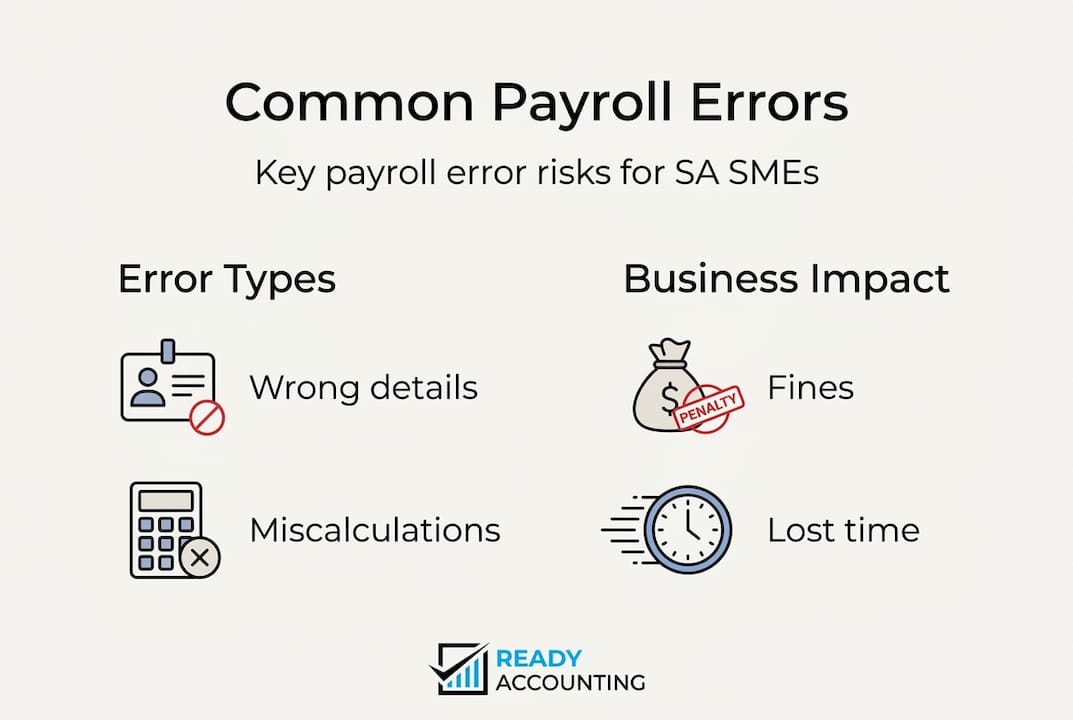
An 84% of small businesses make payroll errors, and nearly half face financial penalties as a result. For South African SMEs, the stakes are even higher. SARS audits, UIF compliance requirements, and IRP5 reconciliations create a minefield of administrative obligations that manual processes simply cannot handle reliably. If your payroll runs on spreadsheets, legacy software, or fragmented data, you are already exposed. This guide breaks down exactly why payroll errors happen, what the most damaging ones look like, and how you can systematically eliminate them before they cost you money, time, and your team’s trust.
Table of Contents
- Why payroll errors happen in South African SMEs
- Identifying the most common payroll mistakes
- How payroll errors impact compliance and finances
- Fixing and preventing payroll errors: practical steps
- Our take: why small mistakes become big headaches (and what to do differently)
- Reduce payroll errors with Ready Accounting
- Frequently asked questions
Key Takeaways
| Point | Details |
|---|---|
| Manual processes drive errors | Using spreadsheets and outdated systems is the leading cause of payroll mistakes for SMEs. |
| Compliance is critical | South African payroll errors frequently result in penalties from SARS and delays in UIF benefits. |
| Automation reduces risk | Switching to automated payroll systems lowers error rates and ensures legal compliance. |
| Prevention is actionable | Regular audits, automation, and outsourcing are proven steps to fix and prevent payroll errors. |
Why payroll errors happen in South African SMEs
Most business owners do not set out to make payroll mistakes. They happen because of the systems and processes in place, not because of bad intentions. Understanding the root causes is the first step toward fixing them for good.
Manual spreadsheets are the biggest culprit. The majority of small businesses in South Africa still rely on Excel or similar tools to calculate salaries, deductions, and UIF contributions. These tools were never designed for payroll. A single formula error can cascade across an entire payroll run, and without built-in validation rules, incorrect figures get processed, submitted, and paid out before anyone notices.
Legacy payroll software is almost as problematic. Older systems often lack updates for the latest SARS tax tables, leave calculation rules, or UIF rate changes. If your software has not been updated since the last PAYE threshold adjustment, you are almost certainly calculating deductions incorrectly. The global payroll accuracy rate for manual and legacy systems sits at just 80.15%, meaning one in every five payroll cycles contains at least one error.
South Africa’s regulatory environment adds another layer of complexity. You are not just calculating salaries. You need to correctly handle PAYE, UIF, SDL (Skills Development Levy), COIDA (Compensation for Occupational Injuries and Diseases Act), and varying leave types under the Basic Conditions of Employment Act. Each of these has its own submission deadlines, calculation rules, and reporting formats. Miss one, and you are facing penalties or, worse, a compliance audit.
Knowing how to manage payroll efficiently starts with recognising that the process needs to be systematised, not just carefully watched.
| Process type | Average accuracy rate | Error frequency | SARS compliance risk |
|---|---|---|---|
| Manual spreadsheets | 74% | High (monthly) | Very high |
| Legacy payroll software | 80.15% | Moderate (every 2nd cycle) | High |
| Cloud-based automation | 97%+ | Low (rare exceptions) | Low |
The data is clear. The payroll outsourcing benefits of shifting away from manual processing include not just accuracy, but time savings, reduced compliance risk, and far fewer stressful month-end reconciliations.
Pro Tip: Automation tools like Sage Payroll or Xero Payroll are designed to apply SARS-compliant tax tables automatically. If you are still manually updating deduction tables each year, you are creating unnecessary risk with every single payroll run.
Identifying the most common payroll mistakes
Understanding the causes, let’s look at the high-impact errors themselves. The mistakes SMEs make most often are not random. They cluster around specific process weaknesses, and once you know where they hide, they become much easier to prevent.
Here are the five most common payroll errors South African SMEs encounter:
- Incorrect employee details. Wrong ID numbers, bank account details, or employment start dates cause both payment failures and inaccurate UIF and IRP5 records.
- Late submission of returns. Missing EMP201 or EMP501 submission deadlines triggers automatic SARS penalties, even when the tax amount itself is correct.
- Wrong payment amounts. Miscalculated overtime, incorrect leave pay, or PAYE deductions based on outdated tax tables result in both over and underpayments.
- Missing or duplicate employee entries. Employees omitted from UIF submissions do not build up benefit history, which causes serious problems when they claim. Duplicates inflate contributions.
- Incorrect UIF contribution calculations. UIF is calculated at 1% of remuneration from both employee and employer, capped at a specific ceiling. Many businesses apply the wrong remuneration definition or miss the cap entirely.
The consequences for UIF uFiling errors are specific and painful. Late submissions attract a penalty of 1% of the outstanding amount per month, with a maximum cap of R17,712. Duplicate records delay employee benefit claims. Missing employees can expose you to disputes and CCMA referrals.
“Nearly half of the 84% of small businesses that make payroll errors end up paying financial penalties as a direct result.” That is not a rounding problem. That is a systemic failure.
| Error type | Manual process risk | Automated system risk |
|---|---|---|
| Wrong employee details | High | Low (validation rules) |
| Late submissions | High | Low (automated reminders) |
| Incorrect tax calculations | High | Very low (auto-updated tables) |
| UIF duplicate entries | Moderate | Very low |
| Missing IRP5 data | High | Low |
The understanding of payroll mistakes reveals a pattern: most errors are not one-off blunders. They repeat every month because the underlying process never changes. And every repeated error compounds the financial and compliance exposure your business carries.
For a deeper breakdown of what these errors look like in practice, the payroll compliance analysis on our site walks through real case examples from South African SMEs at different growth stages.
How payroll errors impact compliance and finances
Now, let’s connect these errors to financial and compliance consequences. Most business owners think of payroll errors as inconveniences. The reality is that they are slow leaks in your financial engine, and they get worse the longer they go uncorrected.

SARS penalties are immediate and non-negotiable. A late EMP201 submission triggers a 10% penalty on the PAYE amount due, plus interest at the prescribed rate. For a business with a R200,000 monthly payroll, that can mean R4,000 to R6,000 in penalties from a single missed deadline. Multiply that over six months of non-compliance and you are looking at a serious cash flow impact.
UIF reporting errors have a different but equally damaging effect. When an employee is incorrectly recorded or missing from your UIF returns, they cannot claim benefits when they need them, whether due to retrenchment, illness, or maternity leave. That creates legal exposure for your business and destroys employee trust at the worst possible time.
The productivity cost is less visible but very real. When payroll goes wrong, someone has to fix it. That usually means your most experienced administrator or financial manager spends hours or days on corrections, resubmissions, and SARS correspondence. That time has a direct cost, and it is time not spent on growing the business.
The global accuracy rate of 80.15% for manual systems means that statistically, your payroll is wrong in some way almost every other month. Over a full year, that adds up to six or more payroll cycles with errors, each carrying its own penalty risk, reconciliation burden, and staff impact.
Here is a summary of the main compliance and financial risks to monitor:
- SARS penalties for late or incorrect EMP201 and EMP501 submissions
- UIF penalties for late contributions or incorrect employee records
- IRP5 discrepancies that trigger individual employee tax assessments and SARS queries
- COIDA under-reporting that leaves employees without adequate compensation cover
- Payslip inaccuracies that create disputes and potential CCMA (Commission for Conciliation, Mediation and Arbitration) referrals
- Reputational damage when employees receive incorrect payments or experience benefit claim rejections
Knowing how to streamline payroll management is not optional. It is a core business risk management function. If you want to see how modern tools handle compliance tracking in real time, our guide to SimplePay payroll registration is a practical starting point for SMEs exploring better systems.
Fixing and preventing payroll errors: practical steps
With the stakes clear, here is how to address payroll errors for good. The good news is that the solutions are practical, proven, and increasingly affordable for businesses of any size.
The single biggest lever is automation. Manual processes amplify human error at every step. Automation tools like Sage Payroll reduce the number of manual steps to fewer than three per cycle, apply current SARS tax tables automatically, and generate UIF and IRP5 submissions in compliant formats without any manual data translation. That shift alone moves your accuracy rate from the 80% range into the 97% and above range.
Here is a step-by-step approach to fixing and preventing payroll errors in your business:
- Audit your current payroll process. Map every manual step. Identify where data is entered by hand, where calculations are done in spreadsheets, and where submissions are made manually. Each of these is an error point.
- Verify all employee master data. Pull a full employee register and confirm ID numbers, tax numbers, banking details, employment dates, and leave balances are accurate and match SARS and UIF records.
- Reconcile your last six payroll cycles. Compare what was submitted to SARS with what was actually paid. Any discrepancy is a liability sitting on your books.
- Migrate to a SARS-compliant payroll platform. Choose a system that automatically updates tax tables, generates EMP201 and UIF files, and provides an audit trail for every transaction.
- Schedule monthly internal reviews. Before each payroll is processed, a second person should sign off on the employee list, deductions, and totals. This simple check prevents most errors from reaching submission.
- Set up automated compliance reminders. SARS submission deadlines are fixed. Use your payroll software or calendar system to trigger preparation tasks at least five business days before each deadline.
- Consider outsourcing. For many SMEs, full outsourcing payroll success is the most cost-effective path. A specialist provider carries the compliance knowledge, keeps up with regulatory changes, and is accountable for accuracy in a way an internal administrator often cannot be.
Understanding which accounting tasks to automate can help you prioritise. Payroll sits at the top of that list, not just because it is time-consuming, but because the penalty exposure for errors is immediate and significant. If you want a full framework, our accounting automation guide covers the entire scope of what South African SMEs can automate and how to sequence the transition.
Pro Tip: Schedule a payroll compliance audit every quarter, not just at year-end when you are preparing IRP5s. Catching a data error in month three is far cheaper than correcting six months of cumulative mistakes during reconciliation.
Our take: why small mistakes become big headaches (and what to do differently)
Stepping back, here is what we have learned from working with real South African businesses. The businesses that struggle most with payroll accuracy almost always share one common trait: they treat payroll as an administrative task rather than a compliance and financial management function.
That framing matters. When payroll is just something admin handles, it gets under-resourced, under-reviewed, and under-systemised. When leadership treats payroll accuracy as a business risk, everything changes. Deadlines get respected. Audits happen proactively. Technology gets funded. And errors, when they do occur, get caught before they become penalties.
We have seen businesses with ten employees make the same UIF errors every single month for two years because no one was accountable for checking the output. And we have seen businesses with fifty employees run error-free payroll cycles because they invested in the right platform and built a simple review process around it.
The second thing we have observed is that automation is not just a technology decision. It is a mindset shift. Business owners sometimes resist moving away from spreadsheets because they feel like control comes from touching the numbers directly. In practice, that hands-on approach creates more risk, not less. Handing repetitive tasks to a validated system frees you to focus on the exceptions, the ones that actually need human judgment.
The businesses that fix their payroll problems for good are the ones that stop trying to manage errors and start designing processes that prevent them.
The accounting automation perspective we bring to every client engagement is simple: technology should remove friction, not add it. When your payroll system works correctly, you stop hearing about it. That silence is the sound of compliance running on autopilot.
Reduce payroll errors with Ready Accounting
Ready to make your payroll both accurate and effortless? At Ready Accounting, we help South African SMEs replace error-prone manual processes with cloud-based payroll infrastructure that keeps you compliant with SARS, UIF, and all relevant employment legislation. Our team acts as your Fractional CFO, identifying compliance gaps before they become penalties and building systems that scale with your headcount. Whether you need to automate specific tasks to automate or want to understand how automation improves cash flow across your entire finance function, we have the tools and experience to get you there. Reach out to the Ready Accounting team and let’s build a payroll process you never have to worry about again.
Frequently asked questions
What is the most common payroll error among South African SMEs?
Incorrect employer and employee details and miscalculations in UIF submissions are the most frequent payroll mistakes, often causing delayed benefit claims and compliance penalties.
How often do payroll errors result in penalties?
Nearly half of the 84% of small businesses that make payroll errors face financial penalties, making consistent accuracy a direct financial protection strategy.
Can automation eliminate payroll errors completely?
Automation through tools like Sage Payroll reduces errors to fewer than three manual steps per cycle, but a monthly human review is still essential to catch edge cases and data entry issues.
What are the consequences of missing deadline submissions for payroll taxes?
Late EMP201 or UIF submissions trigger penalties of 1% per month on the outstanding amount, capped at R17,712, plus interest charges from SARS, which accumulate quickly across multiple missed cycles.