

Grow your business with outsourced accounting services
Executive Summary
- Outsourced accounting enhances compliance and operational performance for South African SMEs.
- It offers cost savings, real-time financial insights, and access to specialist expertise and technology.
- Focusing on routine and advisory services maximizes growth, strategic decision-making, and scalability.
Many South African SME owners hold a firm belief: keeping accounting in-house means better control. The data tells a different story. Outsourced accounting improves compliance and operational performance, saving businesses three times the cost through optimized cash flow and tax efficiency. This article cuts through the noise, explaining exactly what outsourced accounting covers, why it works, and how you can use it to stop firefighting your finances and start engineering real growth. Whether you are a founder managing cash burn or an established SME looking to scale, what follows gives you the clarity and tools to act.
Table of Contents
- What are outsourced accounting services?
- Key benefits for South African SMEs
- Routine vs. non-routine: How service types impact results
- How to get started with outsourced accounting
- The overlooked advantage: Advisory focus in outsourcing
- Streamline your finances with expert outsourced support
- Frequently asked questions
Key Takeaways
| Point | Details |
|---|---|
| Major cost savings | Outsourced accounting can deliver up to three times the cost savings over in-house teams. |
| Compliance and performance | Routine outsourced services significantly improve compliance and operational performance for SMEs. |
| Advisory value | Ongoing advisory support unlocks long-term strategic business benefits many SMEs overlook. |
| Custom fit for growth | Services can be tailored to your business’s size, needs, and growth phase. |
What are outsourced accounting services?
At its core, outsourced accounting means handing some or all of your financial management to a specialist third-party provider, rather than employing a full internal team. For most South African SMEs, this is not a compromise. It is a deliberate upgrade. You gain access to a team of professionals, cloud-based tools, and structured processes, often for less than the monthly salary of a single bookkeeper.
Understanding what is outsourced accounting helps you match the right services to your business stage. Outsourced providers typically cover a wide spectrum of financial work, not just capturing transactions. The most common service areas include:
- Bookkeeping: Recording day-to-day transactions, reconciling bank accounts, and maintaining accurate ledgers
- Payroll administration: Calculating salaries, managing PAYE (Pay As You Earn) submissions, and handling UIF (Unemployment Insurance Fund) compliance
- Tax compliance: Preparing and submitting VAT returns, provisional tax, and income tax to SARS (South African Revenue Service)
- Tax planning: Structuring your finances throughout the year to legally reduce your tax burden
- Management reporting: Producing monthly profit-and-loss statements, cash flow reports, and balance sheets you can actually use for decisions
- Financial advisory: Interpreting your numbers and advising on pricing, growth strategy, funding readiness, and risk
In practice, a South African SME might outsource only bookkeeping and VAT compliance at first, then add payroll and advisory services as the business grows. Providers set up cloud accounting software such as Xero or Sage, connect it to your bank feeds, and deliver real-time reporting without you needing to be in the same room or even the same city.
“Routine and advisory outsourced accounting services provide clearer compliance and management performance benefits than non-routine or once-off engagements.”
This matters for scaling SMEs because compliance failures are expensive. A single SARS penalty for a late VAT submission can cost more than a full month of outsourced bookkeeping fees. And for startups preparing for investor due diligence, clean books are not optional. The right outsourced accounting for startups model ensures your financial records are investor-ready, audit-proof, and built for growth from day one.
The shift from viewing accounting as a grudge cost to seeing it as operational infrastructure is exactly what separates businesses that scale cleanly from those that hit a ceiling every time they try to grow.
Key benefits for South African SMEs
Now that we know what outsourced accounting covers, let us examine the advantages for your business. The benefits are not theoretical. They show up in your bank account, your SARS penalty history, and your ability to make fast, confident decisions.
Cost savings that compound over time
The benefits of outsourced accounting begin with the numbers. Hiring a qualified, full-time accountant in South Africa costs between R25,000 and R55,000 per month when you factor in salary, benefits, office space, software licences, and training. Outsourced packages covering bookkeeping, payroll, and tax compliance often start below R8,000 per month for a small business. Monthly outsourced bookkeeping alone can save SMEs up to 3x more than internal handling through improved cash flow and tax optimization.
Compliance you can rely on
Tax law in South Africa changes frequently. SARS updates its e-filing platform, adjusts VAT rules, and revises provisional tax thresholds. An outsourced team that specializes in SME compliance tracks every change, so you are never caught off guard. You also eliminate the risk of losing critical institutional knowledge when a finance employee resigns.

Access to expertise and technology
When you outsource, you get a team, not a person. That team includes bookkeepers, tax practitioners, and financial advisors who work with multiple businesses across industries. They spot patterns and opportunities your in-house generalist might miss. Combined with automation and cash flow tools, this means faster reporting, fewer errors, and real-time visibility into your runway.
Pro Tip: Ask your outsourced provider to include a monthly 30-minute advisory call in your package from the start. This single habit transforms accounting from a reporting exercise into a strategic conversation.
| Factor | In-house accounting | Outsourced accounting |
|---|---|---|
| Monthly cost | R25,000 to R55,000+ | R5,000 to R20,000 |
| Compliance risk | High if staff turnover occurs | Low, managed by specialists |
| Cash flow visibility | Monthly at best | Real-time with automation |
| Tax optimization | Reactive | Proactive and structured |
| Scalability | Slow and costly | Fast and flexible |
| Technology access | One tool, one person | Full stack, full team |
The table above makes one thing clear. Outsourcing is not just cheaper. It delivers more capability, more frequently, at a lower risk profile. For an SME trying to grow, that combination is difficult to replicate internally at any budget.
Routine vs. non-routine: How service types impact results
With core benefits mapped out, it is vital to break down the types of services and their effects. Not all outsourced accounting services deliver the same results, and misunderstanding this distinction is one of the most expensive mistakes SME owners make.
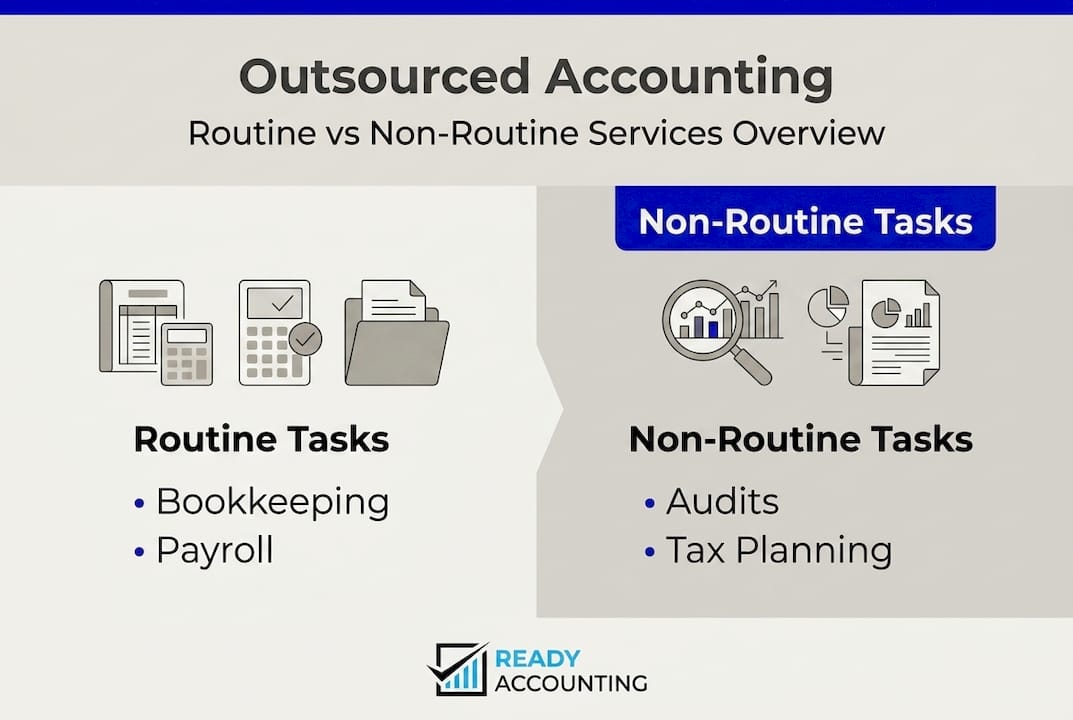
Routine services are ongoing, recurring tasks performed monthly or weekly. These include bookkeeping, payroll, VAT returns, management accounts, and regular advisory check-ins. Because they run continuously, they create a feedback loop that catches errors early, maintains clean data, and supports consistent compliance.
Non-routine services are once-off or annual tasks. Annual financial statements, year-end tax returns, company secretarial filings, and ad hoc special-purpose reports fall into this category. These are important but limited in their ongoing impact.
“Non-routine services have less direct impact on compliance than routine or advisory services, but are still important for meeting statutory obligations.”
This distinction has a direct bearing on what you should prioritize when outsourcing for scaling companies. A business that only outsources its year-end tax return gains compliance but misses the cash flow insights, payroll accuracy, and monthly tax optimization that routine services provide.
| Service type | Examples | Compliance impact | Management benefit |
|---|---|---|---|
| Routine | Bookkeeping, payroll, VAT | High, ongoing | High, continuous |
| Advisory | Strategy sessions, CFO input | Moderate | Very high |
| Non-routine | Annual statements, tax return | Moderate | Low to moderate |
One common misconception among practitioners relates to the turnover tax regime. Many advisors assume that SMEs qualifying for turnover tax (a simplified tax system for businesses with less than R1 million annual turnover) do not need robust monthly accounting. This is wrong. Turnover tax still requires accurate revenue tracking, and poor record-keeping during the year creates problems at submission time.
Here are the practical steps to ensure you get the best service mix for your needs:
- Audit your current pain points. Identify whether your biggest risks are compliance, cash flow visibility, payroll errors, or tax timing. This shapes which services you prioritize.
- Start with routine services. Establish a monthly bookkeeping and management reporting rhythm before adding advisory layers.
- Build in advisory frequency. Schedule regular strategic reviews, not just year-end conversations.
- Review your service mix every six months. As your business grows, your needs shift. Your outsourced partner should proactively flag when you need more or different support.
- Use your how to outsource accounting checklist to ensure nothing is missed during onboarding or transitions.
Getting this mix right means your accounting partner is delivering value every month, not just once a year when the auditors arrive.
How to get started with outsourced accounting
Understanding the types of outsourced services sets you up to take the first steps confidently. The setup process is simpler than most SME owners expect. The key is scoping your needs clearly before you sign anything.
Here is how to move from intention to implementation:
- Define your scope. List every financial task your business currently handles: bookkeeping, payroll, VAT, PAYE, provisional tax, management accounts, and year-end. Identify which are consuming the most time or carrying the most risk.
- Set a budget range. Know what you are currently spending on internal finance resources. Use that as your baseline. Outsourcing should deliver more value at the same or lower cost.
- Shortlist providers with SME experience. Look for firms that work specifically with South African SMEs, understand SARS processes, use cloud-based tools, and can demonstrate clear reporting outputs.
- Request a scoping call. Any reputable provider will want to understand your business before quoting. Use this conversation to test their advisory capability, not just their compliance knowledge.
- Review the engagement letter carefully. Ensure the deliverables, turnaround times, communication channels, and escalation paths are all documented before you start.
- Run a clean handover. If you have existing records, ensure they are reconciled before the new provider begins. Inheriting messy books creates delays and unexpected costs.
- Activate cloud access and integrations. Your provider should connect your accounting software to your bank feeds, payroll system, and invoicing tools from day one. This is where investing in outsourced accounting delivers measurable operational gains immediately.
Pro Tip: From your first month, ask for a management pack that includes a profit-and-loss statement, balance sheet, cash flow summary, and a short narrative explaining your numbers in plain language. If your provider cannot deliver this, find one who can.
Common pitfalls to avoid during onboarding:
- Not communicating deadlines clearly. SARS has strict submission dates. Your provider needs your documents well ahead of time.
- Assuming your provider handles everything automatically. You still need to approve payroll, review reports, and flag unusual transactions.
- Skipping the advisory conversation. Compliance without strategy is just record-keeping. Push for financial insights, not just reports.
- Choosing on price alone. The cheapest provider often delivers the least. Look for value, responsiveness, and expertise before comparing costs.
Using a structured outsourcing framework for SMEs ensures you do not leave money or opportunity on the table. And understanding why outsource accounting in the South African context specifically helps you choose the right partner for your industry and growth stage.
The overlooked advantage: Advisory focus in outsourcing
Most SMEs choose outsourced accounting for one of two reasons: they want to reduce costs, or they need help staying compliant. Both are valid. But both miss the most powerful thing outsourcing can do for a growing business.
The real leverage is not in the bookkeeping. It is in the advisory layer that sits on top of clean, real-time financial data. When your numbers are current, accurate, and interpreted by someone who understands your business model, you can make faster and better decisions on pricing, hiring, inventory, and investment.
Advisory services provided via outsourcing deliver deeper management benefits that basic compliance services simply cannot match. A once-a-year conversation about your tax return tells you nothing about why your gross margin is shrinking or how much runway you have before you need to raise capital.
The businesses that grow fastest with outsourced accounting are those that treat their provider as a Fractional CFO, not a filing service. They bring their financial partner into pricing decisions, hiring plans, and investment discussions. They use their monthly management pack to drive the agenda at leadership meetings. That is where the outsourcing advisory benefits become genuinely transformative. Most providers are capable of this level of support. Most clients never ask for it.
Streamline your finances with expert outsourced support
To put these insights into action, consider how the right outsourced partner can become your most productive business decision of the year. Ready Accounting works with South African SMEs and VC-backed startups to replace manual, reactive bookkeeping with automated, real-time financial infrastructure. As your premier outsourced accounting firm, we combine cloud automation, tax defense, and fractional CFO thinking into one integrated service. Whether you want to reduce tax liability or build a finance function that supports scale, our accounting automation guide is the place to start. Explore our resources and reach out to map the right solution to your stage of growth.
Frequently asked questions
How do outsourced accounting services save costs?
Outsourced accounting can save up to 3x the cost of in-house handling by optimizing cash flow and providing efficient, structured tax management throughout the year.
Which accounting tasks are best outsourced for SMEs?
Routine and advisory services such as bookkeeping, payroll, VAT compliance, tax planning, and management reporting deliver the clearest and most consistent results when outsourced.
Is outsourcing safe for my company’s financial data?
Yes. Reputable outsourced accounting firms use encrypted cloud platforms, role-based access controls, and strict data protection protocols to keep your financial information secure and confidential.
What is the difference between routine and non-routine outsourced accounting?
Routine services cover ongoing work like bookkeeping and payroll, while non-routine services cover annual tasks such as financial statements or tax returns, which have less continuous compliance impact.
How should I select an outsourced accounting provider?
Look for proven experience with South African SMEs, a strong compliance track record, transparent pricing, cloud-based tools, and clear advisory capabilities beyond basic bookkeeping.