

Income statement guide for South African SMEs
Executive Summary
- South African SMEs operate with an average profit margin of just 1.3%, making income statement accuracy crucial.
- The income statement reveals revenue, expenses, and profit, guiding operational and strategic decisions.
- Regular, consistent review of financial reports enhances compliance, profitability, and business growth.
South African SMEs are operating on a knife’s edge. With an average after-tax profit margin of just 1.3%, there is almost no room for financial blind spots. The income statement, also called a profit and loss (P&L) statement, is the single financial document that shows you exactly where your money comes from, where it goes, and what survives at the end. If you are running a growing South African business and not fully using this report, you are likely leaving critical decisions to guesswork. This guide breaks down the income statement in plain language so you can improve your reporting, stay compliant, and make sharper business decisions.
Table of Contents
- Understanding the income statement: Purpose and fundamentals
- Key elements of an income statement: Breaking it down
- IFRS for SMEs: Presentation and compliance essentials
- From statement to strategy: Using your income statement to drive business decisions
- Why most SMEs underestimate the power of the income statement
- Level up your financial reporting with expert support
- Frequently asked questions
Key Takeaways
| Point | Details |
|---|---|
| Income statement fundamentals | An income statement tracks a business’s revenue, expenses, and profit for any set period. |
| Reporting options | South African SMEs must choose and consistently apply how they present and classify their income statement details under IFRS for SMEs. |
| Thin profit margins | Average SME profit margins in South Africa are only 1.3%, making disciplined income statement review essential. |
| Practical business use | Regularly analyzing your income statement helps you spot trends, control costs, and meet tax and compliance requirements. |
Understanding the income statement: Purpose and fundamentals
The income statement is not just a tax document you hand to your accountant once a year. It is the clearest picture your business produces of its own financial health across a specific period. Most SMEs look at it quarterly or annually, but the real value comes from understanding it on a deeper level.
Simply put, the income statement shows revenue, expenses, and profit over a defined period. That period could be a month, a quarter, or a full financial year. Unlike a balance sheet, which is a snapshot of what you own and owe at a single point in time, the income statement captures movement. It tells the story of your business activity over time, not just where you stand today.
For South African SMEs, understanding the basics of financial statements is not optional. SARS, banks, investors, and potential buyers all rely on income statements to assess your business. Without a clean, accurate income statement, you cannot apply for funding, negotiate supplier credit, or defend your tax position with confidence.
The income statement answers questions every business owner should be asking regularly:
- Are my revenues growing month on month or shrinking?
- Which expense categories are eating into my margins?
- Did I actually make a profit this quarter, or just generate revenue?
- How does my gross profit compare to last year?
- Where can I cut costs without damaging operations?
- Am I pricing my products or services correctly?
These are not abstract questions. They are operational decisions that determine whether your business survives or thrives. The income statement is the only document that gives you the raw data to answer all of them at once.
Statistic callout: With the average SME profit margin sitting at just 1.3% in South Africa, a single overlooked expense category or a pricing mistake can push you from profit into loss. That is not a financial theory. That is the reality for thousands of small businesses.
Pro Tip: Set a recurring calendar reminder to review your income statement at the same time every month. Consistent review habits help you spot cost creep and revenue dips before they compound into serious problems.
Key elements of an income statement: Breaking it down
Understanding why the income statement matters is one thing. Knowing what each part actually means is the next step. Let’s walk through the core components using plain language and a practical example.
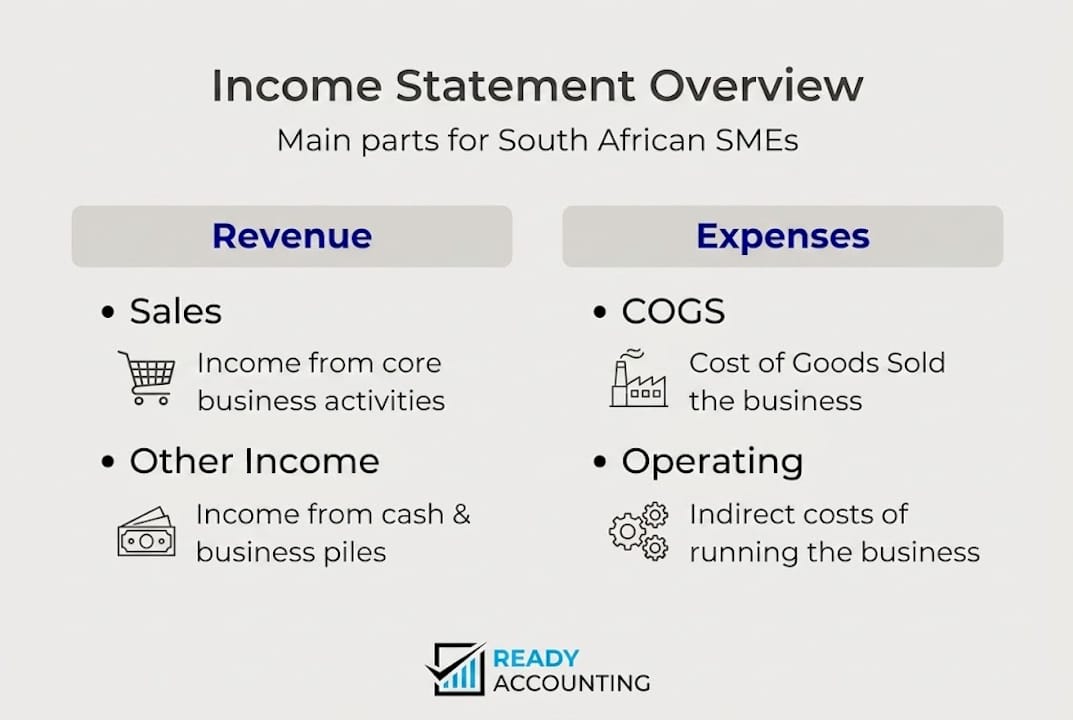
Income statements typically present revenue, cost of sales, gross profit, operating expenses, and net profit. Each line tells a different part of your financial story. You can also explore SME statement examples to see how these elements look in real-world South African contexts.
Here is a simplified income statement for a fictional South African SME to illustrate the structure:
| Line item | Amount (ZAR) |
|---|---|
| Revenue (turnover) | R 850,000 |
| Cost of sales (COGS) | R 510,000 |
| Gross profit | R 340,000 |
| Operating expenses | R 270,000 |
| Operating profit (EBIT) | R 70,000 |
| Interest expense | R 12,000 |
| Tax | R 16,440 |
| Net profit | R 41,560 |
Notice how each layer strips away a different cost. Revenue alone tells you very little. It is the net profit that reveals the real health of the business.
Here is what each element actually means in plain English:
- Revenue: The total income your business earns from selling goods or services before any costs are deducted. This is your top line.
- Cost of sales (COGS): The direct costs tied to producing or delivering your product or service. For a manufacturer, this is raw materials and direct labour. For a retailer, it is the cost of purchasing inventory.
- Gross profit: Revenue minus cost of sales. This tells you how efficiently you produce or deliver your offering.
- Operating expenses: Indirect costs like rent, salaries not tied to production, marketing, software subscriptions, and insurance. These are the costs of running the business regardless of how much you sell.
- Operating profit (EBIT): Gross profit minus operating expenses. This shows how profitable your core business operations are before financing and tax.
- Net profit: The final bottom line after all expenses, interest, and tax are accounted for. This is the number that truly matters.
Common expense categories that South African SMEs frequently overlook include bank charges, merchant processing fees, vehicle running costs, staff training, and annual software licence renewals. These line items individually seem small, but together they can reduce your net profit significantly when margins are already tight.
IFRS for SMEs: Presentation and compliance essentials
Getting the statement’s layout right is not just a formality. South African law expects SMEs to make smart, consistent choices in how they present their financial statements, and there are real consequences for getting it wrong.
South Africa requires most private companies to prepare financial statements in line with IFRS for SMEs (International Financial Reporting Standards for Small and Medium-sized Entities). This framework is less complex than full IFRS, but it still has specific requirements for income statement presentation that many SME owners are not aware of.
SMEs can present either a single statement of comprehensive income or separate statements, and may classify expenses by nature or by function, provided disclosure is consistent and appropriate. This flexibility sounds helpful, but it creates real pitfalls if you switch approaches without proper disclosure. Refer to the annual financial statement guide for a full breakdown of what is required under South African law.
Here is a comparison of the two main choices you need to make:
| Decision area | Option A | Option B |
|---|---|---|
| Statement presentation | Single statement of comprehensive income | Separate income statement + statement of comprehensive income |
| Expense classification | By nature (salaries, depreciation, materials) | By function (cost of sales, admin, distribution) |
| Best suited for | Simpler SMEs with limited expense types | SMEs with multiple departments or divisions |
| Disclosure requirement | Lower additional disclosure needed | Requires more footnote disclosure |
“SMEs can present either a single statement of comprehensive income or separate statements, and may classify expenses by nature or by function, provided disclosure is consistent and appropriate.” This guidance is not bureaucratic noise. It directly affects how transparent and defensible your financials are during a SARS audit or due diligence review.
Common mistakes that South African SMEs make include switching between expense classification methods from year to year without disclosure, omitting other comprehensive income items entirely, and mixing cash-basis thinking into accrual-basis statements. These errors create inconsistencies that trigger compliance red flags for auditors and SARS alike.
Pro Tip: Once you choose your presentation format and expense classification method, stick with it year after year. Consistency is a compliance requirement under IFRS for SMEs, and switching without a documented reason and proper disclosure can attract unwanted scrutiny.
From statement to strategy: Using your income statement to drive business decisions
Now that your income statement is structured and compliant, what can you actually do with it? The document only becomes valuable when you use it actively in your decision-making process rather than filing it away until the next audit.
With profit margins often razor-thin, close monitoring and disciplined cost reporting are crucial for South African SMEs. Here are the four most powerful ways to use your income statement as a strategic tool:
-
Monitor trends over time. Pull three to six months of income statements side by side. Look for patterns in revenue and expense lines. Is your cost of sales creeping up as a percentage of revenue? Are operating expenses growing faster than revenue? Trends reveal problems before they become crises. A single month of data is a snapshot. Six months of data is a story.
-
Benchmark against your industry. Raw numbers mean very little without context. A 40% gross profit margin sounds excellent until you discover that your industry average is 55%. Industry benchmarks help you identify whether your pricing, supplier costs, or operational efficiency are competitive. SARS sector data and industry associations often publish benchmark figures that are directly applicable to South African SMEs.
-
Plan your tax position proactively. Your income statement is the foundation of your tax calculation. By reviewing it regularly, you can identify legitimate deductions, time certain expenses strategically, and avoid surprises when your tax return is due. Pairing income statement review with tax-saving strategies can meaningfully reduce your tax liability while keeping you fully compliant.
-
Drive cost management decisions. Every line item on your income statement represents a decision. When you see operating expenses rising, you can drill down into which category is responsible and make targeted interventions. Renegotiating supplier contracts, switching service providers, or cutting underperforming marketing channels are all decisions that start with a careful income statement review. Connect this process to setting financial goals to give your cost management a clear target.
Pro Tip: Treat your monthly income statement review as a structured meeting, not a casual glance. Bring your statement, your previous month’s version, and a list of three questions you want to answer. This discipline turns financial data into actionable intelligence.
The most strategic SME owners also use their income statements when approaching banks or investors. A well-prepared, consistently formatted income statement signals that the business is professionally managed. It builds trust faster than any pitch deck.
Why most SMEs underestimate the power of the income statement
Most South African SME owners see the income statement as compliance paperwork. Something the accountant needs. Something that lives in a folder until SARS asks for it. That mindset is quietly costing businesses money every single month.
Here is the uncomfortable reality. A business owner who reviews their income statement only at year-end is essentially driving by looking in the rearview mirror. By the time you see the problem, you have already driven off the road. We have worked with SMEs who discovered, only during their annual review, that a single unchecked expense category had been eroding their margins for eleven months. That is eleven months of avoidable losses.
The owners who avoid these traps treat their income statement the way a pilot treats an instrument panel. Not something to look at when things go wrong. Something that tells you, in real time, whether you are on course or drifting. One simple habit change, reviewing the statement monthly and asking one focused question each time, catches common bookkeeping mistakes before they compound. The income statement is not historical paperwork. It is your most honest business advisor, if you actually listen to it.
Level up your financial reporting with expert support
If you are ready to turn financial insight into business advantage, the next step is building systems that make income statement accuracy automatic rather than effortful. At Ready Accounting, we replace manual, error-prone bookkeeping with cloud-based financial infrastructure that gives you real-time visibility into your revenue, expenses, and profit. Our accounting automation guide walks you through exactly how automation eliminates the friction that keeps most SMEs stuck in reactive mode.
If tax efficiency is your priority, explore our practical resource on how to reduce SME tax liability and protect your margins. Not sure whether you need dedicated support? Our guide on when to hire a bookkeeper helps you make that call with confidence. Accurate, consistent financial reporting is not just a compliance requirement. It is a competitive advantage.
Frequently asked questions
What does an income statement show for a small business?
It shows a summary of all revenues earned, expenses incurred, and the resulting profit or loss for a defined period. The income statement shows revenue, expenses, and profit or loss, giving business owners a clear picture of financial performance over time.
Why do South African SMEs need to follow IFRS for SMEs guidelines for income statements?
IFRS for SMEs ensures your statements are presented consistently, legally, and transparently for compliance and comparison purposes. Presentation under IFRS for SMEs requires consistency and disclosure, which protects you during audits and builds credibility with lenders and investors.
What is the difference between classifying expenses by nature or by function?
By nature means grouping expenses by type, such as salaries or materials, while by function groups them by business area like manufacturing or sales. Expense classification by nature or function affects how costs appear on your statement and what additional disclosures are required.
How often should an SME review its income statement?
Monthly is ideal for close monitoring, especially with thin profit margins. With the average SME profit margin at just 1.3%, a quarterly or annual review cycle leaves too much time for undetected cost leaks to compound.