
Integrity in financial reporting: practical steps for SA SMEs
Executive Summary
- Many South African SMEs have not fully adopted IFRS for SMEs, risking inaccurate reporting.
- Consistent practices like bank reconciliation and cloud solutions enhance financial integrity.
- Accurate, honest records are more important than perfection for long-term business trust.
Most South African SME owners are confident they’re running a tight financial ship, yet fewer than 50% of surveyed SMEs have formally adopted IFRS for SMEs since its introduction. That gap between perception and reality is where businesses get hurt, whether through SARS penalties, rejected loan applications, or fraud that goes undetected for months. Integrity in financial reporting isn’t a privilege reserved for large corporates with full finance departments. It’s a practical, step-by-step discipline that any SME owner can build into their business with the right understanding, habits, and tools.
Table of Contents
- What integrity in financial reporting means for SA SMEs
- Common barriers SA SMEs face in achieving reporting integrity
- IFRS for SMEs: do the benefits justify the burden?
- How cloud-based solutions drive real financial reporting integrity
- A practical perspective: what most SMEs miss about financial integrity
- Take the next step towards reporting integrity with expert help
- Frequently asked questions
Key Takeaways
| Point | Details |
|---|---|
| Integrity isn’t optional | Building honest, complete financial reports protects your business reputation and legal standing. |
| Barriers can be overcome | Despite complex standards, simple steps like reconciliations and cloud automation make integrity achievable. |
| Cloud tools boost compliance | Automated solutions dramatically reduce errors, speed up reporting, and help SMEs meet regulatory expectations. |
| Consistency over perfection | Making regular, transparent improvements matters more than achieving flawless compliance on day one. |
What integrity in financial reporting means for SA SMEs
The term “integrity in financial reporting” sounds formal, but the concept is straightforward. It means your financial records accurately reflect what actually happened in your business. Nothing hidden, nothing inflated, nothing delayed. According to the IFRS conceptual framework, information must be complete, neutral, error-free, and represent substance over form. Those four principles are the backbone of trustworthy reporting.
For a South African SME, this has very practical meaning. It means your revenue figure reflects real cash earned, not invoices you hope will be paid. It means your expenses are recorded in the period they occurred, not when you felt like capturing them. It means your bank balance in your accounting software matches your actual bank statement, every single month.
Integrity in financial reporting is not about perfection. It’s about consistency, honesty, and a commitment to showing the truth about your business, even when the truth is uncomfortable.
Why does this matter beyond just keeping SARS happy? Because your financial statements are a communication tool. When a bank considers your loan application, they’re reading those statements and deciding whether to trust you with their money. When an investor evaluates your business, they want to know the numbers are real. When a key supplier considers extending credit terms, your financials are part of their decision. Reporting integrity, therefore, directly influences your access to capital and growth opportunities.
South Africa aligned with IFRS for SMEs as the preferred reporting standard for private companies that don’t have public accountability. But as the data shows, adoption remains low. The standard itself covers everything from revenue recognition to leases to employee benefits, and for a business owner who is also the salesperson, operations manager, and HR department, the complexity is genuinely overwhelming. Understanding the basics of financial statements is the first concrete step toward closing that gap.
The risks of poor reporting integrity go beyond compliance. Fraud thrives in businesses where records are inconsistent or incomplete, because there’s no clean baseline to compare against. Businesses with weak reporting also face a harder time raising funding, tend to make decisions on inaccurate data, and are far more vulnerable during a SARS audit. Getting the foundations right isn’t just about ticking boxes. It’s about protecting everything you’ve built.
Common barriers SA SMEs face in achieving reporting integrity
Knowing what integrity looks like and actually achieving it are two very different things. Most SME owners in South Africa aren’t cutting corners by choice. They’re running into genuine structural obstacles that make consistent, accurate reporting extremely difficult.
The IFRS for SMEs standard, while simpler than full IFRS, still contains over 200 pages of guidance. For a business with one bookkeeper or none at all, navigating that framework alongside the day-to-day demands of running a business is unrealistic without external support. Less than 50% of SA SMEs adopted the standard post-introduction, and complexity combined with resource constraints are the primary reasons cited.
Here are the most common barriers we see:
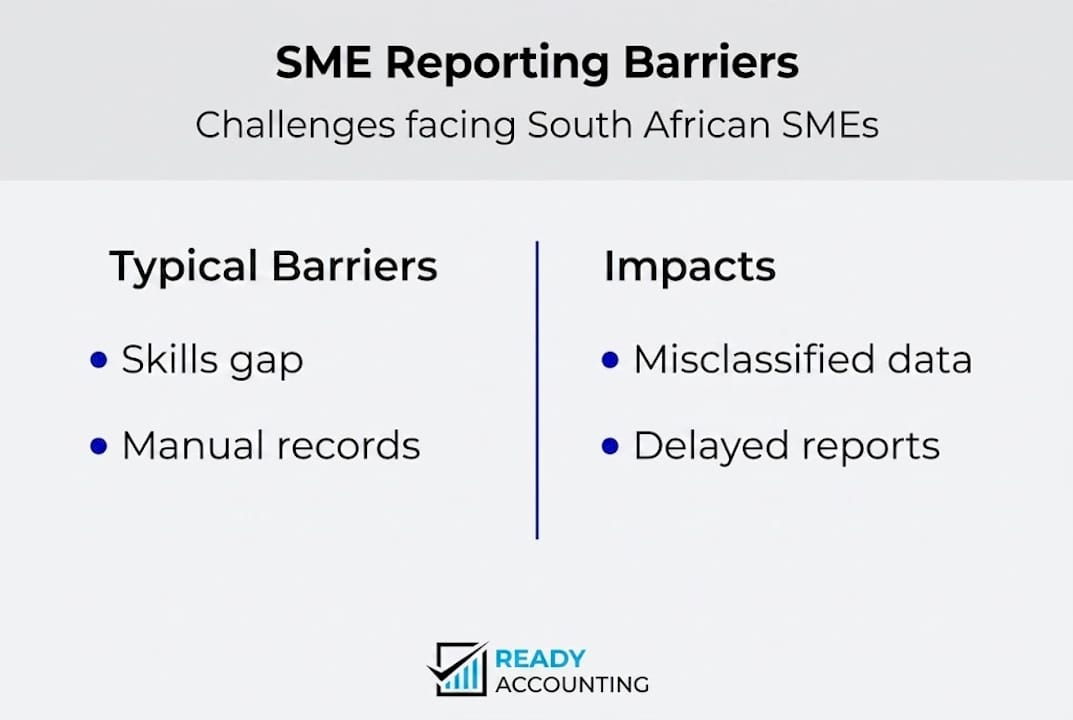
- Skills gap: Many SME owners lack formal accounting training, and hiring a qualified accountant full-time is cost-prohibitive for small businesses.
- Time constraints: When you’re wearing ten hats simultaneously, recording every transaction on time doesn’t feel like a priority until month-end chaos hits.
- Delayed entries: Capturing expenses weeks after they occur leads to mismatched periods, inaccurate profit figures, and reconciliation nightmares.
- Missing invoices: Lost supplier invoices cause understated expenses and overstated profits, both of which distort business decisions and tax obligations.
- Manual processes: Spreadsheet-based bookkeeping creates enormous error risk, especially when multiple people touch the same file.
| Barrier | Frequency among SA SMEs | Potential impact |
|---|---|---|
| Skills gap | Very high | Misclassified transactions, incorrect tax filings |
| Delayed entries | High | Inaccurate period reporting, reconciliation errors |
| Missing invoices | High | Overstated profits, SARS penalties |
| Manual processes | Medium to high | Data errors, fraud vulnerability |
| Regulatory complexity | Medium | Non-adoption of IFRS for SMEs |
Looking at financial statement examples from comparable businesses gives you a practical benchmark to measure your own reporting against. Combining that with intentional planning for financial reporting cycles reduces the reactive scrambling that causes most errors.
Pro Tip: Set a recurring calendar reminder every Friday to reconcile your bank account for that week. Five minutes on Friday prevents five hours of confusion at month-end. This simple habit, done consistently, is one of the most effective fraud prevention tools available to any SME.
The pattern we see repeatedly is that small businesses delay reconciliations until the pressure of a tax deadline forces them into a frantic catch-up exercise. That pressure environment is where mistakes multiply and where fraud slips through undetected. Consistency, not sophistication, is the real solution to most reporting integrity problems at the SME level.
IFRS for SMEs: do the benefits justify the burden?
This is the question every honest advisor should be helping you answer. The debate around IFRS adoption for SMEs is real. Proponents see IFRS alignment as boosting credibility, while critics argue the standard is still too complex and costly for the average small business. Both sides have a point.
Here’s a side-by-side comparison of what you’re working with:
| Feature | IFRS for SMEs | Full IFRS | Basic cash-based reporting |
|---|---|---|---|
| Complexity | Medium | Very high | Low |
| Stakeholder acceptance | High | Very high | Low |
| Cost to implement | Medium | High | Low |
| SARS acceptability | Yes | Yes | Limited |
| Bank/investor credibility | Good | Excellent | Poor |
| Suitable for SMEs | Yes | Rarely | Short-term only |
What banks and investors actually want is confidence that your numbers are reliable and consistently prepared. Full IFRS isn’t usually required unless you’re preparing for an IPO or operating in a regulated industry. SARS is primarily concerned with accurate income tax and VAT submissions, which don’t require full IFRS compliance but do require accurate, well-documented records.
When does adopting IFRS for SMEs genuinely make sense for your business? Consider these indicators:
- You’re actively seeking external investment or a bank loan above R1 million.
- You have more than one business entity and need consolidated reporting.
- Your business has significant fixed assets, leases, or foreign currency transactions.
- You’re planning to sell the business within three to five years and want maximum valuation credibility.
- Your industry requires external audit or review, such as construction, healthcare, or manufacturing.
If you’re a sole trader or micro-business with simple transactions, a streamlined approach that maintains the principles of integrity (accuracy, completeness, timeliness) without full IFRS application may be more appropriate for now. The goal of understanding steps to standardized reporting is to identify the level of formality your business actually needs, not to impose maximum complexity for its own sake.
The key takeaway is this: the standard you use matters less than whether your records are honest, current, and consistently maintained. A business with clean, accurate basic records is far better positioned than one with technically formatted statements built on unreliable data.
How cloud-based solutions drive real financial reporting integrity
Standards and frameworks tell you what to aim for. Technology tells you how to get there without burning out your team or your budget. This is where cloud-based accounting genuinely changes the game for South African SMEs.

The numbers speak clearly. Cloud accounting reduces closing time by 35%, cuts errors by up to 40%, and 72% of SMEs report improved tax compliance after adopting cloud-based systems. For a business owner managing cash flow, staff, and customer relationships simultaneously, those improvements are not just convenient. They are the difference between a clean audit and a SARS nightmare.
Cloud accounting enforces integrity through structure, not willpower. Here’s how it works in practice:
- Automated bank feeds pull transactions directly from your bank account, eliminating manual data entry and the errors that come with it.
- Audit trails record every change made to a transaction, including who made it and when. This is one of the most powerful fraud prevention tools available.
- Access controls mean your accounts payable clerk can capture invoices without being able to approve payments, creating natural segregation of duties.
- Real-time dashboards give you a live view of your financial position, removing the monthly guesswork that leads to poor decisions.
- Automated reconciliations flag discrepancies the moment they occur, rather than surfacing three months later when they’re much harder to resolve.
Integrating cloud accounting with IFRS for SMEs via automated workflows and controls directly boosts transparency, cuts compliance costs, and addresses integrity risks including fraud. This isn’t theoretical. Businesses that move their core processes to cloud platforms consistently report more confidence in their numbers and fewer surprises at year-end.
If you’re ready to make that move, here’s a practical migration approach:
- Step 1: Audit your current data. Understand what records you have, where they live, and how accurate they are before migrating anything.
- Step 2: Choose a platform built for South African compliance, including VAT, PAYE, and SARS eFiling integration.
- Step 3: Migrate your chart of accounts and opening balances carefully. This is where most migrations go wrong.
- Step 4: Set up your bank feeds and automated rules for recurring transactions.
- Step 5: Train whoever touches the system and assign clear roles with appropriate access levels.
Understanding cloud accounting for SMEs in detail helps you evaluate which platform fits your specific business model. The SMB cloud adoption guide walks through the decision framework in practical terms for South African business owners.
Pro Tip: When evaluating cloud accounting platforms, prioritise those with built-in SARS eFiling compatibility and local support teams who understand South African tax law. A globally popular platform that requires expensive local customisation will cost you more in the long run than a locally focused solution.
A practical perspective: what most SMEs miss about financial integrity
Here’s the uncomfortable truth we’ve seen confirmed again and again working with scaling South African businesses: most SME owners equate financial integrity with never making mistakes. That belief is both wrong and paralyzing.
No business has perfect records. Not a single one. What separates high-integrity businesses from low-integrity ones isn’t the absence of errors. It’s the culture around how errors are found and handled. A business that catches a misclassified expense in week two and corrects it immediately has far more reporting integrity than one that avoids looking closely because they’re afraid of what they’ll find.
The most damaging thing we see isn’t inaccurate records. It’s the avoidance of honest review. When business owners are too busy, too stressed, or too uncomfortable to look clearly at their numbers, small problems compound into large ones. What could have been a straightforward reconciliation adjustment in March becomes an audit risk by November.
Small, consistent habits outperform sporadic perfection every single time. A weekly five-minute bank reconciliation. A monthly review of your top ten expense categories. A quarterly comparison of your actuals versus your projections. These practices, applied consistently, build the kind of financial culture that investors notice and that fraud cannot easily penetrate. Exploring a practical guide to sustainable growth shows how these financial habits connect directly to long-term business performance.
The goal isn’t flawless statements. The goal is a business where honest numbers are always available and always acted on.
Take the next step towards reporting integrity with expert help
Building financial reporting integrity into your SME doesn’t have to be a solo effort. Ready Accounting works with South African SMEs and VC-backed startups to replace manual, error-prone processes with custom cloud infrastructure that enforces integrity at every step. Whether you need automated workflows, real-time dashboards, or a Fractional CFO who can translate your numbers into growth decisions, the tools and expertise are available to you right now. Explore our automation guide to see how businesses like yours are eliminating reconciliation chaos and closing their books faster with fewer errors. Read more about the practical cloud accounting benefits that are already transforming SA SME reporting. Your finance department should be an asset, not a liability.
Frequently asked questions
What is the main difference between IFRS for SMEs and full IFRS?
IFRS for SMEs is a simplified set of standards designed for smaller businesses, reducing complexity compared to full IFRS requirements while still ensuring credible, stakeholder-ready financial statements.
How does cloud-based accounting increase financial reporting integrity?
Cloud accounting automates key tasks, reduces human error, and enables quicker, more accurate reporting. Research shows it can reduce errors by 40% and improve tax compliance for 72% of SMEs.
Is full IFRS adoption mandatory for all South African SMEs?
No, most South African SMEs can use IFRS for SMEs and are not required to adopt full IFRS. South Africa uses IFRS for SMEs as the default standard unless specific stakeholder requirements demand the full version.
What are quick wins for improving reporting integrity in my SME?
Start with weekly bank reconciliations, move at least one core process to a cloud-based accounting platform, and conduct monthly spot checks on your top expense categories to catch errors and irregularities early.