

Master risk management in accounting for SME success
Executive Summary
- Less than half of South African SMEs have adopted proper accounting standards, leaving them vulnerable to risks. Many overlook the importance of ongoing risk management, resulting in compliance issues, fraud, and cash flow problems. Implementing simple frameworks, automation, and a risk-aware culture can significantly improve SME financial resilience.
Fewer than half of South African SMEs have successfully adopted structured accounting standards, leaving most exposed to risks they don’t fully understand. Many business owners believe that formal risk management belongs in boardrooms of large corporations, not in the back office of a growing SME. That assumption is expensive. From cash flow surprises to SARS penalties and internal fraud, the consequences of unmanaged accounting risk hit SMEs harder than any other business segment. This guide cuts through the complexity, giving you practical frameworks and concrete steps to protect your financial interests, stay compliant, and build a business that can absorb setbacks without falling apart.
Table of Contents
- Why risk management is essential for South African SMEs
- Core types of accounting risks: What SME owners need to know
- How to identify and analyze accounting risks in your business
- Practical strategies and tools for managing accounting risks
- Building resilience: Developing a risk-aware accounting culture
- What most SME owners miss about risk management in accounting
- Next steps: Modern accounting solutions for risk management
- Frequently asked questions
Key Takeaways
| Point | Details |
|---|---|
| Risk management is essential | Effective risk management in accounting is crucial for SME stability and compliance. |
| SMEs face unique challenges | South African SMEs often struggle with complex standards and resource limits. |
| Simple frameworks work best | Streamlined risk identification and regular reviews make the biggest impact. |
| Digital tools boost control | Automation and cloud accounting help reduce errors and improve compliance. |
| Culture controls future risk | Ongoing staff training and open communication build long-term business resilience. |
Why risk management is essential for South African SMEs
South African SMEs operate in one of the most demanding regulatory environments on the continent. You’re dealing with SARS tax obligations, CIPC compliance, BEE considerations, and shifting economic conditions, all at the same time. Yet most small business owners treat accounting risk as an afterthought, something to address only after a problem surfaces.
The reality is sobering. Less than 50% of surveyed South African SMEs successfully adopted IFRS for SMEs post-adoption, largely because of complexity and low compliance capacity. This is not a fringe statistic. It reflects a structural gap between what South African SMEs are expected to do and what they are actually equipped to handle without proper systems.
The most persistent myth is that risk management is a “big company thing.” The opposite is true. Large enterprises have dedicated compliance teams, external auditors, and risk officers. When something goes wrong, they have layers of protection. Your SME does not. A single fraudulent transaction, a missed VAT filing, or a material error in your income statement can trigger a SARS audit, damage your banking relationships, or wipe out months of profit.
The financial risks facing South African SMEs can be grouped into several overlapping categories:
- Compliance risk: Failing to meet SARS, CIPC, or industry-specific reporting requirements
- Fraud risk: Internal theft, invoice manipulation, or unauthorized access to accounts
- Cash flow risk: Mismanaging working capital, late collections, or poor payment forecasting
- Reporting risk: Errors in financial statements that misrepresent the actual business position
- Operational risk: System failures, process breakdowns, or inadequate record-keeping
“The question is not whether your business faces accounting risk. The question is whether you have a system in place to catch it before it catches you.”
Reviewing your South African SME financial statements regularly is one of the simplest ways to start. Financial statements are not just for tax season. They are a live diagnostic of your business health, and reading them with risk in mind changes everything.
Core types of accounting risks: What SME owners need to know
Before you can manage accounting risk, you need to understand exactly what you are managing. Risk is not a single thing. It shows up differently depending on your industry, your team size, and how your finances are structured.
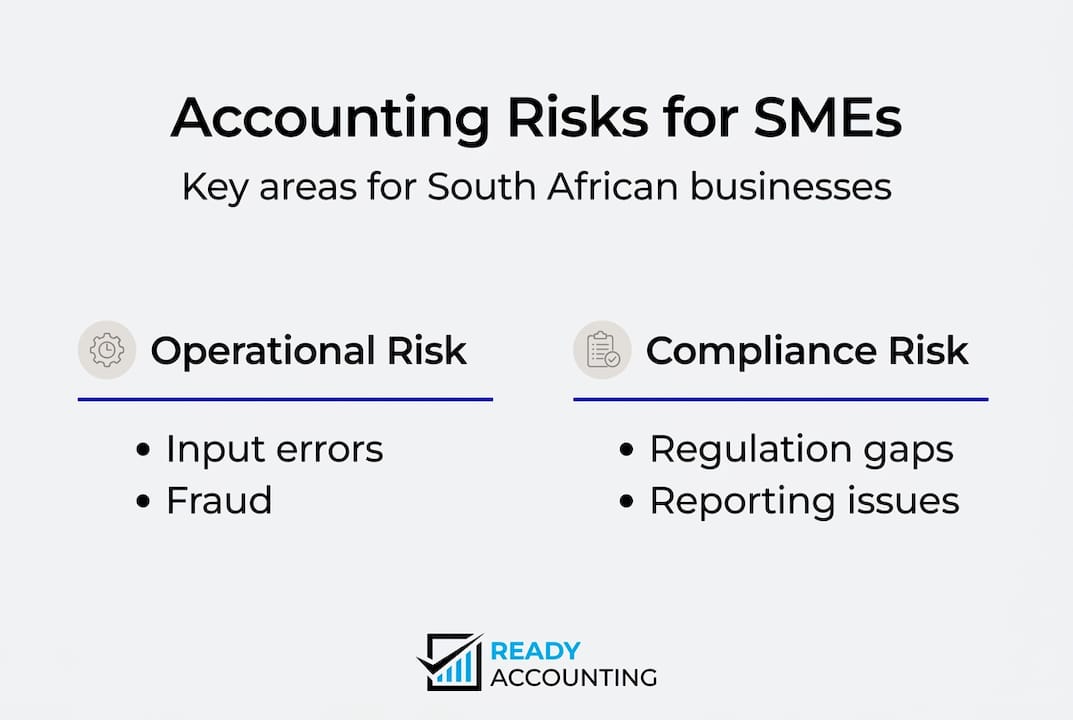
Operational risk covers everything that goes wrong inside your business processes. This includes a bookkeeper entering the wrong amount, a payroll system glitch that overpays staff, or an employee who creates fake supplier invoices to redirect payments. Operational risk is the most common type for SMEs precisely because most small businesses rely on a handful of people doing multiple jobs with minimal oversight.

Compliance risk is the gap between what regulators expect and what your records actually show. In South Africa, this means SARS income tax and VAT returns, CIPC annual returns, and for some sectors, additional regulatory filings. The 3rd edition IFRS for SMEs standard has introduced more alignment with full IFRS, which increases complexity and makes compliance harder, not easier, for smaller businesses.
Financial risk relates to the structure and movement of your money. Poor credit management, offering customers extended payment terms you cannot afford, or failing to maintain a cash buffer for seasonal downturns all fall here. Many SMEs only discover these risks when they can’t meet payroll.
Qualitative risk analysis is common in SMEs due to limited resources, but it often introduces bias. Owners tend to underestimate familiar risks and overestimate unfamiliar ones. Larger and older SMEs generally handle learning and resilience better than their smaller counterparts, mainly because experience builds pattern recognition. If you’re still in the early stages of your business, you have to be more deliberate about identifying these patterns.
Key accounting risks to monitor at your SME level:
- Unauthorized access to banking or accounting software credentials
- No reconciliation of bank statements to internal records
- Single-person control over both payment approvals and record-keeping
- Outdated or incorrect VAT registration details
- Missing or inconsistent documentation for business expenses
Understanding the basics of SME financial statements is the first step to reading risk signals correctly. Your balance sheet and cash flow statement tell you far more than your profit figure alone.
Pro Tip: If one person in your business both approves payments and records transactions, that is a structural risk, not just a process issue. Separating these two duties is the single most cost-effective fraud prevention step available to any SME.
Financial forecasting also plays a critical role in spotting financial risk early, giving you visibility into potential shortfalls before they become crises.
How to identify and analyze accounting risks in your business
Knowing that risk exists is different from having a method to find it. Most SMEs skip this step entirely, relying on a “we’d know if something was wrong” approach. That assumption fails constantly. The goal is a repeatable process that surfaces risk before it becomes damage.
A validated framework, tested on 208 South African SMMEs, breaks operational risk management into three phases: disaster preparedness (identifying risks), disaster learning (analyzing what went wrong or could go wrong), and enterprise resilience (treating and responding to risks). This structure maps directly to what SMEs need, because it is simple enough to implement without a dedicated risk department.
Step-by-step risk identification for your SME:
- List all financial processes in your business from invoicing to payroll to tax filing
- Identify who controls each process and whether there is any oversight or second check
- Check your compliance calendar against actual filings for the past 12 months
- Review your bank reconciliations for any unresolved items older than 30 days
- Audit your user access on all accounting software to remove former employees and restrict permissions
- Assess your documentation habits for all business expenses and supplier payments
Once you have a list of potential risks, the next step is analysis. The two most common methods are quantitative (assigning financial values and probabilities) and qualitative (rating risks as high, medium, or low based on experience). Most SMEs use qualitative analysis because it requires less data, but pairing it with a simple impact table makes it far more reliable.
| Risk type | Likelihood | Potential impact | Priority action |
|---|---|---|---|
| VAT filing error | Medium | High financial penalty | Monthly reconciliation |
| Unauthorized payment | Low | Very high financial loss | Dual authorization process |
| Payroll miscalculation | Medium | Medium staff and legal issue | Automated payroll software |
| Missing expense documentation | High | Medium tax deduction loss | Receipt capture app |
| System failure or data loss | Low | High operational disruption | Cloud backup and recovery plan |
A good risk assessment process always connects likelihood to impact. A risk that is likely but low-impact needs less attention than one that is unlikely but would be catastrophic if it occurred.
Pro Tip: Run a quarterly “risk sprint” where you spend 90 minutes reviewing your top five identified risks. Update the likelihood and impact ratings based on what happened in the previous quarter. This keeps your risk awareness current without requiring a full-time risk manager.
Following financial management best practices gives you the framework to embed these reviews into your existing monthly reporting cycle.
Practical strategies and tools for managing accounting risks
Identifying risk without a mitigation plan is just a worry list. The goal is to move from awareness to action. Fortunately, even resource-constrained SMEs have effective options available to them.
Core risk mitigation strategies:
- Segregation of duties: Ensure no single person controls an entire financial process from start to finish
- Regular internal reviews: Monthly or quarterly audits of key accounts, reconciliations, and approvals
- Automation: Use cloud accounting software to reduce manual entry errors and generate automatic audit trails
- Access controls: Restrict who can approve payments, edit records, or export financial data
- Document retention: Keep source documents for a minimum of five years as required by SARS
One of the most significant shifts you can make is moving from manual to automated accounting processes. The difference in risk exposure is substantial.
| Approach | Manual or traditional | Automated or digital |
|---|---|---|
| Error rate | High due to human input | Significantly lower |
| Audit trail | Inconsistent or paper-based | Automatic and timestamped |
| Compliance reminders | Depends on individual memory | System-generated alerts |
| Fraud detection | Reactive and delayed | Real-time anomaly flagging |
| Cost | Low upfront, high long-term | Moderate upfront, lower long-term |
| Scalability | Breaks down as business grows | Scales with the business |
The increasing alignment of IFRS for SMEs with full IFRS adds layers of complexity, particularly around revenue recognition and fair value measurement. This complexity makes reporting irregularities more likely when businesses rely solely on manual processes.
Using a risk management checklist tailored to your business type gives you a consistent starting point for each review cycle, without needing to rebuild the process from scratch every time.
Pro Tip: Cloud accounting platforms like Xero or Sage Business Cloud store every transaction with a user timestamp. If a figure changes, you can see exactly who changed it and when. This single feature eliminates a significant category of fraud risk at virtually no additional cost.
Building resilience: Developing a risk-aware accounting culture
Systems and checklists matter. But the most durable risk protection in any SME comes from culture, meaning the daily habits and attitudes your team brings to financial processes.
Larger and older SMEs implement learning and resilience better than smaller or younger ones, largely because they have had time to build organizational memory. As a smaller business, you have to build that memory deliberately rather than waiting for experience to accumulate.
What a risk-aware accounting culture actually looks like in practice:
- Leadership modeling: Owners and managers treat financial controls seriously and visibly follow them
- Open error reporting: Staff feel safe flagging mistakes without fear of punishment
- Regular training: Even quarterly 30-minute sessions on fraud awareness or compliance updates make a measurable difference
- Documented processes: Every key financial task has a written procedure, so knowledge is not locked inside one person’s head
- Feedback loops: After any financial incident or near-miss, the team reviews what happened and updates the process
“Resilience is not built in a crisis. It is built in every small decision you make about how your finances are managed on an ordinary Tuesday.”
For sustainable SME growth, a risk-aware culture is not an optional extra. It is the foundation that allows every other growth strategy to function properly.
What most SME owners miss about risk management in accounting
Here is the uncomfortable truth we’ve observed repeatedly: most SMEs don’t fail at risk management because of a lack of tools or knowledge. They fail because of timing. They only act after something goes wrong.
The “we’re too small for this” belief is not just incorrect, it is actively harmful. It gives business owners permission to delay building controls until they feel big enough to justify them. By that point, they’ve usually already absorbed a painful loss or a compliance shock that would have been entirely preventable.
There’s also a cultural habit in South African business culture, particularly among entrepreneurs who built their companies through hustle and resilience, of treating financial structure as bureaucracy. It isn’t. Structured monthly reviews, clear approval chains, and a basic risk register are not corporate overhead. They are the difference between a business that grows steadily and one that keeps restarting from setbacks.
The businesses we see thrive long-term are not the ones with the most sophisticated software. They are the ones where the owner genuinely understands their numbers and reviews them with a critical eye every single month. That habit, applied consistently, outperforms any tool. Pairing it with expert financial management practices accelerates the protection significantly.
Start small. One monthly review. One segregated duty. One risk register entry. Build from there.
Next steps: Modern accounting solutions for risk management
Taking action on accounting risk management is easier with the right resources behind you. Ready Accounting works with South African SMEs to replace fragmented, reactive financial processes with cloud infrastructure and automated controls that catch risks before they become losses. Whether you’re starting with a guide to accounting automation or need to urgently address exposure around avoiding tax penalties, we provide the systems and expertise to build real protection into your accounting function. Explore how modern accounting technology can turn your finance department into a competitive advantage rather than a liability.
Frequently asked questions
What are the top accounting risks for South African SMEs?
The main risks are regulatory non-compliance, internal fraud, and cash flow mismanagement. With fewer than half of SMEs meeting IFRS adoption standards, compliance risk is particularly widespread and underestimated.
How can my SME get started with risk management in accounting?
Begin by mapping your financial processes and identifying where a single person has unchecked control. A simplified ORM framework covering preparedness, learning, and resilience gives you a practical three-phase starting structure.
Does using automated accounting software reduce risk for SMEs?
Yes, automation reduces manual data entry errors, creates timestamped audit trails, and flags anomalies in real time, but it must be paired with proper access controls and regular process reviews to be fully effective.
Is risk management a legal requirement for South African SMEs?
It is not always a formal legal requirement, but effective risk management is essential for meeting your SARS tax obligations, CIPC reporting requirements, and sector-specific compliance standards that carry real penalties for failure.
What’s the biggest mistake SMEs make with accounting risk?
The most common and costly mistake is treating risk management as a once-off exercise. SMEs that fail to revisit controls regularly, especially smaller and younger businesses, accumulate undetected exposure that only surfaces when the damage is already done.
Recommended
- Financial Statement Basics: A Guide for Business Owners - Ready Accounting
- How to scale your SME: Proven strategies for South Africa - Ready Accounting
- Set financial goals for SME growth: a South African guide - Ready Accounting
- Mastering profit and loss for smarter business decisions | Ready Accounting