

Protect Profits in 5 Steps: Mental Health at Work for SA SMEs
Protect Profits in 5 Steps: Mental Health at Work for SA SMEs
Mental health at work means the psychological wellbeing employees experience because of their job, and it can go either way: the same workplace that builds confidence and purpose can just as easily grind someone down. The single highest priority action is a psychosocial risk assessment paired with a visible support pathway, backed by frameworks from the World Health Organization and the U.S. Department of Health and Human Services. Employees struggling right now should talk to a trusted manager, HR contact, or an employee assistance programme today, not next quarter.
Executive Summary
- Conduct a psychosocial risk assessment first, focusing on the most severe hazards like workload, role clarity, bullying, and job insecurity that employers can control.
- Implement a well-funded wellness program, train managers in supportive conversations, and make support pathways visible to encourage early help-seeking.
- Integrate primary, secondary, and tertiary prevention strategies, adopting standards like ISO 45003 for a structured, preventative approach to mental health at work.
- When employees struggle, hold confidential, supportive conversations, clearly document accommodations, and involve HR early, avoiding conflating mental health with performance issues.
- Frame mental health investments as occupational safety costs, using automation and clear tools to monitor absenteeism, engagement, and help-seeking trends for ongoing management.
Table of Contents
- Mental health at work: the numbers South African employers can’t ignore
- What actually causes harm: workplace risks employers can change
- What leaders should do this month: a practical action plan
- Preventing harm before it starts: a three-level approach
- Supporting an employee who’s struggling: what to actually do
- Building a culture where people actually ask for help
- Where to find real tools, not just advice
- Why this matters to a South African business owner’s bottom line
- Sources
Mental health at work: the numbers South African employers can’t ignore
Work-related depression and anxiety cost the global economy roughly US$1 trillion every year in lost productivity, with millions of working days disappearing to poor mental health annually. That figure isn’t abstract for a South African SME. Every unplanned absence, every disengaged team member pushing through a bad month, shows up directly in your bottom line, your VAT filings, and the numbers your tax accountant sees at year end.
Three frameworks anchor most credible workplace mental health guidance:
- The WHO fact sheet on mental health at work, which sets global standards for employer action
- The HHS Surgeon General’s workplace wellbeing framework, built around psychological safety and manager training
- Occupational safety standards like ISO 45003 and SANS 45001, which increasingly treat mental health as a workplace safety issue, not a soft HR extra
Statistic worth sitting with: a trillion dollars in lost global productivity is roughly what several mid-sized national economies produce in a year. It’s a signal that mental health support isn’t charity work. It’s operational risk management.
What actually causes harm: workplace risks employers can change
Most workplace mental health damage traces back to a short list of psychosocial risk factors, and the good news is these are fixable because employers control most of them.
- Excessive workload with no control — long hours, unrealistic deadlines, and zero say in how work gets done
- Role ambiguity — employees who don’t know what’s expected of them tend to burn out faster than those with clear, even demanding, roles
- Bullying and harassment — from colleagues, clients, or management, and often left unaddressed because nobody wants to be “that person” who reports it
- Job insecurity — restructuring rumours, short contracts, and vague performance reviews create chronic low-grade anxiety
- Poor HR practices — inconsistent discipline, unclear grievance processes, and management that avoids difficult conversations
Personal factors compound these risks. Someone already dealing with poor sleep, a physical health hazard, or substance use walks into a high-pressure workplace with less resilience in reserve. That’s not a reason to individualise the problem. It’s a reason to fix the organisational factors you actually control, because you can’t manage someone else’s sleep, but you can manage their workload.
What leaders should do this month: a practical action plan
Good intentions don’t fix psychosocial risk. A prioritised plan does. Here is the sequence that works, in order of leverage.
- Run a psychosocial risk assessment. Use a short, structured template to flag hazards by severity and how easy they are to fix, then pilot a fix on the worst one before rolling anything out company-wide, an approach the WHO recommends for avoiding wasted effort on low-impact changes.
- Set up a wellness programme with a real budget and calendar. Not a poster in the break room. Assign owners, set quarterly milestones, and put money behind it.
- Train managers in supportive conversations. Supervisors mediate almost all of the daily workload and psychosocial exposure your staff experience, which makes manager training the single highest-leverage intervention at the team level.
- Make support pathways obvious. An employee assistance programme nobody knows exists helps nobody. Put the number on the intranet, in onboarding packs, and on the noticeboard.
- Measure and adjust. Track absenteeism, engagement survey scores, and EAP uptake, then revisit your risk assessment every year.
Pro Tip: Frame mental health spend as occupational safety budget, not HR nice-to-have. Framing the investment as risk management rather than welfare makes it far easier to defend at budget time, because safety spend gets approved differently than “soft” wellness spend.
If your business is still running payroll and leave tracking on spreadsheets, this whole plan gets harder to execute consistently. Clean, automated systems make it easier to track who’s used their EAP sessions, who’s due sick leave, and where absenteeism patterns are forming, which is exactly the kind of visibility payroll best practices for South African SMEs are meant to give you.
Preventing harm before it starts: a three-level approach
Workplace mental health programmes work best when they operate on three levels at once, borrowed from public health prevention models and adapted for the office or the factory floor.
Primary prevention stops harm before it happens. That means sensible job design, realistic workloads, protected rest breaks, and access to decent food and movement during the workday. This is the cheapest level to run and the one most South African businesses skip entirely.
Secondary prevention catches problems early. Screening tools, medical surveillance where relevant, and a clear referral pathway to professional care mean a struggling employee gets help in month one, not month twelve. A South African guidance note for the mining sector sets out exactly this kind of layered model, and it translates well to offices, warehouses, and retail floors.
Tertiary prevention deals with what’s already happened: treatment access, rehabilitation support, and a phased return-to-work plan with reasonable accommodation built in. This is where most employers improvise badly, usually because nobody wrote a plan while things were calm.
Adopting recognised standards like ISO 45003 gives you a defensible structure to build all three levels around, rather than reinventing the wheel every time HR changes hands. It also gives your management team a shared vocabulary for talking about risk, which matters more than most people expect once a real case lands on someone’s desk.
Supporting an employee who’s struggling: what to actually do
When someone on your team is visibly battling, the mechanics of that conversation matter as much as the intention behind it.
- Hold the conversation privately, and listen more than you talk. Avoid diagnosing, minimising (“everyone’s stressed”), or rushing to fix it in the first five minutes.
- Document reasonable accommodations clearly. That might mean adjusted hours, a temporary reduction in client-facing work, or extra check-ins, recorded in writing so both sides know what was agreed.
- Loop in occupational health or HR early, especially before any performance process starts. South African labour guidance is consistent on this point: employers carry a duty to investigate and accommodate before considering dismissal where mental illness affects performance.
- Plan return-to-work as a phased process, not a single date on a calendar. Light duties, adjusted hours, and a check-in schedule for the first few weeks back reduce relapse risk substantially.
- Keep records confidential and separate from general HR files, sharing only what’s operationally necessary with only the people who need it.
Pro Tip: Never let a performance conversation double as a mental health conversation. Separate the two clearly, on paper and in the room, because blending them exposes your business to legal risk and makes the employee feel punished for being unwell.
Building a culture where people actually ask for help
Policies only work if people trust them enough to use them, and that trust gets built through visible leadership behaviour, not memos.
- Leaders model the behaviour they want to see — a manager who takes a mental health day openly does more for stigma reduction than any poster campaign
- Manager training becomes mandatory, not optional, with clear anti-harassment procedures everyone actually knows
- Pulse surveys track culture shifts over time, not just once a year in a formal engagement survey
- Low-cost peer networks and awareness campaigns normalise help-seeking without needing a big budget
Framing this as occupational safety rather than a wellness perk helps secure the leadership buy-in and budget that keeps these programmes alive past their first year. A well-structured employee benefits package that includes mental health cover also signals, in a very concrete way, that the business means what it says.
Where to find real tools, not just advice
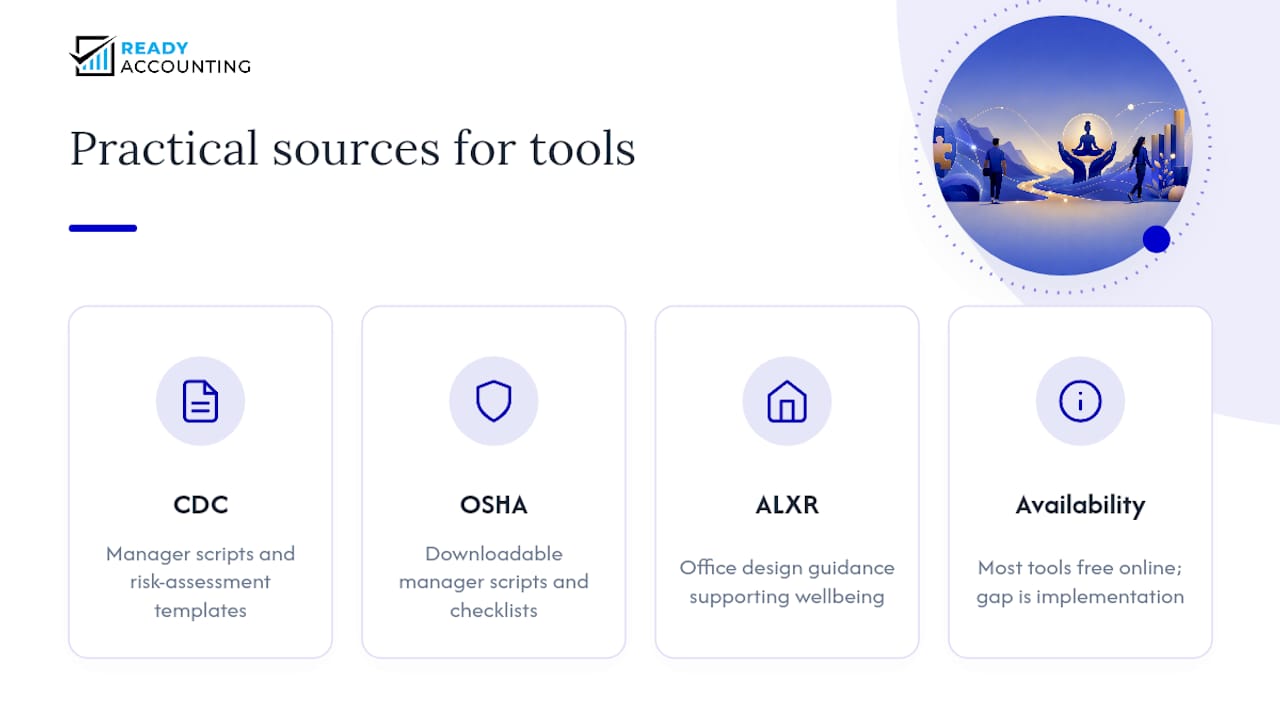
The CDC’s workplace mental health resources and OSHA’s guidance library both offer downloadable manager scripts and risk-assessment checklists you can adapt without starting from a blank page. For office environments specifically, ALXR’s practical workplace guidance covers physical and social space design that supports wellbeing.
Look for: risk-assessment templates, manager conversation scripts, EAP vendor comparison checklists, and return-to-work planning documents. Most of these exist free online. The gap is usually implementation, not information.
Why this matters to a South African business owner’s bottom line
Struggling businesses often blame cash flow, tax deadlines, or slow sales. Underneath a lot of that, there’s a team running on empty, and burnout is expensive long before anyone quits. Retention, productivity, and financial resilience are connected in ways most owners underestimate until they’ve lost a key staff member mid-project.
Businesses that automate the administrative grind free up management time and headspace for exactly the kind of people-focused leadership this article describes. If your finance function is still eating hours that should go toward your team, it’s worth seeing how automation improves cash flow and business resilience. Get in touch with Readyaccounting to talk through what a healthier, better-supported finance department could look like for your business.
— Johan
This article is general information, not a substitute for advice from a qualified doctor. Consult a qualified healthcare professional about your own circumstances before acting on anything here.
Sources
- Mental health at work - World Health Organization (WHO)
- Hhs
- Mental health and workplace safety: Evolving employer responsibilities under occupational health and safety - Cliffe Dekker Hofmeyr (CDH)
- Guidance note for the prevention and management of non-communicable diseases and mental health disorders in the South African mining industry