

Tax planning guide for South African SMEs in 2026
Executive Summary
- Proactive, year-round tax planning helps SMEs reduce costs, avoid penalties, and maximize incentives.
- Selecting the correct tax regime and maintaining compliance are critical to unlocking significant savings.
- Regular review, proper documentation, and professional advice are essential for effective SME tax management.
Tax planning is not something you do once a year before your SARS submission deadline. That approach costs South African SMEs real money, real penalties, and real stress. Proactive, year-round tax management can save your business anywhere from R50,000 to R500,000 annually by ensuring you are in the right tax regime, claiming every legitimate deduction, and staying ahead of compliance requirements. This guide explains what tax planning actually means for SMEs, which tax regimes apply to your business, the costly mistakes to avoid, and the practical steps you can start implementing right now.
Table of Contents
- What is tax planning and why does it matter?
- Understanding key tax regimes for SMEs in South Africa
- Common pitfalls and compliance risks for SMEs
- Smart tax planning strategies and best practices
- The hard truths (and missed opportunities) of SME tax planning
- Achieve smarter tax outcomes with the right support
- Frequently asked questions
Key Takeaways
| Point | Details |
|---|---|
| Tax planning is proactive | Effective tax planning means managing your taxes throughout the year, not just at filing deadlines. |
| Regime choice matters | Choosing the right tax regime for your SME can save significant money and reduce compliance burden. |
| Awareness prevents penalties | Understanding disqualifiers and compliance risks helps you avoid costly SARS penalties. |
| Leverage expert support | Professional advice and automation can unlock savings and maximize SME tax incentives. |
What is tax planning and why does it matter?
Tax planning is the process of using your knowledge of South Africa’s tax rules to legally reduce what your business owes, time your income and expenses to maximum effect, and keep your cash flow healthy throughout the year. For an SME owner, this means more than just filing returns on time. It means making deliberate decisions, from how you structure your business to when you invest in equipment, with an eye on the tax consequences before you commit.
Many business owners assume that tax planning is reserved for large corporations with dedicated finance departments. That is simply not true. In fact, SMEs arguably have more to gain from smart planning because every rand saved flows directly back into growth, salaries, or reserves. The businesses that grow fastest are often the ones that treat tax as a strategic input, not an annual administrative burden.
Ongoing tax planning helps you avoid two of the biggest financial shocks SME owners face: a surprise tax bill at year-end and SARS penalties for non-compliance. Both are preventable. When you integrate tax thinking into your monthly cash flow reviews and business decisions, you stop being reactive and start being in control.
Key benefits of proactive tax planning include:
- Avoiding SARS penalties by staying compliant with filing deadlines and regulatory requirements
- Freeing up cash that would otherwise go toward preventable tax overpayment
- Accessing incentives such as accelerated depreciation and regime-specific tax rates
- Reducing audit risk by maintaining clean, well-documented financial records
- Supporting smarter decisions around hiring, asset purchases, and business structure
“Tax planning is year-round proactive management, not reactive filing; integrate into cash flow for compliance and optimization.”
The practical implication here is straightforward: if tax is only on your agenda in February or March, you are already behind. Exploring smart tax savings strategies and reviewing your tax-efficient business structures year-round is what separates a well-run business from one that constantly scrambles.
With a clear motivation for why tax planning matters, let’s dig into how South Africa’s key SME tax regimes shape your options.
Understanding key tax regimes for SMEs in South Africa
South Africa offers three primary tax regimes that apply to SMEs, and choosing the right one has a direct impact on your effective tax rate, your administrative workload, and the deductions you can claim. Understanding these options is not optional. It is foundational.
Comparison of SME tax regimes
| Feature | Turnover Tax (TOT) | Small Business Corporation (SBC) | Standard Corporate Tax |
|---|---|---|---|
| Eligibility | Turnover ≤ R1 million | Gross income ≤ R20 million | All companies |
| Tax rate | 0% to 3% on turnover | Progressive 0% to 27% | Flat 27% |
| Deductions allowed | No | Yes, including accelerated depreciation | Yes |
| Compliance complexity | Low | Medium | High |
| Best suited for | Micro-businesses, sole traders | Growing SMEs with qualifying structure | Larger, complex businesses |
According to the SARS Tax Guide for Small Businesses, Turnover Tax applies to micro-businesses with annual turnover at or below R1 million, taxed at rates from 0% to 3% on gross turnover with no deductions permitted. The SBC regime applies to qualifying companies with gross income up to R20 million, offering progressive rates from 0% on the first R95,750 of taxable income up to 27% above R550,000, plus full deductions and accelerated depreciation on assets.
How to check if you might qualify:
- Check your annual turnover or gross income against the regime thresholds.
- Confirm that no shareholder holds shares in any other private company.
- Verify that tainted income (investment income, rental from unrelated assets) does not exceed 20% of total income.
- Confirm you are not classified as a personal service provider.
- Check that at least one shareholder is actively involved in daily business operations.
Pro Tip: Most growing SMEs benefit more from the SBC regime than from Turnover Tax, even though TOT sounds simpler. The absence of deductions under TOT means you pay tax on revenue, not profit. If your margins are tight, that can hurt significantly more than the SBC’s slightly higher administrative requirements.
Understanding top tax questions for small businesses and getting clear on business structure tax efficiency before the financial year starts will save you from paying the wrong rate on the wrong base for twelve full months.
Knowing which regime fits your business is vital, but avoiding disqualifiers and common mistakes is equally critical.
Common pitfalls and compliance risks for SMEs
Understanding the regimes is one thing. Staying in them, and out of SARS’s crosshairs, is another. Many SMEs start the year in a qualifying position and then inadvertently lose that status through business decisions they did not realize had tax consequences.
The most common reasons SMEs get disqualified from the SBC or TOT regimes include:
- Cross-shareholding: If any shareholder also holds shares in another private company, SBC qualification is lost immediately
- Tainted income exceeding 20%: Investment income, foreign income, or passive rental income above this threshold disqualifies you
- Personal service provider classification: Businesses where a single client would typically hire the owner as an employee fall into this category and are excluded
- Sector exclusions under TOT: Certain professional services, mining, and financial services businesses cannot use Turnover Tax regardless of turnover
- Failure to maintain required records: SARS expects complete, accurate bookkeeping that supports every deduction or regime claim you make
Research on SME tax awareness in South Africa highlights that SBC disqualification most commonly results from shareholding in other firms, tainted income above the 20% threshold, and personal service provider status. The same research notes that many SMEs remain in the wrong regime simply because they are unaware of the alternatives, which translates into missed incentives worth potentially R50,000 to R500,000 annually.
The penalty reality is stark. SARS non-compliance penalties range from R250 to R16,000 per month depending on the nature and duration of the failure. For a business that misses several filing obligations across a year, those amounts accumulate fast. A business paying R5,000 per month in administrative penalties for six months has effectively thrown R30,000 into the bin, money that could have funded a new employee, a marketing campaign, or a capital asset.
Common audit triggers that SARS watches for in SME returns include:
- Home office deductions that are disproportionately large relative to business income
- Related-party transactions that do not reflect arm’s length pricing
- Large vehicle or travel expense claims without supporting logbooks
- Inconsistent income reporting between VAT returns and income tax filings
Pro Tip: If you are deducting home office expenses, document everything. SARS requires that the space is used exclusively and regularly for business, and the proportion claimed must reflect actual usage. Vague estimates are a fast track to an audit adjustment.
Staying compliant is covered in more detail in our tax compliance guide for South African SMBs, and if you are concerned about exposure, reviewing how to avoid tax penalties is a worthwhile starting point.
With risks and pitfalls in mind, you can now move toward practical steps to actively manage your tax position.
Smart tax planning strategies and best practices
Now that you understand the regimes and the risks, let’s talk about what you can actually do. Effective tax planning for an SME is not complicated, but it does require consistency. The biggest gains come from doing the right things regularly, not from a single clever move at year-end.
Seven practical steps for proactive SME tax planning:
- Review your regime eligibility annually, ideally two to three months before your financial year-end, to allow time for structural adjustments if needed.
- Integrate tax into cash flow forecasting by accounting for VAT obligations, provisional tax payments, and PAYE in your monthly cash position.
- Time large asset purchases before year-end to claim depreciation or the accelerated write-off available under SBC rules.
- Document everything consistently, from travel logs to business meal receipts to home office measurements, so claims are supported if queried.
- Use cloud accounting software that automates reconciliation, flags anomalies, and generates real-time reports rather than relying on manual spreadsheets.
- Run a mid-year incentive review to check whether you qualify for Section 12C, 12E, or learnership allowances that many SMEs never claim.
- Consult a tax professional at least twice a year, not just at submission time, so decisions are informed by current rules and your specific circumstances.
Commonly missed SME tax incentives and potential savings
| Incentive | What it covers | Estimated annual saving |
|---|---|---|
| SBC accelerated depreciation | Assets written off faster, reducing taxable income | R15,000 to R80,000 |
| Section 12E manufacturing write-off | 100% in year one for qualifying plant and machinery | R20,000 to R150,000 |
| Learnership allowance | Registered learnerships create a deductible allowance | R40,000 per learner |
| Employment Tax Incentive (ETI) | Hiring qualifying young employees reduces PAYE | Up to R1,500 per month per employee |
| Home office deduction | Proportional household costs deductible if criteria met | R10,000 to R40,000 |
“Low SME tax literacy leads to outsourcing and missed incentives worth R50k to R500k annually.”
The practical takeaway here is that tax planning is year-round work, not a once-a-year event. Building simple monthly routines, like reconciling accounts, reviewing provisional tax estimates, and checking for new SARS guidance, creates a compounding advantage over time.
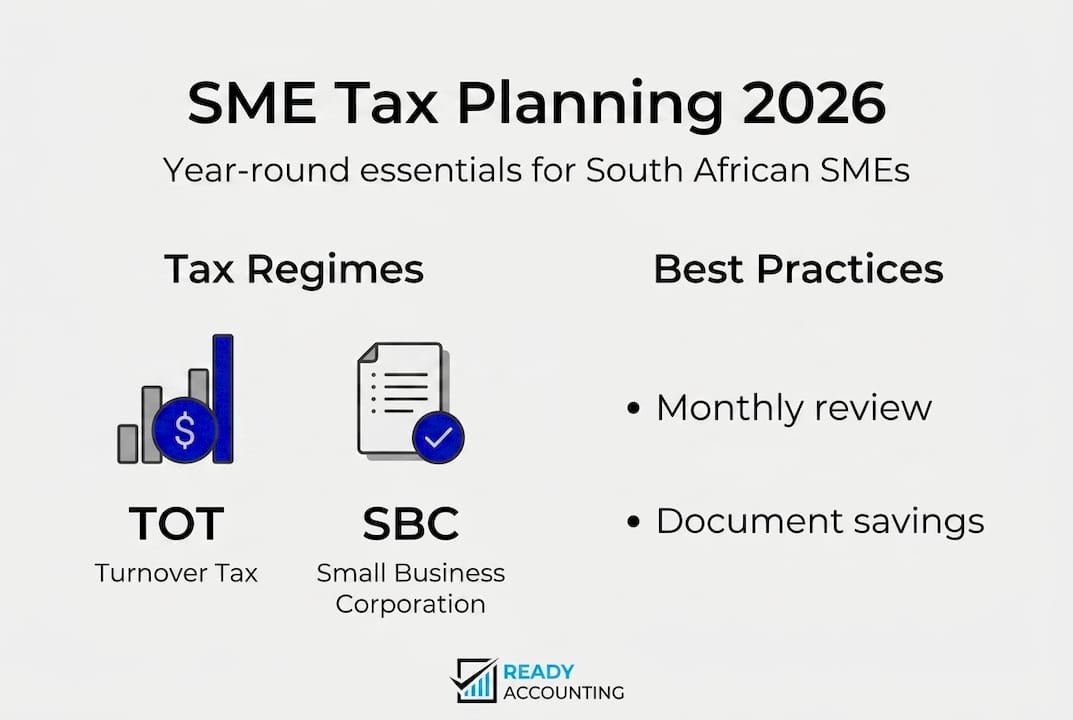
For a structured approach to this, our guide on top tax planning strategies provides a practical framework. If you want to understand exactly where your business is losing money through unnecessary tax, exploring how to reduce tax liability is the logical next step. You can also find practical deduction tips to add to your toolkit.
The hard truths (and missed opportunities) of SME tax planning
Here is what most SME tax guides will not tell you. The problem is rarely a lack of access to information. The problem is that most business owners treat tax as a compliance event rather than a business function. You would not review your sales pipeline only once a year. You would not check your bank balance once a year. So why would you only think about tax when a deadline forces you to?
The cost of this mindset compounds quietly. You miss the regime that would have saved you R100,000. You claim a home office deduction without documentation and attract an audit. You buy equipment in April instead of March and lose a year of depreciation. None of these are catastrophic in isolation. Together, over three to five years, they represent a significant financial drag.
The SMEs that get this right are not necessarily the ones with the most complex structures. They are the ones where the owner or CFO treats tax as one input into every meaningful business decision, from hiring to asset purchases to how profit is distributed. When you build year-end tax planning habits into your quarterly rhythm, the year-end becomes a confirmation of good decisions rather than a scramble to minimize damage.
Short-term penny-pinching, like avoiding a professional consultation to save a few thousand rand, often costs more than it saves. A good adviser pays for themselves in regime selection alone. Business owners who engage consistently throughout the year unlock more incentives, avoid more pitfalls, and carry less stress into every quarter.
Achieve smarter tax outcomes with the right support
Ready Accounting works with South African SMEs and scaling startups to replace reactive tax scrambles with structured, proactive financial systems. From identifying the right tax regime for your current stage to building cloud-based accounting infrastructure that flags compliance risks in real time, our team functions as your Fractional CFO, not just your bookkeeper. If you are serious about protecting your margins and keeping SARS satisfied, start by reading our practical guide on how to reduce your tax liability and learn exactly how to avoid tax penalties before they become a cash flow crisis.
Frequently asked questions
What is the difference between Turnover Tax and SBC for SMEs?
Turnover Tax applies to micro-businesses with turnover up to R1 million and is simpler but allows no deductions, while Small Business Corporations benefit from lower progressive rates and full deductions for companies under R20 million gross income.
Can my business switch between tax regimes if our earnings grow?
Yes, but eligibility must be carefully checked each year because SBC disqualification can result from shareholding changes, tainted income, or sector restrictions that require an immediate switch to a different regime.
What are the penalties for late or incorrect tax filings with SARS?
Penalties can range from R250 to R16,000 per month depending on the severity and duration of non-compliance, making consistent, timely filing one of the most cost-effective habits an SME can build.
Do I need to use a tax adviser for SME tax planning?
While not legally required, a qualified adviser helps most SMEs claim incentives and avoid costly structural mistakes, especially since low tax literacy causes businesses to miss R50,000 to R500,000 in annual savings through incorrect regime selection alone.
What is the most overlooked SME tax planning opportunity in South Africa?
Many SMEs miss the Small Business Corporation regime entirely due to awareness gaps, with tax practitioners noting that eligible businesses often remain on standard corporate tax rates and lose out on progressive rates and accelerated depreciation.