

Why outsource payroll: save time and stay compliant
Executive Summary
- Outsourcing payroll saves SMEs time, reduces compliance risks, and offers access to advanced technology.
- In-house payroll can be costlier due to admin, errors, penalties, and opportunity costs.
- Choosing a compliant, experienced partner streamlines processes and supports business growth.
Running payroll in a South African SME feels straightforward until it isn’t. One missed UIF submission, one incorrect PAYE calculation, and you’re staring down a SARS penalty that wipes out a month of hard-won profit. Most business owners underestimate just how much time their team spends on payroll admin every single month, and how much risk they quietly absorb by keeping it in-house. Outsourcing payroll is not a luxury reserved for large corporates. It is a practical, cost-effective decision that frees your leadership team, reduces compliance exposure, and gives you access to expertise that would cost far more to hire full-time.
Table of Contents
- The real costs and challenges of in-house payroll
- Key reasons South African SMEs outsource payroll
- Compliance and payroll outsourcing: keeping up with SARS and local laws
- How to choose the right payroll outsourcing partner
- Our perspective: payroll outsourcing is about growth, not just admin
- Streamline your payroll and unlock growth with expert help
- Frequently asked questions
Key Takeaways
| Point | Details |
|---|---|
| Save valuable time | Outsourcing payroll frees up hours each month for SME owners to focus on growth. |
| Reduce compliance risk | Professional payroll services help you avoid costly mistakes and SARS penalties. |
| Gain expert support | Outsourced providers stay on top of changing regulations for you. |
| Scale with confidence | A good payroll partner can handle your business growth and adapts to your needs. |
The real costs and challenges of in-house payroll
First, let’s look at why payroll is such a pain point for SMEs.
Most South African SME owners assume in-house payroll is cheaper. After all, you already have someone handling admin, right? The truth is more complicated and more expensive than it first appears.
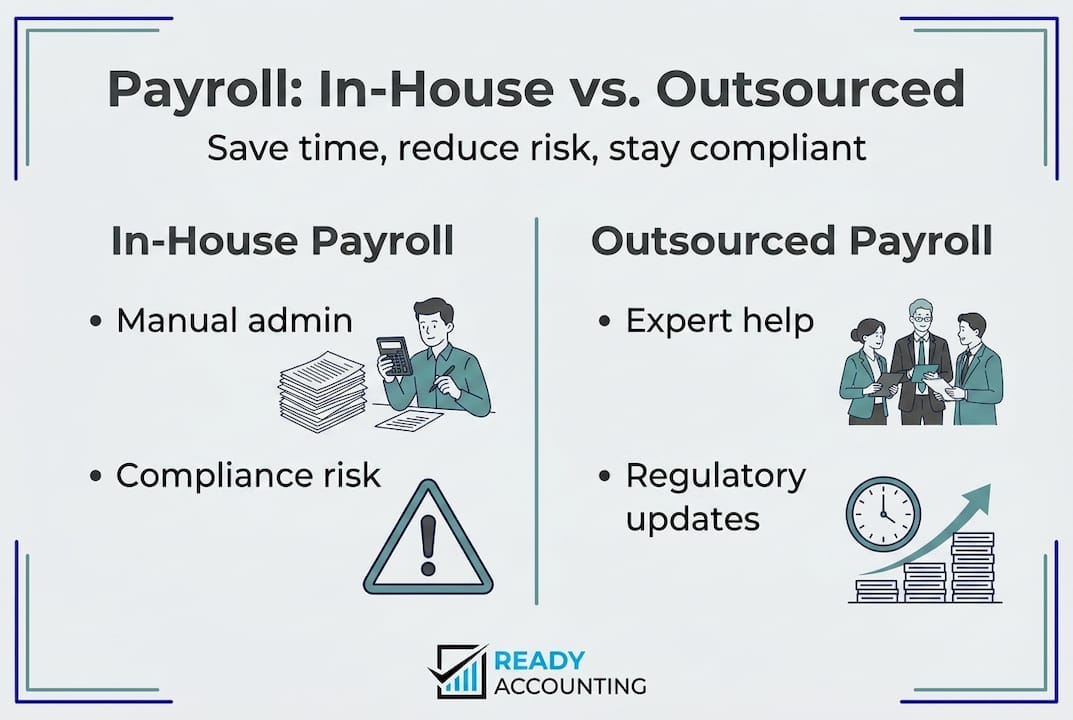
The admin burden alone is significant. A typical monthly payroll cycle for even a small team involves capturing hours and leave, calculating gross pay, applying tax tables, deducting UIF and SDL contributions, generating payslips, submitting EMP201 returns to SARS, and reconciling everything at year-end with an IRP5 submission. That is not a one-hour job. For a business with 15 to 30 employees, this process can consume 8 to 15 hours per month, and that is before you factor in queries from staff or corrections from errors.
In-house payroll demands ongoing admin work and poses compliance risks for small businesses, especially when the person doing it wears multiple hats and lacks dedicated payroll training.
Here is a breakdown of the typical hidden costs SMEs face with in-house payroll:
| Cost category | In-house estimate (monthly) | Notes |
|---|---|---|
| Staff time (admin or bookkeeper) | R2 500 to R6 000 | Based on 8 to 15 hours at market rate |
| Payroll software licence | R300 to R1 500 | Depends on headcount and features |
| Training and updates | R500 to R1 000 | Regulatory changes require ongoing learning |
| SARS penalties (avg. when errors occur) | R1 500 to R10 000+ | Per incident, not per month |
| Audit preparation time | R1 000 to R3 000 | Time cost during SARS reviews |
The figures above only capture the visible costs. What they do not show is the opportunity cost of your most capable people spending their Friday afternoons on payroll instead of growing the business.
Common mistakes that trigger SARS penalties include:
- Submitting EMP201 returns late or not at all
- Miscalculating employee tax brackets after annual budget changes
- Failing to register new employees for UIF timeously
- Incorrectly applying tax directives for commission earners
- Overlooking leave encashment tax treatment at termination
“The question is never whether you can afford to outsource payroll. The real question is whether you can afford the penalties, stress, and lost time if you don’t.”
If you want to manage payroll efficiently without constantly firefighting errors, understanding these hidden costs is the essential first step. The moment you start adding up the real numbers, in-house payroll rarely looks as cheap as it did.
Key reasons South African SMEs outsource payroll
Given these challenges, why do more SMEs choose to outsource their payroll?
The answer is not one single reason. It is a combination of pressures that build up until the in-house model simply stops making sense. SMEs outsourcing payroll benefit from specialised expertise and reduced regulatory risk that would otherwise require a dedicated compliance team to manage internally.
Here are the top reasons South African SMEs make the switch:
-
Compliance confidence. SARS updates tax tables, thresholds, and submission requirements regularly. A specialist payroll provider tracks every change and applies it automatically. You stop worrying about whether your team noticed the latest gazette.
-
Time returned to leadership. When a business owner or financial manager stops spending 10 hours a month on payroll, those hours go back into sales, strategy, and operations. That is a compounding return, not a once-off benefit.
-
Access to enterprise-grade technology. Payroll software with full SARS integration, automated submissions, and digital payslip delivery costs significantly more than most SMEs want to spend. Outsourcing providers spread that cost across many clients, so you get premium tools at a fraction of the price.
-
Scalability without growing pains. Adding five new employees to an in-house payroll system means more work, more risk, and possibly another hire. With an outsourced provider, scaling up is a simple conversation.
-
Reduced fraud risk. Payroll fraud is one of the most common forms of internal fraud in small businesses. A third-party provider introduces a layer of separation and oversight that reduces this risk considerably.
Pro Tip: Before signing with any payroll provider, ask them specifically how they handle the annual SARS budget changes. A strong provider should have a documented process for implementing updates before the effective date, not after.
Here is a direct comparison of in-house versus outsourced payroll outcomes for a typical 20-person SME:
| Factor | In-house payroll | Outsourced payroll |
|---|---|---|
| Monthly time cost | 10 to 15 hours | Less than 2 hours (oversight only) |
| SARS compliance updates | Manual, reactive | Automatic, proactive |
| Error rate | Higher without dedicated staff | Significantly lower |
| Technology quality | Budget software | Enterprise-grade systems |
| Scalability | Requires extra staff | Flexible by agreement |
| Fraud risk | Higher | Lower with third-party controls |
Understanding the full picture of payroll outsourcing benefits changes how you see the cost equation entirely. And if you are wondering where to start, a clear how to outsource payroll guide can walk you through the practical steps.
Compliance and payroll outsourcing: keeping up with SARS and local laws
One of the most cited reasons for outsourcing is compliance. Here’s why that’s critical.
South African payroll compliance is genuinely complex. It is not just about calculating salaries correctly. You are navigating a web of obligations that includes PAYE (Pay As You Earn), UIF (Unemployment Insurance Fund) contributions, SDL (Skills Development Levy), annual IRP5 reconciliations, and bi-annual EMP501 submissions. Each of these has its own deadline, its own format, and its own penalty structure if you get it wrong.
The compliance obligations most South African SMEs must manage include:
- PAYE: Monthly deduction from employee salaries, submitted via EMP201 by the 7th of each month
- UIF: 1% from employer and 1% from employee, submitted monthly alongside PAYE
- SDL: 1% of leviable payroll amount, payable monthly if your annual payroll exceeds R500 000
- EMP501 reconciliation: Submitted twice a year in May and October, reconciling all payroll deductions
- IRP5 certificates: Issued to all employees and submitted to SARS annually
Missing any one of these triggers penalties. And SARS is increasingly using automated systems to detect inconsistencies between what employers submit and what employees declare. Accurate payroll processing reduces the risk of costly SARS penalties significantly, particularly as their algorithmic detection capabilities improve.
The financial impact of non-compliance is not trivial. Administrative penalties from SARS can range from R250 to R16 000 per month per offence, depending on the nature and duration of the non-compliance. For a business that misses three consecutive EMP201 submissions, you are already looking at a penalty exposure that could have funded several months of outsourced payroll.
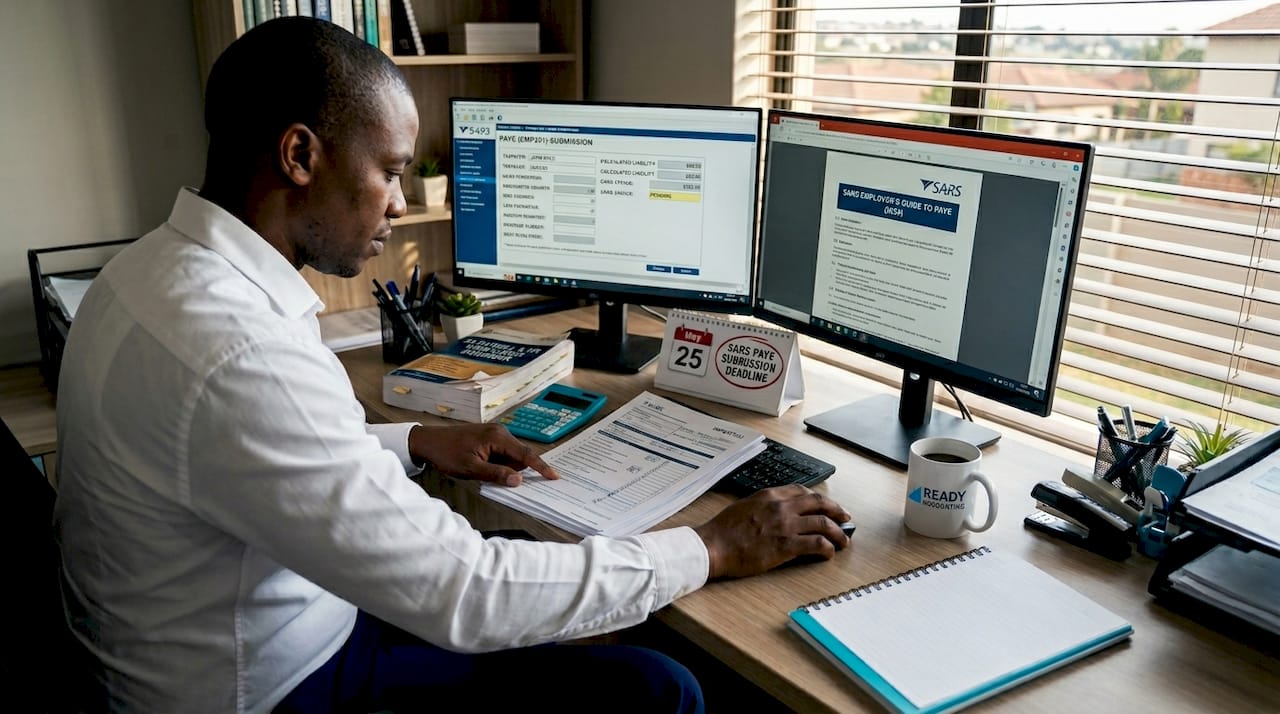
Pro Tip: Even if your business is small enough that SDL does not apply yet, it is worth having your payroll provider monitor your payroll growth so you register at the right threshold. Retroactive SDL assessments with penalties are a nasty surprise that structured outsourcing payroll in South Africa can easily prevent.
The most significant compliance advantage of outsourcing is the automatic regulatory update model. When the annual budget speech introduces new tax brackets, a professional provider updates your payroll system before the next pay run. When SARS changes its eFiling submission format, your provider’s technical team handles it. You never need to read the Government Gazette on a Sunday night to make sure your Monday payroll is correct.
How to choose the right payroll outsourcing partner
If you’re ready to explore outsourcing, how do you find a trustworthy partner?
Not all payroll providers are equal. Choosing the wrong one can introduce new problems rather than solving the ones you have. The key is knowing exactly what to look for before you sign anything. Selecting the right provider is key to efficient, secure payroll management, and it starts with asking the right questions.
Follow this structured approach to evaluate any payroll outsourcing partner:
-
Confirm SARS registration and compliance credentials. Your provider should be a registered tax practitioner or operate under one. Ask for proof and do not accept vague assurances.
-
Assess their technology stack. Find out which payroll software they use, whether it integrates with SARS eFiling, and how payslips are delivered to employees. Cloud-based systems with employee self-service portals are the current standard.
-
Understand their data security protocols. Payroll data includes employee ID numbers, banking details, and salary information. Ask specifically about encryption, access controls, and their response plan for a data breach.
-
Clarify their update process for regulatory changes. As mentioned above, this is non-negotiable. They should have a clear, documented process.
-
Check sector experience and client references. A provider that has worked extensively with SMEs in your industry understands nuances that generic providers might miss, such as commission structures in sales businesses or overtime rules in manufacturing.
-
Compare service levels and pricing transparency. Get itemised pricing. Some providers charge per payslip, others per employee per month, and others have flat fees with add-ons. Make sure you understand exactly what is included and what will cost extra.
Here is a practical checklist of must-have features when evaluating providers:
- Registered with SARS and compliant with POPIA (Protection of Personal Information Act)
- Automated EMP201 and EMP501 submissions
- Real-time payroll reporting and dashboards
- Employee self-service for payslips and IRP5s
- Clear escalation process for employee queries
- Dedicated account manager, not just a call centre
- Proven track record with businesses of your size and structure
Pro Tip: Ask for two or three client references specifically from businesses similar in size to yours. Generic testimonials on a website tell you little. A direct conversation with a current client tells you everything.
For a more detailed breakdown of how to navigate this decision, the step-by-step payroll outsourcing process guide covers provider selection through to onboarding.
Our perspective: payroll outsourcing is about growth, not just admin
Let’s step back and look at the bigger picture of why payroll outsourcing matters.
Most SMEs frame payroll outsourcing as a cost-reduction decision. They do the maths, compare what they pay internally versus what a provider charges, and make a judgment call. That is a useful exercise, but it completely misses the strategic dimension.
At Ready Accounting, we see something consistent across the SMEs we work with: the ones who outsource early grow faster. Not because payroll outsourcing directly generates revenue, but because it removes a specific type of cognitive weight from leadership. When your managing director is not mentally tracking payroll submission deadlines, that mental space goes to clients, strategy, and scaling decisions.
The other underrated advantage is resilience. What happens to your in-house payroll when your bookkeeper resigns? Most SMEs have a single point of failure in their payroll process. An outsourced model eliminates that risk entirely.
Consider also how outsourcing accounting for SMEs creates a scalable financial infrastructure rather than a patchwork of manual processes. Payroll is just one part of that picture, but it is often the entry point. Once you experience the clarity that comes from professional payroll management, the case for outsourcing other financial functions becomes obvious.
Payroll outsourcing is not about admitting you cannot handle it internally. It is about choosing where your energy goes. And for a scaling South African SME, that energy belongs in your product, your people, and your market.
Streamline your payroll and unlock growth with expert help
If you want to get started with reliable payroll outsourcing, here’s how our team can help.
Ready Accounting provides payroll outsourcing and compliance expertise designed specifically for South African SMEs and growth-stage startups. We handle your entire payroll process, from monthly submissions to SARS reconciliations, so your team focuses on what actually moves the business forward. Our cloud-based infrastructure means you get real-time visibility into your payroll data without the admin burden.
Beyond payroll, we help clients build financial systems that scale through cash flow automation and fully managed outsourced accounting solutions tailored to your growth stage. If you are ready to stop firefighting and start building, talk to our team about a payroll package that fits your business.

Frequently asked questions
What risks do I avoid by outsourcing payroll?
You reduce the risk of SARS penalties, compliance errors, and staff admin mistakes by trusting experts with up-to-date knowledge. In-house payroll demands ongoing admin work and compliance risks that most SME teams are not equipped to manage consistently.
Is payroll outsourcing affordable for small businesses?
Yes, many providers offer scalable packages, and the time and penalty savings usually offset the service cost. SMEs benefit from specialised expertise that would cost far more to replicate with a dedicated in-house hire.
Can outsourced payroll handle changing South African tax rules?
Reputable providers stay updated with local law and SARS regulations to ensure ongoing compliance. Accurate payroll processing is built on a foundation of continuously monitored regulatory changes applied before each pay run.
How quickly can I switch to an outsourced payroll solution?
Many SMEs can transition in less than a month, depending on payroll size and provider processes. A well-structured onboarding usually requires your current payroll data, employee records, and existing SARS registration details.