

Accounting for marketing agencies: streamline, comply, grow
Executive Summary
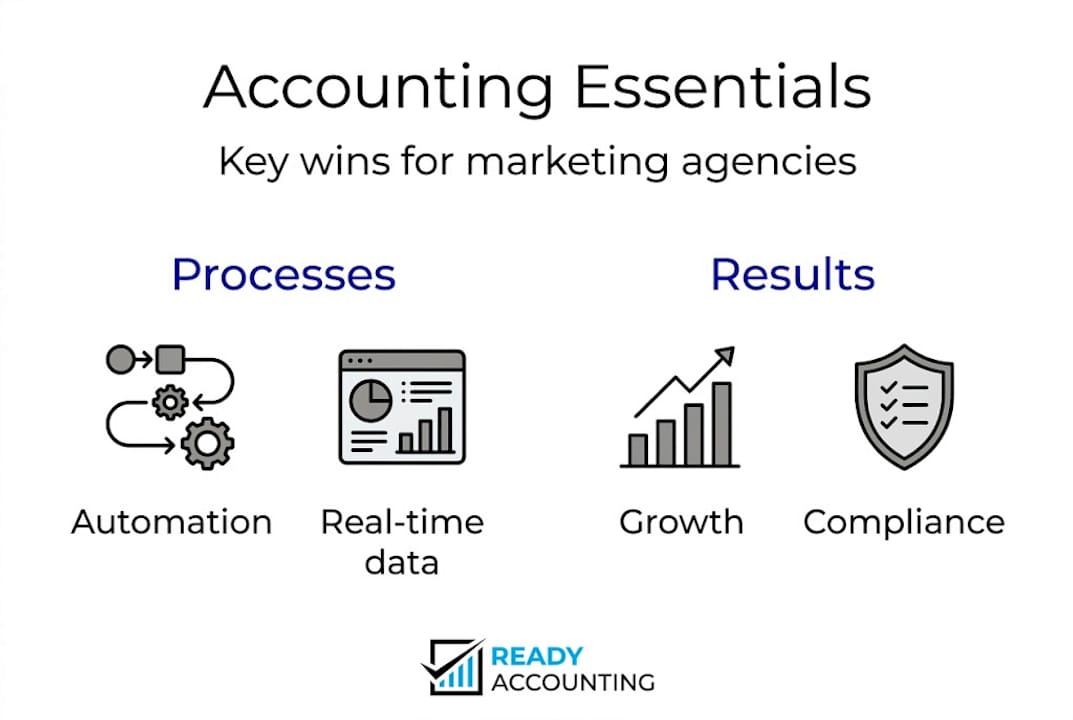
- Accurate and real-time cloud accounting enhances cash flow management and SARS compliance for agencies.
- Automating invoicing, expenses, and payroll saves time and reduces risks in financial operations.
- Strong financial visibility enables better decision-making, profitability tracking, and sustainable growth.
Running a marketing agency in South Africa is demanding enough without your finances becoming a liability. Yet many agency owners treat accounting as an afterthought, focusing energy on campaigns and client relationships while ignoring the financial infrastructure holding everything together. That gap creates real risk: missed VAT deadlines, inaccurate project costing, and cash flow gaps that can sink even a thriving agency. This article shows you how to use cloud accounting to fix that. You will get practical steps, honest comparisons, and compliance guidance built specifically for South African marketing agencies looking to scale with confidence.
Table of Contents
- Why accurate accounting matters for marketing agencies
- Cloud accounting solutions: What South African agencies need
- Tax compliance for South African marketing agencies
- Practical steps to automate your agency’s accounting
- What most agency owners miss: The hidden ROI of robust accounting
- Streamline your agency’s accounting with Ready Accounting
- Frequently asked questions
Key Takeaways
| Point | Details |
|---|---|
| Accounting drives growth | Robust accounting underpins both agency stability and scalable business expansion. |
| Cloud solutions simplify compliance | Cloud-based tools automate reporting and tax tasks for seamless South African regulatory adherence. |
| Automation unlocks efficiency | Automating key financial tasks reduces errors and frees up time for creative work. |
| Choose tools that fit | Select accounting solutions tailored to agency workflows and local rules for maximum impact. |
| Expert help transforms results | Leveraging accounting professionals or outsourced services can elevate your agency’s profitability and peace of mind. |
Why accurate accounting matters for marketing agencies
Marketing agencies operate on a fundamentally different financial rhythm than product businesses. You bill in arrears, manage retainer income alongside once-off project fees, and absorb media spend on behalf of clients before recovering it. That complexity makes financial visibility not just useful, it is survival-critical.
The common accounting pain points agencies face include:
- Irregular cash flow from milestone-based or project billing
- Media buying costs that inflate your books without reflecting your actual revenue
- Difficulty separating client expenses from agency overheads
- Late payments from clients causing payroll pressure
- Inadequate records when SARS audits roll around
Cash flow management is where most agencies feel the sharpest pain. You might win a large campaign in January, invoice in March, and collect in April, but your team’s salaries don’t wait. Digital marketing budget tips highlight that agencies frequently underestimate the gap between campaign delivery and payment collection, which compounds when multiple clients pay late simultaneously.
From a compliance perspective, South African tax law is unforgiving. SARS expects accurate, verifiable records. If your bookkeeping is a mess of spreadsheets and emailed invoices, a SARS audit can become expensive very quickly. Knowing when to hire an accountant is the first smart decision an agency owner can make before the penalties arrive.
Beyond compliance, accurate accounting enables the kind of reporting that drives decisions. Which client is actually profitable after all costs are factored in? Which service line carries the highest margin? Without clean books, you are guessing.
“You can’t scale what you can’t measure. For agencies, financial clarity is the most underrated growth tool available.”
| Accounting problem | Business impact | Solution priority |
|---|---|---|
| Irregular cash flow | Payroll pressure, missed investments | High |
| Poor expense tracking | Inaccurate project costing | High |
| Late VAT submissions | SARS penalties and interest | Critical |
| No real-time reporting | Poor decision-making | Medium |
| Mixed personal and business expenses | Tax compliance risk | High |
Pro Tip: Create a dedicated project code for every client engagement in your accounting software. Track time, expenses, and subcontractor costs against that code from day one. This turns your books into a profitability dashboard, not just a compliance exercise.
The foundation is simple: when you know choosing an accountant means choosing someone who understands your business model, you stop treating accounting as an admin cost and start treating it as a strategic investment.
Cloud accounting solutions: What South African agencies need
The old way of doing agency accounting involved a combination of Excel files, desktop software that lived on one computer, and a monthly scramble to get everything ready for your bookkeeper. That model is broken for modern agencies working with remote teams, multiple currencies, and real-time client reporting expectations.
Cloud accounting changes the equation entirely. Instead of software you install, cloud platforms live online. Your financial data updates in real time, your team can access it from anywhere, and it integrates directly with the tools you already use, from project management platforms to payment gateways.
The core benefits of cloud accounting for marketing agencies include:
- Real-time financial dashboards accessible from any device
- Automatic bank feed imports that eliminate manual data entry
- Integration with invoicing, payroll, and project management tools
- Automated VAT calculations and submission support
- Multi-user access for your team, bookkeeper, and accountant simultaneously
- Secure cloud storage that satisfies POPIA document retention obligations
The cloud accounting benefits for small businesses extend far beyond convenience. The automation alone typically saves agencies between five and ten hours of administrative work per month, time better spent on client strategy or new business development.

Agencies that want to grow need financial infrastructure that scales with them. Scaling agency growth requires systems that can handle increased transaction volume, more complex reporting, and faster decision cycles without adding proportional overhead.
The table below compares the three most common accounting approaches agencies use:
| Feature | Cloud accounting | Desktop software | Manual bookkeeping |
|---|---|---|---|
| Real-time data | Yes | No | No |
| Remote access | Yes | Limited | No |
| Automation | High | Medium | None |
| VAT compliance support | Built-in | Partial | Manual |
| POPIA data security | Cloud-encrypted | User-managed | High risk |
| Cost | Monthly subscription | Once-off licence | Variable |
| Scalability | Excellent | Poor | Very poor |
The compliance angle is particularly important for South African agencies. POPIA requires that client data, including financial information, is stored securely with appropriate access controls. A cloud platform with enterprise-grade encryption and audit trails satisfies this requirement out of the box. Manual spreadsheets and desktop systems typically do not.
If building this infrastructure internally feels overwhelming, an outsourced accounting guide can help you understand when bringing in expert support makes more commercial sense than hiring in-house.
Tax compliance for South African marketing agencies
Tax compliance is not optional, and the consequences of getting it wrong are expensive. SARS has significantly upgraded its data matching and algorithmic detection capabilities. Agencies that miss submissions, underreport income, or fail to reconcile correctly are increasingly likely to trigger an audit.
Here is a practical step-by-step overview of your core tax obligations as a South African marketing agency:
- Register for income tax with SARS as a company. This is mandatory and must be done as soon as your agency is incorporated.
- Register for VAT once your taxable turnover exceeds R1 million per year, or register voluntarily if it benefits your input tax position.
- Submit provisional tax twice a year (with an optional third payment), covering your estimated income tax liability before year-end assessment.
- File your annual income tax return using your audited or independently reviewed financial statements.
- Submit VAT returns monthly or bi-monthly depending on your VAT category, by the 25th of the month following the tax period.
- Register for PAYE if you employ staff, and submit monthly EMP201 returns along with the bi-annual EMP501 reconciliation.
- Retain all supporting documents for at least five years, as SARS can audit any period within that window.
Cloud accounting handles most of this systematically. VAT calculations on invoices and expenses update automatically. Payment reminders for submission deadlines appear in your dashboard. Document storage is structured and searchable, meaning a SARS query takes hours to respond to rather than days of frantic searching.
Marketing agency operations are increasingly digital, which means agencies sometimes inadvertently trigger digital services tax obligations, particularly when working with international platforms or invoicing foreign clients. Getting POPIA compliance for accountants right alongside tax compliance protects you on both fronts.
The financial penalty for late or incorrect VAT submissions starts at 10% of the outstanding amount, plus interest at the current SARS prescribed rate. For an agency with R500,000 in monthly turnover, that is a R50,000 penalty for a single missed submission. The tools to avoid this cost a fraction of that figure.
Pro Tip: Set calendar reminders two weeks before every VAT and payroll submission deadline. Use that window to reconcile your accounts rather than scrambling on the due date. Cloud accounting platforms with automated alerts make this routine effortless.
Strategies for reducing tax liability legally and strategically become available to you only when your records are clean. Without accurate books, you cannot claim legitimate deductions, structure your agency efficiently, or plan for the year ahead. Equally important is understanding the specific risks that lead to avoiding tax penalties, which is a discipline, not a stroke of luck.
Practical steps to automate your agency’s accounting
Automation is not about replacing your accountant. It is about removing the manual, error-prone tasks that slow your finance function down and introduce risk. For a marketing agency, the high-volume, repetitive tasks are the obvious starting point.
Accounting tasks marketing agencies should automate first:
- Client invoicing: Generate and send invoices automatically based on project milestones or retainer schedules. Stop chasing people to send invoices.
- Expense tracking: Connect business credit cards and bank accounts directly to your accounting platform. Transactions import and categorise automatically.
- Payroll processing: Automate monthly payroll calculations including PAYE, UIF, and SDL. Submit EMP201 returns without manual intervention.
- Accounts receivable follow-up: Automated payment reminders sent to clients at set intervals after invoice due dates, without human effort.
- Bank reconciliation: Cloud platforms match transactions against invoices and payments automatically, flagging only the exceptions for your review.
- Financial reporting: Generate profit and loss statements, cash flow forecasts, and client profitability reports on a scheduled basis.
There is a clear hierarchy to tasks to automate in 2025 and beyond. Invoicing and collections directly affect cash flow, so they deliver the fastest return. Expense tracking protects you during audits. Payroll automation reduces the single most common source of SARS penalties for small employers.
The common pitfalls agencies encounter when automating their accounting deserve honest attention. First, many agencies automate before their chart of accounts is correctly structured. Garbage in, garbage out: automation speeds up bad processes as effectively as good ones. Fix your account structure first. Second, integrations between project management tools and accounting platforms often require careful setup. A mismatch between how your team tracks time and how your accounting platform recognises revenue can create significant reporting errors.
Financial tech solutions have made it possible for agencies of even five people to operate with the financial infrastructure of a mid-sized firm. The barrier is no longer cost or complexity. It is knowing where to start.
Pro Tip: When evaluating cloud accounting software, prioritise platforms that offer native integration with the tools your agency already uses, such as project management software, time tracking tools, and media buying platforms. The fewer manual data transfers between systems, the more reliable your financial data will be.
Agency success tips consistently point to financial discipline as a differentiating factor between agencies that scale and those that plateau. Automation is the mechanism that makes that discipline sustainable without adding headcount.
What most agency owners miss: The hidden ROI of robust accounting
Here is the perspective most articles skip: accounting done properly is not a cost centre. It is a revenue-generating function that most agency owners never fully activate.
Think about what real-time financial clarity actually gives you. You can identify underperforming client relationships before they drain resources for another six months. You can see which service line carries a 60% margin versus one carrying 15%, and make a deliberate choice about where to direct your sales energy. You can walk into a bank or investor conversation with a runway dashboard that shows exactly how your business performs, not a guess based on last quarter’s gut feeling.
The agencies that scale fastest are not always the ones with the best creative. They are often the ones with the tightest financial visibility, because that clarity enables faster, better decisions. When a large opportunity appears, they know immediately whether they have the capacity and cash to pursue it. When a client becomes unprofitable, they know before the damage is done.
Outsourced accounting for startups and growing agencies delivers this clarity without requiring you to build an internal finance team. The ROI is not theoretical. It shows up in fewer write-offs, better pricing decisions, and the kind of business confidence that makes growth sustainable rather than stressful.
Streamline your agency’s accounting with Ready Accounting
Ready Accounting builds custom cloud accounting infrastructure for South African marketing agencies that want to replace financial chaos with real-time clarity and SARS-ready compliance. We connect your invoicing, expenses, payroll, and reporting into a single automated system that removes administrative friction and protects your margins. Explore the full range of cloud accounting benefits available to agencies your size, get the practical tools from our accounting automation guide, and learn how we approach improving financial reporting so your numbers actually drive decisions. Your finance function should be a competitive advantage, not a source of anxiety.
Frequently asked questions
What are the biggest accounting mistakes marketing agencies make?
Agencies often overlook timely expense tracking and proper tax documentation, which leads to compliance issues and missed financial insights that could have improved profitability and decision-making.
How can cloud accounting help with South African tax compliance?
Cloud accounting automates VAT calculations, submission reminders, and document retention, making it significantly easier to meet SARS obligations for VAT, income tax, and payroll taxes on time.
What accounting tasks should a marketing agency automate first?
Invoicing, expense tracking, payroll, and accounts receivable follow-up are the highest-impact starting points, as they directly affect cash flow accuracy and your risk profile with SARS.
Is outsourced accounting a smart move for small agencies?
Outsourced accounting gives small agencies immediate access to experienced financial professionals and removes the administrative burden, freeing the owner to focus on client delivery and business growth.
How can agencies choose the best accounting software for their needs?
Prioritise cloud platforms that offer South African tax compliance support, automation features for invoicing and payroll, and direct integration with the project management or CRM tools your team already uses daily.