

Business continuity planning: a practical guide for SMEs
Executive Summary
- Business continuity planning ensures essential functions keep operating during disruptions, reducing risks of closure. It involves a risk assessment, Business Impact Analysis, recovery strategies, and regular testing, with leadership owning the process. Testing and updating plans annually prevent failures caused by changing roles, dependencies, and new threats.
Business continuity planning is the structured process of identifying your critical business functions and keeping them running during any disruption, from a cyberattack to a flood to a key employee resigning without notice. The formal standard governing this process is ISO 22301:2019, which defines it as a management discipline rather than a one-time project. For South African SMEs, where SARS compliance deadlines and VAT obligations do not pause for disasters, a tested continuity plan is the difference between a temporary setback and a permanent closure. This guide breaks down the core components, practical steps, and common mistakes so you can build a plan that actually works.
What is business continuity planning and why does it matter?
Business continuity planning is the process of identifying critical functions and ensuring they continue during disruptions. This is distinct from disaster recovery planning, which focuses specifically on restoring IT systems after an outage. Business continuity covers the entire operation: your people, your premises, your suppliers, and your finances.
Two metrics sit at the heart of every continuity plan. Recovery Time Objective (RTO) defines how long a function can be offline before it causes unacceptable damage. Recovery Point Objective (RPO) defines how much data or transactional history you can afford to lose. These targets define the threshold between business viability and failure during an outage. Without them, your recovery priorities are guesses.
For South African SMEs, the stakes are concrete. A business that cannot issue invoices or access its VAT records during a SARS audit faces penalties that compound daily. Business resilience planning is not a corporate luxury. It is a financial protection mechanism.
What are the key components of an effective continuity plan?
A working continuity plan has four core components: a threat assessment, a Business Impact Analysis (BIA), documented recovery strategies, and clearly assigned roles and responsibilities.

The Business Impact Analysis
The BIA is the most important step in the entire process. Without quantitative RTO and RPO per function, recovery priorities become guesswork that leads to misallocated resources. The BIA maps every critical function, estimates the financial and operational impact of losing it, and produces a ranked list of what to restore first.
A practical BIA for an SME covers:
- Revenue-generating functions (sales processing, invoicing, client delivery)
- Compliance functions (VAT submissions, SARS reporting, payroll)
- Communication channels (email, client portals, phone systems)
- Key supplier dependencies and single points of failure
The five resource dimensions
An effective recovery strategy addresses five resource dimensions: People, Premises, Technology, Information, and Suppliers. This framework covers infrastructure failure, cyber incidents, and workforce disruption in one structure. Ignoring any one of these dimensions creates a gap that will surface during a real event.
The 3-stage recovery model
Recovery follows three stages: Responding, Resuming, and Recovering. Responding covers the immediate crisis period, typically the first 24–72 hours. Resuming covers restoring minimum viable operations. Recovering covers returning to full capacity over weeks or months.
Pro Tip: Document who owns each stage before a crisis hits. In smaller teams, one person often holds three critical roles. Identify that person now and build a backup plan around their absence.
How to develop a continuity plan for your SME
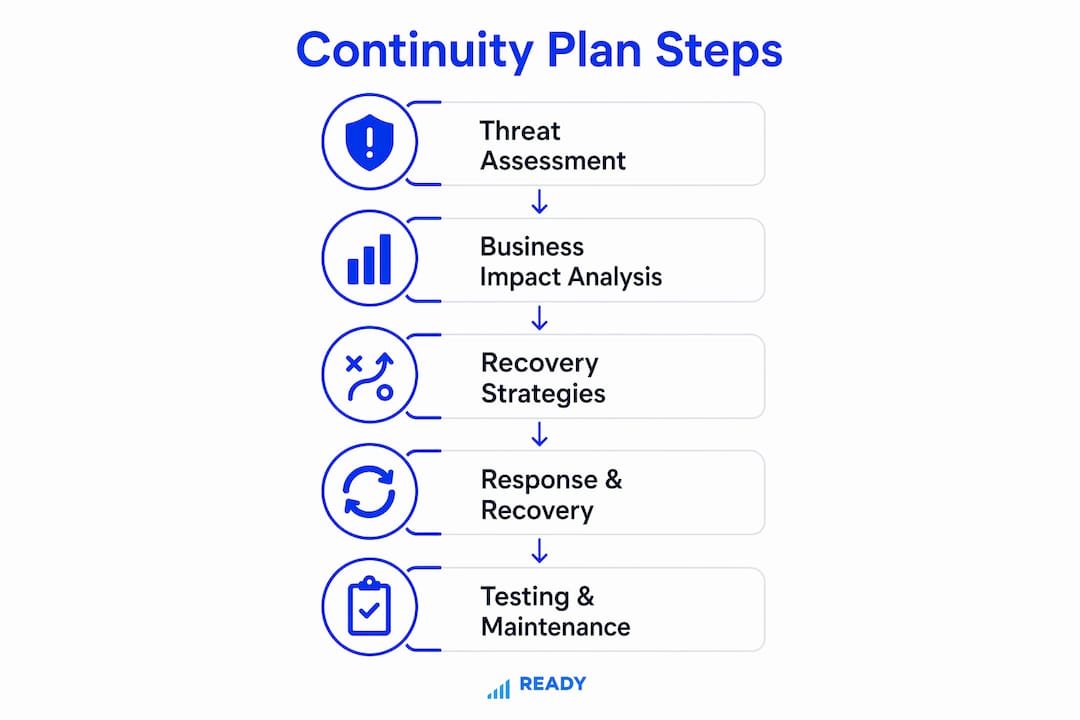
Building a continuity plan does not require a large budget or a dedicated risk team. Five steps cover the full process for most SMEs.
-
Conduct a risk and threat assessment. List every realistic disruption scenario: load shedding, ransomware, supplier failure, staff illness, fire, or flooding. Rank each by likelihood and potential impact on your revenue and compliance obligations.
-
Complete a Business Impact Analysis. For each critical function, set a realistic RTO and RPO. A payroll function might have an RTO of 24 hours. A marketing function might tolerate a week of downtime. BIA is the key tool to correctly prioritize recovery efforts and avoid wasting resources on low-priority systems.
-
Develop recovery strategies. Define minimum viable service levels rather than aiming for 100% capacity recovery. This reduces complexity and cost while protecting your core value chain. For example, a minimum viable level for invoicing might mean one staff member with laptop access to your cloud accounting system, not a fully staffed office.
-
Document the plan and assign ownership. Write down every procedure, contact number, and decision tree. Assign a named owner to each recovery task. Vague plans fail because nobody knows who acts first.
-
Integrate with existing compliance obligations. Your continuity plan must account for SARS submission deadlines, VAT cycles, and CIPC filing requirements. These do not pause during a disruption. Build them into your recovery timeline explicitly.
Pro Tip: Link your continuity plan to your accounting best practices so that financial reporting and tax compliance are treated as critical functions from day one, not afterthoughts.
How do you test and maintain a business continuity plan?
A documented plan that has never been tested is not a plan. It is a document. Plans should be tested at least once a year via simulation exercises, because organizational roles and dependencies evolve faster than documentation updates.
Testing methods range from low-cost to high-fidelity:
- Tabletop exercises: A facilitated discussion where your team walks through a scenario step by step. This takes two to three hours and costs nothing but time.
- Structured walkthroughs: Each team member reviews their section of the plan and identifies gaps or outdated information.
- Live simulations: A controlled test where you actually activate recovery procedures. This is the most revealing method and the most disruptive to schedule.
Regular testing through realistic exercises reveals gaps that documentation alone cannot. This makes testing the key differentiator between plans that work and plans that look good on paper.
The ISO 22301:2019 standard formalizes this through a Plan-Do-Check-Act (PDCA) lifecycle. BCM is not a project with an end date. It is a continuous management cycle requiring regular audits and updates.
After every test or real event, update the plan. Business changes, staff changes, and new risks all create gaps. Senior management must own this process. Without executive accountability, continuity planning gets deprioritized every time it competes with daily operations.
Pro Tip: Schedule your annual continuity review in the same calendar slot as your year-end financial review. Both processes assess your business’s ability to survive and grow. Treating them together reinforces the connection between financial health and operational resilience.
What are the biggest challenges in business continuity planning?
Most SMEs face the same set of obstacles when building a continuity plan. Knowing them in advance saves significant time and money.
-
Treating BCP as an IT task. Focusing solely on IT recovery risks failure because it ignores human factors like succession planning and manual workarounds. Even perfect IT failover is insufficient without staff and workspace continuity. Your plan must cover what happens when your key accountant is unavailable, not just when your server goes down.
-
Treating BCP as a compliance checkbox. Organizations with tested BCM programs recover faster with less reputational damage and stronger regulatory relationships. A plan built only to satisfy an auditor will not perform under real pressure.
-
Overcomplicating the plan. SMEs with limited resources often try to plan for every possible scenario and end up with a document nobody reads. Focus on your top five threats and your top ten critical functions. A simple, tested plan outperforms a complex, untested one every time.
-
Ignoring human factors. Succession planning for key roles, crisis communication scripts for staff and clients, and mental health considerations during a prolonged disruption are all part of a complete emergency preparedness plan. These elements are consistently underestimated.
-
Neglecting supplier dependencies. South African SMEs often rely on a small number of critical suppliers. A single supplier failure can halt operations entirely. Map your supplier dependencies during the BIA and build alternative sourcing options into your recovery strategy.
Tools like ExpiryEdge help track compliance deadlines and contract expiry dates, which is useful for managing supplier and regulatory obligations as part of your continuity framework.
Key takeaways
Business continuity planning works when it is treated as a continuous management discipline, not a one-time document, built on a BIA, tested annually, and owned by senior leadership.
| Point | Details |
|---|---|
| BIA drives everything | Set quantitative RTO and RPO per function to prioritize recovery correctly and avoid wasted resources. |
| Cover all five dimensions | Address People, Premises, Technology, Information, and Suppliers to close every gap in your recovery strategy. |
| Test at least annually | Untested plans fail in real disruptions because roles and dependencies change faster than documentation. |
| Define minimum viable levels | Target the minimum service level needed to protect your core value chain, not full capacity recovery. |
| Integrate compliance obligations | Build SARS, VAT, and CIPC deadlines into your recovery timeline so financial obligations are never missed. |
Why most SMEs get continuity planning wrong
Most SME owners I work with have some version of a continuity plan. Very few have tested it. That gap is where businesses actually fail, not during the disruption itself, but in the weeks after when the plan turns out to be a list of names and phone numbers that nobody knows how to use.
The mistake I see most often is treating continuity planning as a finance or IT department task. The owner signs off on a document, files it, and moves on. Then a key staff member leaves, the cloud accounting login changes, and the plan references a supplier that closed two years ago. The document exists. The capability does not.
The SMEs that recover fastest from disruptions are the ones where the owner personally ran at least one tabletop exercise. Not because they are better planners, but because they understand what the plan actually requires of them. That personal involvement changes how the plan is written, what gets prioritized, and how the team responds under pressure.
Integrating your continuity plan with your risk management in accounting processes is the most practical way to keep it current. When your financial reporting cycle triggers a review of your continuity assumptions, the plan stays alive. When it sits in a separate folder, it dies quietly.
The businesses that treat BCM as a strategic capability, not a compliance exercise, are the ones that come out of a crisis with their client relationships intact and their cash flow protected.
— Johan
How Readyaccounting supports your business resilience
Readyaccounting works with scaling South African SMEs to replace manual financial processes with cloud-based systems that stay operational during disruptions. Real-time financial reporting, automated VAT submissions, and cloud accounting infrastructure mean your compliance obligations are met even when your office is not accessible. Understanding how automation improves cash flow is a direct part of building operational resilience. When your financial data lives in the cloud and your reporting runs automatically, a disruption to your premises does not become a disruption to your SARS obligations. Readyaccounting acts as your Fractional CFO, keeping your finance function running regardless of what happens around it.
FAQ
What is the difference between business continuity and disaster recovery?
Business continuity planning covers all critical business functions during a disruption, including people, premises, and suppliers. Disaster recovery planning focuses specifically on restoring IT systems and data after an outage.
What is a Business Impact Analysis?
A Business Impact Analysis (BIA) identifies your critical business functions and sets Recovery Time Objectives and Recovery Point Objectives for each one. It is the foundation of any effective continuity plan because it tells you what to restore first and how fast.
How often should a continuity plan be tested?
Plans should be tested at least once a year through tabletop exercises or live simulations. Untested plans have a high probability of failing in a real disruption because roles and dependencies change over time.
Does business continuity planning apply to small businesses in South Africa?
Business continuity planning applies to any business with critical functions, compliance obligations, or client dependencies. For South African SMEs, SARS deadlines and VAT cycles make continuity planning a financial necessity, not just a risk management exercise.
What is the ISO 22301 standard?
ISO 22301:2019 is the international standard for business continuity management systems. It defines the Plan-Do-Check-Act lifecycle that organizations use to build, test, and continuously improve their continuity capabilities.