

Corporate social responsibility: a 2026 guide for leaders
Executive Summary
- Corporate social responsibility involves voluntarily integrating social, ethical, environmental, and economic concerns into business operations.
- In 2026, companies prioritize food security, digital inclusion, and employee volunteerism while reducing focus on racial equality and environmental justice.
Corporate social responsibility is defined as the voluntary integration of social, ethical, environmental, and economic concerns into a company’s core operations and stakeholder relationships. It goes well beyond legal compliance. For South African business leaders, CSR is increasingly a driver of trust, talent retention, and long-term financial resilience. Frameworks like ISO 26000 and the United Nations Sustainable Development Goals give companies a measurable path forward. U.S. corporate charitable giving has tripled over two decades, rising from $13 billion in 2003 to over $40 billion in 2024. That trajectory signals one clear truth: CSR is no longer optional for companies that want to compete.
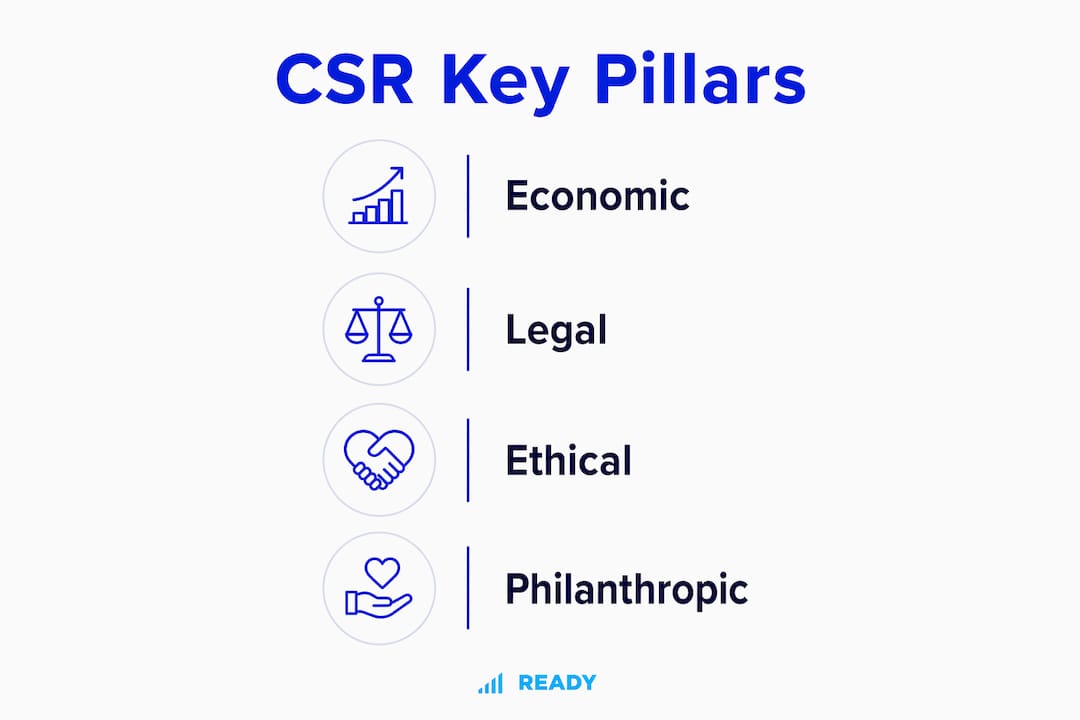
What are the key components of corporate social responsibility?
Corporate social responsibility rests on four distinct pillars: economic, legal, ethical, and philanthropic responsibilities. Each layer builds on the one below it. A company must first be profitable and law-abiding before it can meaningfully invest in ethics or community giving. Peter Drucker captured this well by urging leaders to evaluate both what a company does to society through its operations and what it can do for society through philanthropy.

ISO 26000 is the global standard that translates these four pillars into practice. It provides over 450 recommendations that align business activity with the UN Sustainable Development Goals. That depth of guidance means companies are not left guessing what “ethical business” actually looks like in practice. ISO 26000 covers everything from labour rights and environmental stewardship to fair operating practices and community engagement.
The table below maps each CSR component to its practical focus and the relevant ISO 26000 alignment:
| CSR component | Practical focus | ISO 26000 alignment |
|---|---|---|
| Economic responsibility | Profitability, shareholder value | Organizational governance |
| Legal responsibility | Regulatory compliance, SARS obligations | Fair operating practices |
| Ethical responsibility | Business ethics, anti-corruption | Human rights, labour practices |
| Philanthropic responsibility | Corporate philanthropy, community giving | Community involvement |
South African leaders can use this table as a starting checklist. If your company scores well on economic and legal responsibilities but has no formal ethical or philanthropic programme, you have a clear gap to address.
How are corporate philanthropy priorities shifting in 2026?
Corporate philanthropy is changing direction fast. 45% of business leaders are increasing their focus on food security in 2026, while 41% are prioritising digital inclusion. These are basic needs, not abstract causes. The shift reflects both genuine social pressure and a desire to avoid politically sensitive territory.
At the same time, investment in racial equality is down 29% and environmental justice is down 24% among surveyed companies. This does not mean those issues matter less. It means companies are recalibrating where they can demonstrate clear, measurable impact without triggering stakeholder conflict.
The data on giving methods is equally telling:
| Philanthropy trend | 2026 direction |
|---|---|
| Food security focus | Up 45% among leaders |
| Digital inclusion investment | Up 41% among leaders |
| Racial equality giving | Down 29% |
| Environmental justice giving | Down 24% |
| Employee volunteerism growth | Expected up 57% |
| Companies affected by tax deductibility laws | 64% expect budget impact |
Employee volunteerism is expected to grow by 57% in 2026, becoming the preferred CSR engagement tool over cash grants. This shift matters because volunteering is measurable, visible, and builds employee pride in ways that a cheque to a charity rarely does. 64% of companies also expect current charitable tax deductibility laws to affect their budgets, pushing them toward tighter controls and non-cash contributions.
Pro Tip: If your company is rethinking its giving strategy, start with employee skills-based volunteering. It costs less than cash grants, builds team cohesion, and produces outcomes you can photograph, measure, and report to stakeholders.
What practical steps embed CSR into corporate strategy?
CSR integration fails when it lives only in the marketing department. The most effective approach connects social responsibility directly to core business activities, financial planning, and leadership accountability. Peter Drucker’s framework makes this clear: integrating CSR into business strategy rather than treating it as a peripheral charity produces far better outcomes for both the company and society.
Start with these practical steps:
- Map your stakeholders. Identify employees, customers, suppliers, regulators like SARS and CIPC, and the communities you operate in. Each group has different expectations of your company.
- Appoint a CSR lead or committee. Responsibility without ownership produces nothing. Assign a senior leader or cross-functional team to own the programme.
- Set measurable objectives. Align your CSR goals with ISO 26000 categories and, where relevant, the UN SDGs. Vague commitments produce vague results.
- Report transparently. Publish your CSR outcomes annually, even if the numbers are modest. Transparency builds more trust than silence.
- Link CSR to financial planning. Budget for CSR activities the same way you budget for marketing or operations. Ad hoc giving is not a strategy.
Internal friction and competing priorities block effective CSR integration for 55% of organisations, while 34% struggle to demonstrate ROI to leadership. Both barriers are solvable with the right financial infrastructure. When CSR metrics sit inside your financial dashboards alongside revenue and cost data, the conversation with your board changes completely.
Pro Tip: Build a simple CSR scorecard inside your existing financial reporting tool. Track volunteer hours, rand value of contributions, and community reach alongside your standard KPIs. When CSR data lives next to profit data, executives take it seriously.
How does CSR strengthen business ethics and competitive advantage?
Business ethics and corporate social responsibility are not the same thing, but they reinforce each other directly. Business ethics refers to the standards of conduct that govern how a company treats its employees, customers, and partners. CSR is the outward expression of those standards in the form of programmes, policies, and community investment.
Strong CSR programmes improve employee satisfaction and retention, reducing the recruitment and training costs that quietly drain South African SMEs. That is a direct financial benefit, not just a feel-good outcome. When employees see their employer acting with integrity and investing in the community, they stay longer and perform better.
The competitive advantages of genuine CSR include:
- Customer loyalty. Consumers increasingly choose brands that align with their values. A credible CSR record is a differentiator in a crowded market.
- Investor confidence. Impact investing is growing globally. Investors applying environmental, social, and governance (ESG) criteria favour companies with documented CSR programmes.
- Reduced regulatory risk. Companies with strong ethical business strategies attract less scrutiny from regulators, including SARS and the Companies and Intellectual Property Commission (CIPC).
- M&A advantage. Targeted philanthropy during mergers and acquisitions can reduce integration costs and improve deal outcomes. Poorly targeted giving, by contrast, can harm shareholder trust.
Corporate citizenship is not a cost centre. When measured correctly, it is a source of durable competitive advantage that shows up in retention rates, brand equity, and stakeholder relationships. South African companies that treat CSR as a compliance checkbox miss the full value on offer.
Key takeaways
Corporate social responsibility delivers the most value when it is embedded in financial planning, leadership accountability, and measurable reporting rather than treated as an annual donation.
| Point | Details |
|---|---|
| CSR rests on four pillars | Economic, legal, ethical, and philanthropic responsibilities build on each other in sequence. |
| ISO 26000 is the global benchmark | Over 450 recommendations align your CSR programme with the UN Sustainable Development Goals. |
| Philanthropy is shifting in 2026 | Food security and digital inclusion are rising priorities; employee volunteerism is up 57%. |
| Internal barriers are the biggest risk | 55% of companies cite competing priorities; embedding CSR in financial dashboards solves this. |
| CSR and business ethics compound | Strong ethical practices improve retention, reduce regulatory risk, and attract ESG-focused investors. |
Why I think most companies are doing CSR backwards
Most business leaders I speak with treat CSR as something that happens after the real work is done. A donation here, a team volunteer day there, a paragraph in the annual report. That approach produces nothing lasting and convinces no one.
The companies I have seen get CSR right in the South African context do one thing differently: they treat it as a financial discipline. They budget for it, measure it, and report on it with the same rigour they apply to cash flow or VAT compliance. When CSR lives inside the numbers, it stops being a marketing exercise and starts being a management tool.
The ROI demonstration challenge that blocks 34% of companies is almost always a reporting problem, not a results problem. The outcomes are there. The data just is not being captured or presented in a way that speaks to the board. Fix the reporting infrastructure and the internal resistance tends to dissolve.
Transparency is the other piece most companies underestimate. Stakeholders do not expect perfection. They expect honesty. A company that publishes its CSR shortfalls alongside its wins earns far more trust than one that only reports the good news. In the South African business environment, where public trust in institutions is fragile, that kind of transparency is a genuine competitive asset.
— Johan
How Readyaccounting supports your CSR financial foundation
Readyaccounting works with scaling South African SMEs and VC-backed startups to build the financial infrastructure that makes CSR measurable and credible. Transparent financial reporting for better decisions is the foundation of any CSR programme that can withstand board scrutiny or investor due diligence. When your numbers are clean, your CSR commitments carry weight. Readyaccounting replaces manual bookkeeping with cloud-based systems and real-time dashboards, giving you the data visibility to track CSR spend, volunteer hours, and community impact alongside your core financial KPIs. If you want your social responsibility ambitions backed by financial controls that actually work, accounting automation is the practical next step. Contact Readyaccounting to align your CSR strategy with financial integrity from the ground up.
FAQ
What is corporate social responsibility in simple terms?
Corporate social responsibility is a company’s voluntary commitment to managing its social, environmental, and ethical impacts beyond what the law requires. It covers everything from fair labour practices to community giving and environmental stewardship.
How does ISO 26000 help with CSR implementation?
ISO 26000 provides over 450 practical recommendations that align business activity with the UN Sustainable Development Goals, giving companies a structured framework to design and measure their CSR programmes.
What are the biggest barriers to CSR integration?
Internal friction and competing priorities block 55% of organisations, while 34% struggle to demonstrate ROI. Embedding CSR metrics into financial dashboards is the most direct way to overcome both barriers.
How is corporate philanthropy changing in 2026?
Companies are shifting giving toward basic needs like food security and digital inclusion, while employee volunteerism is expected to grow by 57% as a preferred alternative to cash grants.
Does CSR improve financial performance?
Strong CSR programmes improve employee retention and reduce recruitment costs, attract ESG-focused investors, and can reduce integration costs during mergers and acquisitions, all of which contribute directly to financial performance.
Recommended
- Tax planning guide for South African SMEs in 2026 | Ready Accounting
- Understanding Sustainable Business Practices for Success - Ready Accounting
- Execution Framework: Manage Business Growth in South Africa: 2025 Protocol | Ready Accounting
- Accounting Aggressive Optimization Standards for SA Businesses in 2025 | Ready Accounting