

Importance of business insurance for South African SMEs
Executive Summary
- Most South African small businesses operate without insurance, leaving them vulnerable to catastrophic losses.
- Regular reviews and understanding essential coverages like property, liability, and D&O insurance can protect their continuity.
Business insurance is a financial safety net that protects South African small and medium enterprises from catastrophic losses caused by accidents, lawsuits, property damage, and business interruption. The importance of business insurance becomes clear when you consider that only 18% of South African SMEs carry any form of business insurance. That means more than 80% of local small businesses are one bad event away from financial ruin. For South African entrepreneurs operating under the Companies Act 71 of 2008, the stakes are even higher. Directors can face personal liability for fiduciary breaches, and without the right cover, a single lawsuit or fire can end a business that took years to build.
Why business insurance matters for South African SMEs
South African SMEs face a specific set of risks that make coverage a necessity, not a luxury. Property damage from fire, theft, or flooding can wipe out stock and equipment overnight. A customer injury on your premises can trigger a liability claim that exceeds your annual revenue. Business interruption, the period when you cannot trade after an insured event, can drain cash reserves faster than any operating expense.

The financial consequences of being uninsured are severe. Business insurance enables continued trading, protecting employees and allowing you to keep serving customers after unexpected events. Without it, a single uninsured loss can force retrenchments, supplier defaults, and permanent closure. The ripple effect extends beyond the owner. Jobs disappear, suppliers lose a client, and the local economy absorbs the damage.
The low uptake among South African SMEs reflects a dangerous misconception: that insurance is an optional cost rather than a core business expense. The FinScope MSME Survey data shows this gap is not a niche problem. It is the default position for most small businesses in South Africa. Closing that gap starts with understanding what cover you actually need.
Pro Tip: Treat your insurance premium the same way you treat your SARS VAT obligation. It is a non-negotiable cost of operating a compliant, resilient business.
What types of business insurance are essential for South African owners
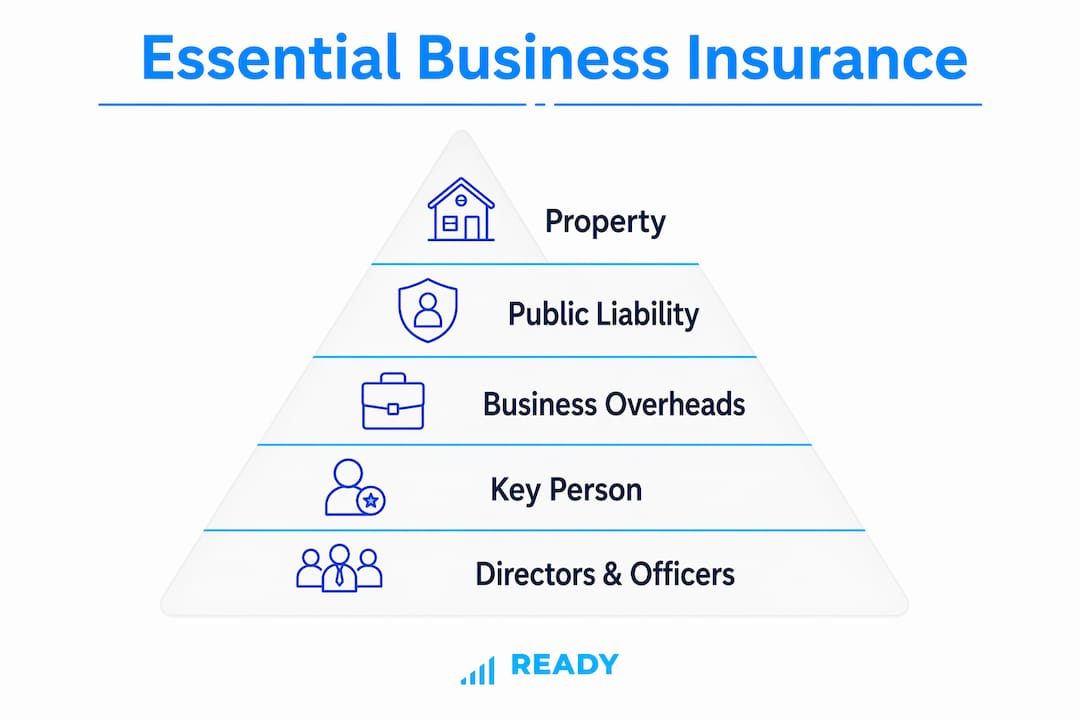
The five insurance categories every South African SME owner should know are property insurance, public liability, business overheads, key person insurance, and Directors and Officers (D&O) liability cover. Each one addresses a different point of failure in your business.
Property and liability cover
Property insurance covers physical assets like your premises, equipment, and stock against fire, theft, and natural disasters. Public liability cover protects you when a third party suffers injury or property damage because of your business operations. These two form the baseline of any SME insurance strategy.
Business overheads and key person cover
Business overheads insurance pays your fixed costs, such as rent and salaries, when you cannot trade due to illness or injury. Key person insurance pays a lump sum if a critical employee or director dies or becomes disabled. Both policies protect business continuity when the people driving the business are suddenly unavailable.
Directors and Officers liability
D&O insurance is not optional for any company registered under the Companies Act 71 of 2008. The Act imposes personal liability on directors for reckless trading and fiduciary breaches. Section 78 of the Act allows indemnification but excludes wilful misconduct. D&O cover fills the gap between what the company can indemnify and what a director owes personally. Without it, your personal assets, including your home and savings, are exposed.
| Insurance type | What it covers | Why it matters for SMEs |
|---|---|---|
| Property insurance | Buildings, equipment, stock | Replaces physical assets after fire, theft, or disaster |
| Public liability | Third-party injury or damage claims | Covers legal costs and compensation payouts |
| Business overheads | Fixed costs during inability to trade | Keeps the business alive when the owner cannot work |
| Key person insurance | Loss of a critical employee or director | Funds replacement costs and revenue shortfall |
| D&O liability | Personal liability of directors | Protects directors under Companies Act 71 of 2008 |
Pro Tip: When reviewing your cover with a broker, ask specifically whether your D&O policy excludes claims arising from SARS audits or CIPC compliance failures. Many standard policies do.
What challenges stop South African SMEs from getting proper cover?
The most common barrier is the “grudge purchase” mindset. Many business owners view insurance as money spent on something that may never happen. Business insurance is best viewed as a financial safety net, not a sunk cost. Shifting that mindset is the first practical step toward adequate protection.
The second barrier is coverage lag. This happens when a business grows but its insurance policy does not. You add a delivery vehicle, hire three new staff members, and move into a larger warehouse. Your policy still reflects the business you had two years ago. Coverage lag means insurance does not keep up with business growth, leading to inadequate payouts when claims occur.
The third barrier is the misconception that insuring everything is the goal. Most SMEs either insure everything at low values or insure nothing at all. Both approaches waste money or leave critical gaps. The risks that matter most are the ones that would halt your operations entirely.
Common coverage gaps that South African SMEs overlook include:
- Cyber liability, which covers data breaches and ransomware attacks on business systems
- Professional indemnity, which covers claims arising from advice or services you provide
- Employer’s liability, which covers workplace injury claims from employees
- Business interruption, which covers lost income during a period when you cannot trade
How to evaluate and maintain adequate business insurance coverage
The starting point is identifying your continuity-critical assets. These are the assets whose loss would stop your business from operating. Insurance should focus on continuity-critical assets like key machinery, core personnel, and essential inventory. Insuring a printer is optional. Insuring the CNC machine that produces your entire product line is not.
Follow these steps to build and maintain a coverage plan that actually works:
- List your continuity-critical assets. Write down every asset, person, or system whose loss would stop your business from trading for more than 48 hours.
- Quantify the financial exposure. For each asset, calculate the replacement cost and the revenue you would lose during the downtime period.
- Match cover to exposure. Select insurance products that address your highest-impact risks first. Start with property, liability, and business interruption before adding specialist cover.
- Work with a registered broker. A SAICA or SAIPA-aligned financial adviser can identify gaps you would miss on your own. Brokers also negotiate terms that generic online policies do not offer.
- Schedule an annual review. Yearly review with a broker is the single most effective way to prevent coverage lag and reduce claim denial risk. Set a calendar reminder every year, ideally before your policy renewal date.
- Update after every major business change. New premises, new staff, new equipment, new revenue streams. Each change creates a new risk that your existing policy may not cover.
Your business structure also affects liability exposure. A sole proprietor carries personal liability for all business debts and claims. A registered company under the Companies Act limits that exposure, but only if directors act within their fiduciary duties. Insurance and business structure work together. Neither replaces the other.
Key takeaways
Business insurance is the single most effective tool South African SMEs have for surviving unexpected financial shocks, and the majority of local businesses currently operate without it.
| Point | Details |
|---|---|
| Low SME insurance uptake | Only 18% of South African SMEs carry any business insurance, leaving most exposed to catastrophic loss. |
| D&O cover is a legal necessity | The Companies Act 71 of 2008 imposes personal liability on directors, making D&O insurance a practical requirement. |
| Coverage lag is a hidden risk | Policies that are renewed without review quickly become misaligned with actual business risks and asset values. |
| Focus on continuity-critical assets | Prioritise insuring assets whose loss would halt operations, not every item in the business. |
| Annual review prevents claim denial | A yearly broker review aligns your policy with business changes and reduces the risk of inadequate payouts. |
Why I think most South African entrepreneurs get insurance backwards
Most business owners I speak with treat insurance as a box to tick, usually when a landlord or bank requires it. That approach produces the worst possible outcome: a policy that exists on paper but fails at the moment it matters most.
The real value of business insurance is not in the payout. It is in the certainty that your business can survive a bad year. A fire, a lawsuit, or the sudden death of your key salesperson should not be able to end a business that is otherwise profitable and well-run. Insurance is what separates a setback from a shutdown.
The Companies Act 71 of 2008 adds a dimension that most entrepreneurs underestimate. Personal liability under the Act is not theoretical. Directors have faced personal claims for decisions made in good faith that were later deemed reckless. D&O cover is the only practical protection against that exposure. Treating it as a luxury is a mistake that can cost you everything outside the business, not just inside it.
My strongest advice is this: review your cover before something goes wrong, not after. The annual review is not a formality. It is the moment you align your policy with the business you actually run today, not the one you registered three years ago.
— Johan
How Readyaccounting helps South African SMEs build financial resilience
Sound insurance decisions start with accurate, up-to-date financial data. When you know your real asset values, monthly overheads, and revenue exposure, you can have a precise conversation with your broker about what cover you actually need. Readyaccounting gives South African SMEs the financial visibility to make those decisions with confidence. Our cloud-based financial reporting shows you exactly where your business is exposed, and our cash flow automation tools give you the real-time numbers that insurance conversations require. Better financial reporting means better risk decisions. Contact Readyaccounting to see how we can strengthen your financial foundation.
FAQ
What is business insurance and why does it matter?
Business insurance is a financial safety net that covers losses from events like fire, theft, lawsuits, and business interruption. It protects South African SMEs from catastrophic financial loss and supports business continuity.
Is business insurance legally required in South Africa?
No single law mandates all forms of business insurance, but the Companies Act 71 of 2008 creates personal liability for directors that makes D&O insurance a practical necessity for any registered company.
What types of business insurance do South African SMEs need most?
The five most critical types are property insurance, public liability, business overheads, key person insurance, and D&O liability cover. Each addresses a different risk that could halt operations or expose owners personally.
How often should I review my business insurance policy?
A yearly review with a registered broker is the minimum standard. You should also update your policy after any major business change, such as new premises, new equipment, or significant revenue growth.
Why do so many South African SMEs go without insurance?
The main reasons are the “grudge purchase” mindset, the belief that insurance is too expensive, and coverage lag where outdated policies are renewed without review. Only 18% of South African SMEs currently carry any form of business insurance.