

Independent contractor payments: SARS-safe guide for SA SMEs
Executive Summary
- Pay South African SMEs must verify independent contractor status, collect compliant documents, and keep records for five years before payments. Misclassifying contractors as employees exposes businesses to liability for unpaid PAYE, interest, and penalties. Automated workflows and proper documentation help ensure compliance and protect against SARS reclassification audits.
Pay independent contractors only after you have verified their status under SARS Interpretation Note 17, collected a compliant tax invoice, and confirmed they operate as a separate business. Miss any one of these and you carry the PAYE liability yourself.
Three actions before every payment:
- Verify contractor status using the two statutory tests in Interpretation Note 17; if inconclusive, apply the common-law dominant-impression test.
- Collect compliant documents: signed service agreement, valid tax invoice with all required fields, and evidence of independent business activity (CIPC registration, separate bank account, other clients).
- Keep contractors out of payroll and retain all records for at least five years.
Readyaccounting helps South African SMEs build exactly this process. Read on for the full how-to.
Table of Contents
- How does SARS decide if a worker is an independent contractor?
- What happens if you misclassify a contractor?
- What paperwork must you collect before paying a contractor?
- How do you pay contractors and record it correctly?
- Who handles tax and VAT — the contractor or you?
- What red flags trigger a SARS reclassification audit?
- Onboarding checklist and invoice fields you can use today
- Key takeaways
- Ready Accounting’s perspective: the mistakes we see most often
- How Readyaccounting protects your contractor payment process
- Useful sources and further reading
How does SARS decide if a worker is an independent contractor?
The answer comes from Interpretation Note 17, which sets out a clear sequence: apply the two statutory tests first. If neither is conclusive, move to the common-law dominant-impression test.
The two statutory tests
Test 1 — Premises and control: If the worker performs more than 50% of their work at your premises and you control how they do it, SARS deems them an employee. Both conditions must be true.

Test 2 — Three-employee rule: If the contractor employs three or more full-time workers (not connected persons) in their own business throughout the year, they are deemed to be trading independently. This test overrides Test 1 and the common-law analysis entirely.
When the statutory tests are inconclusive
SARS forms an overall “dominant impression” using three tiers of common-law indicators:
- Near-conclusive: Who controls the work? Is payment for time or for a result? Can the contractor subcontract?
- Persuasive: Does the worker receive instructions, supervision, or training from you? What does the reporting structure look like?
- Resonant: Who supplies the tools? Does the contractor work from their own premises? Are they integrated into your staff directory?
Pro Tip: The best documentary evidence for each indicator: multiple client invoices (proves non-exclusivity), a separate business bank account statement, photos or lease agreements showing the contractor’s own premises, and their own business letterhead or CIPC registration. Keep copies on file before the first payment.
A signed contract that says “independent contractor” means nothing on its own. SARS looks at the reality of the working relationship, not the label on the document.
What happens if you misclassify a contractor?
The short answer: you pay. Under the Income Tax Act, an employer who incorrectly classifies a worker as an independent contractor is personally liable for the uncollected PAYE, plus interest and penalties. You can recover the tax from the worker afterwards, but only after you have settled with SARS first.
SARS allocates payments in this order: penalty first, then interest, then the outstanding employees’ tax. That sequence matters because it means a backdated assessment can cost significantly more than the original tax shortfall.
Illustrative scenario: You pay a contractor R30,000 per month for two years. SARS audits and reclassifies them as an employee. The backdated PAYE alone could run into six figures before interest and penalties are added. The contractor has long since spent the money. You absorb the bill.
Key risks to keep in mind:
- SARS can audit and assess back tax for prior years.
- Interest accrues on outstanding amounts from the date the tax was due.
- Penalties are applied before interest, compounding the total.
- You carry the liability even if the worker genuinely believed they were a contractor.
Understanding your employer PAYE obligations before you engage any contractor is the cheapest insurance available.
What paperwork must you collect before paying a contractor?
Do not process a single payment without these documents in hand. Clear documentation is your primary defence if SARS ever questions the relationship.
Required documents — collect before the first payment:
- Signed service agreement (scope, deliverables, fee, term, no fixed hours or supervision clauses)
- Contractor’s tax reference number or SARS PIN
- VAT registration certificate (if the contractor is VAT-registered)
- Verified banking details (match to the contractor’s business account)
- CIPC registration or sole-proprietor proof of business
- Evidence of other clients (letterheads, website, LinkedIn profile)
- Proof of own tools, equipment, or premises where applicable
What a compliant tax invoice must include
For VAT-registered contractors, the VAT registration threshold is R1,000,000 in annual turnover. Once registered, they must issue a tax invoice that shows the VAT portion separately so you can claim input VAT.
| Invoice field | Required for all contractors | Required for VAT-registered contractors only |
|---|---|---|
| Contractor’s full name and address | Yes | Yes |
| Invoice number and date | Yes | Yes |
| Description of services rendered | Yes | Yes |
| Fee amount (excl. VAT) | Yes | Yes |
| VAT registration number | No | Yes |
| VAT amount (15%) | No | Yes |
| Total amount payable | Yes | Yes |
| Contractor’s banking details | Yes | Yes |
Validate every invoice before you approve payment. An invoice missing the VAT number or VAT amount means you cannot claim input VAT, and SARS will reject the deduction.
How do you pay contractors and record it correctly?
Handle contractors entirely outside your payroll system. Issuing an IRP5 to a contractor, or running their payment through your payroll software, is one of the fastest ways to trigger a reclassification audit.
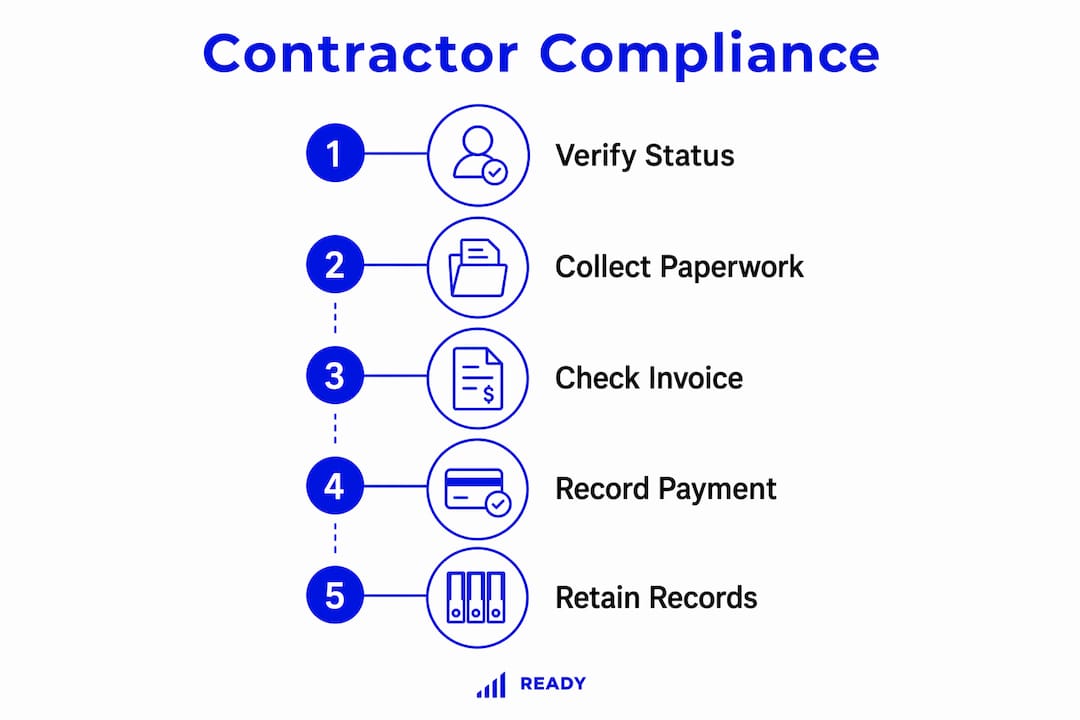
Step-by-step payment workflow:
- Receive invoice from the contractor and check all required fields are present.
- Verify documents are current (valid tax reference, VAT certificate if applicable).
- Two-person approval: a second signatory reviews the invoice before payment is released.
- Process EFT directly from your business bank account to the contractor’s business account.
- Bookkeeping entry: post to “Contractor Fees” or “Subcontractor Costs” — never to “Salaries” or “Wages.”
- Claim input VAT on your VAT return if the invoice is a compliant tax invoice.
- Reconcile monthly and file the invoice with your supplier records.
Accounting entries at a glance
| Scenario | Debit | Credit |
|---|---|---|
| Service fee, no VAT | Contractor Fees (expense) | Bank |
| Service fee with VAT | Contractor Fees + Input VAT | Bank |
| Non-resident contractor (withholding applies) | Contractor Fees | Bank + Withholding Tax Payable |
For non-resident contractors, withholding tax obligations depend on the service type and any applicable double-taxation treaty. SARB exchange control reporting is also required for cross-border payments. Get tax advice before making the first payment to a foreign contractor.
Pro Tip: Automate the invoice-to-payment workflow using cloud accounting software. Set up a dedicated supplier category for contractors so they never appear alongside payroll entries. A two-step approval rule prevents accidental IRP5 issuance.
Store contractor tax and banking details in a POPIA-compliant system with access controls and encryption. Limit who can view or edit payment data to the people who genuinely need it.
Who handles tax and VAT — the contractor or you?
The split is clean in most cases. Contractors manage their own income tax through the provisional tax system, filing IRP6 returns across two compulsory instalments (typically 31 August and end of February) with an optional third top-up by 30 September. They file an ITR12 annual return and keep their own records for five years.
Your obligations as the SME:
- Verify the contractor’s VAT status before paying (check their VAT registration certificate).
- Claim input VAT only on compliant tax invoices.
- Withhold tax on payments to non-resident contractors where required.
- Keep all supplier invoices for five years.
- Do not deduct PAYE unless the statutory or common-law tests show the worker is actually an employee.
Contractor responsibilities:
- Register for VAT once turnover exceeds R1,000,000.
- Pay provisional tax via IRP6 on schedule.
- File ITR12 annually with SARS.
- Retain financial records and invoices for at least five years.
Cross-border engagements, personal service provider structures, or any situation where the statutory tests are borderline all warrant a conversation with a tax professional. Readyaccounting handles exactly these grey areas as part of its Fractional CFO service.
What red flags trigger a SARS reclassification audit?
Operational behaviour matters as much as written contracts. Treating a contractor like payroll creates patterns SARS recognises quickly.
Watch for these red flags in your own business:
- Fixed daily or weekly hours set by you, not the contractor.
- Personal supervision of how (not just what) work is done.
- Single-client dependence with no evidence of other work.
- IRP5 certificates issued to contractors.
- Company tools, laptop, uniform, or email address provided to the contractor.
- Payment for time rather than for a deliverable or milestone.
- Contractor listed on your staff directory or org chart.
- Repeated short-term contracts that collectively look like continuous employment.
Remediation steps if you spot these patterns:
- Rewrite contracts to specify deliverables and milestones, not hours.
- Remove contractors from internal systems (email, directory, access cards).
- Document evidence of their independent business activity immediately.
- Switch to milestone-based pricing where the fee is tied to a result.
- Review your payroll compliance controls to prevent the same issue recurring.
Onboarding checklist and invoice fields you can use today
Use this checklist before processing any contractor’s first payment. For guidance on what documents evidence independent contractor status, the checklist at ucep.co is a useful reference point.
Pre-payment onboarding checklist:
- [ ] Signed service agreement with scope, deliverables, fee, and term
- [ ] Tax reference number or SARS PIN confirmed
- [ ] VAT registration certificate (if applicable) on file
- [ ] Banking details verified against business account
- [ ] CIPC registration or business proof collected
- [ ] Evidence of other clients documented
- [ ] Contractor added to accounts payable (not payroll)
- [ ] POPIA consent obtained for storing personal and banking data
- [ ] Bookkeeping category mapped (“Contractor Fees,” not “Salaries”)
Required invoice fields (share this list with every contractor):
- Contractor’s full legal name and business address
- Unique invoice number
- Invoice date
- Your company name as the client
- Detailed description of services rendered
- Fee amount (excluding VAT)
- VAT registration number (VAT-registered contractors only)
- VAT amount at 15% (VAT-registered contractors only)
- Total amount payable
- Contractor’s business banking details
Retain all onboarding documents and invoices for a minimum of five years. Readyaccounting can automate document retention, invoice validation, and reconciliation so nothing falls through the cracks.
Key takeaways
Correct independent contractor payments in South Africa require verified status, compliant invoices, payroll separation, and five years of records — every time, without exception.
| Point | Details |
|---|---|
| Verify status first | Apply the two statutory tests from Interpretation Note 17 before any payment is made. |
| Collect compliant documents | A valid tax invoice and evidence of independent business activity are non-negotiable before paying. |
| Keep contractors out of payroll | Never issue an IRP5 to a contractor; post fees to “Contractor Fees,” not “Salaries.” |
| Employer carries the PAYE risk | Misclassification makes you liable for uncollected PAYE, interest, and penalties under the Income Tax Act. |
| Readyaccounting | Provides onboarding automation, tax-defence documentation, and bookkeeping separation for SA SMEs. |
Ready Accounting’s perspective: the mistakes we see most often
The three mistakes that show up most consistently are: paying contractors before collecting a compliant invoice, running contractor fees through the payroll system because it is “easier,” and writing a contract that says “independent contractor” while the day-to-day relationship looks exactly like employment.
The second mistake is the most dangerous. The moment a contractor appears on your payroll run, even once, you have created a paper trail that SARS can use to argue the relationship was always employment. One client avoided a costly reclassification by doing something simple: they had a two-person invoice approval rule and a dedicated “Contractor Fees” ledger account. When SARS queried the relationship, the clean paper trail, combined with the contractor’s own CIPC registration and invoices to three other clients, made the case straightforward.
The controls that actually work are not complicated. A contract template that specifies deliverables rather than hours, a two-step invoice approval before any EFT is released, and a cloud accounting setup that physically separates contractor payments from payroll. None of these require a large budget. They require discipline and the right system.
How Readyaccounting protects your contractor payment process
Getting independent contractor payments right is genuinely one of the higher-risk compliance areas for South African SMEs, and it is one where the cost of getting it wrong lands entirely on the business owner. Readyaccounting’s accounting automation replaces the manual steps that create risk: invoice validation, bookkeeping separation, document retention, and POPIA-safe storage of contractor data are all built into the workflow.
As your Fractional CFO, Readyaccounting also handles the grey areas — cross-border contractor payments, personal service provider assessments, and borderline reclassification situations where you need tax-defence documentation ready before SARS asks for it. You get a finance function that protects your business rather than one that creates exposure.
To get your contractor payment process audit-ready, contact Readyaccounting today.
This article is general information, not professional tax or legal advice. Confirm your specific situation with a qualified tax professional or SARS directly.
Useful sources and further reading
- SARS Interpretation Note 17 — The primary SARS document explaining the statutory and common-law tests for determining independent contractor status. Read this before engaging any contractor.
- SARS Tax Guide for Small Businesses — Covers the PAYE framework, independent contractor exclusions, and VAT registration obligations for small businesses.
- SARS Guide for Employers: Employees’ Tax 2027 — Explains employer liability for uncollected PAYE, EMP201 submission requirements, and the penalty and interest allocation order.
- SARS Interpretation Note 35 — Covers personal service providers and labour brokers; relevant when a contractor operates through a company or trust rather than as a natural person.
- Cliffe Dekker Hofmeyr analysis of Interpretation Note 17 — Practical legal commentary on how SARS applies the dominant-impression test and what employers are liable for on misclassification.