

Indianapolis: Vet Outsourced Accounting Proposals, Test API Automation
Indianapolis: Vet Outsourced Accounting Proposals, Test API Automation
If you’re searching for outsourced accounting services, a good partner can get your books current, your filings compliant, and your monthly numbers reliable within a single onboarding cycle. It is recommended to start with a discovery call where the provider reviews your current books and quotes a fixed onboarding scope. Verify credentials against SAIPA or SAICA before you sign anything.
Executive Summary
- Most providers build proposals around core bookkeeping, payroll, VAT, and management accounts, with higher-value advisory work layered in as books stabilize.
- Outsourcing reduces month-end scramble, improves decision-making speed, and enhances compliance by maintaining current, organized financial records monthly.
- Choosing a provider based on industry experience, software compatibility, reporting cadence, security, and tax expertise is more critical than selecting the cheapest option.
- Onboarding usually takes a few weeks to several months, including data migration, process stabilization, and setting clear milestones for progress review.
- Automated, API-connected platforms enable real-time cash flow tracking and forecasting, which are crucial for scaling businesses and strategic planning.
Table of Contents
- What do outsourced accounting services actually include?
- How does outsourcing actually help a small business?
- How do you choose the right local outsourced accounting partner?
- What do pricing and onboarding timelines usually look like?
- How does outsourcing keep you audit ready?
- What’s the step-by-step process to hire and onboard an outsourced accountant?
- Why Ready Accounting takes an automation-first approach
- How Ready Accounting fits your search
- Sources
- FAQ
What do outsourced accounting services actually include?
Most local providers build proposals around a core stack, then layer on higher-value advisory work once your books are stable. Here’s what to expect in a typical proposal:
- Bookkeeping and reconciliations — daily or weekly transaction coding, bank and credit card reconciliations
- Payroll administration — processing, statutory deductions, and filings
- VAT and tax submissions — timely filing so you avoid late-payment penalties
- Management accounts — monthly profit and loss, balance sheet, and cash-flow statements
- Outsourced or fractional CFO work — forecasting, budget variance analysis, and strategic tax planning
Delivery usually comes in one of three shapes: a monthly retainer for ongoing bookkeeping and reporting, a fractional CFO arrangement billed separately for strategic hours, or a fixed-scope cleanup project when your books need repair before ongoing service starts. Expect an onboarding period that typically lasts a few weeks to a few months, depending on the complexity of your existing records. Most firms now run on cloud platforms like QuickBooks Online or Xero rather than desktop software, which matters if you want real-time visibility instead of delayed reporting — and you can also explore useful Google Analytics alternatives for small businesses to enhance your management reporting dashboards.
How does outsourcing actually help a small business?
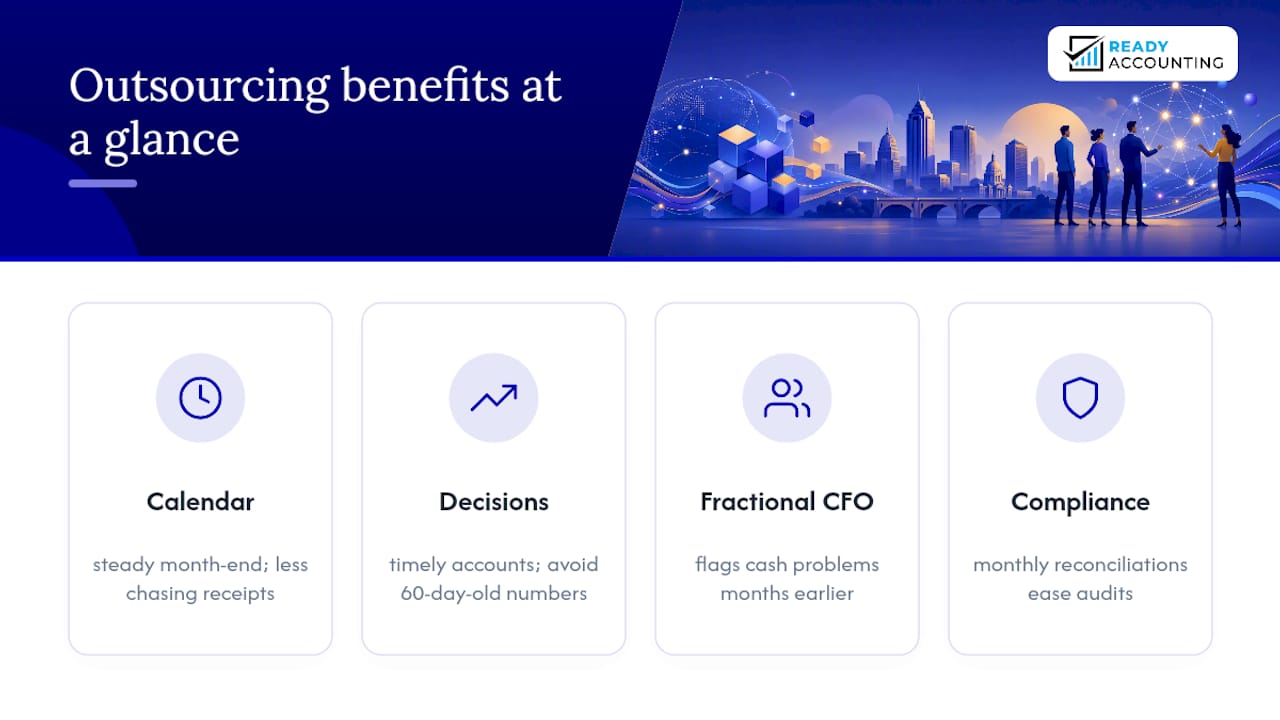
The benefits show up in three places: your calendar, your decisions, and your compliance file.
Operationally, outsourcing turns month-end from a scramble into a routine. You get a steady close date every month, less time spent chasing receipts, and a predictable monthly cost instead of a surprise bill when tax season hits. Strategically, timely management accounts mean you’re not making pricing or hiring decisions off numbers that are 60 days old. A fractional CFO relationship adds a layer most small businesses never get: someone flagging a cash-flow problem three months before it becomes a crisis rather than after.
On compliance, clean, current books make state and IRS queries far less stressful. When your reconciliations are done monthly instead of scrambled together in April, an information request stops being a fire drill.
This isn’t just theory. A 2025 academic study on Cape Town’s SMME sector found that outsourcing accounting functions measurably reduced operational costs and improved time management for small business owners. The mechanism translates directly to Indianapolis: an owner running a 12-person landscaping company who outsourced bookkeeping and payroll stopped spending Sunday afternoons on spreadsheets and started using that time on quotes and client calls instead. That’s the real payoff. It’s not the software. It’s what you do with the hours it frees up.
How do you choose the right local outsourced accounting partner?
Price matters, but it shouldn’t be your first filter. SAIPA warns that choosing an accountant on price alone is one of the most common mistakes business owners make — industry familiarity and the ability to actually produce management accounts and tax planning matter more than a low monthly rate.
Run every proposal through this checklist:
- Industry experience — have they worked with businesses your size and sector before?
- Software stack — do they run cloud platforms that integrate with your bank feeds and point-of-sale system?
- Reporting cadence — will you get monthly management accounts, or just an annual summary?
- Security practices — how do they protect your financial data and login credentials?
- Tax competence — can they show real tax planning experience, not just filing?
On your discovery call, ask directly for a sample management account package, two client references, and a written onboarding timeline. Red flags include vague pricing, no sample reports, and hesitation about how they secure your data.
Pro Tip: Ask for a simple 3-month close-to-report workflow walkthrough during the discovery call. Watching how a provider actually gets from raw transactions to a finished report tells you more about their process than any sales pitch.
What do pricing and onboarding timelines usually look like?
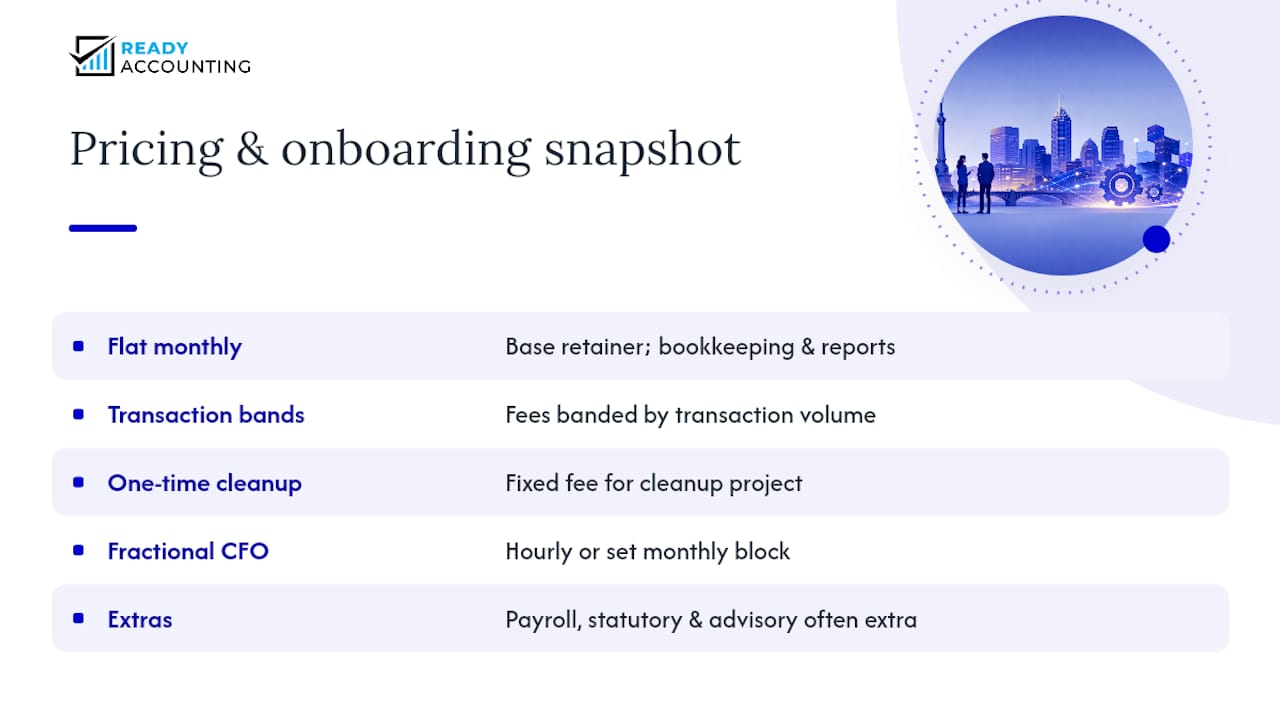
Providers typically price one of four ways: a flat monthly retainer, fees banded by transaction volume, a fixed fee for a one-time cleanup project, or a separate fractional CFO retainer billed by hours or a set monthly block. Bookkeeping and monthly reporting are usually included in the base retainer; payroll processing, statutory submissions, and advisory hours often cost extra. Pricing typically scales based on the size and complexity of your business, from basic bookkeeping for small startups to comprehensive services including CFO-level insight for larger operations. Onboarding generally takes several weeks to a few months, starting with data migration and cleanup, then stabilizing processes, leading to a reliable monthly closing routine.
How does outsourcing keep you audit ready?
Audit readiness isn’t a once-a-year scramble. It’s a habit built into monthly reconciliations and consistent document retention. Good providers file source documents systematically so nothing gets lost between January and the following tax season.
- Reconcile bank and credit accounts every month, not just at year-end
- Retain invoices, receipts, and payroll records in an organized digital archive
- Confirm your provider’s tax practitioner registration and continuing professional development status through SAICA’s member obligations page
- Check current filing rules directly through state revenue resources like the Indiana Department of Revenue
Owners who prioritize steady monthly cycles over one-time cost savings tend to feel far more confident when a state or IRS inquiry actually lands in their inbox.
What’s the step-by-step process to hire and onboard an outsourced accountant?
- Define your objectives and list the systems (bank feeds, payroll, point-of-sale) the provider will need access to
- Request sample deliverables — management accounts, a cash-flow forecast, and two client references
- Confirm software fit and security practices before signing anything
- Agree scope, service levels, and first-month cleanup milestones in writing
- Review progress at 60 and 90 days against the milestones you agreed on
You can also verify your own business registration details through INBiz before onboarding starts, so your provider begins with accurate filing information.
Why Ready Accounting takes an automation-first approach
Ready Accounting builds outsourced accounting around API bridging and real-time runway dashboards, not month-old spreadsheets. That fits scaling SMEs and venture-backed startups that need a fractional CFO watching cash flow in real time, not just a bookkeeper reconciling last quarter.
— Johan
How Ready Accounting fits your search
If you’ve been comparing local firms and generic bookkeeping services, here is a practical difference some providers offer: building books on cloud infrastructure with API-connected dashboards, so you’re looking at today’s cash position instead of a report finished weeks later. That matters when you need someone who can forecast, plan tax exposure, and act as a fractional CFO when decisions get bigger than “can we make payroll.”
An initial consult typically covers where your books stand now, what cleanup (if any) is needed, and which service tier fits your transaction volume. You’ll walk away with a concrete proposal, not a sales pitch. Compare it honestly against any local quote you’ve received. If automation-driven cash-flow management is what your business actually needs, request a proposal and see the numbers side by side.
This article is general information, not a substitute for advice from a qualified financial advisor. Consult a qualified financial professional about your own circumstances before acting on anything here.
Sources
FAQ
What Do Outsourced Accounting Services Typically Cost?
Pricing varies by transaction volume and service tier, ranging from a flat monthly retainer for basic bookkeeping to a separate fractional CFO fee for strategic advisory work. Ask any provider for a written scope before comparing quotes.
How Long Does Onboarding Take?
Onboarding generally takes several weeks to a few months, starting with data migration and cleanup, then stabilizing processes, leading to a reliable monthly closing routine.
How Do I Verify a Provider’s Credentials?
Check professional membership through SAICA’s member obligations page or SAIPA, and ask directly for their tax practitioner registration status.
Can Outsourced Accounting Replace an Internal Bookkeeper?
Yes, for most small and mid-sized businesses. Some providers handle the full cycle, from reconciliations to management accounts, often at a lower and more predictable cost than an in-house hire.
What Should I Ask For Before Signing a Contract?
Request sample management account reports, two client references, a clear onboarding timeline, and details on how the provider secures your financial data.