
Small business accounting: Streamline, save, and scale
Executive Summary
- Accounting provides real-time insights critical for cash flow, cost control, and growth in South African SMEs.
- Cloud accounting automates tasks, improves compliance, and offers accessible, real-time financial data.
- Using accounting strategically shifts it from compliance to a driver of business expansion.
Most small business owners believe accounting is either a grudge task or something only large corporations need to take seriously. That belief costs them money, time, and often, their business. In South Africa, where cash flow is tight and SARS compliance is non-negotiable, getting your numbers right is not optional. It is the single most important operational decision you will make as a growing business. This guide gives you a practical, no-fluff breakdown of how to build an accounting foundation that does more than just keep you out of trouble. It helps you grow faster, smarter, and with far less financial risk.
Table of Contents
- Why accounting matters for small businesses
- Key accounting tasks for South African SMEs
- Harnessing cloud accounting solutions
- Tax compliance made simple for small businesses
- The real advantage: Accounting as a growth lever, not just a safeguard
- Ready to streamline your accounting?
- Frequently asked questions
Key Takeaways
| Point | Details |
|---|---|
| Accounting drives growth | Accurate records enable informed decisions and make scaling your business easier. |
| Cloud solutions save time | Switching to cloud-based accounting automates routine tasks and boosts compliance. |
| Compliance prevents costly errors | Staying on top of tax and financial deadlines averts penalties and builds trust with stakeholders. |
| Outsourcing adds expertise | Professional help is invaluable when complexity or growth outpaces your in-house capability. |
Why accounting matters for small businesses
Accounting gets a bad reputation among small business owners. It feels like paperwork, admin, and bureaucracy wrapped into one. But that framing misses the point entirely. Accounting is the language your business uses to tell you what is working, what is bleeding money, and where your next opportunity is hiding.
When you look at the numbers through that lens, everything changes. Your income statement is not just a document for your accountant. It is a real-time performance report. Your balance sheet is not a formality. It is a snapshot of your business’s financial health at any given moment.
Here is what good accounting actually does for a growing South African SME:
- Prevents cash flow crises by giving you visibility into when money is coming in and when bills are due, well in advance
- Identifies cost leaks that you would never spot by just watching your bank account
- Builds bankability by giving lenders and investors the financial statements they need to trust you with capital
- Positions you for tax efficiency by making sure deductions are captured, not missed
- Reduces SARS audit risk through clean, reconciled records that are harder to trigger algorithmically
South Africa’s regulatory environment adds another layer of urgency. VAT submissions, provisional tax returns, and PAYE are not optional obligations. They come with penalty structures that can cripple a small business if mismanaged. The Companies Act also imposes financial reporting standards that even private companies cannot ignore.
“Professional accountants contribute to the expansion and sustainability of small businesses,” a reality that holds especially true in a competitive and compliance-heavy market like South Africa’s.
The businesses that treat accounting as a strategic function, not just an administrative one, are the businesses that scale. They see financial trends before they become problems. They negotiate from a position of informed strength. And they never get blindsided by a tax bill they did not see coming.
Understanding the accountants’ role in SA businesses is the first step toward treating your finance function as a growth engine rather than a compliance checkbox.
Key accounting tasks for South African SMEs
Knowing that accounting matters is one thing. Knowing exactly what tasks you need to manage, and how often, is where most small business owners fall short. Let’s break it down clearly.
Here are the core accounting tasks every South African SME must handle:
- Invoicing and accounts receivable — Issue invoices promptly and follow up on overdue accounts weekly. Late payments are the number one cause of cash flow problems in small businesses.
- Expense tracking — Capture every business expense at the point of purchase, not at month end. Cloud tools make this frictionless.
- Bank reconciliation — Match your bank statements to your accounting records at least monthly. Discrepancies compound quickly and become hard to trace.
- Payroll processing — Calculate PAYE, UIF, and SDL correctly every pay cycle. A single error cascades into compliance issues and unhappy staff.
- VAT returns — If you are VAT-registered, submit bi-monthly returns accurately and on time. SARS has little patience for late submissions.
- Financial reporting — Generate monthly income statements, balance sheets, and cash flow statements. These are your business dashboard.
| Task | Frequency | Recommended owner |
|---|---|---|
| Invoicing | Weekly or as needed | Owner or bookkeeper |
| Expense capturing | Daily or at point of purchase | Owner or staff |
| Bank reconciliation | Monthly | Bookkeeper |
| Payroll | Monthly | Accountant or payroll service |
| VAT returns | Bi-monthly | Accountant |
| Financial statements | Monthly | Accountant |
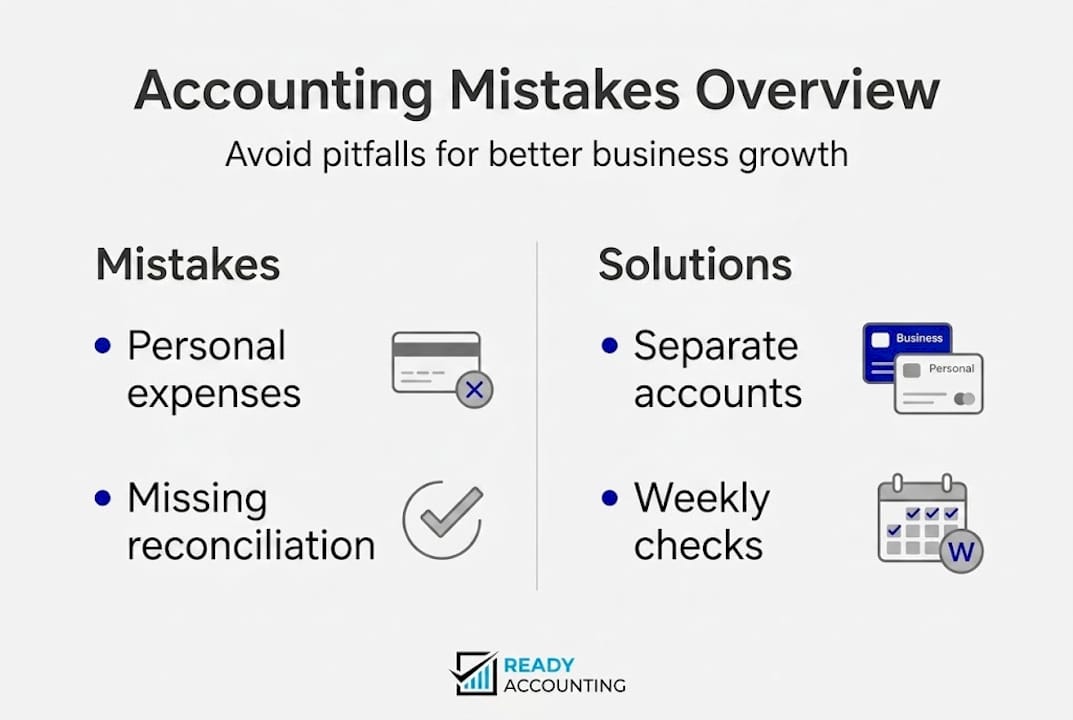
The most common bookkeeping mistakes to avoid include mixing personal and business expenses, not reconciling regularly, and failing to capture all income. Each of these seems minor in isolation but creates serious problems at year end or during a SARS audit.
Who should handle these tasks? In the early stages, owners often do it themselves. That works if your transaction volume is low and your time is not better spent elsewhere. As you scale, delegating bookkeeping to a professional frees you up for revenue-generating activities while reducing costly errors.
Pro Tip: Set a fixed “finance hour” each week where you review your numbers, approve invoices, and check your cash position. Businesses that do this consistently are rarely caught off guard by financial surprises.
Knowing how to interpret the outputs of these tasks matters too. If you are not yet confident at reading financial statements, that is a gap worth closing fast. You do not need to become an accountant, but you do need to understand what your numbers are telling you about your business trajectory.
Harnessing cloud accounting solutions
Manual accounting, spreadsheets, paper receipts, and end-of-month scrambles belong to a different era. For South African SMEs that want to move fast and stay compliant, cloud accounting is not a luxury. It is infrastructure.
Cloud accounting means your financial data lives online, is updated in real time, and is accessible from any device with an internet connection. Instead of emailing spreadsheets to your accountant at month end, your data is always current and always shared. Your accountant can flag an issue on Tuesday morning before it becomes a crisis on Friday.
Here is how cloud-based accounting compares to the traditional manual approach:
| Feature | Manual accounting | Cloud accounting |
|---|---|---|
| Data entry | Manual, time-consuming | Automated bank feeds |
| Accessibility | Office only | Any device, anywhere |
| Error risk | High, human error | Lower, automated checks |
| Reporting speed | Days to weeks | Real-time dashboards |
| Tax readiness | Requires preparation | Always up to date |
| Cost at scale | Increases with admin | Stays predictable |
| Accountant collaboration | Slow, file-based | Live shared access |
The benefits for growing SMEs are significant:
- Automation of repetitive tasks like bank reconciliations, which eliminates hours of manual entry each month
- Real-time cash flow visibility so you always know your current position, not last month’s position
- Integrated invoicing that connects payment receipt to your accounting records instantly
- Multi-user access allowing your bookkeeper, accountant, and yourself to work in the same system simultaneously
- Audit trails that record every transaction change, protecting you during a SARS review
Understanding the cash flow automation benefits is critical for SMEs operating in South Africa’s volatile economic environment, where late client payments and unexpected expenses can destabilise a business within weeks.
Good cash flow management requires more than just tracking income and expenses. It requires forecasting, scenario planning, and understanding the timing gaps between revenue earned and cash received. Cloud tools make this possible for businesses that previously could only afford manual tracking.
Even during slower trading periods, the discipline of monitoring your numbers closely pays off. Strategies for managing expenses during slow periods become far easier to implement when you have real-time data rather than a month-old spreadsheet guiding your decisions.
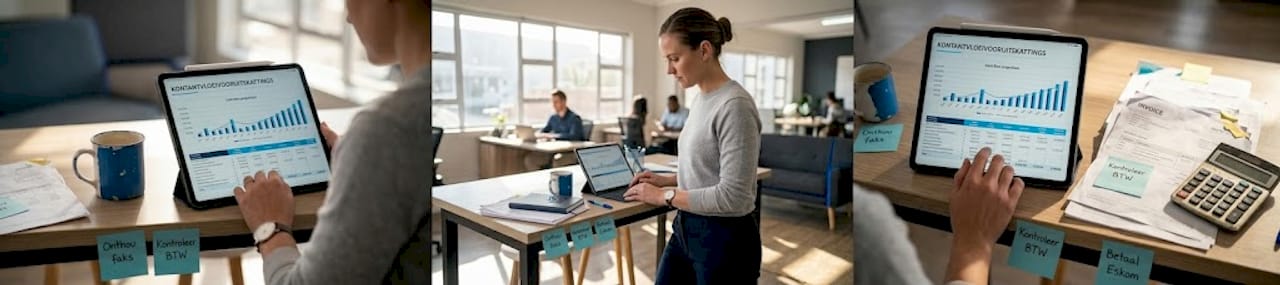
Pro Tip: When choosing a cloud accounting platform for your South African business, confirm that it supports SARS-compliant VAT codes, ZAR as a base currency, and local payroll tax tables. Not all international platforms are configured for the South African context out of the box.
Tax compliance made simple for small businesses
Tax compliance is where many South African SMEs feel the most anxiety, and for good reason. SARS has become increasingly efficient at identifying discrepancies, using automated systems to flag returns that deviate from industry norms or show internal inconsistencies. The cost of getting it wrong is real.
Here are the primary taxes that most South African SMEs must manage:
- VAT (Value Added Tax) — If your annual turnover exceeds R1 million, VAT registration is compulsory. Returns are typically submitted bi-monthly via eFiling.
- Company income tax — All registered companies pay tax on their taxable income. Provisional tax payments are due twice a year, with a third voluntary payment available.
- PAYE (Pay As You Earn) — If you employ staff, you must deduct PAYE from salaries and submit it to SARS monthly via EMP201 returns.
- UIF and SDL — Unemployment Insurance Fund contributions and Skills Development Levy payments are also monthly obligations linked to payroll.
The penalty structure for late or incorrect submissions is steep. SARS can charge administrative penalties, interest on outstanding amounts, and, in serious cases, pursue criminal prosecution for deliberate non-compliance. Beyond the direct financial cost, a compliance dispute with SARS can consume weeks of management time and legal fees that most SMEs cannot absorb.
Cloud accounting tools reduce this risk dramatically by:
- Auto-calculating VAT on every transaction, so your return is always pre-populated and accurate
- Generating EMP201 reports directly from your payroll data, reducing manual transcription errors
- Sending deadline reminders so nothing slips through the cracks during a busy quarter
- Maintaining a complete audit trail that makes any SARS query faster and cheaper to resolve
When should you consider outsourcing your tax compliance rather than handling it in-house? The trigger point varies, but the benefits of outsourcing accounting become compelling when your transaction volume grows, when your tax structure becomes more complex, or when a compliance error has already cost you money.
Outsourcing done properly means partnering with a firm that has cloud access to your accounting data, operates proactively rather than reactively, and understands your industry well enough to flag risks before SARS does. It is not about handing over your books and hoping for the best. It is a deliberate strategic decision to buy back time and reduce risk simultaneously.
For those ready to take that step, understanding how to outsource accounting in SA is a practical starting point that covers what to look for in a partner, what questions to ask, and what red flags to avoid.
The bottom line on non-compliance: A missed VAT return can trigger a penalty of 10% of the VAT owed, plus interest. Multiply that across multiple missed periods and you are looking at a liability that can exceed the original tax obligation itself.
The real advantage: Accounting as a growth lever, not just a safeguard
Here is the uncomfortable truth most accounting conversations miss: the businesses that use accounting purely for compliance are leaving significant competitive advantage on the table.
We have worked with South African SMEs who kept immaculate books for SARS, then made a major hiring or expansion decision based purely on gut feel. The result, in more than one case, was a cash flow crisis that their own financial data could have predicted months in advance.
The shift that changes everything is moving from historical accounting to forward-looking financial intelligence. Historical accounting tells you what happened. Forward-looking financial intelligence tells you what is about to happen, what you can afford to do next, and which parts of your business are genuinely profitable versus which ones only look profitable.
Professional accountants drive business expansion precisely because they use financial data to inform strategy, not just report on it. When your accountant is looking three months ahead rather than three months behind, the relationship transforms from administrative support into genuine accounting as strategic support.
The most successful SMEs we work with treat their monthly financial review as a board meeting. They ask hard questions about margin, customer profitability, and runway. They make decisions with data. That discipline, more than any single product or service, is what separates businesses that scale from businesses that stagnate.
Ready to streamline your accounting?
If this article has shifted how you think about your business finances, the next step is to move from insight to action. Ready Accounting helps South African SMEs replace manual, error-prone processes with cloud-based financial infrastructure that gives you real-time control and SARS-ready compliance at every stage of growth. Start with our accounting automation guide to see exactly how automation reduces admin burden and builds financial clarity. Explore the full picture of cloud accounting benefits for SMEs, or go deeper into what South African cloud accounting looks like in practice. Your numbers should work for you, not the other way around.
Frequently asked questions
What is the simplest way to keep accounting records for a small business?
Using a cloud-based accounting platform is the most straightforward and secure approach, since it automates bank feeds, reduces manual entry, and keeps your cash flow data current without requiring a dedicated finance team.
How often should small businesses in South Africa review their financial statements?
Most successful SMEs review financial statements monthly to stay on top of performance and catch problems early. Waiting until year end to look at your financial statement data means you are always reacting rather than deciding.
Which taxes do small businesses in South Africa need to pay?
SMEs must typically manage VAT (if turnover exceeds R1 million), company income tax, and, if they employ staff, PAYE and UIF contributions. The full breakdown of outsourced compliance options helps clarify which obligations are best handled in-house versus by a specialist.
What are the signs that a small business should outsource their accounting?
If you are spending more time on financial admin than on client work, or if compliance errors are increasing in frequency, those are clear signals. The decision to outsource becomes straightforward once the cost of errors and lost time exceeds the cost of professional support.
Recommended
- 7 Cloud Accounting Benefits for Small Business Growth - Ready Accounting
- Ultimate Guide to Accounting Automation in 2025 - Ready Accounting
- Digital Transformation in Accounting: How South African Scaling Companies Can Modernize Their Financial Management | Ready Accounting
- 7 Common Bookkeeping Mistakes Small Businesses Make - Ready Accounting