
Bookkeeper vs accountant: Key roles for SA business success
Executive Summary
- Bookkeepers record daily transactions, while accountants analyze data and ensure compliance.
- Qualified accountants hold degrees and professional designations, unlike bookkeepers with certifications.
- Businesses should upgrade from bookkeeper to accountant as they grow and face regulatory triggers.
Confusing bookkeepers with accountants is one of the most expensive mistakes South African entrepreneurs make, and most do not realise it until a SARS audit lands in their inbox or a funding round collapses due to messy financials. These are two distinct roles with different training, different legal authority, and very different impacts on your bottom line. Hiring the wrong one at the wrong stage is like asking your mechanic to perform surgery because both use sharp instruments. This guide cuts through the confusion, breaks down each role with South African context, and gives you a practical framework for making the right hiring decision for your business right now.
Table of Contents
- Defining bookkeeping and accounting in South Africa
- Qualification requirements: Credentials, training and certifications
- Core functions: What does each role do for your business?
- How to choose: Decision framework for South African entrepreneurs
- Our take: What most business owners miss when choosing between bookkeepers and accountants
- Take your business financials to the next level
- Frequently asked questions
Key Takeaways
| Point | Details |
|---|---|
| Roles are distinct | Bookkeepers and accountants serve unique, complementary functions critical to business. |
| Credentials drive compliance | Formal qualifications and certifications are essential for meeting regulatory standards in South Africa. |
| Practical decision framework | Entrepreneurs should assess business stage, compliance, and strategic needs before selecting roles. |
| Integration boosts performance | Combining both roles delivers maximum oversight, insight, and efficiency. |
| Expert solutions available | Ready Accounting provides tools and guides to streamline financial operations for SMEs. |
Defining bookkeeping and accounting in South Africa
Bookkeeping and accounting are often used as interchangeable terms in casual conversation. In practice, they represent two very different layers of your financial operation. Understanding that difference is not just academic. It has real consequences for your compliance, your tax exposure, and your ability to make sound business decisions.
Bookkeeping is the process of recording, organising, and maintaining the day-to-day financial transactions of your business. Think of a bookkeeper as the person who keeps the engine running. They capture every invoice, payment, receipt, and bank transaction so your financial records stay current and accurate. They do not typically interpret what those records mean or advise you on strategy. They maintain the system.
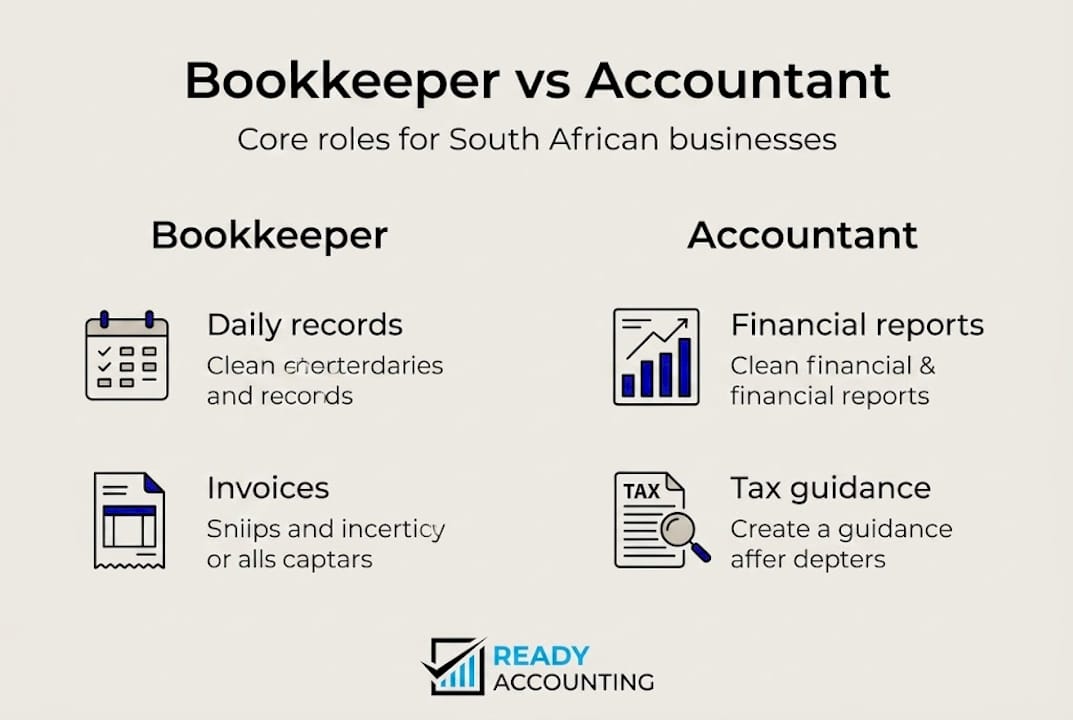
Accounting operates at a higher level. An accountant takes the data your bookkeeper produces and transforms it into financial statements, tax returns, management reports, and strategic insight. Accountants analyse trends, identify risk, structure your business for tax efficiency, and ensure you meet the regulatory requirements set by bodies like the South African Institute of Chartered Accountants (SAICA) and the South African Revenue Service (SARS).
In South Africa, these roles carry different levels of formal recognition. Bookkeepers work under certifications such as the National Certificate in Bookkeeping at NQF Level 3 or 4, while accountants carry professional designations regulated by bodies like SAICA. As one education resource notes, bookkeepers and accountants differ significantly in formal requirements: bookkeepers often enter the field through on-the-job training or certifications like the Certified Bookkeeper designation or QuickBooks ProAdvisor, whereas accountants hold a bachelor’s degree in accounting or finance and pursue professional designations like CA(SA), ACCA, or CPA.
Bookkeeping feeds accounting. Accounting feeds strategy. If either layer is broken, your ability to grow and stay compliant is seriously compromised.
Here are the core distinctions in function:
- Bookkeepers record transactions, reconcile bank accounts, manage accounts payable and receivable, and process payroll.
- Accountants prepare financial statements, file tax returns, conduct audits, advise on tax planning, and ensure regulatory compliance.
- Bookkeepers operate within a defined system set by accountants or management.
- Accountants interpret financial data and translate it into decisions that protect and grow the business.
Understanding these layers is the foundation of sound accounting principles for SA businesses. Without clear definitions, business owners often overpay for bookkeeping services they call “accounting” or underpay for strategic input they desperately need.
Qualification requirements: Credentials, training and certifications
With definitions clear, let’s examine the credentials side by side. This is often where the real confusion lives, because the word “accountant” gets used loosely for anyone who works with numbers.
According to qualification standards for both roles, bookkeepers typically enter the profession through practical training and earn certifications at NQF Levels 3 or 4, while accountants complete formal degree programs and register with regulated professional bodies before they can offer certain services legally.

Here is a direct comparison:
| Criteria | Bookkeeper | Accountant |
|---|---|---|
| Minimum education | No formal degree required | Bachelor’s degree in Accounting or Finance |
| Typical certifications | National Certificate in Bookkeeping (NQF 3-4), Certified Bookkeeper, QuickBooks ProAdvisor | CA(SA) via SAICA, ACCA, CIMA, CPA |
| Regulatory body | No mandatory registration | SAICA, SAIPA, ACCA, IRBA |
| Training path | On-the-job, short courses, online certification | 3-year degree, articles (internship), board exams |
| Legal authority | Limited (recording and reconciliation) | Full (sign off financial statements, audits, tax advice) |
| Typical cost (SA per month) | R5,000 to R15,000 | R15,000 to R50,000+ |
The cost difference is significant, but so is the value difference. A CA(SA) designation from SAICA requires years of full-time study, a three-year articles contract under a registered training officer, and multiple board exams. This is not an informal process. It is one of the most rigorous professional tracks in South Africa.
Here is how most professionals progress into these roles:
- Bookkeeper path: Matric qualification, followed by a short course or National Certificate at a TVET college, then practical experience using accounting software like Xero, Sage, or QuickBooks. Certification from a body like the South African Institute of Professional Accountants (SAIPA) at bookkeeper level is optional but valued.
- Accounting technician path: A bridge between bookkeeping and full accounting, typically requiring a diploma in accounting (NQF Level 5 or 6) and registration with bodies like SAIPA as an accounting technician.
- Chartered Accountant path: A BCom Accounting degree (or equivalent), followed by articles at a SAICA-registered training office, two SAICA board exams, and continuous professional development to maintain the CA(SA) designation.
- Alternative accounting paths: ACCA and CIMA qualifications are internationally recognised and growing in South Africa’s corporate sector, particularly among management accountants.
Ongoing education matters enormously in accounting. Tax law changes, IFRS (International Financial Reporting Standards) updates, and evolving SARS enforcement mean that accountants who do not invest in continuing professional development quickly become a liability rather than an asset. Reviewing accounting best practices South Africa can help you understand what competent, current financial guidance actually looks like.
Core functions: What does each role do for your business?
Credentials explain who these professionals are. Functions explain what they actually do for your business every single day. This is where most business owners find the clarity they need.
A bookkeeper typically handles:
- Recording daily transactions such as sales, purchases, payments, and receipts
- Reconciling bank accounts and credit card statements monthly
- Managing accounts payable (what you owe) and accounts receivable (what is owed to you)
- Processing payroll and ensuring correct PAYE (Pay As You Earn) deductions
- Maintaining petty cash records and capturing expense claims
- Generating basic reports like cash flow summaries and trial balances
The SA record keeping requirements set by SARS are exacting. Businesses must retain financial records for at least five years. A competent bookkeeper ensures this paper trail exists and is organised in a format that survives an audit.
An accountant typically handles:
- Preparing monthly and annual management accounts
- Compiling and signing off on annual financial statements
- Filing VAT, PAYE, income tax, and provisional tax returns
- Providing tax planning advice and structuring business affairs for efficiency
- Advising on company structure, dividends, and distributions
- Performing or coordinating audits where legally required
- Interpreting financial data to support strategic decisions
The distinctions are real and consequential. A bookkeeper trained at NQF Level 3-4 does not have the legal authority or the professional training to sign off on financial statements or provide binding tax advice. Asking your bookkeeper to do so is not just risky. It can expose you to SARS penalties and professional liability claims.
Pro Tip: The clearest signal that you need an accountant rather than a bookkeeper is when your business starts making enough money to have a meaningful tax burden. Tax planning at that point is not an expense. It is an investment with a measurable return.
As your business grows, the two roles work best in tandem. A bookkeeper handles the volume of daily transactions. An accountant reviews the output periodically, ensures compliance, and provides the strategic layer your growth requires.
How to choose: Decision framework for South African entrepreneurs
Understanding functions is only half the story. The real question is who do you need right now, given where your business stands today?
Here is a practical decision framework built around the most common business stages:
-
Start-up phase (revenue under R1 million per year): A competent bookkeeper with solid software skills is usually sufficient. Focus on clean records, regular bank reconciliations, and timely invoice management. Engage an accountant quarterly or annually for tax filing and compliance review.
-
Growth phase (revenue R1 million to R10 million): This is where most entrepreneurs underinvest in accounting support. You need a full-time or dedicated part-time bookkeeper and a regular accountant engagement. VAT registration, provisional tax, and payroll complexity all increase simultaneously at this stage. Getting it wrong here is expensive.
-
Scaling phase (revenue above R10 million or VC-backed): A fractional or full-time CFO-level accountant becomes critical. You need real-time financial dashboards, strategic planning support, and someone who can translate your numbers into a narrative for investors or lenders. A bookkeeper alone cannot do this work.
-
Regulatory triggers: Certain events force the issue regardless of revenue. These include: becoming a VAT vendor, taking on investors, applying for business finance, preparing for a merger or acquisition, or receiving a SARS audit notice.
-
Team capability gaps: If the person managing your books cannot explain the difference between gross profit and net profit, or cannot produce a cash flow statement on demand, you need to upgrade. Weak financial records are the number one reason banks decline SME loan applications in South Africa.
It is worth noting that the cost of getting this wrong extends beyond SARS penalties. Poor financial records destroy founder credibility in funding conversations, delay business decisions, and create blind spots that competitors exploit. The question is never “Can I afford an accountant?” It is “Can I afford not to have one?”
Statistic to consider: According to research, poor financial management and record keeping are cited as primary contributors to the failure of more than 70% of South African small businesses within their first five years. The cost of under-investing in qualified financial support is not theoretical.
The most important mindset shift: bookkeeping and accounting are not costs. They are financial infrastructure. You would not build a factory without foundations. Do not build a business without solid financial infrastructure either.
Our take: What most business owners miss when choosing between bookkeepers and accountants
Most advice on this topic focuses on cost. Hire a bookkeeper when you’re small, upgrade to an accountant when you grow. That framing is dangerously incomplete.
The real mistake we see constantly is treating these roles as sequential rather than complementary. Business owners wait until something goes wrong, a SARS notice, a failed loan application, a cash flow crisis, before they invest in proper accounting support. By then, the damage is already done and the remediation costs far exceed what proactive support would have cost.
What conventional wisdom also misses is the pace of regulatory change in South Africa. SARS updates its enforcement algorithms, changes VAT rules, and tightens compliance requirements with a frequency that most SME owners cannot track alone. An accountant who is actively engaged with your business spots these changes before they become your problem. A bookkeeper, no matter how skilled, is not trained or positioned to do this.
The smartest thing scaling entrepreneurs do is build financial management best practices into their operating rhythm from the beginning, not as a reaction to problems. Bookkeepers and accountants working together, on a shared platform with real-time data access, give you something neither can provide alone: a complete financial picture that informs daily decisions and long-term strategy simultaneously.
Take your business financials to the next level
Ready Accounting engineers financial systems that replace the fragmented, reactive approach most South African SMEs rely on. We bridge bookkeeping and accounting into a single, cloud-powered infrastructure that gives you real-time visibility and professional-grade compliance without the overhead of a full finance department. If you are ready to stop guessing and start making decisions with confidence, explore our accounting automation guide to see how automation transforms your back office. Discover the cloud accounting benefits that scaling SMEs use to outpace competitors, and read our practical cloud accounting guide SA to find the right solution for your business stage.
Frequently asked questions
Can a bookkeeper prepare annual financial statements in South Africa?
Typically, accountants handle annual financial statements because they require the professional qualifications and regulatory oversight that only a registered CA(SA) or SAIPA member can provide. A bookkeeper provides the underlying records, but the final statements must be compiled or reviewed by a qualified accountant.
Do small South African businesses need both a bookkeeper and an accountant?
For most growing businesses, having both is the most effective setup: a bookkeeper manages daily transaction records while an accountant provides strategic insight and ensures your business meets SARS and Companies Act obligations. The professional designations accountants hold, such as CA(SA) or ACCA, are what give them the authority to handle compliance work a bookkeeper legally cannot.
What certifications are most valued for bookkeepers in South Africa?
The National Certificate in Bookkeeping at NQF 3-4, Certified Bookkeeper designation, and QuickBooks ProAdvisor certification are widely recognised by employers and clients across South Africa. Practical software proficiency in Xero, Sage, or QuickBooks is often weighted as heavily as formal certification.
When should a business transition from just a bookkeeper to hiring an accountant?
The clearest triggers are business growth beyond the R1 million revenue mark, VAT registration, taking on investors, applying for business finance, or receiving any correspondence from SARS. At these points, the strategic and compliance capabilities that qualified accountants bring are no longer optional. They are essential to protecting the business you have built.
Recommended
- Key Difference Between Accountant and Auditor for SA Businesses | Ready Accounting
- Difference Between Bookkeeping and Accounting Explained for SA Businesses 2025 | Ready Accounting
- Role of Accountants in Business: Essential Support for SA Companies 2025 | Ready Accounting
- Understanding When to Hire a Bookkeeper for Your Business - Ready Accounting