

Creative team management strategies for innovative SMEs
Executive Summary
- Managing creative teams requires systems-based “creative ops” rather than standard project management.
- Divergence-convergence facilitation and cognitive trust are key to boosting innovation and collaboration.
- Stable, well-structured teams with clear roles and measurable KPIs sustain creative output in SMEs.
Managing a creative team in a South African SME feels like walking a tightrope. Too much structure and you suffocate the very spark that drives innovation. Too little, and you end up with missed deadlines, inconsistent output, and a frustrated team pulling in different directions. Many founders and SME owners default to the same project management tools they use for their operations team, then wonder why creative velocity stalls. This guide cuts through the noise with practical, evidence-backed strategies for managing creative talent in ways that actually move the needle on collaboration, output quality, and business growth.
Table of Contents
- Key criteria for effective creative team management
- Top strategies for collaborative innovation
- Structuring teams for consistent output and resilience
- Metrics and KPIs: Measuring and motivating creative impact
- Optimizing creative team diversity for breakthrough results
- Our perspective: What actually works for creative teams in South African SMEs
- Next steps: Power your business with streamlined team operations
- Frequently asked questions
Key Takeaways
| Point | Details |
|---|---|
| Balance structure and creativity | Too much process can stifle innovation, but clear frameworks avoid chaos and duplication. |
| Adopt evidence-based facilitation | Move teams between idea generation and evaluation using proven models for more productive collaboration. |
| Invest in the right team structure | Centralization and stable team membership boost resilience and deliver better creative results. |
| Use KPIs to drive outcomes | Operational metrics help justify creative value and smooth stakeholder alignment. |
| Manage diversity with trust | Cognitive diversity delivers the best results when teams actively build trust to reduce conflict. |
Key criteria for effective creative team management
Now that you know the challenges, let us break down the criteria top-performing SMEs use to manage creative teams. The first mistake most owners make is treating creative team management as a variation of standard project management. It is not. Managing a design team or a content squad requires you to think in systems, not just schedules.
The concept of creative operations (or “creative ops”) is central here. Creative ops focuses on aligning people, workflows, and tools so creative teams can move quickly while maintaining brand consistency. Rather than firefighting each individual project, creative ops builds guardrails: shared templates, brief formats, review stages, and approval workflows that reduce fragmentation across campaigns.
The second criterion is what we call human-centred clarity. Before any brief lands on a designer’s desk, the team needs to know three things: their role, the rules of the game, and the desired outcome. Ambiguity is the silent killer of creative momentum. When a copywriter does not know whether they are writing a concept or a final draft, and a designer does not know what “on-brand” actually means, you get rework, friction, and resentment.
Here is what separates good creative management from average project management:
- Clarify roles before a project starts, not after problems arise
- Separate creative thinking time from execution time in your sprint planning
- Define approval authority so creatives are not waiting days for a sign-off
- Build a feedback vocabulary that distinguishes subjective preference from objective brand requirements
Pro Tip: Introduce process incrementally. Pick one workflow pain point per quarter and systematise it. Trying to formalise everything at once is the fastest way to kill the creative culture you are trying to build.
Ops leadership in agencies consistently shows that the operations lead is the unsung hero behind creative excellence. The same principle applies in SMEs. Someone needs to own the systems so creatives can own the ideas. Understanding director responsibilities in your SME helps you decide who that person should be.
“Creative operations is not about controlling creativity. It is about creating the conditions in which creativity can be consistent, scalable, and commercially valuable.” — Creative Ops practitioner insight
Top strategies for collaborative innovation
With criteria in hand, here are the strategies that top creative leaders and South African agencies apply for real results.
The most powerful facilitation model for creative collaboration is the divergence-convergence pattern. To unlock innovation, guide your team through creative collaboration by intentionally shifting the group between idea expansion and structured evaluation. In practice, this means running two distinctly different modes in your creative sessions.
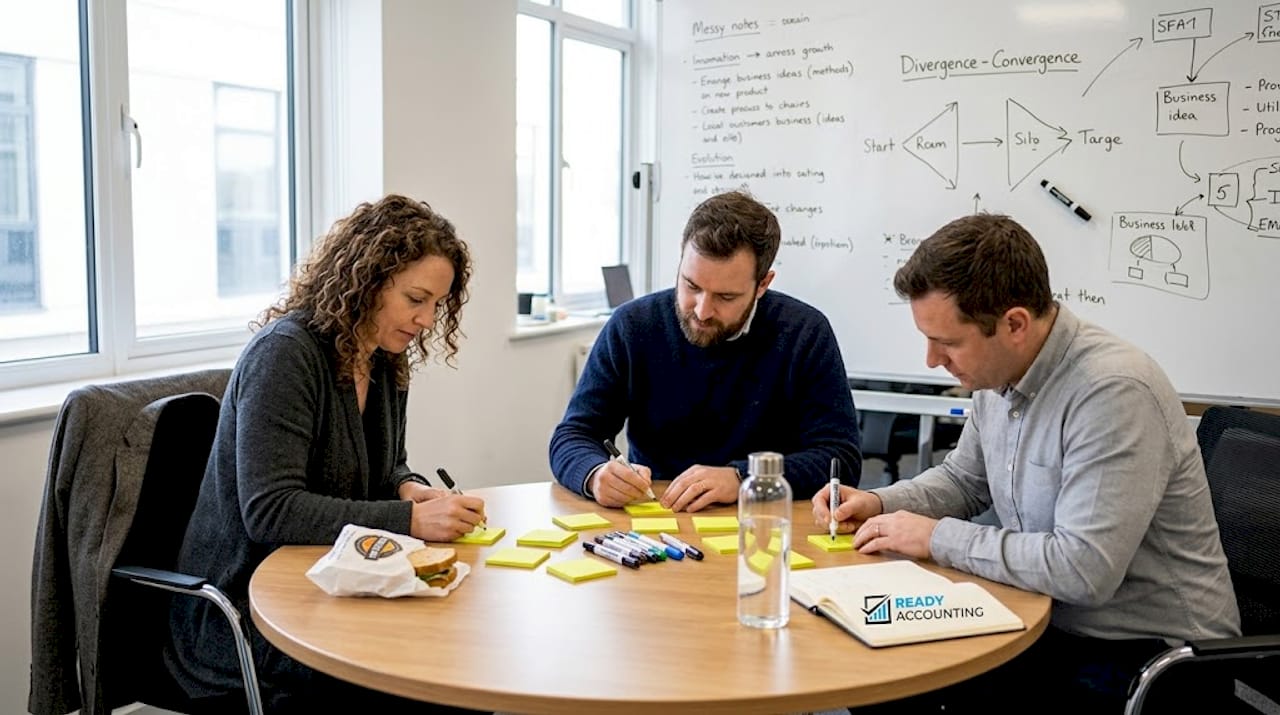
During divergence, everything is on the table. No criticism, no filtering. The goal is volume and variety of ideas. During convergence, the team evaluates, clusters, and selects the strongest concepts against clear criteria. The critical mistake most SMEs make is blurring these two stages. When someone starts critiquing ideas during brainstorming, divergence collapses and the team defaults to safe, predictable thinking.
Local practice reinforces this. In South African creative leadership, collaboration and balance between complementary strengths are core to how top agencies generate standout work. The blending of design thinking with storytelling, and the mutual respect between different disciplines, creates a richer creative output than any solo approach can deliver.
Here are five practical steps to facilitate breakthrough thinking in your team:
- Signal the mode clearly at the start of every session. Say “We are diverging now” or “We are converging.” This removes ambiguity and prevents premature judgment.
- Use time-boxed idea rounds (10 minutes maximum) to force focus and prevent over-analysis during divergence.
- Rotate facilitation roles so no single voice dominates the room, especially important in South African multicultural teams where seniority dynamics can suppress dissent.
- Build in written reflection before verbal discussion to give introverts equal input.
- Evaluate against criteria, not personal taste, during convergence to keep critique objective and productive.
Cognitive diversity research shows that teams with varied thinking styles generate more creative solutions, but only when cognitive trust is established. Cognitive trust is the confidence that your teammates are competent, reliable, and acting in the team’s best interest. Without it, diverse opinions create conflict rather than creativity.
Pro Tip: End every critique session with a “what worked” round before diving into revisions. This takes 90 seconds and dramatically improves team morale and openness to feedback over time. If you want to scale your SME without losing creative quality, building this kind of psychological safety is non-negotiable.
Structuring teams for consistent output and resilience
Great strategies succeed in the right structure. Here is how to set up your team for sustained output and adaptability.
Conditional effects of structural control on creative team resilience show that creative teams perform best when team design mechanisms like centralisation and formalisation interact positively with membership stability. In plain terms: how you organise the team, and how consistent that team is over time, directly affects both creative quality and the team’s ability to recover from setbacks.
Here is a practical comparison of the three common structures SMEs use:
| Structure | Strengths | Weaknesses | Best for |
|---|---|---|---|
| Centralised | Consistent brand voice, clear accountability, easier to manage | Can bottleneck at leadership, slower to respond to client needs | Brands where consistency is critical |
| Decentralised | Fast iteration, client proximity, entrepreneurial energy | Fragmented output, duplication of effort, inconsistent quality | Agencies with diverse client portfolios |
| Hybrid | Balances consistency with speed, scalable | Requires strong coordination, higher communication overhead | Growth-stage SMEs scaling across markets |
For most South African SMEs, the hybrid model works best. A centralised brand and quality function sits alongside decentralised delivery pods that work close to the client or campaign. The key is clear knowledge transfer between the pods so that institutional knowledge does not walk out the door when a team member leaves.
Watch for these warning signs that your current structure is blocking creative delivery:
- Bottlenecks at approval stages that slow project velocity
- Rework rates above 20% on creative deliverables
- Knowledge concentrated in one or two people with no documentation or backup
- Teams that cannot function when a key member is absent
- Low creative risk-taking because failure is penalised rather than learned from
Optimising team workflow is as important for creative teams as it is for software squads. The principles of clear handoffs, defined roles, and regular retrospectives apply directly. Connecting your creative structure to your broader best practices in financial management ensures that team investments are tracked and justified against business outcomes.
Metrics and KPIs: Measuring and motivating creative impact
Once your team is structured for success, data can help you spot roadblocks and drive the right behaviours.
Creatives often resist metrics because they fear that numbers will reduce their work to a commodity. That fear is valid when the wrong KPIs are used. But KPIs for creative teams can also be powerful tools for protecting creative value, by giving you objective evidence that the investment in creativity is delivering business results.
The key is choosing metrics that reflect both operational efficiency and creative impact.
| KPI | What it measures | Typical target |
|---|---|---|
| Lead time per project | Time from brief to delivery | Under 5 business days for standard assets |
| Rework rate | Percentage of projects requiring major revision | Below 15% |
| Resource utilisation | Percentage of capacity on billable or value-add work | 70 to 80% |
| Time estimate accuracy | Actual vs estimated project hours | Within 20% variance |
| Business impact score | Correlation of creative output to campaign KPIs | Reviewed quarterly |
Here is how to implement KPI discipline without destroying creative culture:
- Co-create the metrics with your team. Creatives who help design their KPIs feel ownership rather than surveillance.
- Review metrics in retrospectives, not in real-time performance conversations.
- Use the data to remove obstacles, not to judge individuals.
- Link KPIs to stakeholder alignment by showing how creative output connects to marketing or sales goals.
Pro Tip: Share your KPI dashboard with key business stakeholders every quarter. This single habit shifts the narrative from “the creative team is slow” to “here is the data on where bottlenecks occur and what we are doing about them.” It also aligns your cash flow KPIs guide metrics with operational spending on your creative function, giving you a clearer picture of creative ROI.
Optimizing creative team diversity for breakthrough results
Diversity is a game-changer, but only if you manage its risks. Here is how to get the mix right.
South African SMEs have a unique opportunity. Operating in one of the world’s most culturally diverse markets, your creative team can draw on a genuinely rich mix of lived experiences, communication styles, and aesthetic sensibilities. But cognitive diversity and creative team performance research reveals a critical nuance: cognitive diversity has a double-edged effect. Up to an optimum, it fuels creative output. Beyond that point, cognitive conflict rises and creativity actually declines.
The mediating factor is cognitive trust: the shared belief that your teammates are competent and well-intentioned, even when they think differently.
“Cognitive trust does not mean everyone agrees. It means everyone believes the debate is honest, the motives are shared, and the disagreement is about ideas, not people.” — Research synthesis on team creativity
Here is how to build cognitive trust in multicultural South African creative teams:
- Name differences explicitly. Acknowledge that team members bring different cultural assumptions about hierarchy, directness, and creative risk.
- Establish shared communication norms early, including how feedback is given, how conflict is raised, and how decisions are made.
- Celebrate cognitive wins, moments when a different perspective prevented a bad decision or unlocked a better idea.
- Invest in team-building that builds competence trust, not just social connection. Skills workshops and collaborative problem-solving exercises are more effective than social events alone.
- Rotate leadership in creative projects to build mutual respect across different thinking styles.
The right diversity mix includes not just cultural backgrounds, but cognitive styles (analytical vs. intuitive), professional disciplines (strategy vs. craft), and experience levels (senior judgment vs. fresh perspective). Getting this balance right is one of the most powerful levers in your creative management toolkit. Connecting this to your broader sustainable growth guide ensures diversity investment is tied to long-term business outcomes.
Our perspective: What actually works for creative teams in South African SMEs
Here is the uncomfortable truth: most management frameworks are designed for large, well-resourced teams in stable environments. South African SMEs operate in high-volatility conditions with small budgets, load shedding disruptions, and tight talent pools. The frameworks matter, but they are starting points, not blueprints.
What we have seen work consistently in local creative teams is simpler than most consultants will tell you. Informal trust built over shared struggle outperforms any facilitation model. Psychological safety matters more than the right software tool. And over-engineering your creative processes, adding layer upon layer of briefs, approvals, and retrospectives, kills the creative energy you are trying to protect.
The principle that consistently makes the difference is this: fewer, more stable, cross-functional teams beat larger, fluid ones every time. When your designer, strategist, and writer work together across multiple projects, they build a shorthand that accelerates creative output far beyond what any sprint framework can deliver. Choose stability over flexibility wherever possible. Then build your scaling protocols for growth around that stable core.
Start with honest conversations about what process actually helps versus what just creates admin. Most creatives know exactly what is slowing them down. Ask them.
Next steps: Power your business with streamlined team operations
Ready to embed these high-performing practices into your SME or startup? Operational clarity and financial visibility are the foundation of creative excellence. When your team is not chasing invoices, managing spreadsheet chaos, or waiting for budget approvals, they are freed to do their best creative work. Ready Accounting replaces manual financial admin with cloud-based automation and real-time dashboards that give you the operational control to lead your creative team with confidence. Explore our accounting automation guide to see how financial automation removes friction, and read our cloud accounting guide to understand how smarter financial infrastructure supports every function in your business, including the creative ones.
Frequently asked questions
What is the difference between creative operations and standard project management?
Creative operations establish the entire workflow system for creative teams, not just schedules and budgets for single projects. Creative ops aligns people, workflows, and tools so creative teams can move quickly while maintaining consistency across all output.
How do I measure creative output objectively?
Use KPIs like lead time, rework rate, and resource utilisation to link creative effort with business results. KPIs including rework rate and lead time per project give you objective benchmarks that remove subjective quality debates.
What risks come with having a very diverse creative team?
Too much cognitive diversity can trigger conflict and reduce creativity unless you actively build cognitive trust within the group. Cognitive diversity has a double-edged effect on creativity, and cognitive trust is the variable that determines whether diversity helps or hurts.
How can I foster better collaboration among creative team members?
Apply structured facilitation such as divergence-convergence patterns and build on complementary strengths across disciplines. Guiding teams through creative collaboration with intentional mode-switching between idea generation and evaluation keeps sessions productive.
What role does leadership stability play in creative team success?
Stable team membership, combined with clear structural control, directly drives resilient and consistently creative performance over time. Creative team performance depends on design mechanisms and membership stability, making team continuity one of your most valuable management assets.